Download the App and manage your eSIMs easily
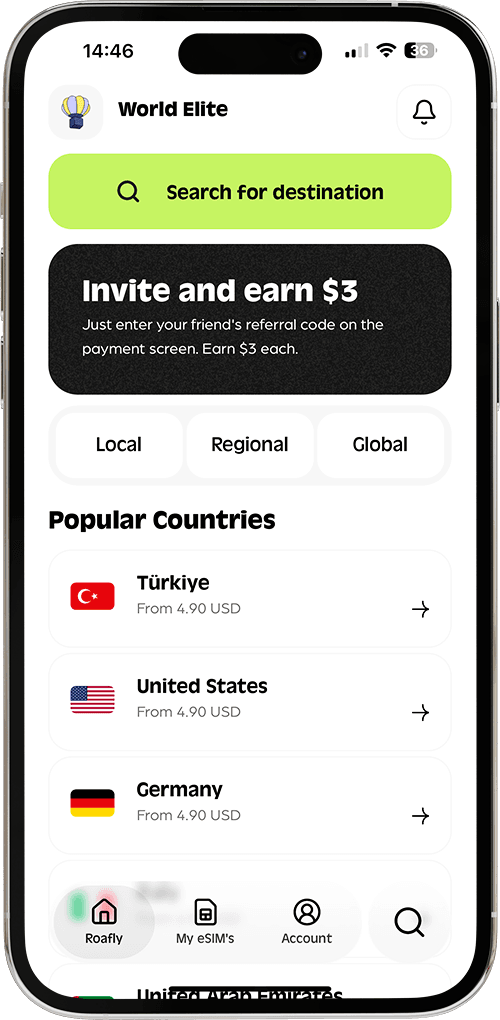
Create your order quickly
See your eSIM details
Track your remaining data
Download the App and manage your eSIMs easily
Create your order quickly
See your eSIM details
Track your remaining data
Dubai uses the UAE’s entry rules, so the first question is which passport you will travel on. GCC citizens can enter without a visa, many other visitors receive permission on arrival, and others need an approved visa before flying. Holding a qualifying foreign visa or residence permit can also change your options.

Lena Hartley
Updated Nov 9, 2026
9 min read

Save 15% on your Roafly eSIM
Stay connected on your next trip. Use the code below at checkout.
View All DestinationsJump to section
👇Save 15% on your Roafly eSIM
Stay connected on your next trip. Use the code below at checkout.
View All Destinations
Manage your eSIM in the app
Install, top up and track data.
The passport examples and entry routes below were checked on 9 November 2026 for short tourist visits on ordinary passports. Start with your nationality, then consider any residence status or supporting visa that gives you another route.
Use this table to identify the relevant route. The country examples are a selection, not a complete eligibility list.
| Passport or traveller group | Entry route | Stay or main condition |
|---|---|---|
| Citizens of Bahrain, Kuwait, Oman, Qatar and Saudi Arabia | Visa-free entry | Present a valid GCC passport or national ID |
| US ordinary passport holders and full British citizen passport holders | Permission issued on arrival; no advance visa application | Up to 90 days within a 180-day period |
| French, German, Italian and Dutch ordinary passport holders | No advance visa application; admission processed on arrival | Up to 90 days within a 180-day period |
| Mexican passport holders | Multiple-entry visit visa on arrival | Up to 180 days in total within its six-month validity |
| Eligible Indian, Indonesian, Vietnamese, Thai, Philippine, Kenyan and South African passport holders | Conditional 14-day or 60-day visa on arrival | Requires a qualifying foreign visa or residence permit, explained below |
| Turkish, Pakistani and Egyptian ordinary passport holders | Prearranged visa | Obtain approval before travel; standard tourist options include 30 or 60 days |
| Residents of another GCC country who need a visa on their passport | GCC-resident application route | Residence and profession requirements apply; obtain approval before arrival |
Use the official UAE passport eligibility checker for nationalities outside these examples. Its general nationality result should be read alongside the conditional visa and residence routes below.
British and US visitors should plan around the current 90/180-day allowance rather than older 30-day guidance. Previous visits matter: a new arrival does not necessarily start a fresh 90-day stay.
The UAE’s conditional visa-on-arrival scheme covers India, Indonesia, Vietnam, Thailand, the Philippines, Kenya and South Africa. The six countries alongside India were added in the expansion announced on 25 June 2026.
Ordinary passport holders in this group can qualify through either of these document categories:
United States, an EU member state or the United Kingdom: a valid qualifying visa or residence permit; a US Green Card is also accepted.
Australia, Canada, Japan, New Zealand, Singapore or South Korea: a valid residence permit.
The distinction matters. Holding a tourist visa for one of the second group of countries is not the same as holding residence there. Nationality remains part of the test, so these benefits do not extend to every passport simply because its holder has a US or UK visa.
The available stays are 14 days or 60 days, depending on the visa issued. The 14-day category can be extended once for another 14 days; the 60-day category is non-extendable. Your passport must have at least six months’ validity.
Review the ICP’s conditional entry requirements and have your airline check the type and expiry of your supporting document before departure. Carry that document with the passport you will use to enter.
Living in Saudi Arabia, Qatar, Oman, Bahrain or Kuwait does not give you the visa exemption enjoyed by those countries’ citizens.
If your passport already qualifies for entry without an advance application, use that eligibility. Otherwise, the GCC-resident route requires an online application and approval before arrival. Dubai’s application asks for your passport, photograph and residence evidence showing your profession and residence validity. The profession must fall within the approved categories.
Keep nationality and residence separate when completing the application. An Indian citizen living in Qatar, for example, travels on an Indian passport; a Qatari residence permit does not turn that into the Qatari-citizen entry route.
If you do not qualify for an exemption or a visa on arrival, arrange a tourist visa through an authorised UAE tourism business or an airline offering the service. Standard options include single-entry stays of 30 or 60 days, with multiple-entry products available through the relevant channels.
Dubai’s single-entry tourist visa requirements specify a tourism-sector sponsor. Seeing an online government application form does not mean every visitor can submit that sponsored application independently.
Before paying, get these details in writing:
The visa type, permitted stay and number of entries.
The deadline for entering the UAE after approval.
The full price, including the provider’s charges and applicable taxes.
The documents needed for your nationality.
Any airline or itinerary conditions attached to the service.
GDRFA lists an expected processing time of 48 hours for its single-entry tourist service. Your provider’s document checks and handling can take longer, so allow for its complete processing window rather than treating 48 hours as a guaranteed turnaround.
Once the visa arrives, match the passport number and personal details against your travel document. Save the issued permit, not just the payment receipt or application confirmation.
Your passport should be valid for at least six months from arrival for a normal tourist visit. Emergency passports and other non-standard travel documents need their own eligibility check.
Keep the following accessible for check-in and arrival:
Passport: the original document used for your booking and visa application.
Approved entry permission: if your route requires a visa before travel.
Qualifying foreign visa or residence evidence: if using the conditional entry or GCC-resident route.
Return or onward ticket: required for the standard sponsored tourist visa and specified for US visitors entering on arrival.
UAE-valid medical insurance: required for Dubai’s standard sponsored tourist visa.
Accommodation details: your booking or host’s address and contact information, kept as practical arrival records.
Some advance applications need additional identity documents. Dubai’s single-entry tourist service specifies a home-country identity card for applicants from Pakistan, Iraq, Iran and Afghanistan.
Save offline copies of your visa, ticket and accommodation details. If you are arranging mobile data before departure, compare the best eSIM for Dubai for your trip length and expected use.
Keep immigration paperwork separate from packing decisions. Check medicines and restricted items against the Dubai airport customs rules before packing.
Agree on a contact method and meeting point with any hotel or driver meeting you. Review how WhatsApp works in Dubai if that is your usual way of calling.
The useful dividing line is whether you will pass through immigration.
Remaining airside does not normally involve entering the UAE. Confirm that your itinerary allows this, with your baggage handled through to the next flight where necessary.
Separate tickets deserve particular attention. Collecting and rechecking a bag, changing airports or using accommodation outside the transit area can require you to enter the country.
Going into Dubai during a layover requires the appropriate UAE entry permission. If your passport qualifies for visa-free entry or a visa on arrival, that route may cover the visit.
If you need advance permission, 48-hour and 96-hour transit visas are available through approved channels, including UAE-based airlines. Arrange approval before travel. These are short, single-entry stays and are not extendable.
Dubai’s transit-visa application requires a photograph, a passport copy with at least six months’ validity and an onward flight ticket. Ask the airline handling the application for its complete fee and itinerary conditions.
Leave time for immigration, the journey back and departure formalities if you plan a city stopover. Download your route before leaving the terminal; Roafly’s UAE eSIM provides mobile data for navigation and booking updates during the visit.
Your deadline to enter and your allowed time in the UAE serve different purposes. A visa can have a pre-entry validity window and a separate stay measured from arrival. Read both before setting your return date.
After admission, keep a record of the permission granted and its expiry. Visitors using a 90/180-day allowance need to account for earlier trips within the relevant period.
Request any available extension through the issuing authority or your authorised provider before your stay ends. Dubai matters are handled through GDRFA; ICP handles the federal channels. Extension eligibility depends on the visa category, so an extendable tourist visa and a non-extendable conditional 60-day visa should not be treated alike.
Overstaying can incur a fine of AED 50 per day. Paying a fine does not extend your permission to remain.
Before your first outing, get familiar with Dubai’s tourist laws and the local rules that may differ from those at home.
Travelling between Dubai and Abu Dhabi does not itself require another visa. Both are within the UAE. Follow the conditions of your entry permission and any travel arrangements attached to the visa service you used.
No. An eVisa is issued electronically through an application process. A visa on arrival is issued at the border to an eligible traveller. Receiving a visa by email does not make it an arrival visa, and completing an online application does not establish approval.
Yes, if your passport or circumstances qualify you for entry without an advance visa application. Otherwise, obtain the appropriate permission before travelling. The length of the layover alone does not give you the right to enter the UAE.
