

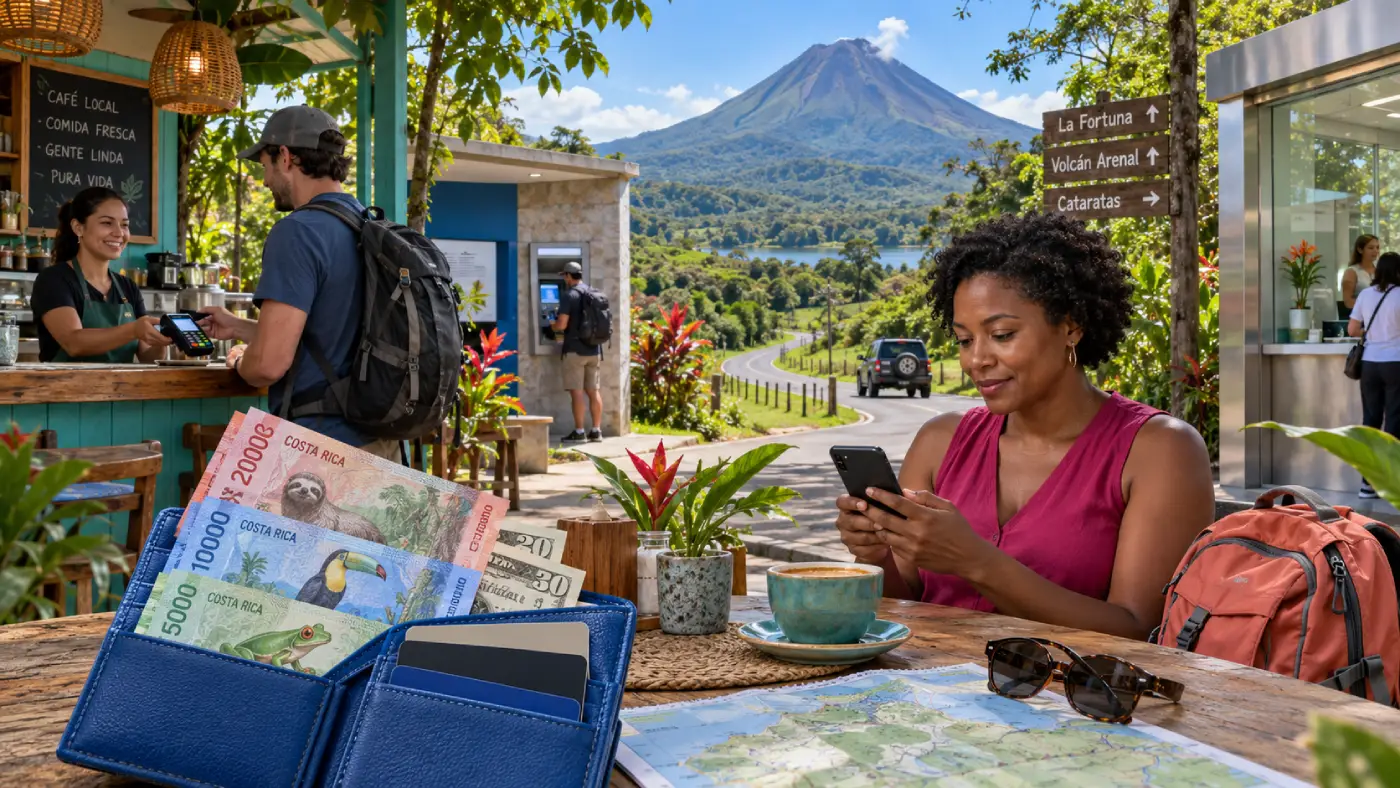

Use cards for most purchases where they are accepted, and keep some Costa Rican colones for smaller payments and backup. US dollars are useful too, particularly for tourism services priced in dollars, but you do not need to convert your entire travel budget into dollar notes before flying.
Costa Rica's currency is the colón, written as ₡ or CRC; the plural is colones. Hotels and tour operators may quote in USD while a nearby café prices everything in CRC. Understanding that distinction matters more than arriving with a wallet full of both currencies.
Cash or Card in Costa Rica?
Credit cards are widely accepted, and Visa or Mastercard is a practical main card to bring. Hotels, larger restaurants, supermarkets and many tour operators accept cards. Smaller businesses and individual service providers vary, so keep a cash option for the parts of your trip that depend on them.
| Where you are paying | Practical starting point | What changes the decision |
|---|---|---|
| Hotels and established tour operators | Card, in the agreed billing currency | Any unpaid balance or cash payment arrangement |
| Supermarkets and larger restaurants | Card | The currency and total shown on the terminal |
| Small sodas, market stalls and independent vendors | Colones available as backup | Whether the individual business accepts cards |
| Taxis and individually arranged transfers | Agree on payment method before setting off | Cash requirements and the currency of the fare |
| Public buses and urban trains | Colones, or a supported contactless card where available | Whether the vehicle uses SINPE-TP |
Costa Rica's SINPE-TP transport payment system accepts compatible foreign Visa and Mastercard contactless cards on participating services. It also supports compatible devices linked to those cards. Bus coverage is being introduced gradually, so a successful tap on route does not establish how you can pay on the next.
Bring your physical card even if you normally pay with your phone. It gives you another way to pay when a phone battery, wallet setup or contactless transaction causes trouble.
US Dollars or Colones: Which Should You Use?
Start with the currency in which the price was agreed. Paying a colón-priced purchase in colones avoids asking the business to convert your dollars. Paying an originally dollar-priced booking in USD can similarly avoid a merchant conversion into colones.
That still leaves your own bank's exchange costs. If your card account is in pounds, euros or Canadian dollars, the bank may need to convert either currency. Compare the actual totals and your card's terms instead of treating USD as an automatic saving.
Dollar cash is most useful in small denominations. Bring clean $5, $10 or $20 notes if you already have dollars; large notes can be harder to spend. Change may come back in colones, using the business's exchange rate. For small purchases, paying with colones keeps the calculation simpler.
The dollar option on a card terminal is a separate decision
Suppose your restaurant bill is in colones and the terminal offers to charge your card in its home currency. That is dynamic currency conversion, or DCC. The conversion is being offered at the point of payment, potentially with an additional markup.
Our default recommendation is to decline that conversion and keep the transaction in colones, leaving conversion to your card provider. Your bank's own fees still apply. Under Visa's currency conversion rules, the screen should show both amounts, the exchange rate and any conversion markup, and the choice belongs to you. Declining DCC does not itself cancel the purchase or cash withdrawal.
Tours originally priced and charged in the agreed USD amount are different from CRC bills converted into USD at checkout. Look at the original price and the terminal together before approving payment.
Using ATMs in Costa Rica: Fees and Currency Choices
ATMs are available across Costa Rica, but access is less convenient on some remote itineraries. Take out cash before a transfer that would make reaching another machine difficult. Some ATM locations close overnight, so avoid making a late arrival depend on particular machine.
Use a debit card linked to your bank account for routine ATM withdrawals. Withdrawing on a credit card may be treated as a cash advance, with a separate fee and interest accruing from the transaction date under your issuer's terms.
The cost of a withdrawal can include three separate elements:
-
The ATM operator's fee: the charge for using that machine with your card.
-
Your card issuer's charges: costs under your own account's overseas withdrawal terms.
-
Currency conversion: the applicable exchange rate and any conversion costs, including DCC if you accept it.
BAC, for example, charges US$7.80 in Costa Rica for cards from other banks, including international cards, under its ATM withdrawal terms, checked on September 10, 2026. Your card issuer may charge separately. This is a BAC-specific example, not a standard fee for every Costa Rican ATM.
At that operator fee, two withdrawals would cost $15.60 before your bank's charges. Repeated small withdrawals can therefore become expensive. Balance that cost against how much cash you actually need and are comfortable carrying.
Use the machine's displayed fee to decide whether to proceed. Request colones for local cash spending and consider the conversion offer separately from the ATM fee. Declining conversion does not remove the operator's charge.
Your card's withdrawal limit and the machine's limit can also differ. There is no single daily amount that applies to every visitor's card.
Where to Exchange Money in Costa Rica
Banks and authorized exchange offices are the places to exchange cash. Bring your original valid passport for a bank transaction; a photo or photocopy is not a substitute.
Compare the amount of colones you will receive after charges. An offer described as “no commission” can still be less attractive because of its exchange rate.
If you are handing over USD and receiving CRC, the bank is buying your dollars. The relevant rate is its dollar buying rate, usually labelled compra. The venta rate applies when it sells dollars to you. Keeping those labels straight makes exchange-board comparisons much easier.
Airport exchange can be convenient for immediate arrival needs. Before exchanging a larger amount, compare the net return with a bank or an ATM withdrawal under your own card's fees. Convenience may be worth paying for when you need cash to continue your journey.
Visitors whose money starts in another currency should compare a direct card payment or CRC withdrawal with buying USD first and exchanging it again. Two separate conversions can add costs without making payment any easier.
How Much Cash Should You Carry?
Work out your cash needs from the itinerary, rather than assigning a fixed cash amount to every day of the holiday.
Add together:
-
Bookings or transfers you have agreed to pay in cash.
-
Meals, local transport and small purchases likely to need cash before your next practical withdrawal opportunity.
-
A modest reserve for an unsuccessful card payment or an unexpected change of plan.
Someone with accommodation and tours prepaid may need relatively little cash. Someone heading to a remote lodge with an unpaid balance could need considerably more. The unpaid services and access to another ATM determine the difference.
Keep some smaller colón notes for everyday purchases. Carrying enough total money is less helpful if your first small payment requires a business to change a large note.
Your overall spending allowance is a separate calculation. Use the Costa Rica trip budget to estimate the holiday cost, then identify which parts need cash. If you intend to bring a large sum across the border, review the Costa Rica cash declaration rules as part of your arrival preparation.
Can Tourists Use SINPE Móvil?
If you arrive with a foreign bank card, plan to use cards and cash. The SINPE Móvil requirements include an account in colones at a participating financial institution, an active mobile line and enrollment under that institution's conditions. Downloading a banking app or buying mobile data does not complete those requirements.
Foreign nationality alone is not the deciding factor: the account and registration requirements are. Visitors who already hold an eligible account can ask their financial institution about linking a phone number to it.
SINPE Móvil transfers are separate from tapping a foreign card on a SINPE-TP transport reader. You do not need to enroll in SINPE Móvil simply to use a supported foreign contactless card on participating transport.
If a small business offers cash or SINPE as its payment options and you are not enrolled, use cash. Treat SINPE availability as useful information about that business's payment methods, not a reason to start opening a local account during a short holiday.
What to Do If Your Card Stops Working
First, establish whether the problem is the card, the terminal or a request for bank verification. Try inserting the physical card if contactless fails, then use a backup card or cash if needed. Avoid repeatedly approving the same payment without establishing whether an earlier attempt went through.
Open your banking app to look for a security alert, card lock or limit issue. Mobile access through a Costa Rica eSIM can help you reach those controls while you are out. Roafly's plan is data-only: if your bank sends verification codes by SMS, you still need access to the phone number registered with the bank. Arrange that authentication method before departure.
Contact the bank through its app or the number on your card if you cannot resolve the problem. Keep transaction receipts and note the merchant, amount and currency if a charge needs investigating. An unexpected conversion or disputed total is easier to explain with those details; our guide to common tourist scams in Costa Rica covers related taxi, rental and booking problems.
If the card is missing or you suspect unauthorized use, lock it and contact the issuer promptly. Keep your backup card separately from your main wallet so losing does not leave you without a way to pay.