


The rules below were checked on 10 November 2026 and cover ordinary passport holders travelling for a short tourist visit.
Which entry route applies to your passport?
Start with the passport you will use, then consider any foreign visa or residence permit you hold. Living in a visa-exempt country does not automatically give you the entry rights of that country’s citizens.
| Your situation | Entry route | Stay limit or main condition |
|---|---|---|
| Ordinary passport from the United States, United Kingdom, Canada, Australia, Germany or Türkiye | Visa-free tourist entry | Generally up to 90 days in any rolling 180-day period |
| Ordinary passport from India, Pakistan or Egypt, without a qualifying foreign visa or residence permit | Obtain a Bosnian visa before travel | Your visa determines the permitted stay and number of entries |
| Visa-required nationality with a qualifying Schengen, EU or US visa or residence permit | Conditional visa exemption | No more than 30 consecutive days per visit, within an overall 90 days in any 180-day period and the document’s validity |
| Ordinary passport from Saudi Arabia, Bahrain or Oman, travelling after 30 September 2026 | The 2026 summer waiver no longer covers the trip | A Bosnian visa or another applicable exemption is needed |
These are representative examples, not a complete nationality list. Use the official nationality-specific visa information for your passport. The ministry’s country pages also cover Bosnian citizens travelling abroad, so read the passage about foreign citizens entering Bosnia and Herzegovina.
Count both your arrival and departure dates as days spent in the country. The rolling allowance includes earlier visits; crossing a border and returning does not start a fresh 90 days.
The summer exemption has ended for 2026
Saudi, Bahraini and Omani ordinary passport holders had a seasonal exemption from 1 June to 30 September 2026, allowing up to 60 days within that period. That exemption does not cover a November visit or extend a stay beyond the seasonal window.
Some older official pages still show different country lists or a 30-day summer allowance. The Council of Ministers’ decision of 15 April 2026 set the 60-day limit for the 2026 season. Plan an autumn or winter trip using the entry route that applies on your travel dates.
Using a Schengen, EU or US visa or residence permit
Bosnia and Herzegovina accepts qualifying foreign documents as a basis for visa-free entry by otherwise visa-required nationals. The relevant documents are:
-
A valid multiple-entry visa issued by a Schengen country, an EU member state or the United States.
-
A valid residence permit issued by one of those countries.
Carry your passport and the qualifying document together. Your stay must remain within the document’s validity, as well as the Bosnian limits in the table.
The foreign-visa and residence-permit exemption is particularly useful for someone whose passport normally requires a Bosnian visa. Someone travelling on an Indian passport with a qualifying multiple-entry Schengen visa, for example, can use this route for a short holiday. Staying for 45 uninterrupted days would exceed its 30-day limit, even with an otherwise unused 90-day allowance.
UK-issued visas and residence permission do not qualify under this exemption. British citizenship and permission to live in Britain are different cases: a British citizen may qualify through their passport, while a visa-required national living in the UK still needs a Bosnian visa or another qualifying document.
Apply before travelling if you need a Bosnian visa
Short tourist trips use the Type C visa. It can permit one or more entries, with an overall ceiling of 90 days in any 180-day period. The visa you receive may authorize a shorter visit, so follow its permitted duration, validity dates and entry count.
Contact the Bosnian embassy or consulate responsible for your country of residence to arrange the application. Embassy procedures include personal submission; an online form or an agency booking is not an issued visa.
Prepare the core application documents:
-
A completed and signed application form.
-
Your passport and photographs meeting the mission’s specifications.
-
An itinerary or travel reservation.
-
Accommodation evidence, a travel voucher or an invitation appropriate to the purpose of your visit.
-
Evidence of financial means.
Travel medical insurance and proof of lawful residence where you apply can also form part of the mission’s checklist. Photo specifications, invitation requirements, fees and payment methods differ between consular instructions, so use the checklist for the office handling your application.
There is no routine tourist visa-on-arrival route to rely on. Border visas are reserved for exceptional circumstances, such as compelling humanitarian or serious personal reasons, with evidence explaining why an application could not be made beforehand. Arrange an ordinary holiday visa before departure.
Documents to carry to the border
Visa exemption removes the advance-visa requirement; the remaining entry conditions still apply.
Passport or an accepted national identity card
Your passport must have been issued within the previous ten years and remain valid for at least three months after your intended departure. Visa applications also require at least two blank passport pages.
Citizens of EU and Schengen states, among other eligible nationalities, can enter with an accepted valid national identity card. This is a nationality-based arrangement: a residence card issued to a foreign resident does not replace that person’s passport.
Accommodation, funds and onward travel
Keep the following accessible:
-
Where you will stay: your accommodation address and booking, or your host’s details.
-
How you will support yourself: suitable evidence of available funds.
-
How you will leave: a return or onward ticket, or relevant evidence for onward travel by vehicle.
-
Your next destination’s documents: any visa or permission needed to continue the journey.
-
Your Bosnian visa or qualifying foreign document, where applicable.
The minimum financial-resources amount for 2026 is 150 BAM per day, or its equivalent in a convertible foreign currency. Seven days therefore amounts to 1,050 BAM. This is a means-of-support requirement, not an entry fee or an instruction to carry the entire sum in cash. Recognized non-cash payment facilities and other accepted evidence, including paid accommodation or an appropriate invitation, can establish financial support.
Save copies of reservations and your host’s address offline. If you want mobile data arranged before departure, compare the best eSIM for Bosnia and Herzegovina options while you still have time to choose a plan and install it.
Keep admission documents separate from declarations for belongings. Food, medicine, cash and other goods fall under Bosnia customs rules, even when you qualify for visa-free entry.
Arriving from Croatia, another neighbour or by air
Even a day trip from Dubrovnik to Mostar involves entering Bosnia and Herzegovina. The same passport and visa eligibility questions apply if you return to Croatia that evening.
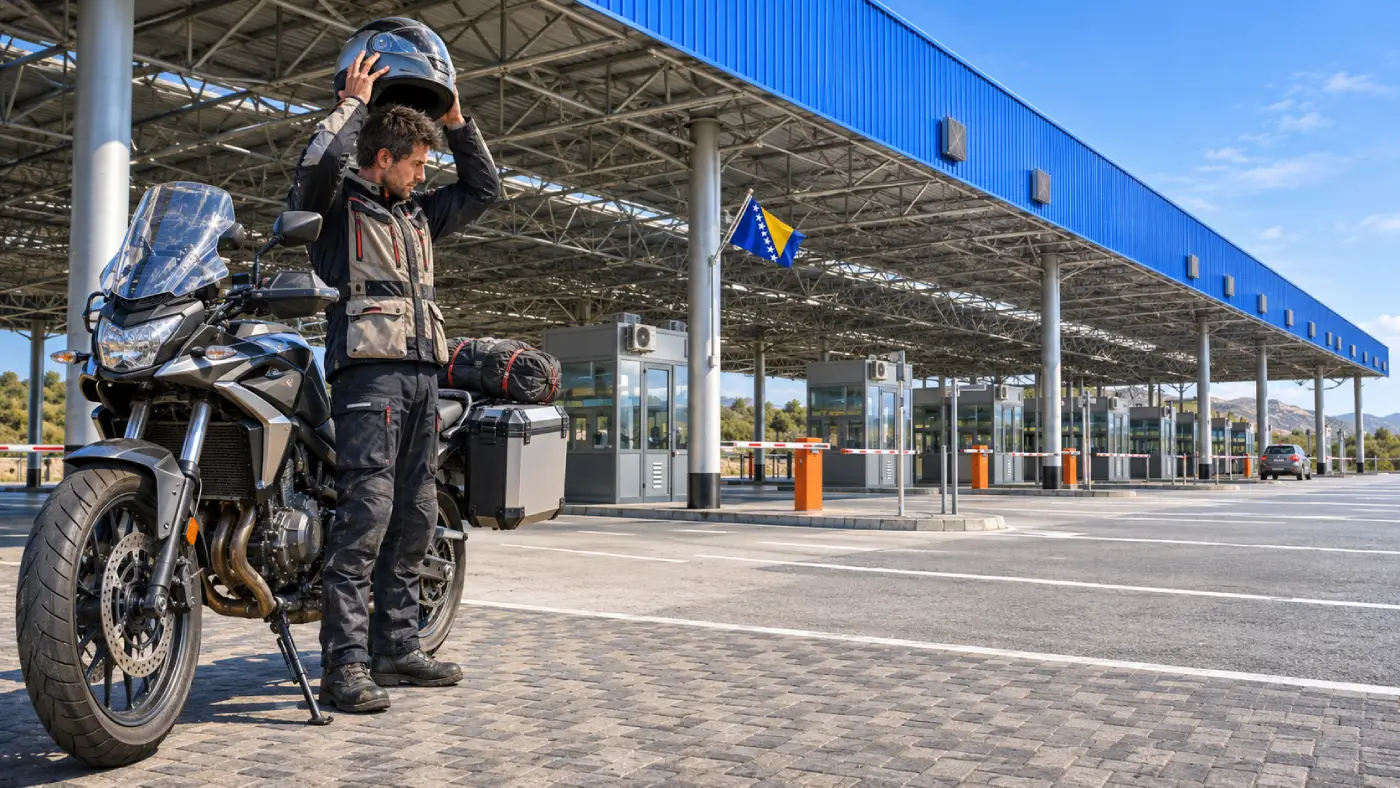
Use a border crossing open to international traffic and travel during its operating hours. Some crossings serve restricted local or neighbouring-country traffic, so the nearest line on a map is not necessarily an appropriate crossing for every visitor.
Check your permission to enter the next country separately. Admission to Bosnia and Herzegovina does not establish a right to enter Croatia, Montenegro or Serbia afterwards.
Airport transit and arrival in Sarajevo
Remaining in an airport’s international transit area is different from entering the country. Collecting baggage landside, leaving the airport or making a transfer that requires passing immigration brings the normal entry rules into play. For a connection, establish whether your airline can keep you airside and whether any nationality-specific transit requirement applies.
After entering the country, Roafly’s Bosnia and Herzegovina eSIM provides mobile data for accessing bookings, checking your route and messaging your accommodation. It is data-only and requires an unlocked, compatible device.
If you prefer to buy a physical SIM after arrival, the guide to buying a SIM at Sarajevo Airport covers that separate arrival decision.
Register your stay after arrival
Accommodation registration is separate from permission to enter. Who handles it depends on where you stay.
Hotels and other accommodation providers handle the guest-registration process. Ask for confirmation of registration or the accommodation receipt, and keep it with your travel records.
If you stay with a private host outside the accommodation-provider system and will remain in Bosnia and Herzegovina for more than three days, you or your host must report your stay to the competent Service for Foreigners’ Affairs office or police within 48 hours of entry. The deadline is counted from arrival, not from the fourth day.
The official stay-registration guidance sets out this distinction. If you booked a private apartment, establish whether the provider registers guests rather than assuming the booking platform completes the process.
Keep your registration evidence until you leave; border officers may request it on departure.
If an unexpected event prevents you from leaving before your authorized stay ends, contact the Service for Foreigners’ Affairs promptly. Type C visa extensions are available only on specified grounds, including force majeure or humanitarian and serious personal reasons. Request advice before your permission expires.