

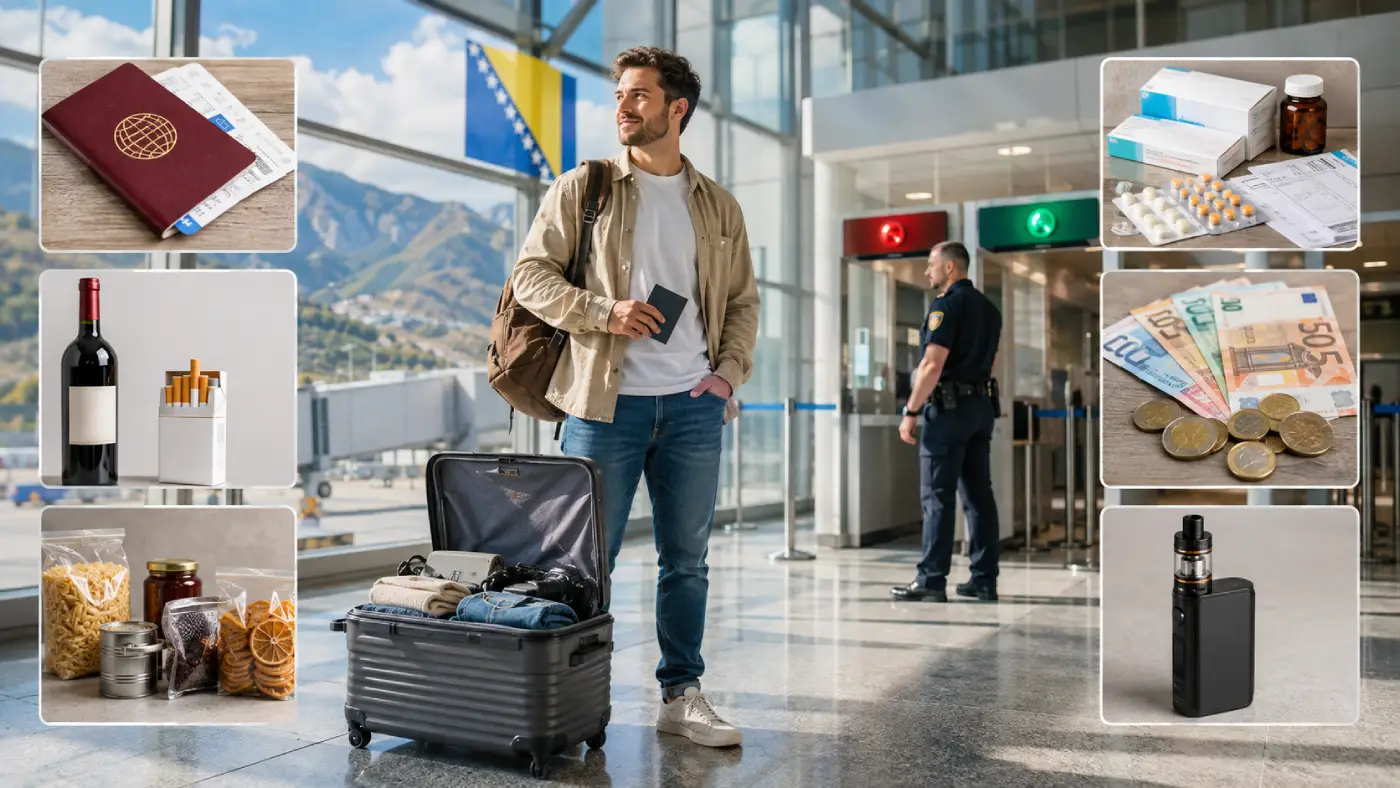
What you can bring into Bosnia and Herzegovina at a glance
| Item | Current rule | Best action |
|---|---|---|
| Other non-commercial goods | Up to 600 BAM per traveler per day | Keep proof of value for expensive items |
| Cigarettes | Up to 200, or an alternative tobacco allowance | Do not combine full alternative allowances |
| Alcohol | 1 L above 22% or 2 L at 22% or below; plus wine and beer limits | Check quantities before packing |
| Medicines | Personal therapy with medical documentation | Carry prescription or equivalent records |
| Psychotropic medicines | Usually up to 7 days for personal use | Declare and show medical documents |
| Cash / portable instruments | Current threshold wording differs by rule set | Declare €10,000 or more and check current scope |
| Animal-origin food | Admissibility depends on product and origin | Check official food rules before packing |
The 600 BAM allowance covers non-commercial goods in personal luggage and applies per traveler per day regardless of transport method. Tobacco, alcohol, still wine and beer have separate quantitative allowances and are not counted inside that 600 BAM value.
Rules checked on 26 August 2026. Requirements can change; verify the linked official guidance before travel.
The Bosnia and Herzegovina Indirect Taxation Authority traveler guidance is the main national reference for personal baggage, allowances, medicines, food and border declarations.
Duty-free allowances for alcohol, tobacco and other goods
Bosnia and Herzegovina exempts non-commercial goods in personal baggage from import duties up to 600 BAM per traveler per day. The exemption is intended for occasional goods whose nature and quantity indicate personal, household or gift use rather than commercial import.
One important rule affects expensive purchases. If a single item is worth more than 600 BAM, its value cannot be split between travelers or divided into an exempt portion and a taxable remainder. Customs calculates import duties and other indirect taxes on the item's full value.
Separate duty-free quantities apply to alcohol and tobacco:
-
Tobacco: 200 cigarettes, 100 cigarillos, 50 cigars or 250 g of smoking tobacco, or a proportional combination of those alternatives.
-
Alcohol: 1 liter above 22% alcohol by volume, or 2 liters at 22% or below, or a proportional combination.
-
Still wine and beer: up to 4 liters of still wine and 16 liters of beer.
Travelers under 17 do not receive the import-duty exemption for tobacco, alcohol, still wine or beer.
These are allowances for entry into Bosnia and Herzegovina. They do not determine what you may take into another country after your trip.
Food, meat, dairy, plants and seeds
Food is not governed by a single rule saying packaged or factory-sealed products are automatically admissible. Bosnia and Herzegovina applies veterinary and phytosanitary controls, so the product category and its origin can change what may cross the border.
Current traveler guidance permits personal consignments of meat, milk and their products from the EU and specified other European origins listed by the authority. Travelers arriving from other origins should not assume that meat or dairy qualifies simply because it is packaged or intended for personal consumption.
Special conditions apply to powdered infant milk, infant food and food required for medical reasons. The published traveler limit is 1 kg per person. These products must not require refrigeration before consumption, must be commercially packaged for sale to the final consumer and must remain unopened unless currently in use.
Small quantities of specified plants and plant products may enter without phytosanitary inspection:
-
Fresh fruit and vegetables, except potatoes: up to 5 kg in total.
-
Flower and vegetable seeds, except potato seed: up to 100 g in original packaging and no more than five packages.
-
Ornamental bulbs and tubers: up to 3 kg.
The official list also contains separate allowances for some cut flowers, potted plants and other small plant consignments, so check the exact category if you plan to carry live plants or planting material.
Animal-origin products that do not meet the personal-import conditions may need to be taken back out of the customs territory or placed in designated containers for destruction. Quantities exceeding the published limits can require veterinary border inspection and an international health certificate.
For specialist controls, the Bosnia and Herzegovina Veterinary Office Border Veterinary Inspection Department oversees international movements of animals and products of animal origin.
Medicines and psychotropic substances
Medicines needed for personal treatment may be brought into Bosnia and Herzegovina in quantities necessary for standard therapy when accompanied by relevant medical documentation. The Indirect Taxation Authority gives examples including a medical-history record, a doctor's authorization or a prescription.
Stricter requirements apply when a medicine contains psychotropic substances:
-
Carry medical documentation supporting the treatment.
-
Limit the quantity to no more than seven days of personal use in the ordinary case.
-
Declare the medicine's name and quantity to customs and show the supporting documentation.
An exception allows up to 15 days for people undergoing addiction-substitution treatment or symptomatic treatment in the terminal phase of malignant disease, again on the basis of medical documentation.
Because the active ingredient determines whether the controlled-medicine rule applies, check the substance rather than relying on the brand name. A prescription from another country does not remove Bosnia and Herzegovina's applicable quantity and declaration requirements.
Cash at €10,000: check the current rule before travel
Cash rules need extra care in 2026 because official sources are not fully synchronized.
The current Bosnia and Herzegovina Indirect Taxation Authority traveler page still says travelers must declare cash, cheques, securities and other covered portable payment instruments when their value is more than €10,000.
A newer Republika Srpska regulation, adopted in February 2026, uses a threshold of €10,000 or more for physical transfers of cash at border crossings. It also applies the declaration framework to investment gold. The Republika Srpska Ministry of Finance cash-transfer guidance provides the current entity-level rules.
For Republika Srpska residents, a further rule applies when taking money out of the country: exporting cash or cheques worth €10,000 or more requires prior approval from the Republika Srpska Ministry of Finance. That approval rule should not be presented as a universal requirement for every foreign visitor.
The Federation of Bosnia and Herzegovina amended its foreign-exchange law in 2026 and, as of August 2026, its finance ministry is still updating secondary rules dealing with physical transfers and approval procedures. The Federation Ministry of Finance public consultation on foreign-exchange secondary legislation provides the current regulatory update.
For a traveler, the safest practical approach is clear: declare €10,000 or more rather than relying on the older “more than €10,000” wording. If you are transporting that amount or more, especially when leaving Bosnia and Herzegovina, confirm any additional residency- or entity-specific documentation before departure.
The declaration threshold is not itself a legal maximum on how much money you may carry.
Vapes and nicotine products
The current official traveler guidance publishes specific personal allowances for cigarettes, cigarillos, cigars and smoking tobacco. It does not state a separate traveler quantity for electronic cigarettes or e-liquid in the same allowance guidance.
That absence does not establish either a blanket import ban or an unlimited personal allowance. It also does not justify applying the 200-cigarette allowance to disposable vapes, refillable devices, e-liquid, heated-tobacco products or nicotine pouches.
If you need a definitive import quantity or classification for of these products, confirm the current treatment directly with the Indirect Taxation Authority before travel.
This section covers import at the border. Rules on smoking, vaping, sale, possession or use after entry are local-law questions rather than customs rules.
How customs declarations work at the border
Goods entering the Bosnia and Herzegovina customs area remain subject to customs supervision even when they qualify for an exemption. Customs officers determine whether personal baggage qualifies for duty relief or requires another customs procedure.
For eligible personal baggage, the Indirect Taxation Authority states that the exemption from import duties may be approved orally by the customs officer. Cash and covered portable payment instruments use a specific declaration process when the applicable threshold is reached.
Do not assume every item above a personal allowance can enter merely after payment of duty. Restricted goods, commercial quantities, controlled medicines and regulated animal products may require permits, specialist inspection or another customs procedure.
The Bosnia and Herzegovina customs procedures guidance explains the wider customs framework for goods entering the country.
Mobile internet after customs
Once border formalities are complete, mobile data can keep maps, bookings and messages available during the trip. Using your Bosnia and Herzegovina eSIM provides data connectivity without changing a physical SIM solely for internet access after arrival.
Internet in Bosnia explains the differences between airport or local SIMs, eSIMs, roaming and WiFi.
Best eSIM for Bosnia and Herzegovina is designed for comparing provider, plan and coverage options before choosing.
Customs checklist before you travel
-
Check whether non-commercial purchases remain within the 600 BAM per-person, per-day allowance.
-
Compare alcohol and tobacco quantities with the separate duty-free limits and age requirement.
-
Verify origin and product category before packing meat, dairy, plants, seeds or other regulated food.
-
Carry medical documentation for personal medicines and check whether an active ingredient is psychotropic.
-
Declare €10,000 or more in cash rather than relying on older threshold wording, and check whether residency or the relevant entity creates extra requirements.
-
Confirm unclear vape, nicotine-product or other regulated-item classifications with the responsible authority before departure.