


'/%3e%3cuse xlink:href='%23b' transform='rotate(90)'/%3e%3c/g%3e%3c/defs%3e%3cpath d='M0 0h300v200H0z' style='fill:%23fff'/%3e%3cpath d='M130 0v80H0v40h130v80h40v-80h130V80H170V0h-40z' style='fill:red'/%3e%3cuse xlink:href='%23c' fill='red' transform='translate(64.45 39.45)'/%3e%3cuse xlink:href='%23c' fill='red' transform='translate(235.55 160.55)'/%3e%3cuse xlink:href='%23c' fill='red' transform='translate(235.55 39.45)'/%3e%3cuse xlink:href='%23c' fill='red' transform='translate(64.45 160.55)'/%3e%3c/svg%3e)
In this article, you’ll see a practical, traveler-first comparison of Georgia eSIM plans across Roafly, Airalo, Saily, Roamless, Yesim, AloSIM, Jetpac, and Holafly—focused specifically on 30-day packages and the most common data sizes travelers buy (5GB, 10GB, and 20GB, where available). We’ll break down pricing in USD, note the underlying local networks when they’re disclosed (such as Geocell/Silknet and Cellfie), and then zoom out to cover the main local operator options and typical airport SIM offers—so you can pick the most sensible setup for your route and data needs.
Why an eSIM is the most practical choice in Georgia
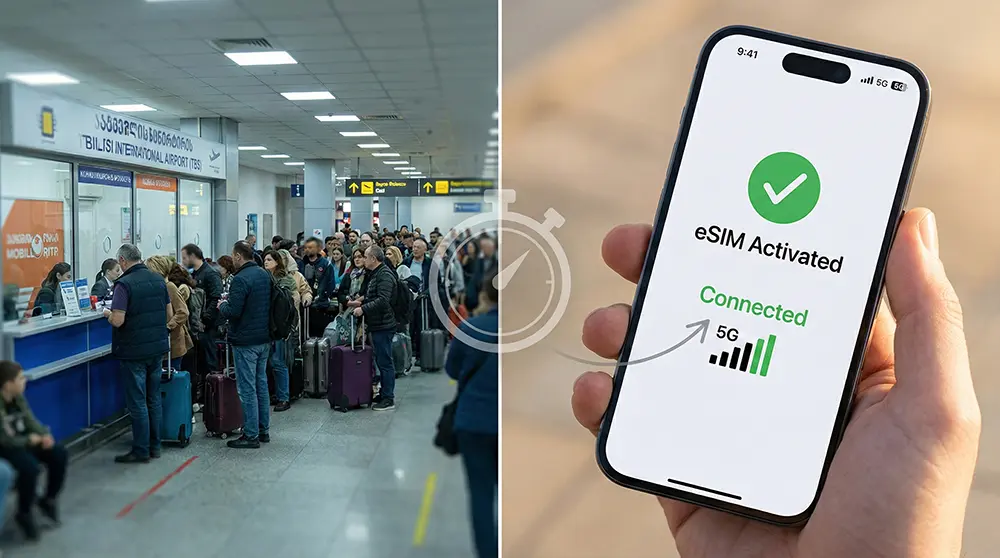
An eSIM isn’t just “a digital SIM.” For Georgia trips, it solves a few annoying realities:
-
You’ll want data immediately after landing. Airport Wi-Fi can be slow or inconsistent. Having mobile data ready means you can call a ride, open hotel directions, and message your host without stress.
-
No passport/registration time at a counter. Local SIMs are easy, but they still usually mean a queue and ID checks, especially at airports and main operator shops.
-
You can keep your home number active. That matters for bank OTPs, WhatsApp, and iMessage while your Georgia data runs on the travel eSIM line.
-
Predictable spend. Roaming surprises are real. A 30-day, prepaid data bundle keeps your budget stable.
Roafly also supports all common install flows—iOS Direct Install, QR Code, and Manual setup—so you can activate the plan in minutes before you fly.
Best eSIM for Georgia: 5GB / 10GB / 20GB price comparison (30 days)
All prices below are USD and each plan is valid for 30 days, as requested. Networks listed are the underlying operators when provided.
Georgia eSIM plan comparison table (30 days)
| Provider | Network | 5GB | 10GB | 20GB | Notes |
|---|---|---|---|---|---|
| Roafly | Geocell (Silknet) | 9.90 | 19.00 | 29.90 | Strong price/performance |
| Airalo | Cellfie | 17.00 | 28.50 | 36.50 | Operator listed: Cellfie |
| Saily | Not specified | 17.99 | 24.79 | 39.19 | Operator not stated |
| Roamless | Cellfie | 20.95 | 30.95 | 48.95 | Higher cost per GB |
| Yesim | Cellfie, Geocell | 16.80 | 25.20 | 31.20 | Multi-operator listing |
| AloSIM | Geocell | 18.00 | 31.00 | 36.50 | Higher cost per GB |
| Jetpac | Geocell | — | 45.00 | — | Higher cost per GB |
| Holafly | — | — | — | — | 7-day “Unlimited” $27.30 (Fair Usage Policy applies) |
Pricing note: Prices reflect December 21, 2025.
Which Georgia eSIM is best for most travelers?
Roafly: best overall value for 5GB, 10GB, and 20GB
For most trips, Roafly is the easiest recommendation because it offers the best price across the three most common 30-day data sizes—5GB, 10GB, and 20GB—while running on a well-known local network partner (Geocell / Silknet). That combination of predictable validity and strong value makes it a reliable “set it and forget it” option for Georgia.
It’s a particularly good fit if your daily usage looks like this:
-
Google Maps and live navigation in Tbilisi, Kutaisi, and Batumi
-
Messaging and translation apps
-
Booking confirmations, banking logins, and-time passcodes (OTPs)
-
Day trips where you rely on your phone for directions and timing
Need data in Georgia? Get an eSIM!
Choose the perfect data plan for your trip
Exclusive Reader Bonus!
Enjoy an extra %10 OFF your first Roafly eSIM purchase as a thank you for reading.

Manage your eSIM in the app
Install, top up and track data.
If you want a single place where readers can view every available bundle and choose their preferred data size, the Georgia eSIM page is the most direct reference point.
A quick note on “unlimited” eSIMs in Georgia
Some travelers prefer an “unlimited” plan for peace of mind, especially on short trips. Holafly’s Georgia option is marketed as unlimited, but it comes with a Fair Usage Policy. In practice, that means very heavy use can trigger temporary speed reductions. If you expect to hotspot, work remotely, or stream frequently, a clearly sized 10GB or 20GB plan is often more predictable than “unlimited” wording.
Georgia mobile networks and coverage expectations
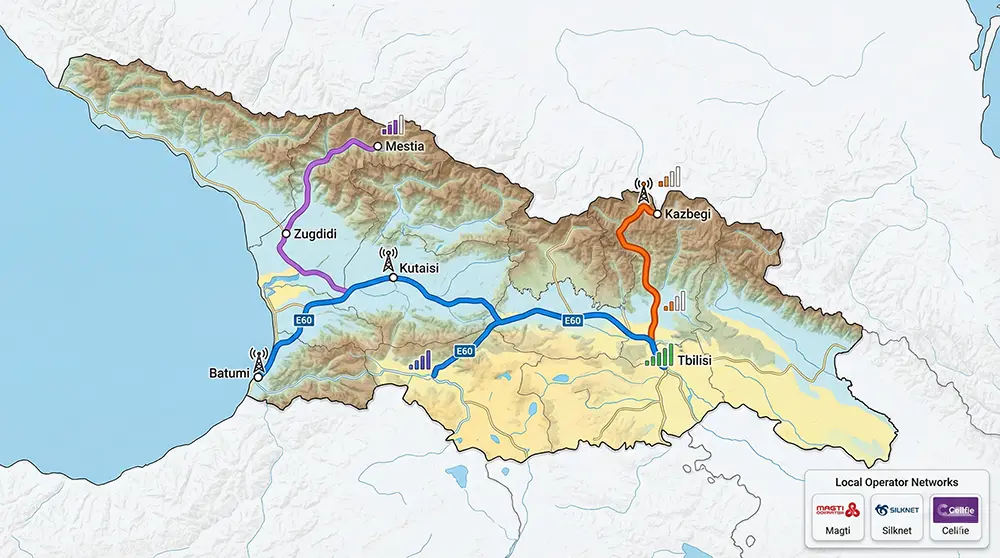
Georgia has three nationwide mobile networks you’ll see referenced in eSIM listings and at airport counters:
-
Magti (MagtiCom)
-
Silknet (often shown as Geocell / Silknet)
-
Cellfie (Cellfie Mobile)
In central Tbilisi, Kutaisi, and Batumi, 4G/LTE is the normal baseline on all three. Where things change is on road trips and in the mountains: deep valleys, tunnels, and remote passes can create short dead zones even when a coverage map looks “green.”
Magti (MagtiCom): broad footprint, strong outside cities
Magti positions itself as having very wide domestic reach—its official coverage statement says the MagtiCom network covers 99% of the populated controlled territory of Georgia, and it lists support for 2G/3G/4G/4.5G/5G.
Magti also actively markets 5G and publishes technical network information and supported bands on its site.
What this means for travelers: if your itinerary includes long drives and smaller towns (or you simply want the “most likely to work” option), Magti is often the network people default to—especially when convenience matters more than shaving a few dollars off the plan.
Silknet (Geocell / Silknet): strong urban performance, expanding 5G
Silknet is the parent brand you’ll see behind “Geocell” in many plan listings. The company announced the start of its 5G service in central Tbilisi, specifically describing the initial 5G area as Freedom Square to Bagebi (launch communicated in December 2023).
For most travelers, you should still think in terms of 4G reliability first, and treat 5G as a bonus when you happen to be inside a supported zone.
If your eSIM uses Geocell / Silknet (as Roafly’s Georgia plan does), you’re essentially choosing of the “big three” Georgian networks—good for typical city travel and common tourist routes, with performance that depends heavily on terrain you go deep into mountain regions.
Cellfie: value-focused competitor with targeted 5G rollout
Cellfie is a major Georgian operator and often appears in travel eSIM listings. On its official 5G page, Cellfie describes a rollout approach focused on densely populated areas, tourist areas, ports, airports, and major motorways, with a multi-year coverage commitment.
That’s a useful signal for travelers: Cellfie can be perfectly fine for city stays and popular corridors, while the most remote routes may vary more due to geography.
How to sanity-check coverage before you buy
Coverage marketing can be broad. The quickest practical check is a crowdsourced map by carrier—nPerf provides Georgia coverage maps for Magti and Geocell, which can help you spot weaker areas along your route (especially if you’re planning mountain drives)
Local SIM cards in Georgia: airport offers and local operator pricing (USD equivalents)
Local prepaid SIMs in Georgia can be very cost-effective, especially if you’re staying longer or want a Georgian number. The tradeoff is convenience: you may spend time at a counter, manage top-ups, and handle setup.

To convert GEL to USD, the National Bank of Georgia lists 1 USD = 2.6984 GEL on 21/12/25.
Airport SIM options (Tbilisi and Kutaisi)
Magti publishes a specific airport offer for tourists: a free SIM with a “Welcome Package,” including a 3,000MB option (valid 15 days) and a 5,000MB option (valid 15 days).
This is a useful fallback if you land without data and want something quick right inside the airport.
Local operator bundles (what you might pay in practice)
Cellfie (official tariff example):
-
Cellfie’s “Maxi” plan shows 25 GEL for 30 days with 20GB. That’s roughly $9.26 at the 21/12/25 rate.
Magti (official individual offer page example):
-
Magti lists 20,000MB for 15 GEL (and shows it as “instead of 30 GEL”), which is roughly $5.56 at the same exchange rate. It also lists “Unlimited Internet (Month) 16 GEL” with a high-speed allowance shown as 50,000MB, after which speed is 5 Mbps (per the page notes).
Because this is presented as an “instead of” price, it can be promotional—so local pricing may shift.
Silknet / Geocell (official offer example):
-
Silknet has promoted unlimited internet pricing (example offer text shows 30 days – 32 GEL), roughly $11.86 at the 21/12/25 rate.
The takeaway: local SIMs can be cheaper per GB, but an eSIM often wins on time saved, setup simplicity, and having data instantly for the first day.
How much data do you actually need in Georgia?
5GB (light trip)
Pick 5GB if you:
-
Mostly use hotel Wi-Fi
-
Need data for maps, messaging, and basic browsing
-
Aren’t hotspotting
10GB (typical travel)
Pick 10GB if you:
-
Move between cities (Tbilisi ↔ Kutaisi ↔ Batumi)
-
Use navigation daily and upload photos
-
Want buffer for occasional video
20GB (heavy / work-friendly)
Pick 20GB if you:
-
Work remotely (calls + hotspot)
-
Spend lots of time on the road
-
Post video or stream regularly
If you’re unsure whether 5GB is enough, a simple data usage calculator can help you estimate your needs based on how often you use maps, social media, video, and hotspotting. It’s an easy way to avoid running out of data mid-trip—or paying more later for top-ups.
Setup checklist so your eSIM works right after landing
A smooth Georgia arrival usually comes down to three things: installing before you travel, selecting the correct line for data, and enabling roaming for the eSIM line.
-
Install the eSIM before departure (Wi-Fi makes it easier).
-
After landing, set the eSIM as your Cellular Data line and enable Data Roaming for the eSIM line.
-
If your eSIM is installed but you still don’t have data, follow this quick fix guide: How to Fix ‘No Service’ Issues with eSIM After Landing. If you’re on iPhone and activation gets stuck or behaves oddly, this step-by-step walkthrough usually resolves it: Unable to Activate eSIM on iPhone – how to fix it step by step
Final recommendation
If you want the best mix of pricing, a simple 30-day allowance, and easy installation, Roafly is the strongest pick for Georgia in this comparison—especially at 10GB and 20GB.
Check the latest Georgia eSIM packages and install before you fly so you land with data ready to go.