Download the App and manage your eSIMs easily
Create your order quickly
See your eSIM details
Track your remaining data
Download the App and manage your eSIMs easily
Create your order quickly
See your eSIM details
Track your remaining data
Australia’s entry requirements begin with your passport and the visa attached to it. As of 9 November 2026, most overseas tourists need a visa granted before travelling, usually an eVisitor, Electronic Travel Authority (ETA) or Visitor visa.

Ethan Brooks
Updated Nov 9, 2026
8 min read

Save 15% on your Roafly eSIM
Stay connected on your next trip. Use the code below at checkout.
View All DestinationsJump to section
👇
Manage your eSIM in the app
Install, top up and track data.
Save 15% on your Roafly eSIM
Stay connected on your next trip. Use the code below at checkout.
View All DestinationsAustralian citizens do not need a visa. Eligible New Zealand citizens have a separate arrangement under which a Special Category visa can be granted on arrival. Everyone else should settle their visa before reaching the departure airport.
Nationality and passport type determine which visitor routes are available. Living in an eligible country does not make another country’s passport eligible.
These are representative examples, not complete nationality lists:
| Entry route | Passport examples | Tourist stay | Main condition |
|---|---|---|---|
| eVisitor — subclass 651 | United Kingdom—British Citizen, Germany, France, Italy, Netherlands | Up to 3 months per visit | Obtain the visa online before travel. |
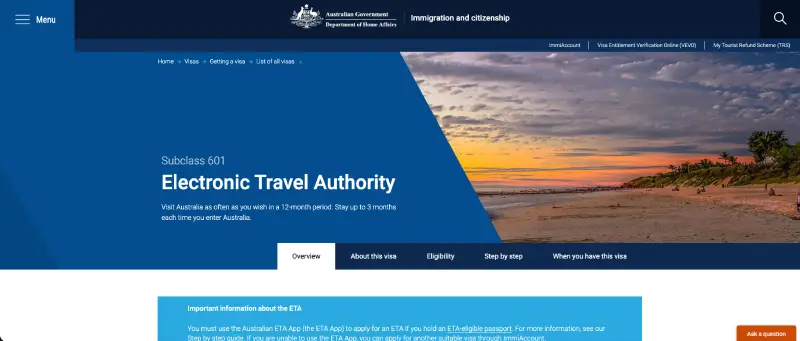
| ETA — subclass 601 | United States, Canada, Japan, Singapore, South Korea | Up to 3 months per visit | Apply through the Australian ETA app before travel. |
| Visitor visa — subclass 600, Tourist stream | India, mainland China, Indonesia | The period in your grant letter; generally 3 months, with up to 12 months possible in some circumstances | Apply through ImmiAccount with supporting documents. |
| Special Category visa — subclass 444 | New Zealand citizens using a valid New Zealand passport | The SCV normally remains valid until you leave | Eligible citizens can receive it on arrival, subject to health and character requirements. |
Use the official visitor visa finder to match your passport and trip to the full eligibility rules.
Several European passports qualify for both eVisitor and ETA. If you qualify for both and are taking a straightforward short holiday, the free eVisitor is the sensible starting point. Paying the ETA app’s service charge does not buy a longer tourist stay.
British passport categories matter: British Citizen passports qualify for eVisitor, while British National (Overseas) passports are on the ETA list but not the eVisitor list.
New Zealand residence alone does not provide the New Zealand-citizen arrival arrangement. Family members travelling on another country’s passport need their own appropriate permission.
Australia’s ETA is itself a visa. It is not an exemption from having one, and it is not the same document as an arrival declaration.
eVisitor applications go through ImmiAccount and have no visa application charge. You must be outside Australia when applying and when the visa is granted.
ETA applications use the official Australian ETA app. The app service charge is AUD20, with no additional ETA visa application charge. You need a compatible phone with NFC, a camera and location services, plus your passport, email address and payment method. The application includes a passport scan and a live facial image.
Someone can help you apply on their phone, but you must be physically present. If the app cannot be used, the alternative is to apply for another suitable visa through ImmiAccount.
Visitor visa applications require a fuller account of your holiday and circumstances. Upload the requested documents, pay the applicable application charge and respond to any requests for biometrics or health examinations. Fee concessions apply to some nationalities; the application process determines the charge for your case.
Each person needs a separate application, including children. Families can organise applications together, but one parent’s approval does not cover the rest of the family.
Apply with enough time for additional checks. Acknowledgement of an application or payment is not approval: wait for the grant notification before travelling. Airlines check visa records electronically against passport details.
If you have a criminal conviction, use the Visitor visa route and disclose the details. Home Affairs directs applicants with convictions away from the ordinary ETA/eVisitor process; possession of an eligible passport does not remove the character assessment.
Australia does not impose a general rule requiring six months of passport validity. Travel with a passport valid for your visit, and account separately for the requirements of any country you transit through. Your route can create a passport-validity requirement that Australia itself does not have.
Renewing a passport can also affect an existing visa. An ETA ends when its linked passport expires or is replaced, so you need a new ETA. With other visa types, notify Home Affairs of the new passport details and make sure the visa record matches the document you will use.
Keep the following accessible during your journey:
Your passport and visa grant notification.
Your first accommodation address and contact details in Australia.
Your itinerary and return or onward travel arrangements.
Evidence that you can fund the visit and leave Australia.
Any additional documents requested for your application, including consent documents for a child where applicable.
Visitor visa applicants may need bank statements, employment or study evidence, an invitation from a host, and evidence of reasons to return home. Supply English translations of non-English supporting documents. The relevant evidence depends on your circumstances; there is no single universal tourist bank-balance figure.
Save essential documents offline. An email account that needs a new login or an unavailable connection should not be your only way to retrieve your accommodation address.
Health paperwork can depend on your recent itinerary. If you visited a yellow-fever risk country or area in the preceding six days, declare it on arrival; you may be asked for a vaccination certificate. Australia does not refuse entry solely because you have not received, or cannot prove, that vaccination. Follow any instructions given by biosecurity officers.
Most arriving passengers complete an Incoming Passenger Card (IPC). It asks for identity, flight or ship details, your Australian address, and immigration, health, customs and biosecurity information. Complete it accurately in English.
The digital Australia Travel Declaration (ATD) is an alternative only where the relevant service is available. On 9 November 2026, the public ATD web form is restricted to arrivals at Western Sydney International Airport. A separate Qantas app pilot covers eligible flights and invited passengers.
Do not complete a form for a different arrival airport. If your flight is not covered by a digital option, use the paper IPC supplied on board or at the terminal. The announced expansion to all international airports and seaports by the end of 2027 is a future rollout, not a current nationwide requirement.
The official passenger-card guidance explains the paper form and the Qantas pilot.
Visa approval and declarations about your belongings are separate parts of arrival. Before packing food, medicines or other controlled items, read Australia’s customs and biosecurity rules.
Staying inside an airport does not, by itself, remove the need for an Australian visa.
Transit without a visa is available only to eligible travellers who meet all the relevant conditions: arrival by air, a confirmed onward flight to a third country within eight hours, valid documents for that destination, and no need to clear immigration or leave the transit lounge.
Collecting checked baggage, changing terminals or making an overnight connection can change that answer. Australian airports have different transit facilities, so establish whether your actual connection remains airside before relying on the exemption.
If you need a visa specifically for transit, the Transit visa, subclass 771, allows a stay of up to 72 hours and has no application charge. It must be obtained before travel. If you already hold a suitable Australian visa, establish whether it covers the transit before applying for another one: a new Transit visa can end an existing visa.
Cruise passengers also need the appropriate entry permission. On a round-trip cruise from Australia, time aboard can count towards your Australian stay; the cruise does not reset your permitted stay. Ask the operator how your itinerary is classified when calculating your departure deadline.
The date until which you can travel to Australia and the length of each visit are different.
eVisitor holders normally have a 12-month window for multiple entries, with up to three months per visit. ETA travel validity is normally 12 months or until the linked passport expires, whichever comes first, also with up to three months per visit. Use months, rather than assuming the limit is always exactly 90 days.
Visitor visas can have single or multiple entry permission and different authorised periods. Your grant letter sets the terms; receiving a Visitor visa does not automatically mean you can remain for 12 months.
Use your grant notification or Visa Entitlement Verification Online (VEVO) to establish the conditions and departure deadline. Extending a holiday usually means applying for another suitable visa, not extending the existing ETA or eVisitor. Conditions such as 8503—No Further Stay can restrict an application from within Australia.
Frequent entries are still assessed against genuine-visitor requirements. Plan the visa around the trip you intend to take rather than relying on a short departure to secure more time.
Tourist status does not permit ordinary employment in Australia. Beyond immigration conditions, familiarise yourself with the local laws for visitors, which cover everyday conduct during your stay.
Once entry permission is settled, organise the practical details that follow border clearance. Save your accommodation address, decide how to reach it, and allow for the actual arrival time when planning transport. Our guide to getting around Australia covers taxis, ride-hailing and longer journeys.
Arrange mobile data before departure if you want to open bookings, message your host or follow a route after landing. Compare the best eSIM for Australia options against your trip length and intended destinations.
Roafly’s Australia eSIM provides prepaid mobile data for a compatible, carrier-unlocked phone. Install it while you have a connection before travelling, and keep your entry documents saved offline for the journey.
