Download the App and manage your eSIMs easily
Create your order quickly
See your eSIM details
Track your remaining data
Download the App and manage your eSIMs easily
Create your order quickly
See your eSIM details
Track your remaining data
Your residence permit can change how you enter Armenia, even when your passport normally requires a visa. Before booking a flight or a journey from Georgia, establish which permission covers your visit and what you must carry to use it.

Sophie Callahan
Updated Nov 18, 2026
11 min read
Save 15% on your Roafly eSIM
Stay connected on your next trip. Use the code below at checkout.
View All DestinationsJump to section
👇Save 15% on your Roafly eSIM
Stay connected on your next trip. Use the code below at checkout.
View All Destinations
Manage your eSIM in the app
Install, top up and track data.
Armenia allows visa-free visits for many nationalities, while others need an eVisa, a visa issued at the border or an advance consular visa. Some visitors who would normally need a visa can instead use a temporary exemption linked to a qualifying foreign residence permit.
These rules were checked on 18 November 2026 for short tourist visits with ordinary passports. Start with your citizenship, then consider any residence permit you hold. Your departure country alone does not determine your entry route.
The examples below cover common tourist situations. They are not complete nationality lists, and exemptions for diplomatic passports or special travel documents follow different rules.
| Passport or qualifying status | Entry route | Stay and main condition |
|---|---|---|
| United States, United Kingdom, Germany, Australia and Japan | Visa-free by nationality | Up to 180 days in a year for these examples |
| Eligible nationals holding a qualifying US, EU, Schengen or Gulf residence permit | Temporary visa exemption | Up to 180 days within a one-year period; nationality, permit validity and physical-document requirements must all be met |
| Canada, Türkiye and Mexico | Visa on arrival, with advance eVisa also available | Obtain a visitor visa unless a separate exemption applies; follow the permitted stay and dates on the issued visa |
| India, Egypt and the Philippines | eVisa available | Apply before travel unless you qualify for residence-based exemption or a separate visa-on-arrival route |
| Pakistan, Bangladesh and Nigeria, without an applicable exemption | Invitation-based consular visa | Arrange the invitation and visa through an Armenian diplomatic mission before departure |
Use Armenia’s official visa eligibility guidance to check your citizenship and passport type. Its links also lead to the complete visa-free, invitation-only and temporary-exemption lists.
Canadian and US passports illustrate why country-by-country checks matter: US citizens qualify for ordinary visa-free visits, while Canadian citizens normally need a visa unless they meet a separate exemption.
The temporary exemption runs from 1 July 2026 to 1 July 2027 and covers nationals of 111 listed countries. Examples include India, Egypt, the Philippines, Pakistan, Sri Lanka and Nepal.
You must hold a residence permit issued by one of these jurisdictions:
The United States.
EU member states and Schengen Area states.
The United Arab Emirates, Bahrain, Qatar, Saudi Arabia, Kuwait or Oman.
The permit must remain valid for at least six months from your entry date. Qualifying visitors can stay for up to 180 days within a one-year period.
Present the permit as a physical residence card or a sticker in your passport. Keep it with your travel documents; a photograph on your phone should not replace the required physical document.
The document must show the relevant identity and validity information in Latin script, including your name, nationality and date of birth, with dates in the Gregorian calendar.
Holding a Schengen visitor visa is different from holding a Schengen residence permit. Likewise, a UAE tourist visa is not a UAE residence permit.
UK residence permits are outside this particular exemption. Some foreign visas and permits can instead support a visa-on-arrival application, under the separate rules below.
Check your nationality against the temporary list even if your permit was issued by an eligible country. Residence in an eligible jurisdiction is only one part of the test.
The eVisa route lets eligible visitors arrange their visa before reaching Armenian immigration. It is particularly useful when your trip depends on having permission in place before departure.
Apply through the official Armenian eVisa portal, selecting the country that issued your passport and the correct travel-document type.
| Visitor visa option | Maximum permitted stay | Published fee in USD |
|---|---|---|
| Short visitor visa | Up to 21 days | $8 |
| Longer visitor visa | Up to 120 days | $39 |
These are non-refundable visa fees. Read the approval’s entry dates and permitted stay separately: the period during which you can use a visa and the number of days you may remain are different details.
Prepare the core application materials:
Completed online application.
Clear scan of your passport or travel document.
Recent photograph.
Payment of the visa fee.
Accommodation bookings, travel tickets, proof of funds, travel insurance and relevant previous visas or residence permits can support the application. The authorities can request additional documents during assessment; follow any request attached to your case.
Normal processing is three working days, counted from the business day after online submission. Requests for further information can extend this, so allow time beyond the normal processing window. Travel with the issued approval rather than relying on an application receipt.
Since 9 October 2026, the additional eVisa conditions previously imposed specifically on Indian, Egyptian and Iraqi citizens have been removed. The government amendment repealed the relevant provision.
Those applicants no longer need to satisfy the old nationality-specific combination of insurance and a qualifying foreign visa or residence permit, or the alternative prescribed document package, merely to access the eVisa route. General application checks and individual requests for supporting evidence still apply.
This change concerns eVisa applications. It does not make these passports universally visa-free or give every holder unconditional visa-on-arrival eligibility.
Canada, Türkiye, Mexico, Indonesia, South Africa and Thailand are examples of nationalities eligible to apply for an Armenian visa at a border crossing.
Other eligible nationalities can qualify through particular foreign documents. The conditional route covers valid visas or residence status from the United States, Australia, New Zealand, South Korea, the United Kingdom, Canada, Russia, Japan, EU member states or Schengen states. For the six Gulf Cooperation Council countries, residence status is the relevant document.
This conditional route excludes the invitation-only nationality group. It also involves obtaining a visa, rather than entering under the temporary residence-permit exemption.
If your passport permits an advance eVisa, arranging it before departure can simplify the arrival process. Keep the original foreign visa or residence document available if you intend to rely on it for a border application.
Visitors from invitation-only countries generally need an approved invitation and an Armenian visa issued abroad. Pakistan, Bangladesh, Nigeria, Nepal and Sri Lanka are examples.
Establish whether a separate exemption applies first. For example, an eligible Pakistani passport holder with a qualifying UAE residence permit may use the temporary residence-based exemption instead of the usual invitation route.
If you need the consular route, coordinate the invitation with the relevant host in Armenia and the Armenian diplomatic mission handling your application. The invitation supports the application; it is not the issued visa.
Special provisions also exist for applicants of Armenian origin. Use the requirements for that specific route rather than assuming that ancestry alone settles the documents needed at the border.
Your passport must remain valid throughout your stay in Armenia. The six-month validity condition in the temporary-exemption section concerns the foreign residence permit used for that exemption; it should not be turned into a blanket six-month Armenian passport rule.
Before leaving, put these items together:
Your valid passport.
Your issued Armenian visa, if required.
The original qualifying residence permit or foreign visa, if your entry route depends on it.
Your accommodation address and contact details.
Your return or onward travel arrangements and supporting booking information.
Keep accessible copies of approvals and bookings, including offline copies. The last two items help explain your intended visit; they should not be confused with the nationality-specific permission that allows you to travel.
If you are carrying medicines, gifts or substantial cash, review Armenia’s customs rules separately. Immigration checks concern your admission, while customs rules govern what you bring across the border.
Zvartnots is Yerevan’s international airport. Have your passport and any visa or qualifying residence document ready before reaching passport control.
Once through arrivals, visitors who want to buy a local line can check the options for SIM cards at Yerevan Airport. If you prefer to arrange mobile data before departure, Roafly’s Armenia eSIM supports arrival tasks such as opening your hotel location and messaging your driver on a compatible, unlocked phone.
Keep essential immigration documents available offline regardless of how you plan to connect.
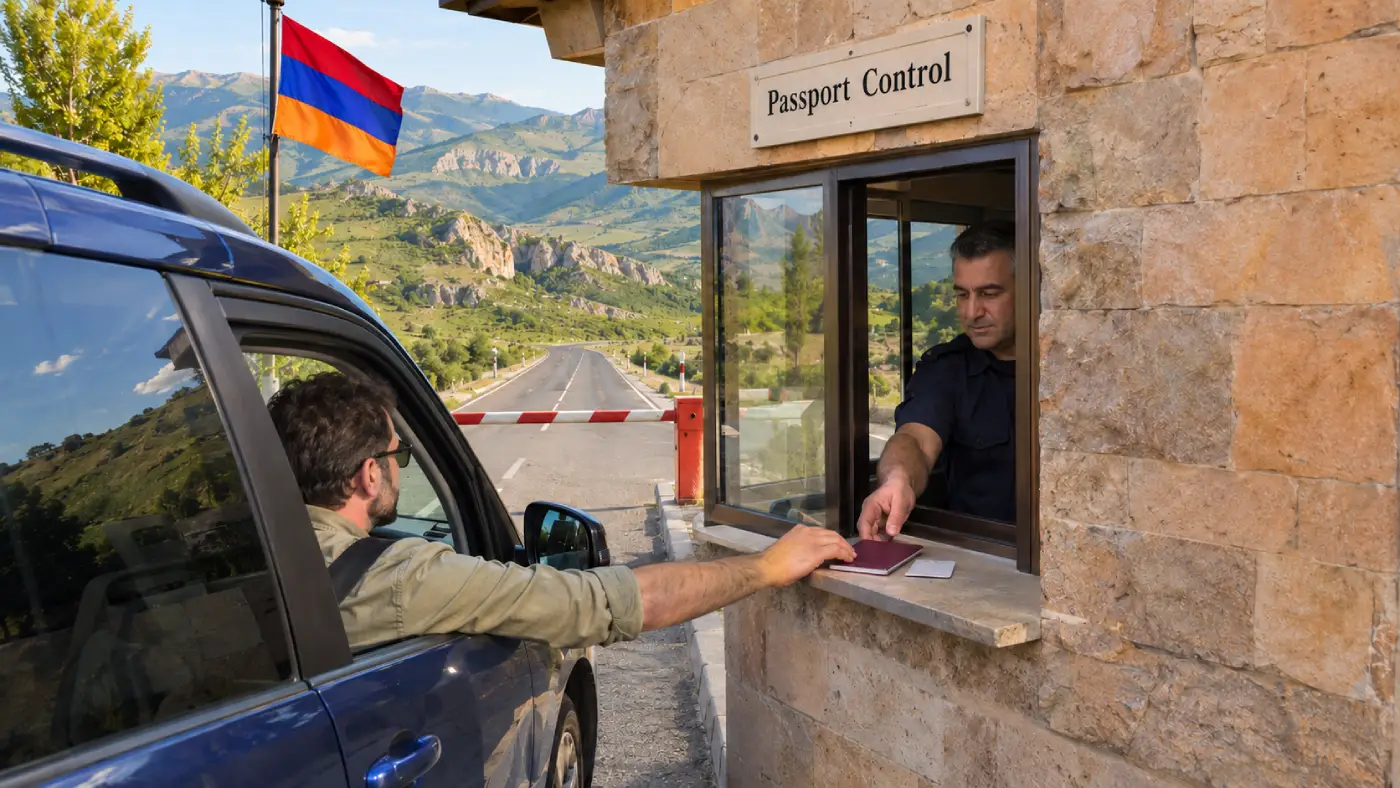
Armenia has land crossings with Georgia and Iran. Established Georgian road crossings include Bagratashen, Bavra and Gogavan; Agarak is the crossing on the Armenian side of the Iranian border.
Your visa or exemption must cover entry into Armenia. Permission to enter Georgia or Iran is a separate matter, so a journey through either country requires its own entry check.
Choose the crossing before arranging transport, particularly if you are relying on a visa issued at the border. Opening conditions and access to an individual crossing can change independently of the national visa rules.
Arranging data before a land crossing can help with onward transport once you have entered Armenia. Compare the best eSIM options for Armenia when planning this part of your journey.
The Türkiye–Armenia and Azerbaijan–Armenia land borders remain closed to ordinary tourist crossings as of the checked date.
Direct flights between Istanbul and Yerevan are a separate option. The existence of those flights does not mean you can drive across the Türkiye–Armenia border.
If your itinerary combines Armenia with Azerbaijan, plan the journey through another country or an available flight connection, with the entry permissions each stage requires.
Remaining in an airport’s transit area is different from passing Armenian immigration. The legal limit for staying in the transit zone without entering the country is 48 hours, except in emergencies.
Your flight connection must actually allow you to stay airside. Ask the airline whether your baggage is checked through and whether the transfer requires immigration clearance, especially with separate tickets.
If you need to collect luggage, change airports or leave the terminal for an overnight stay, arrange the entry permission appropriate to your passport. Calling the journey a “transit” does not remove the border crossing.
Visitor visas can be extended by up to 60 additional days, subject to approval. Applications go to the Migration and Citizenship Service of Armenia’s Ministry of Internal Affairs, with the reason for requesting more time.
Contact the service before your current permission expires. Visa-free visitors approaching their allowed stay need advice appropriate to their status; the visitor-visa extension is not an automatic addition to every visa-free allowance.
Keep track of the days already spent in Armenia. Leaving and returning should not be treated as a guaranteed reset of an annual stay limit.
US passport holders and holders of a full British citizen passport can visit visa-free for up to 180 days in a year. Different British nationality categories should be checked separately.
Eligible nationalities can use the temporary exemption if their UAE residence permit meets the validity and physical-document conditions. Check both your passport’s inclusion and the permit itself.
Yes. The old additional eVisa conditions were removed in October 2026. Indian applicants can use the general eVisa process, subject to its requirements and assessment.
Canadian citizenship alone does not provide the ordinary visa-free exemption. Canadians can apply for an eVisa or a visa on arrival, unless a separate exemption covers them.
No. The temporary exemption requires a qualifying residence permit. Eligible nationalities may instead use a valid Schengen visa to support a visa-on-arrival application.
Ordinary tourist travel across the land border is unavailable. Use an available flight or plan a route through another country, checking that country’s entry requirements too.
