Roafly esim logo
Shop eSIMsHelp CenterDownload app
global

Where to go next?

Languages

Login
All articles

AFCON 2025 Guide: Dates, Host Cities, Qualified Teams & Stadiums in Morocco

The Africa Cup of Nations is returning to Morocco for the first time since 1988, and AFCON 2025 is shaping up to be one of the most unique editions in the tournament’s history.

Sophie Callahan

Dec 8, 2025

AFCON 2025 Guide: Dates, Host Cities, Qualified Teams & Stadiums in Morocco
Jump to section 👇

In this article

  • When Does AFCON 2025 Take Place?
  • Where Is AFCON 2025 Being Held?
  • AFCON 2025 Host Cities and Stadiums in Morocco
  • Tournament Format: How AFCON 2025 Will Work
  • Which Countries Have Qualified for AFCON 2025?
  • AFCON 2025 Groups: Who Plays Where?
  • Is AFCON Every 2 or 4 Years?
  • Traveling to Morocco for AFCON 2025: What Fans Should Expect
  • How to Move Between Host Cities in Morocco
  • Host City Breakdown: What Each AFCON Venue Offers
  • Accommodation and Match-Day Logistics
  • Connectivity in Morocco During AFCON 2025 (Essential for Travelers)
  • Recommended Data Amounts for AFCON Fans
  • How to Use Mobile Apps During AFCON 2025
  • Safety & Travel Tips for AFCON 2025 Visitors
  • Final Thoughts: AFCON 2025 Will Be One of the Most Dynamic Editions in Years

For the first time, Africa’s biggest football event will run over the Christmas and New Year period, bringing together 24 national teams, nine stadiums and six Moroccan host cities in a month-long festival of football.

This guide walks through the key facts fans are searching for right now: when AFCON 2025 takes place, why it’s being played in December, which cities and stadiums will host matches, and which countries have qualified. In the second half of the guide, we will look more closely at travel logistics for Morocco during the tournament and how visitors can stay connected while following their team around the country.


When Does AFCON 2025 Take Place?

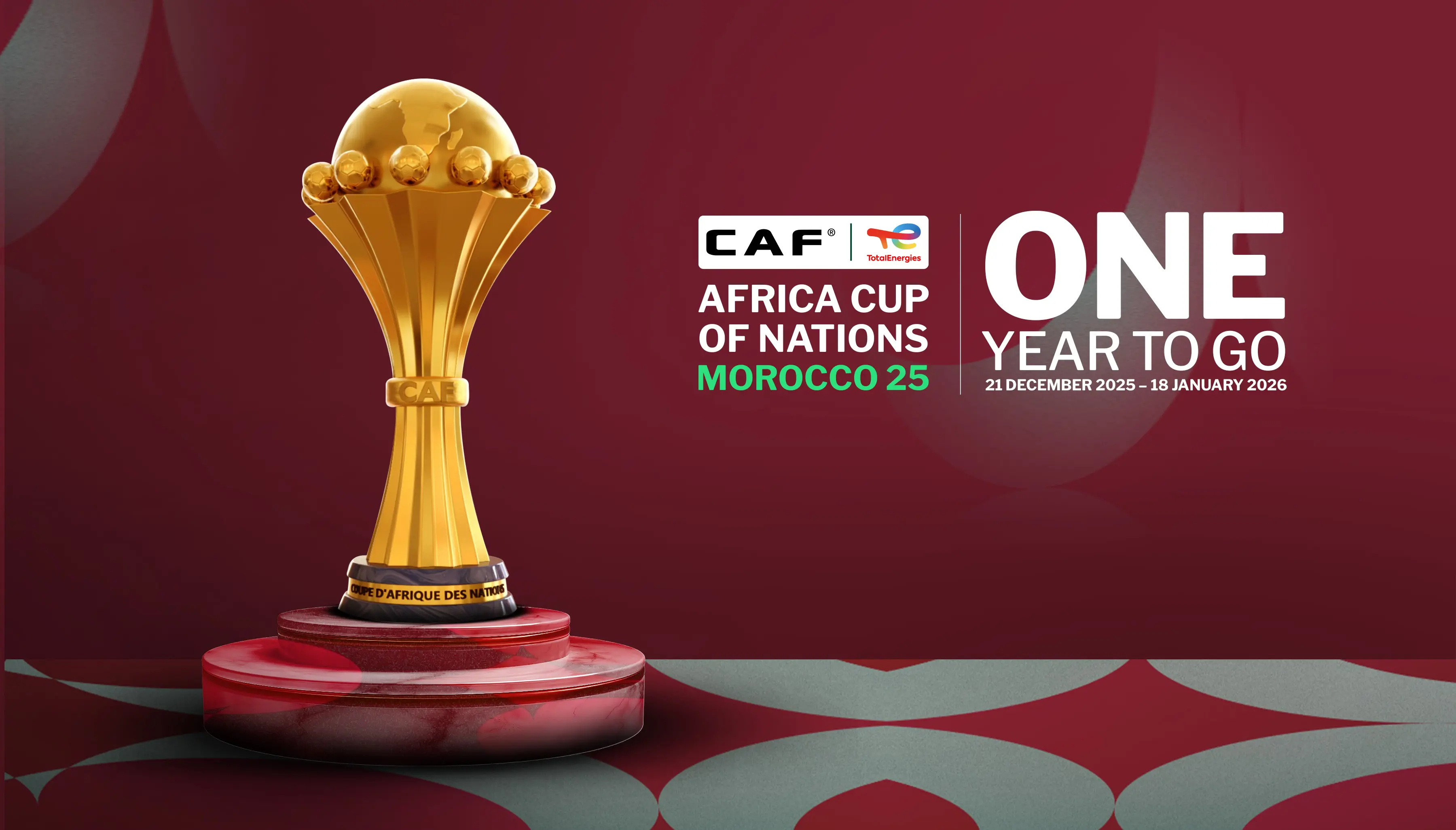
AFCON 2025 will be held from 21 December 2025 to 18 January 2026 and will be hosted entirely in Morocco.

This scheduling is unusual for the tournament, which has a long history of being played either in January–February or, more recently, in June–July. For 2025, CAF and FIFA were forced to navigate a tight, crowded global calendar.

Why is AFCON 2025 in December and January?

Originally, AFCON 2025 was expected to be a summer tournament, but two major factors made that impossible:

  1. Expanded FIFA Club World Cup:
    FIFA’s new 32-team Club World Cup will be played in June and July 2025.
    Running AFCON at the same time would have created impossible conflicts for African players contracted to European and global clubs.

  2. European club season changes:
    The 2025–26 UEFA Champions League will introduce an expanded league phase with extra matchdays in January, putting further pressure on the calendar.

To avoid a direct collision with these competitions, CAF moved AFCON to late December and early January. That timing also reduces the heavy-rain risk that has affected previous editions held mid-season in West and Central Africa.

For players and clubs, the compromise is still challenging. FIFA’s Bureau recently confirmed that clubs are only obliged to release players from 15 December 2025, giving national teams less than a week with full squads before the tournament kicks off.


Where Is AFCON 2025 Being Held?

AFCON 2025 will be held in Morocco, marking the 35th edition of the Africa Cup of Nations and Morocco’s second time as host.

Morocco was officially awarded the hosting rights in September 2023 after Guinea was stripped of the tournament due to slow preparations.

Since then, the country has invested heavily in infrastructure—renovating existing venues, expanding airports and transport links, and upgrading hospitality capacity—not only for AFCON but also in preparation for co-hosting the 2030 FIFA World Cup.


AFCON 2025 Host Cities and Stadiums in Morocco

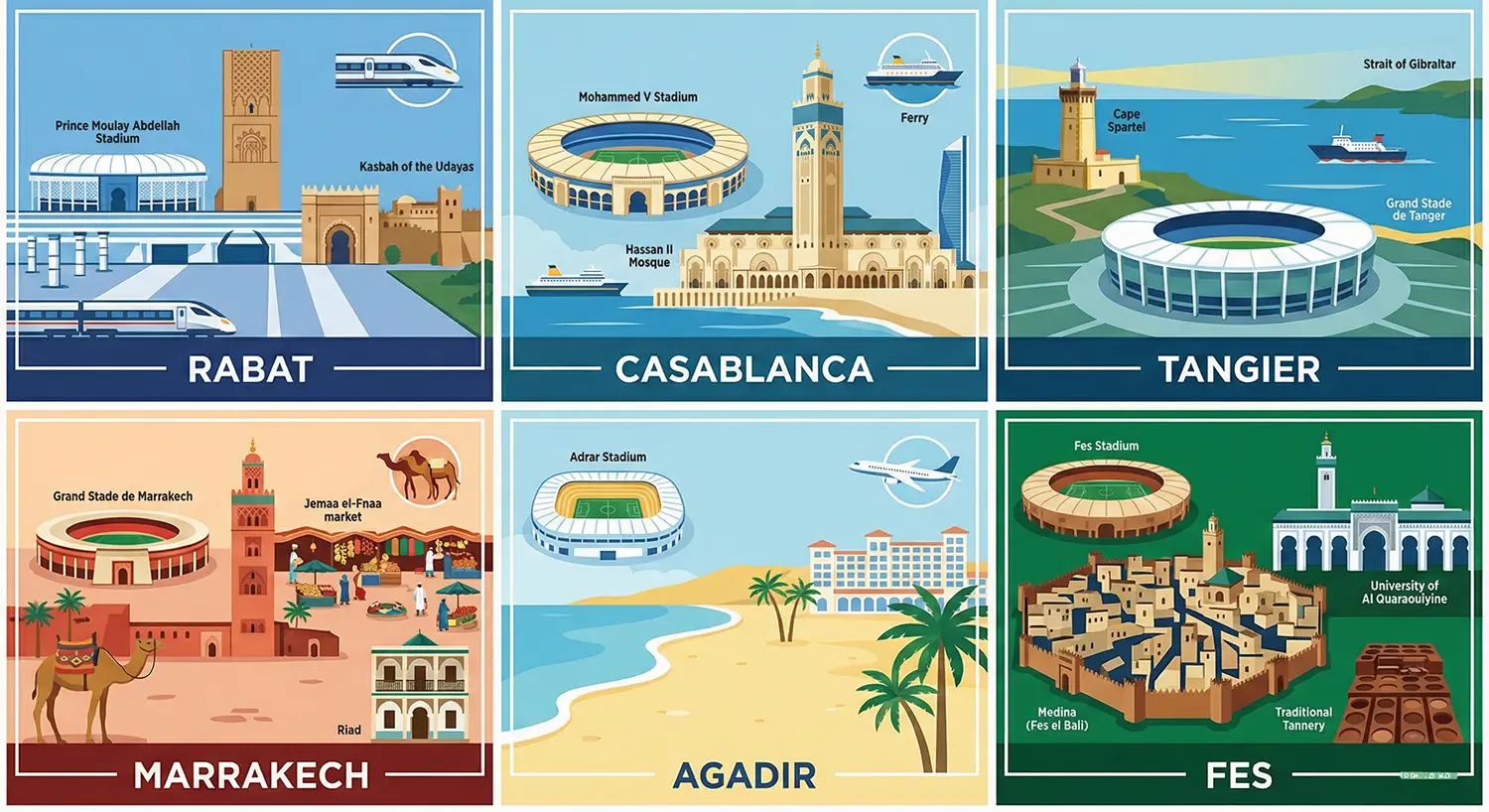
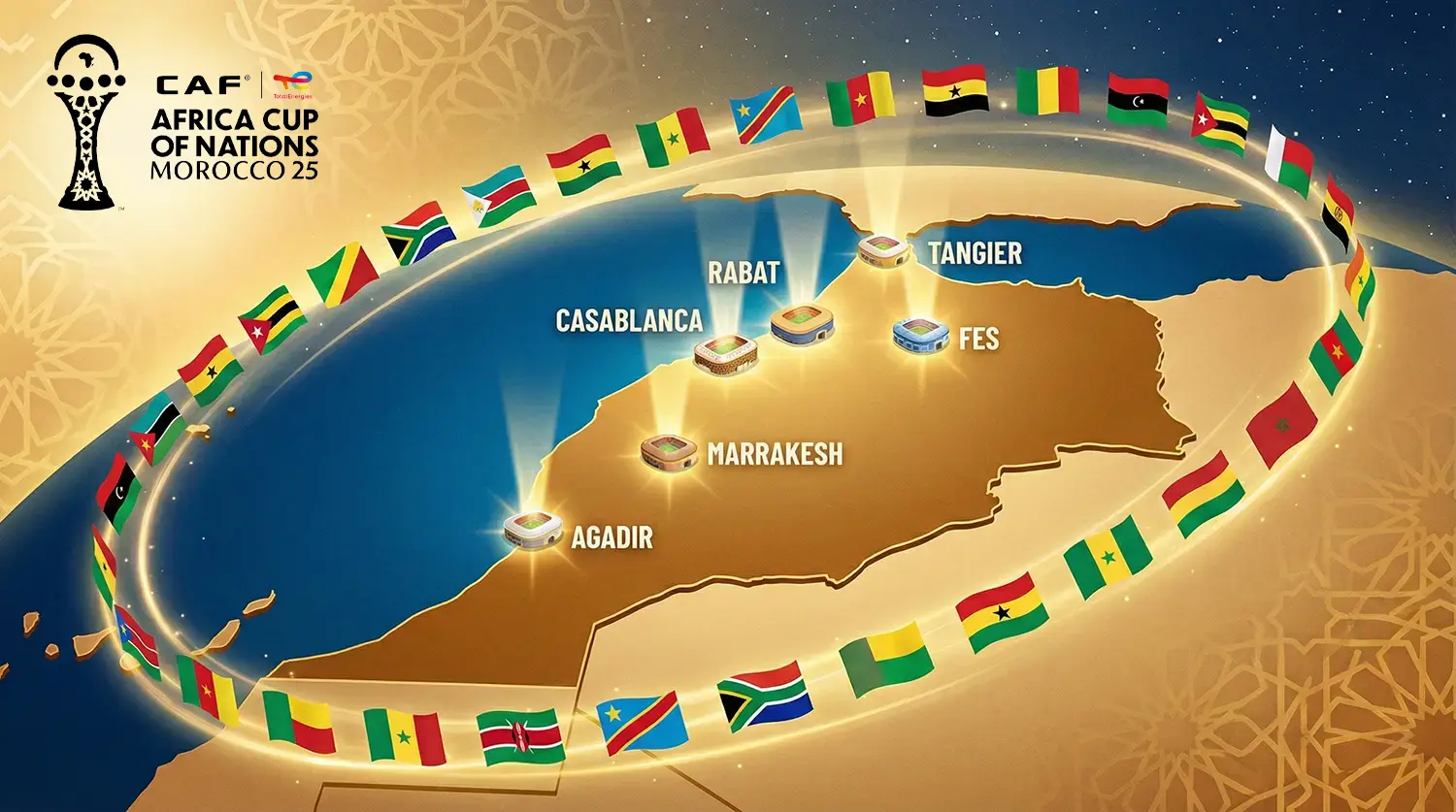
CAF and the Moroccan Local Organising Committee have designated six host cities and nine stadiums for AFCON 2025: Rabat, Casablanca, Tangier, Marrakesh, Agadir and Fes.
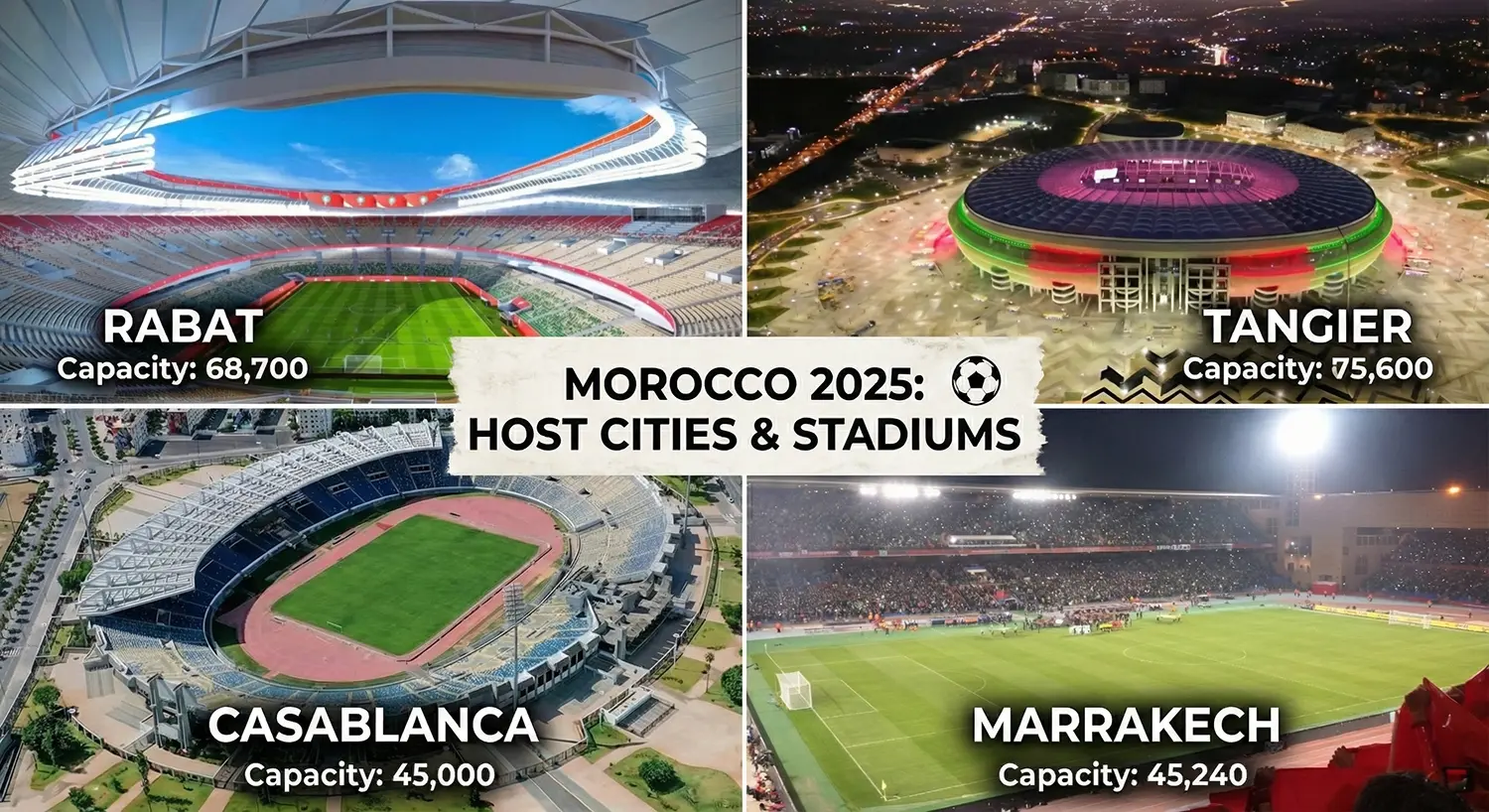
Rabat—Morocco’s capital—will be the main hub of the tournament, hosting the opening match, one semi-final, and the final at the newly redeveloped Complexe Sportif Prince Moulay Abdellah. Tangier’s Ibn Batouta Stadium will host the other semi-final. Casablanca, Marrakesh, Agadir and Fes will host group-stage and knockout fixtures throughout the competition.

AFCON 2025 Host Cities & Stadiums

(capacities are approximate and may vary slightly by source)

Host City Stadium Approx. Capacity Notes
Rabat Complexe Sportif Prince Moulay Abdellah ~69,500 Hosts opening match (Morocco vs Comoros), one semi-final and the final; fully modernised in 2025.(Confédération Africaine de Football)
Rabat Stade Al Barid / annex Olympic venues ~18,000–21,000 Secondary venues for group matches and training.(Confédération Africaine de Football)
Casablanca Stade Mohammed V ~45,000 Historic stadium, used for quarter-finals and key group fixtures.(Vikipedi)
Tangier Grand Stade de Tanger (Ibn Batouta Stadium) ~75,000 Largest stadium of the tournament; hosts one semi-final.(Sofascore)
Marrakesh Grand Stade de Marrakech ~45,000 Major venue in the “Red City”, hosting multiple group games and knockouts.(Confédération Africaine de Football)
Agadir Adrar Stadium ~45,000 Coastal stadium used for group-stage matches.(Afrika Cup 2025)
Fes Fez Stadium / sports complex ~45,000 Hosts several group fixtures, including Group C games.(come to Morocco)

These stadiums have been upgraded with improved seating, hospitality areas, media facilities and pitch technology, as Morocco positions itself not only as AFCON host but as a long-term football hub for Africa and the Mediterranean region.


Tournament Format: How AFCON 2025 Will Work

AFCON 2025 will feature 24 teams, the same expanded format introduced in 2019.

The structure is:

  • Six groups (A to F) of four teams each

  • Single round-robin in the group stage (three matches per team)

  • Top two teams from each group qualify automatically for the Round of 16

  • The four best third-placed teams also progress, creating a 16-team knockout bracket

The total tournament schedule includes 52 matches.

This format balances inclusivity—allowing more mid-tier African nations to qualify—with the intense knockout drama that has made AFCON one of the most unpredictable and entertaining international tournaments.


Which Countries Have Qualified for AFCON 2025?

All 24 spots are now confirmed following qualifiers that ran from March to November 2024.

Morocco, as host nation, qualified automatically but still participated in the qualifiers for competitive match practice.

A striking storyline from this cycle is that Ghana failed to qualify, finishing bottom of their group and missing the Africa Cup of Nations for the first time since 2004.

According to CAF and multiple tournament previews, the 24 qualified teams are:

  • Algeria

  • Angola

  • Benin

  • Botswana

  • Burkina Faso

  • Cameroon

  • Comoros

  • Côte d’Ivoire (Ivory Coast) – defending champions

  • DR Congo

  • Egypt

  • Equatorial Guinea

  • Gabon

  • Morocco (hosts)

  • Mozambique

  • Nigeria

  • Senegal

  • South Africa

  • Sudan

  • Tanzania

  • Tunisia

  • Uganda

  • Zimbabwe

  • Gabon (returning)

  • One more returning side (Benin/Uganda/Botswana context, already listed)

Different sources present the list in slightly different orders, but the key point is clear: every qualified team has previous AFCON experience, making this one of the most competitive fields in recent memory.


AFCON 2025 Groups: Who Plays Where?

The final draw, conducted by CAF in early 2025, produced several heavyweight clashes in the group phase.

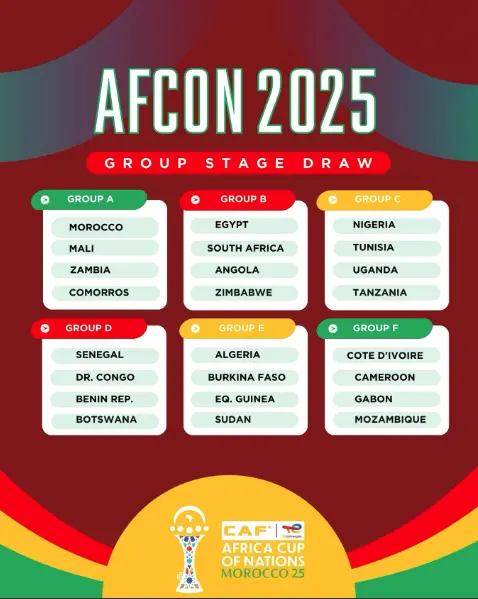
The groups are:

  • Group A: Morocco, Mali, Zambia, Comoros

  • Group B: Egypt, South Africa, Angola, Zimbabwe

  • Group C: Nigeria, Tunisia, Uganda, Tanzania

  • Group D: Senegal, DR Congo, Benin, Botswana

  • Group E: Algeria, Burkina Faso, Equatorial Guinea, Sudan

  • Group F: Côte d’Ivoire, Cameroon, Gabon, Mozambique

Group A immediately stands out: Morocco, as host and one of Africa’s most in-form teams, will face a resurgent Mali and a dangerous Zambia side, plus Comoros, who have developed a reputation as giant-killers in recent cycles. Group C, containing Nigeria and Tunisia, also looks particularly fierce, while Group F recreates a classic heavyweight rivalry between Côte d’Ivoire and Cameroon.


Is AFCON Every 2 or 4 Years?

One of the most common questions around AFCON 2025 is whether the tournament is held every two or every four years.

The Africa Cup of Nations is officially a biennial competition, meaning it is intended to be played every two years.

However, recent editions have seen disruptions and calendar reshuffles due to:

  • Weather conditions in host countries (e.g., 2023 AFCON moved to early 2024 in Ivory Coast)

  • Overlaps with World Cup qualification and expanded club tournaments

  • Logistical and infrastructure challenges in some host nations

AFCON 2025 fits back into the two-year rhythm following the 2023/2024 edition in Ivory Coast, but the December–January timing and the global club calendar will continue to generate debate around how sustainable this schedule is.


Traveling to Morocco for AFCON 2025: What Fans Should Expect

With six host cities spread across Morocco and matches running through the Christmas and New Year period, AFCON 2025 will bring one of the largest waves of football tourism Africa has ever seen. Many fans will move between cities to follow their national team, a pattern that makes travel planning and connectivity crucial.

Morocco has invested heavily in transportation infrastructure ahead of AFCON 2025 and the 2030 World Cup. However, distances between host cities are significant, and travel demand will be unusually high from late December through mid-January.

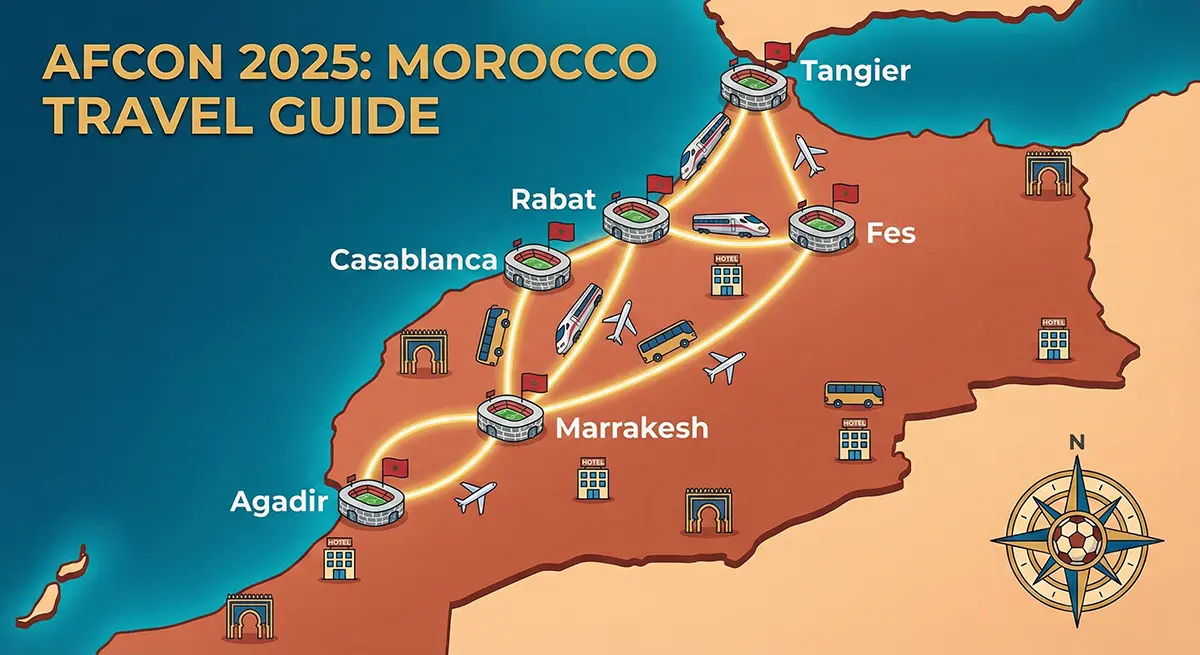
Below is a detailed travel guide covering transportation, accommodation, match-day logistics and essential connectivity tips for anyone attending the tournament.


How to Move Between Host Cities in Morocco

Rail Travel

ONCF (Morocco’s national railway operator) offers modern, efficient train services linking major cities. The Al Boraq high-speed line connects Tangier–Kenitra–Rabat–Casablanca, and will be the backbone of fan movement between northern host cities.

Match clusters suggest that fans following Groups A, B and C will likely spend more time around Rabat and Casablanca, where rail links are strongest. Marrakesh is also connected to Casablanca via a comfortable intercity train service, though travel times may increase during peak tournament periods.

Bus Transport

For reaching Agadir and certain regional towns, long-distance buses such as CTM and Supratours are the most reliable option. These routes are typically modern, air-conditioned and relatively punctual, but fans should book well in advance to avoid full schedules during the tournament.

Domestic Flights

Although not necessary for most fans, internal flights between Tangier, Agadir and Marrakesh can be useful for those with tight schedules or those following knockout fixtures in different corners of the country.


Host City Breakdown: What Each AFCON Venue Offers

Below is a city-by-city guide to help fans understand where they will be based, what to expect on match days and how to navigate each destination.

Rabat – The Tournament Hub

Rabat will stage the opening match, one semi-final and the final. It offers the best balance of accommodation, transport and stadium access. Fans staying here will find it easy to reach Casablanca, Kenitra and Tangier via high-speed rail. The city centre, Oudaias, and the seafront offer a wide range of dining and leisure options.

Casablanca – The Commercial Capital

Casablanca’s Mohammed V Stadium is one of the most historic venues in Africa. The city is likely to host high-profile group games and knockout rounds. Accommodation fills up months in advance for major events, so early booking is essential.

Tangier – The Northern Gateway

Grand Stade de Tanger (Ibn Batouta Stadium) will host one semi-final and several key group games. Tangier is a vibrant port city with easy access to Spain via ferry and excellent rail connections southward.

Marrakesh – The Tourism Heart

Fans travelling to Marrakesh should expect lively markets, heavy tourism and strong hospitality options. The Grand Stade de Marrakech will host group-stage games and several knockout fixtures. Winter weather here is mild and ideal for travel.

Agadir – Coastal and Relaxed

Agadir’s Adrar Stadium will feature group-stage fixtures. The city is known for its beaches and resorts, offering a more relaxed environment compared to Rabat and Marrakesh. However, transport links to other host cities are more limited.

Fes – One of Morocco’s Oldest Imperial Cities

Fes is a cultural center with a unique medina and strong historical appeal. The city’s stadium will stage multiple group matches. Fans staying here will likely rely on trains or domestic flights if moving south to Marrakesh or Agadir.


Accommodation and Match-Day Logistics

Booking Early Is Essential

AFCON overlaps with peak winter tourism season in Morocco, New Year holidays and school breaks in parts of Europe. Hotels in Rabat, Casablanca and Marrakesh are expected to reach high occupancy rates well before December.

Stadium Transport

Fans should account for security zones around stadiums, which may require walking 10–20 minutes from designated drop-off points. Rabat’s newly modernised Complexe Sportif Prince Moulay Abdellah includes vastly improved entry lanes, but match-day queues will still be significant.

Weather in December–January

Morocco’s winter is mild by global standards. Rabat and Casablanca range between 12–18°C, while Marrakesh can be slightly warmer during the day. Nights in Fes and inland regions can be cold. Stadium visits at night will require warm layers.


Connectivity in Morocco During AFCON 2025 (Essential for Travelers)

Although the tournament itself does not directly relate to mobile connectivity, fans travelling to different host cities will quickly realise that having stable internet is essential for navigating transport, booking tickets, accessing match information, coordinating with friends and using messaging or ride-hailing apps.

This is where a travel eSIM becomes critical.

Travelers usually face three options for mobile data:

1. Buying a Local SIM

Morocco’s main operators—Maroc Telecom, Orange and Inwi—offer prepaid SIM options, but buying one requires a physical shop visit and, in many cases, ID registration. During AFCON, long queues are expected in central locations, including train stations and malls. For a broader comparison of all local operators and traveler options, you can read our guide on the which SIM card is best for tourists in Morocco.

2. Roaming with a Foreign SIM

This is typically the most expensive option. Many travelers report unexpectedly high roaming charges when using data-heavy apps such as maps, live messaging or streaming. If you’re considering alternatives, our guide on whether it’s worth getting an eSIM for Morocco explains how roaming compares to local and travel eSIM options in detail.

3. Using a Travel eSIM

A travel eSIM is the most convenient option for AFCON visitors because it works instantly, avoids identification requirements and allows travelers to activate data before they even land in Morocco.

This is why many fans look for Morocco eSIM plans from Roafly, which offer competitive pricing and work seamlessly on Morocco’s strongest networks.

Roafly provides a range of data packages that are ideal for multi-city travel during the tournament, with long validity periods and fast speeds suitable for navigation, WhatsApp, booking platforms and stadium-area congestion.

For travelers who want a deeper breakdown of pricing, networks and coverage, you can also read our guide to the best eSIM for Morocco, which compares all major providers in detail.


Recommended Data Amounts for AFCON Fans

Different types of fans will need different data amounts:

  • 1–3 GB: Sufficient for travelers staying primarily in one city and using maps + messaging.

  • 5–10 GB: Suitable for fans moving between Rabat, Casablanca and Marrakesh.

  • 20 GB or more: Ideal for content creators, remote workers or fans staying for the entire month.

The extended 30-day validity on Roafly’s Morocco plans is particularly helpful for those attending both group-stage and knockout rounds.


How to Use Mobile Apps During AFCON 2025

Transport

  • ONCF app for train schedules

  • Careem and Roby for ride-hailing in major cities

  • CTM and Supratours booking platforms for intercity buses

Stadium Information

  • CAF’s official app (updated fixtures and stadium guidelines)

  • Morocco 2030 infrastructure updates (selected venues include new digital turnstile systems)

Travel Essentials

  • Google Maps / Maps.me for offline navigation

  • WhatsApp for group coordination

  • Hotel booking apps for last-minute changes

Stable internet makes all of this significantly easier—especially for fans navigating unfamiliar cities on match days.


Safety & Travel Tips for AFCON 2025 Visitors

Stay near main transport corridors

Rabat, Casablanca and Marrakesh have reliable rail and taxi systems. Fans staying close to these corridors will avoid the largest match-day bottlenecks.

Buy tickets only from verified platforms

CAF has warned of counterfeit tickets circulating online for previous tournaments. Fans should use official channels only.

Expect heavy security

Morocco is known for well-organised events, but AFCON will increase police presence around stadiums, medinas and transport hubs. Plan extra time for checks.

Keep devices charged

With heavy photo/video use during match days, bring a power bank for extended connectivity.


Final Thoughts: AFCON 2025 Will Be One of the Most Dynamic Editions in Years

With 24 strong teams, six vibrant host cities and a unique winter schedule, AFCON 2025 will offer an unforgettable experience for fans across Africa and beyond. Morocco’s modern stadiums, transport upgrades and hospitality industry make it well equipped to host the continent’s biggest football celebration.

For travelers, reliable connectivity is as essential as tickets and accommodation—whether for navigating Morocco’s cities or simply sharing the experience with friends back home. This is why many visitors choose Morocco eSIM plans, the most efficient, cost-effective solution for staying connected during the tournament.
Download the App and manage your eSIMs easily

Download on the

App Store

GET IN ON

Google Play

Roafly esim
  • Create your order quickly
  • See your eSIM details
  • Track your remaining data
Roafly logo
App Store Google Play
symantec
apple pay
amex
visa
mastercard
diners club

Popular Countries

Learn more

About usContactHelp CenterFAQCompatible DeviceseSIM SetupBlogTrip Data EstimatorDownload app

Copyright © 2024 Roafly. All rights reserved.

Privacy PolicyTerms and ConditionsRefund Policy
Need data in Morocco? Get an eSIM!
5 GB30 Days
$12.90
10 GB30 Days
$19.90
20 GB30 Days
$29.90
See all data plans
Need data in Morocco? Get an eSIM!
5 GB30 Days
$12.90
10 GB30 Days
$19.90
20 GB30 Days
$29.90
See all data plans