

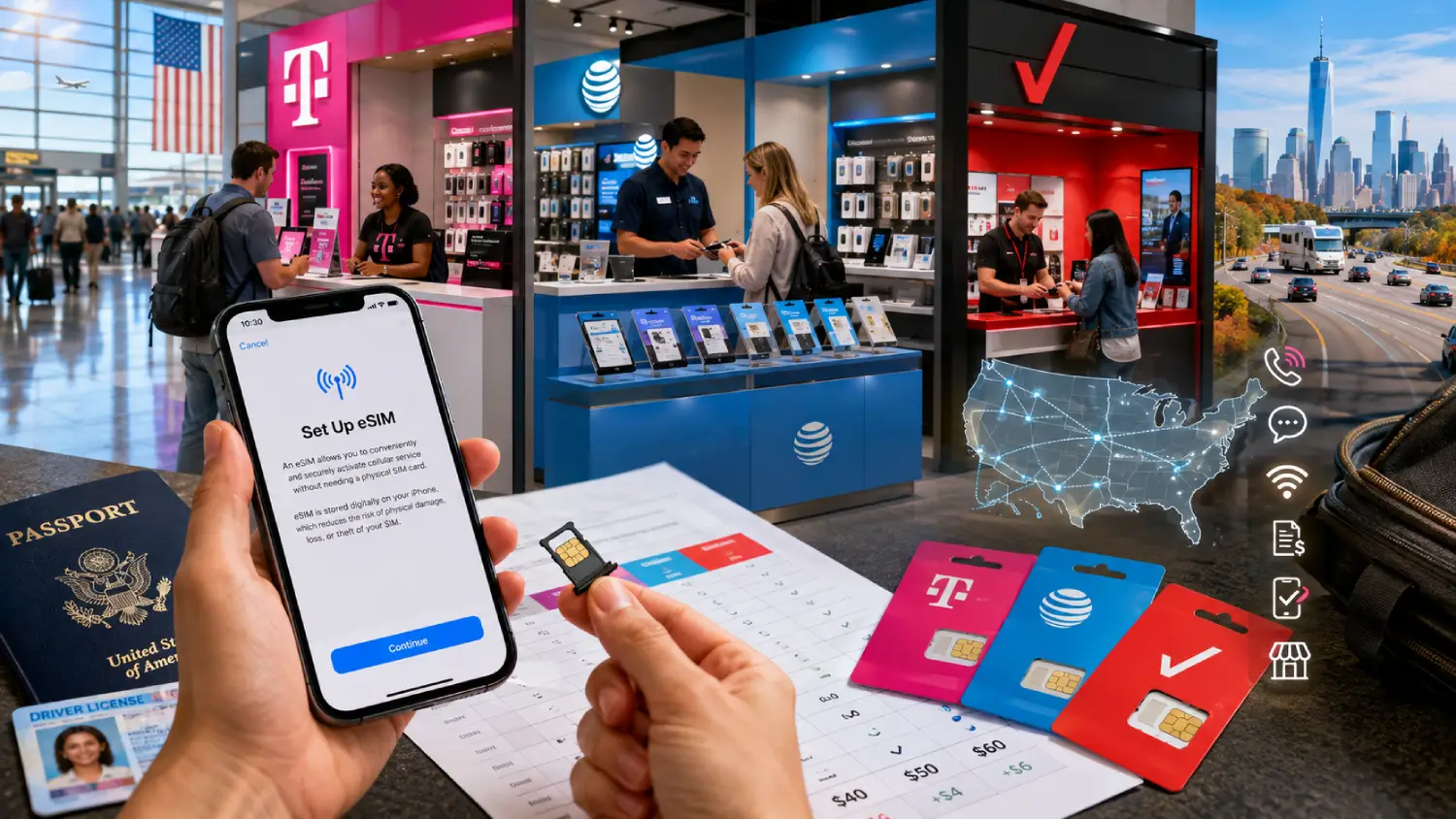

Buying a local prepaid SIM in the United States is possible without signing a long-term mobile contract. T-Mobile, AT&T and Verizon all have prepaid options that can work for visitors using an unlocked, compatible phone.
Price comparisons need more care than simply looking at the monthly plan rate. SIM charges, activation fees, AutoPay conditions, operator fees and location-dependent taxes can all affect what you actually pay.
| Operator / Option | Plan | Data & Validity | Total Upfront Price | Key Difference |
|---|---|---|---|---|
| T-Mobile Connect | $15 prepaid | 5GB / 30 days | From $15 + taxes/fees; SIM kit may add cost | Unlimited talk/text |
| AT&T Prepaid | $25 unlimited | 30GB at max 3Mbps, then max 1.5Mbps / monthly | $25 + $2.63 AT&T fee + applicable taxes/other fees | Online-only offer |
| Verizon Prepaid | 15GB | 15GB / first month | $45 + applicable taxes/fees | Hotspot uses plan allowance |
| Roafly eSIM | 10GB | 10GB / 30 days | $16.90 | Data-only; Verizon + AT&T listed |
| Roafly eSIM | 20GB | 20GB / 30 days | $24.00 | Data-only; Verizon + AT&T listed |
Prices and terms checked on August 19, 2026. Operator offers, taxes, SIM charges, activation fees and other purchase conditions may change.
Visitors who mainly need mobile data can check current USA eSIM plans before departure instead of arranging a physical prepaid SIM after arrival.
Need data in United States? Get an eSIM!
Choose the perfect data plan for your trip
Exclusive Reader Bonus!
Enjoy an extra %10 OFF your first Roafly eSIM purchase as a thank you for reading.

Manage your eSIM in the app
Install, top up and track data.
Can tourists buy a prepaid SIM card in the USA?
Yes. The major U.S. carriers sell prepaid service without requiring an annual mobile contract, and the plans compared here are not presented as resident-only postpaid subscriptions.
Tourist access still depends on the purchase route. Your phone needs to be unlocked and compatible, while payment method and any information requested during checkout can determine whether activation is straightforward.
T-Mobile Connect is open to new and existing prepaid customers. AT&T Prepaid promotes service without an annual contract or credit check, while Verizon provides prepaid BYOD routes for customers bringing their own compatible devices.
Passport requirements are less clear-cut than many generic travel guides suggest. Current operator purchase pages reviewed for this guide do not state that every prepaid customer nationwide must register using a passport.
The FCC was still considering stronger prepaid customer-verification requirements in 2026 rather than describing them as a universal rule already in force. Visitors who want the regulatory detail can review the FCC’s April 2026 customer-verification notice.
Bringing a passport or another government-issued photo ID is still sensible when visiting a carrier shop. Store staff may request identification or account details during activation even when no nationwide tourist passport rule applies.
Best USA prepaid SIM options for tourists
T-Mobile Connect: low monthly entry price
T-Mobile Connect works best when your data use is fairly light and a U.S. number with domestic talk and text matters.
The $15 Connect plan currently includes 5GB of smartphone data over a 30-day prepaid service period. Unlimited domestic talk and text are included.
Key purchase details include:
-
5GB of smartphone data
-
Unlimited domestic talk and text
-
30-day service period
-
No annual contract
-
Tethering from the included data allowance
-
Online activation fee listed as $0
-
In-store activation/change fee listed as $10 for the benchmark plan
Current details are available on the official T-Mobile Connect page.
Physical-SIM costs need separate attention. T-Mobile prepaid terms indicate that a SIM starter kit may be required on some transactions, so the $15 plan price should not automatically be treated as the complete physical-SIM purchase total.
The data allowance is also firm rather than unlimited at reduced speed. Heavy streaming or constant hotspot use can therefore make the 5GB plan less suitable than its low headline price suggests.
AT&T Prepaid: more data, but with speed limits
AT&T’s current $25 prepaid offer takes a different approach. Service is described as unlimited, but the first 30GB each month runs at a maximum speed of 3Mbps, followed by a maximum of 1.5Mbps.
Unlimited talk and text are included, making the plan more relevant to visitors who want a local U.S. number rather than data-only service.
The main conditions are:
-
$25 advertised plan price
-
New single-line customers
-
Online-only purchase
-
30GB at a maximum of 3Mbps
-
Maximum 1.5Mbps after 30GB
-
Unlimited talk and text
-
Taxes and fees charged separately
-
No annual contract or credit check
AT&T currently lists a $2.63 Administrative & Regulatory Cost Recovery Fee per prepaid service payment. Other applicable charges and government taxes can also affect the final amount, so the first payment should not be reduced to a fixed $27.63 nationwide total.
The safest comparison is therefore the structure rather than a falsely precise checkout figure: $25 plan price, the published AT&T service-payment fee, then any other applicable taxes or charges.
Current plan conditions can be checked on the official AT&T Prepaid plans page.
Verizon Prepaid: higher first month with clearer BYOD terms
Verizon’s 15GB prepaid plan has a higher first-month price than the other local benchmarks in this comparison.
The first month is currently $45. The price drops to $35 per month with Auto Pay after the first month, which makes the discounted rate less useful when comparing a short tourist stay.
Included features cover:
-
15GB of plan data
-
Unlimited talk and text
-
Mobile hotspot use from the plan allowance
-
$45 first-month plan price
-
$35 monthly price with Auto Pay after the first month
-
No annual contract
-
Additional taxes and fees where applicable
Verizon’s physical-SIM terms are comparatively easy to understand through its BYOD process. The carrier says it can ship a physical SIM at no charge when is needed, while activation through the eligible BYOD route does not add the usual activation fee.
Shipping a physical SIM still requires a U.S. delivery address. Device compatibility also needs to be confirmed before activation.
Visitors considering this route can review the official Verizon prepaid BYOD page.
What will you actually pay for a USA SIM?
Monthly plan prices are part of the purchase.
Several cost components can affect the first payment:
-
Plan price: the prepaid service amount shown in the offer.
-
Physical SIM or starter kit: free on some purchase routes and separately charged on others.
-
Activation or service charge: sometimes different and in-store.
-
Mandatory first payment: usually due when service starts.
-
AutoPay condition: a discounted monthly rate may begin after the first month.
-
Operator fees: separate administrative or service-related charges may apply.
-
Government taxes: amounts can vary by state and locality.
T-Mobile illustrates why this distinction matters. The Connect plan can begin with a low advertised service price, yet a physical-SIM purchase or in-store activation may increase the initial amount.
AT&T creates a different situation. Its offer avoids treating activation as a large standalone charge, but the carrier’s published prepaid fee and applicable taxes still sit outside the basic $25 plan price.
Verizon’s pricing creates the opposite problem. Search results may emphasize the lower recurring AutoPay figure, while a short-term customer starts at the higher first-month price.
Checking the final payment screen before completing an order is more reliable than assuming national total for every buyer.
Where can you buy a prepaid SIM in the USA?
Purchase channels vary between carriers, and the cheapest-looking plan is not always offered through every store.
T-Mobile
-
Prepaid and Connect plans can be started.
-
Physical prepaid SIM kits are available through T-Mobile sales channels.
-
Retail stores can assist with activation.
-
In-store activation may cost more than activation for the Connect benchmark.
AT&T
-
The $25 benchmark used in this guide is an-only offer.
-
Physical prepaid SIMs are available through AT&T’s prepaid purchase routes.
-
Retail stores sell prepaid service, but an-exclusive price should not be assumed to apply at the counter.
Verizon
-
Physical prepaid SIMs can be ordered through the BYOD process for delivery within the United States.
-
Verizon stores can assist customers who prefer an in-person purchase.
-
Compatible phones may also qualify for Verizon’s own prepaid eSIM setup.
Airport availability is much harder to generalize. kiosk, electronics retailer or terminal seller cannot establish a nationwide U.S. airport SIM price.
Stock may also change without notice. Visitors depending on a physical SIM shortly after arrival should identify an official store or confirmed purchase route rather than assuming every airport will have the same operator inventory.
Registration, activation and payment
Preparation before purchase can prevent many activation problems.
Use this sequence:
-
Confirm the phone is unlocked. Carrier-locked devices may fail the BYOD process.
-
Run the operator’s IMEI compatibility check. Model name alone is not enough to guarantee support.
-
Choose physical SIM or operator eSIM. Availability depends on the carrier and device.
-
Check the complete first payment. Look beyond the recurring monthly figure.
-
Review requested account details. ZIP code, billing information or delivery details may be required depending on the purchase route.
-
Confirm payment support. Do not assume every foreign-issued card will work through every U.S. prepaid checkout.
Foreign-card acceptance is especially difficult to generalize because the operator pages reviewed do not promise that every overseas card will be accepted in every sales channel.
Activation timing should also be treated cautiously. Carrier pages can describe the activation method without guaranteeing an exact number of minutes for every customer or device.
Local SIM or Roafly eSIM?
Local prepaid service has a clear advantage when you need a U.S. mobile number, native calls or standard SMS. The T-Mobile, AT&T and Verizon benchmark plans above include voice and text service, while Roafly’s USA product is data-only.
Roafly solves a different travel problem. Setup can be completed before travel on a compatible eSIM phone, so there is no physical SIM swap and no dependence on local store stock or opening hours.
Keeping your primary SIM in the device can also help when you still need access to your usual number. Hotspot and tethering are supported across the purchased Roafly data allowance without a separate hotspot quota.
Roafly lists Verizon and AT&T for its USA product. That network listing should not be interpreted as a promise of automatic switching, guaranteed coverage, 5G access, network priority or a particular speed.
Roafly also covers 200+ destinations, which can be useful when the United States is stop in a wider itinerary.
Readers who want a broader comparison of travel-eSIM choices rather than local prepaid service can use our eSIM options for the USA guide.
Coverage and roaming: check the exact plan
Network performance varies across a country as large as the United States. Cities, highways, rural areas and indoor locations can produce different results, so operator maps are more useful than declaring carrier universally best.
Plan terms matter just as much when leaving the country. Roaming, Canada or Mexico usage should never be inferred from a domestic data allowance unless the exact prepaid plan explicitly includes it.
T-Mobile Connect, AT&T Prepaid and Verizon Prepaid can also differ from other plans sold by the same carrier. Checking the conditions attached to the exact offer is safer than applying carrier-wide roaming rule to every prepaid product.
Broader connectivity choices, including WiFi, roaming and eSIM, are covered separately in our ways to get internet in the USA guide.
Which option fits your trip?
Choose T-Mobile Connect when:
Data use is relatively light, a U.S. number matters and keeping the basic monthly plan cost low is the priority.
Choose AT&T Prepaid when:
More data matters than maximum speed, purchase works for your situation and the 3Mbps cap is acceptable for the trip.
Choose Verizon Prepaid when:
You want 15GB, native calls and texts, hotspot use from the same plan allowance and a clearly documented prepaid BYOD route, while accepting the higher first-month price.
Choose Roafly when:
Mobile data matters more than having a U.S. number and avoiding a physical SIM purchase, local shop visit and SIM swap is more valuable than native voice service.
Longer stays can change the calculation. AutoPay discounts, larger local allowances and the usefulness of a U.S. number become more important service continues beyond the first prepaid cycle.
FAQ
Do I need a passport to buy a SIM card in the USA?
Current operator purchase pages reviewed for this guide do not state that every prepaid customer nationwide must register with a passport.
Store staff may still request government-issued identification or other account details. Regulatory proposals under discussion in 2026 also mean identification rules deserve another check if you are reading this guide later.
Can I use a European or other foreign phone?
Usually, the exact device matters more than the country where it was purchased. The phone needs to be unlocked and compatible with the chosen operator.
Running the carrier’s IMEI checker before paying is the safest approach.
Does a U.S. prepaid SIM include calls and texts?
The three local benchmark plans in this guide include talk and text.
Roafly’s USA product is data-only, so internet-based calling and messaging apps use the purchased data allowance rather than native mobile voice service.
Can I buy the SIM before arriving in the USA?
Some physical-SIM routes allow advance ordering when you have a suitable U.S. delivery address.
Operator eSIM rules are different and should be checked separately because eligibility, payment and location requirements can change between carriers.
Is an airport SIM cheaper or more expensive?
No reliable nationwide answer exists.
Airport sellers, stock and prices vary by location, so airport observation should not be treated as the standard U.S. prepaid SIM price.
Final recommendation
Short visits do not have universal winner. T-Mobile Connect suits lighter data use and customers who want a local number, AT&T gives substantially more data under a speed-limited structure, and Verizon offers clear BYOD terms with a higher first-month price.
Roafly makes more sense when the main goal is mobile data without buying or swapping a physical SIM. Local prepaid service remains the stronger fit when a U.S. number, native calls and texts, or longer-term service matter more.
Roafly publishes this guide and offers the travel-eSIM alternative discussed above.