

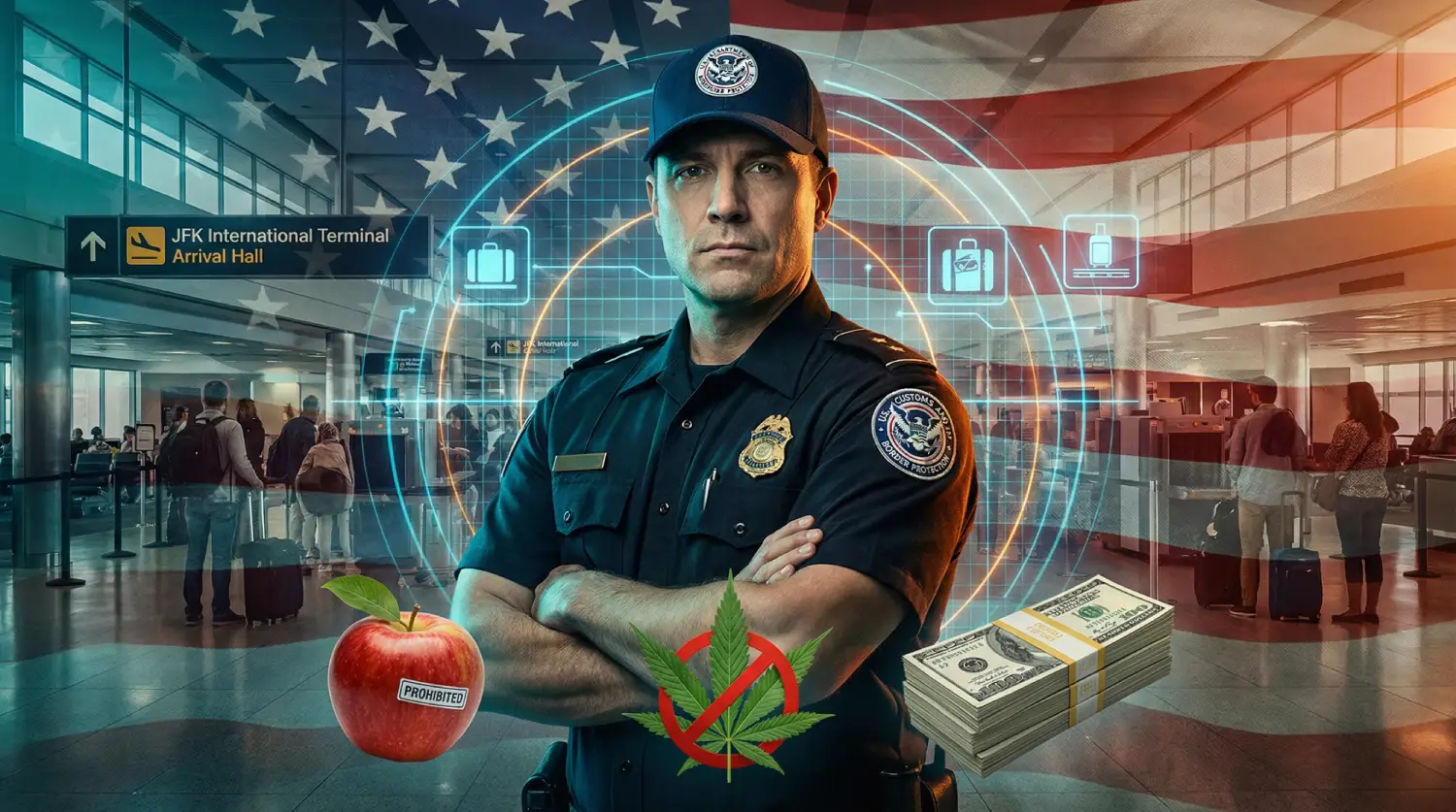

Many travelers make the mistake of assuming US laws are uniform. They are not. You are walking a fine line between Federal Law (which governs the airport) and State Law (which governs the city you are visiting). Understanding this distinction is the difference between a smooth vacation and a deportation order.
This guide covers everything from the "Marijuana Paradox" in California to the strict agricultural blockades of Hawaii.
The "Federal Jurisdiction" Reality
Before we discuss what is in your suitcase, you must understand where you are standing. When you land at JFK (New York), LAX (Los Angeles), or MIA (Miami), you are not yet "in" that state. You are in a Federal Zone.
The Marijuana Paradox
This is the number trap for tourists in 2026.
-
The Scenario: You are flying into Los Angeles or New York. You know that recreational cannabis is legal in these states.
-
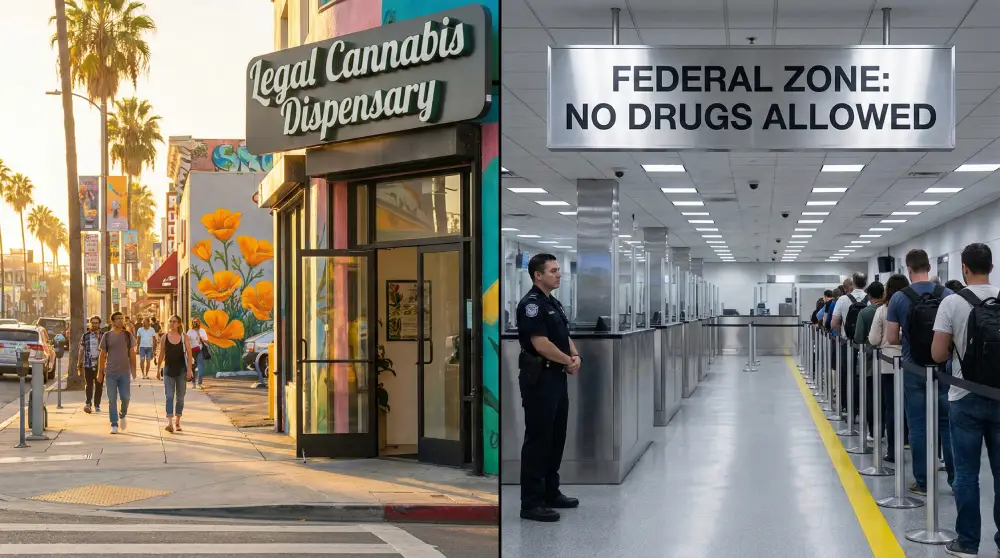
The Trap: The airport falls under Federal Jurisdiction, where marijuana remains classified as a Schedule I controlled substance (same category as heroin).
-
The Rule: Bringing cannabis INTO the US is an international drug trafficking offense. It does not matter if you have a prescription from your home country or if you are going to a weed-friendly state. Zero Tolerance.
Strict Warning: Do not carry any paraphernalia (grinders, pipes) with residue. CBP dogs are trained to detect this, and "it's legal in LA" is not a valid defense at the federal border.
The Arrival Process & Digital Screening
The US has moved away from paper forms for most travelers, but the scrutiny has increased.
1. APC Kiosks & Facial Recognition
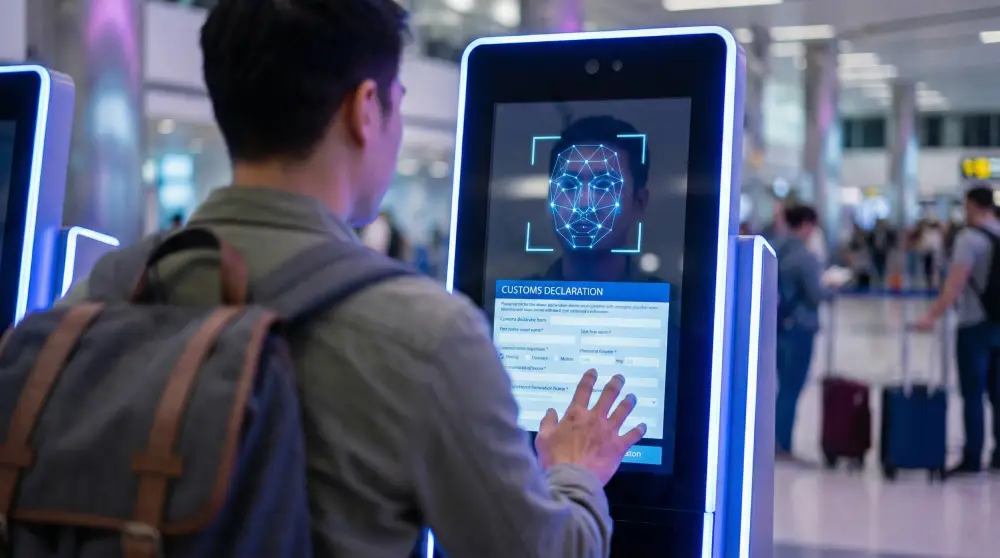
Most international airports now use Automated Passport Control (APC) kiosks. You will scan your passport, take a photo, and answer the customs declaration questions digitally.
-
Biometric Data: The US takes a photo of every arriving passenger. If you have overstayed a visa in the past, this system will flag you immediately.
2. The "Secondary Screening" & Phone Searches
If an officer marks "SSSS" on your boarding pass or directs you to a separate room, you are in Secondary Screening.
-
Digital Privacy: Under current border search exceptions, CBP officers can demand you unlock your phone and laptop. They can search your text messages, social media, and photos for evidence of illegal work intent or prohibited items.
-
Advice: Ensure your devices are charged. A dead battery can be viewed as "suspicious" and lead to device confiscation for forensic analysis.
Customs Limits & Allowances (The "Duty-Free" Rules)
You are allowed to bring items for personal use, but the limits are strict.
The $10,000 Cash Trap (Structuring)
This is where families often lose their life savings.
-
The Law: You can bring $100,000 if you want. It is legal. But you MUST declare any amount over $10,000 on FinCEN Form 105.
-
The Crime: If a family of three splits $25,000 so that no single person has $10,000, this is called "Structuring." It is a federal crime. The money will be seized, and you may never get it back.
The "Bio-Security" Wall (Food & Agriculture)
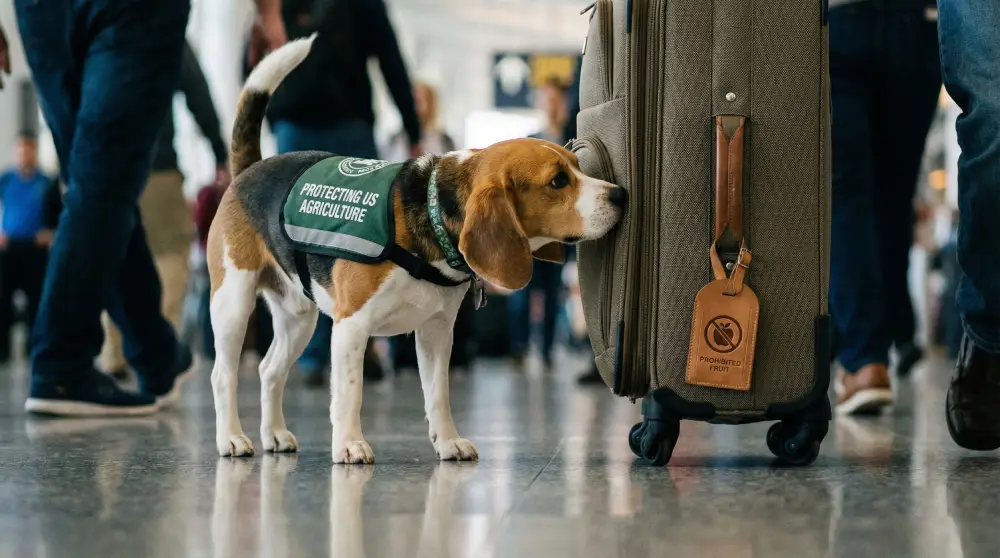
The USDA (Department of Agriculture) works alongside Customs. They use the famous "Beagle Brigade"—cute dogs that can smell an apple at the bottom of a sealed suitcase.
Why is it so strict? The US agriculture industry is worth trillions. A single orange carrying the Mediterranean Fruit Fly or a sausage carrying Foot and Mouth Disease could devastate the economy.
The "Red List" (Strictly Banned):
-
Meat: Fresh, dried, canned, cured, or cooked. Just assume NO MEAT.
-
Fruit & Veg: Fresh produce is almost always banned.
-
Seeds: Even if packaged.
-
Kinder Surprise Eggs: Banned by the FDA/CPSC due to the "non-nutritive object" (toy) inside posing a choking hazard. Fines can reach $2,500 per egg.
For the official, searchable database of allowed food items, refer to the USDA Animal and Plant Health Inspection Service: USDA Traveler Information.
State-Specific Nuances & Connecting Flights
This section is critical if you are not staying in your arrival city.
1. The "Luggage Re-Check" Rule
Unlike in Europe, in the USA, you must collect your bags at your first point of entry.
-
Example: You fly London -> New York -> Los Angeles.
-
Process: You land in NY. You pass immigration. You pick up your suitcase. You walk through Customs. You drop your bag back off at the "Connecting Flights" belt.
-
The Risk: If you bought Duty-Free liquids (over 100ml) in London, you must put them in your checked luggage before re-dropping it. If you carry them through security in NY for your LA flight, they will be confiscated.
2. State-Specific Traps
California (LAX, SFO, SAN)
-
Agriculture: California acts almost like a separate country regarding plants. They have strict "Ag Checkpoints" on highways, but at the airport, federal rules apply. However, be aware that bringing certain fruits from other states into CA is also restricted.
-
Connectivity: LAX is notorious for poor public Wi-Fi in certain terminals.
Hawaii (HNL, KOA)
-
The "Second Border": Hawaii has the strictest eco-laws in the US.
-
Form Required: You must fill out a separate State of Hawaii Agricultural Declaration Form.
-
Strict Bans: Snakes, certain dog breeds, and almost all plants are heavily policed to protect the island ecosystem.
New York (JFK, EWR)
-
Weapons: NY laws on knives and pepper spray are incredibly strict. A small pocket knife that is legal in Texas might be illegal to possess in NYC. If Customs finds it, and you are entering NYC, you could face local charges.
Connectivity – The Key to a Smooth Entry
In 2026, entering the USA is a digital experience. You need internet access before you leave the airport for three critical reasons:
-
Mobile Passport Control (MPC): This official CBP app allows you to submit your customs declaration via your phone and skip the long paper-form lines. It requires data.
-
Ride-Sharing: Uber and Lyft are the primary ways to leave US airports. You cannot book them without data.
-
Maps & Translation: If you are pulled into secondary screening, having a translation app ready can help clear up misunderstandings quickly.
Do not rely on "Free Airport Wi-Fi," which is often insecure and spotty in arrival halls.
-
Comparison Guide: To understand the difference between local SIMs and eSIMs, read our detailed analysis: Best eSIM for USA: Prices, Coverage & Real Comparison
-
Setup Guide: If you are unsure how to activate an eSIM on your iPhone or Android, check our step-by-step utility guide: How to Get Mobile Internet in the USA: eSIM, SIM Card and Roaming Guide for Travelers
The Smart Traveler Move: Install your USA eSIM before you board your flight. When you land at JFK or LAX, you will have instant connection while others are struggling to find Wi-Fi passwords.
Need data in United States? Get an eSIM!
Choose the perfect data plan for your trip

Manage your eSIM in the app
Install, top up and track data.
Fines, Penalties & The "Blacklist"
What happens if you break the rules?
-
The Spot Fine: Failing to declare a prohibited food item usually results in a $300 to $1,000 fine. You must pay this immediately.
-
Visa Revocation: If you lie to a CBP officer, your Visa (or ESTA) can be cancelled on the spot. You will be sent back home on the next flight and banned from the US for 5-10 years.
-
Global Entry Loss: If you are a trusted traveler, one single violation (even an accidental apple) will permanently disqualify you from Global Entry and TSA PreCheck.
Summary Checklist for US Entry
-
Visa/ESTA: Ensure it is valid and printed (just in case).
-
The $10k Rule: Count your family's total cash. If >$10k, file Form 105.
-
Food Purge: Eat or discard all fruits, meats, and sandwiches on the plane.
-
Meds: Keep prescriptions in English and in original bottles.
-
Digital Prep: Download the "Mobile Passport" app and activate your Roafly eSIM.
-
Re-Check Bags: If connecting, remember you must pick up your luggage at the first US airport.
Travel Planning Tips 🇺🇸
Now that you have navigated the complex maze of US Customs, the real adventure begins. The United States is vast, and the East Coast vibe is entirely different from the West Coast.
-
City Showdown: Are you unsure whether to visit the glamour of Hollywood or the streets of Manhattan? We compared costs, vibe, and transit in our guide: NYC vs. Los Angeles: Which City is Better for Tourists? (2026 Guide)
Disclaimer: Information is based on current US Federal Regulations (CBP/USDA) but is subject to change. Always verify with official government sources linked in the article.