

'/%3e%3c/g%3e%3cuse xlink:href='%23d' x='45.714'/%3e%3cuse xlink:href='%23e' transform='matrix(-1 0 0 1 479.792 0)'/%3e%3cg id='f' fill='%23fff'%3e%3cpath fill='%23039' d='M232.636 202.406v.005c0 2.212.85 4.227 2.212 5.69 1.365 1.466 3.245 2.377 5.302 2.377 2.067 0 3.944-.905 5.303-2.365 1.358-1.459 2.202-3.472 2.202-5.693v-10.768l-14.992-.013-.028 10.766'/%3e%3ccircle cx='236.074' cy='195.735' r='1.486'/%3e%3ccircle cx='244.392' cy='195.742' r='1.486'/%3e%3ccircle cx='240.225' cy='199.735' r='1.486'/%3e%3ccircle cx='236.074' cy='203.916' r='1.486'/%3e%3ccircle cx='244.383' cy='203.905' r='1.486'/%3e%3c/g%3e%3cuse xlink:href='%23f' y='-26.016'/%3e%3cuse xlink:href='%23f' x='-20.799'/%3e%3cuse xlink:href='%23f' x='20.745'/%3e%3cuse xlink:href='%23f' y='25.784'/%3e%3c/svg%3e)
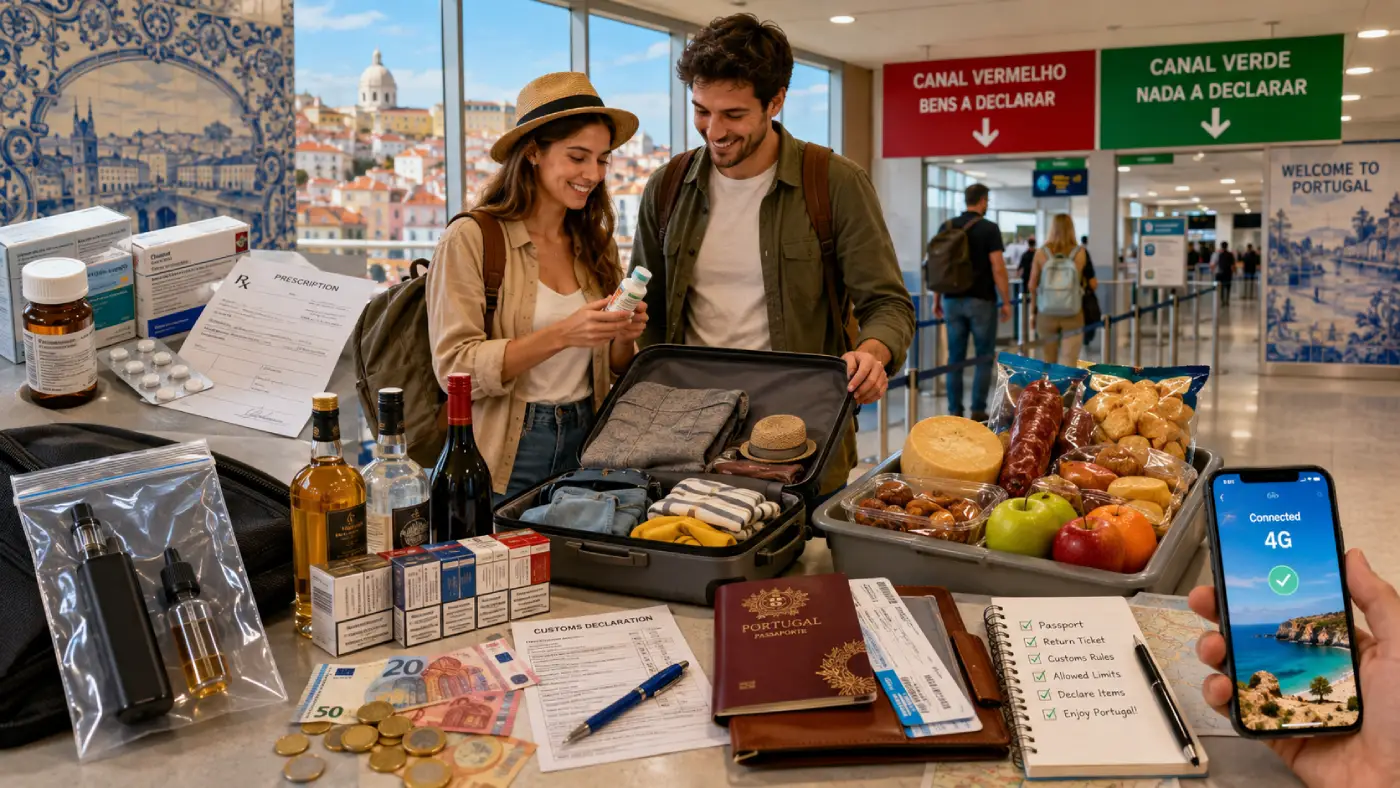
What you can bring into Portugal at a glance
| Item | Current rule | Best action |
|---|---|---|
| Other goods | Non-EU air/sea: €430 duty/tax-free value | Keep receipts |
| Food | Non-EU meat and dairy generally prohibited | Check product and origin |
| Medicines | Personal needs; prescription required | Carry medical documents |
| Alcohol & tobacco | Allowances depend on origin; non-EU exemption is 17+ | Check quantities |
| Vapes & nicotine | 30 ml e-liquid; 20 g heated tobacco/pouches | Stay within exemption |
| Cash | €10,000+ entering/leaving EU: declare | File the declaration |
The key distinction is not simply “EU versus non-EU country.” Customs, VAT and excise territories do not always have identical geographic coverage. Most travelers arriving from the ordinary EU VAT and excise territory face different rules from those entering from a third country, but some EU territories fall outside those tax areas. Check your actual departure territory when the distinction affects an allowance.
Portugal’s Tax and Customs Authority traveler guide provides the passenger allowances used below.
Rules checked on August 11, 2026. Requirements can change; verify the linked official guidance before travel.
EU and non-EU arrivals have different customs allowances
Passengers entering Portugal from outside the relevant EU customs and tax area may bring non-commercial goods in their personal luggage within defined traveler exemptions.
For travelers arriving by commercial air or sea, the duty- and tax-free value allowance for “other goods” is €430 per person. The allowance is €300 for arrivals by other means, including road or rail, and €150 for travelers under 15.
These value limits cover goods such as gifts, clothing, electronics and other purchases. They are separate from the specific excise allowances for tobacco, alcohol, e-liquids and certain nicotine products.
A restricted product does not become admissible merely because its value is below €430. Food controls, medicine rules, protected-species restrictions and other import requirements apply independently.
Travel from within the EU VAT and excise territory is treated differently. Goods acquired and carried for personal use generally do not use the same third-country traveler allowance. Excise goods such as alcohol and tobacco have separate rules and indicative quantities used when authorities assess personal rather than commercial carriage.
Because some territories associated with EU member states sit outside parts of the EU VAT or excise system, check the departure territory rather than relying on the country name.
Food, meat, dairy, plants and fresh produce
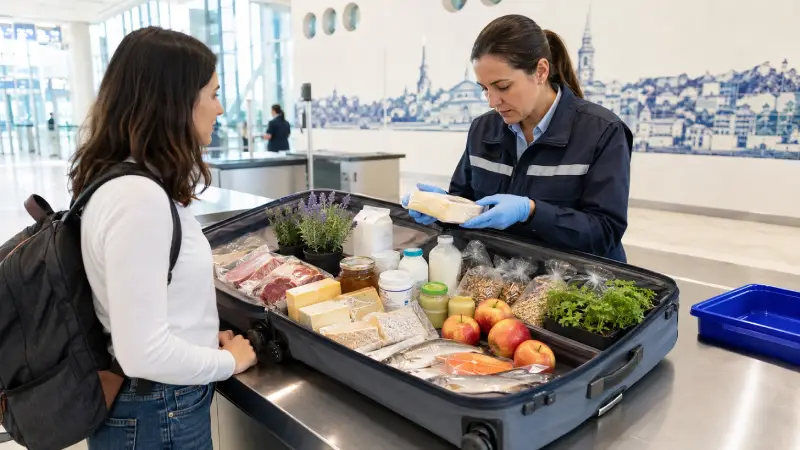
Food rules depend heavily on where the product originates. Commercial packaging or an unopened seal does not automatically make a food product admissible.
For travelers entering from most non-EU countries, Portugal follows EU animal-health controls that generally prohibit personal imports of meat, milk and products made from them.
The main practical rules include:
-
Meat and dairy: generally do not bring meat, meat products, milk or milk products from non-EU countries unless a specific exception applies.
-
Fishery products: qualifying fish and fish products may generally be carried up to 20 kg per person, or fish if that single fish weighs more.
-
Honey and certain other animal products: a personal allowance of up to 2 kg generally applies to the relevant category.
-
Infant or medical foods: up to 2 kg may qualify when the applicable conditions are met, including suitable commercial packaging and no requirement for refrigeration before opening.
Portugal’s Directorate-General for Food and Veterinary Affairs explains the rules for personal consignments of products of animal origin.
Prohibited animal products can be surrendered at the border. Undeclared prohibited goods detected by the authorities may be seized and destroyed, with further enforcement possible under the applicable rules.
Plants and fresh produce use a separate plant-health system. Plants for planting, many fruits and vegetables, seeds and cut flowers entering from outside the EU generally require a phytosanitary certificate.
The main fruit exceptions include pineapple, coconut, durian, banana and dates. Check the European Commission plant-health guidance before packing plants, seeds or fresh produce.
Vapes, e-liquids, heated tobacco and nicotine pouches
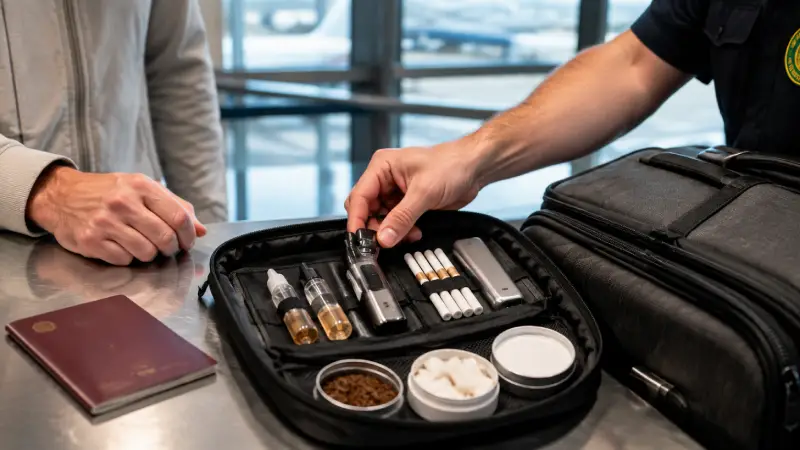
Portugal’s current traveler customs guidance lists specific excise exemptions for several nicotine and tobacco-related products. Do not assume quantity covers every type of vape or nicotine product.
For qualifying travelers entering from outside the EU excise territory, the guide lists:
-
E-liquid for disposable or refillable e-cigarettes: 30 ml.
-
Heated tobacco: 20 g.
-
Nicotine pouches: 20 g.
-
Snuff: 250 g.
-
Chewing tobacco: 250 g.
The 30 ml allowance applies to e-liquid, including liquid contained in disposable or refillable electronic cigarettes. The traveler guide does not state a separate number-of-devices exemption for the electronic hardware itself.
A newly purchased vape device can instead be relevant to the general value allowance for other goods when brought from outside the applicable EU tax area.
These are border-entry and customs rules. Where a vape may be used, where smoking or vaping is prohibited, and how nicotine products may be sold after entry are separate local-law questions rather than customs allowances.
Alcohol and tobacco allowances
Travelers aged 17 or older entering from a third country can use Portugal’s specific duty- and tax-free exemptions for alcohol and tobacco. Travelers under 17 do not receive these alcohol or tobacco exemptions.
For a qualifying third-country arrival, the tobacco allowance is:
-
200 cigarettes; or
-
100 cigarillos; or
-
50 cigars; or
-
250 g of smoking tobacco.
A proportional combination may be used within the overall tobacco allowance.
The alcohol exemption includes 1 liter of spirits or other alcoholic drinks above 22% ABV, or 2 liters of qualifying alcoholic products up to 22% ABV, together with up to 4 liters of still wine and 16 liters of beer.
These quantities are customs and tax exemptions, not general possession limits. Carrying more means the goods fall outside the exemption and should be declared. Declaration does not itself guarantee that every quantity or product will be admitted.
Travelers carrying alcohol or tobacco from within the EU excise territory are subject to a different system. Portugal’s guidance lists quantities used for assessing whether excise goods are being carried for personal use, including 800 cigarettes, 10 liters of spirits, 20 liters of intermediate products, 90 liters of wine—of which no more than 60 liters may be sparkling—and 110 liters of beer.
Medicines and controlled substances
Medicines carried into Portugal should be limited to what is required for personal needs and accompanied by the relevant medical prescription.
Do not assume a medicine that is routinely prescribed or sold in your home country is automatically treated the same way at the Portuguese border. The ingredient matters, particularly for medicines containing narcotic or psychotropic substances.
Portuguese controlled-drug legislation allows travelers crossing the border to carry covered controlled substances for their own treatment in an amount not exceeding what is required for 30 days, provided they can present medical documentation supporting the need for the medicine.
That 30-day rule applies to the relevant controlled substances and should not be presented as a universal quantity limit for all ordinary prescription medicines.
If your treatment contains a controlled ingredient, check current INFARMED controlled-substance legislation before departure.
Keep the prescription or required medical document accessible during arrival. The verified rules support carrying medical documentation; they do not establish a blanket requirement in this guidance for every medicine to have an English translation or remain in original retail packaging.
Cash, purchases and declaring goods at the airport
Portugal does not impose a €10,000 maximum on how much cash a traveler can carry. €10,000 is a declaration threshold.
Anyone entering or leaving the EU with €10,000 or more in cash, or its equivalent in currencies or other instruments covered by the EU definition, must submit a cash declaration to customs.
The definition is broader than banknotes and coins. Before traveling with substantial funds, check the current European Commission cash-control rules to see which instruments and commodities are included.
If Portugal is not your first point of entry into the EU, the relevant customs formality may arise at the place where you actually enter the EU rather than simply at your final Portuguese airport.
New electronics, gifts and other purchases brought from outside the EU may count toward the applicable general traveler value allowance. Keep invoices or other proof of purchase when carrying higher-value goods.
Portuguese airport customs guidance uses green / Nothing to Declare and red / Goods to Declare channels where those channels are available. Use the red channel when your goods require declaration or when you are unsure whether the green-channel conditions are met.
Using the green channel does not prevent customs officers from inspecting your baggage. Airport-specific information is available through ANA Airports customs guidance.
Mobile internet after customs
Once customs is clear, using a Portugal eSIM can provide mobile data without requiring an immediate physical SIM purchase after arrival.
For a wider comparison of airport SIMs, local SIM cards, eSIMs, roaming and WiFi, read How to Get Internet in Portugal: Airport SIMs, Local SIM Cards, eSIMs, and Pocket WiFi.
For provider, plan and coverage comparisons, use Best eSIM for Portugal: Compare Prices & Networks.
Need data in Portugal? Get an eSIM!
Choose the perfect data plan for your trip

Manage your eSIM in the app
Install, top up and track data.
Portugal customs checklist before you fly
-
Confirm whether your departure point falls inside or outside the relevant EU customs, VAT and excise territory.
-
Keep qualifying third-country air or sea purchases within the €430 traveler value allowance or prepare to declare them.
-
Remove prohibited meat and dairy and verify plants, fresh produce, fish and other animal products before packing.
-
Carry the required prescription or medical documentation for medicines and check controlled ingredients separately.
-
Measure alcohol, tobacco, e-liquid, heated tobacco and nicotine products against the correct traveler exemption.
-
Declare €10,000 or more in cash when entering or leaving the EU and check what the legal definition of cash includes.
-
Use the Goods to Declare channel when your baggage does not clearly meet the Nothing to Declare conditions.