

'%3e%3ccircle r='9'/%3e%3cg id='d'%3e%3cg id='c'%3e%3cg id='b'%3e%3cpath d='m-19 0 1.169 1.169L0 0l-17.831-1.169z'/%3e%3cpath id='a' d='m-.884.116.05.05L0 0z' transform='scale(19.2381)'/%3e%3cuse xlink:href='%23a' transform='scale(1 -1)'/%3e%3c/g%3e%3cuse xlink:href='%23b' transform='rotate(45)'/%3e%3c/g%3e%3cuse xlink:href='%23c' transform='rotate(90)'/%3e%3c/g%3e%3cuse xlink:href='%23d' transform='rotate(180)'/%3e%3cg transform='translate(-2.02)'%3e%3cg id='f' transform='translate(37.962)'%3e%3cpath id='e' d='M5 0 1.618 1.176l-.073 3.58-2.163-2.854-3.427 1.037L-2 0z'/%3e%3cuse xlink:href='%23e' transform='scale(1 -1)'/%3e%3c/g%3e%3cuse xlink:href='%23f' transform='rotate(120)'/%3e%3cuse xlink:href='%23f' transform='rotate(-120)'/%3e%3c/g%3e%3c/g%3e%3c/svg%3e)
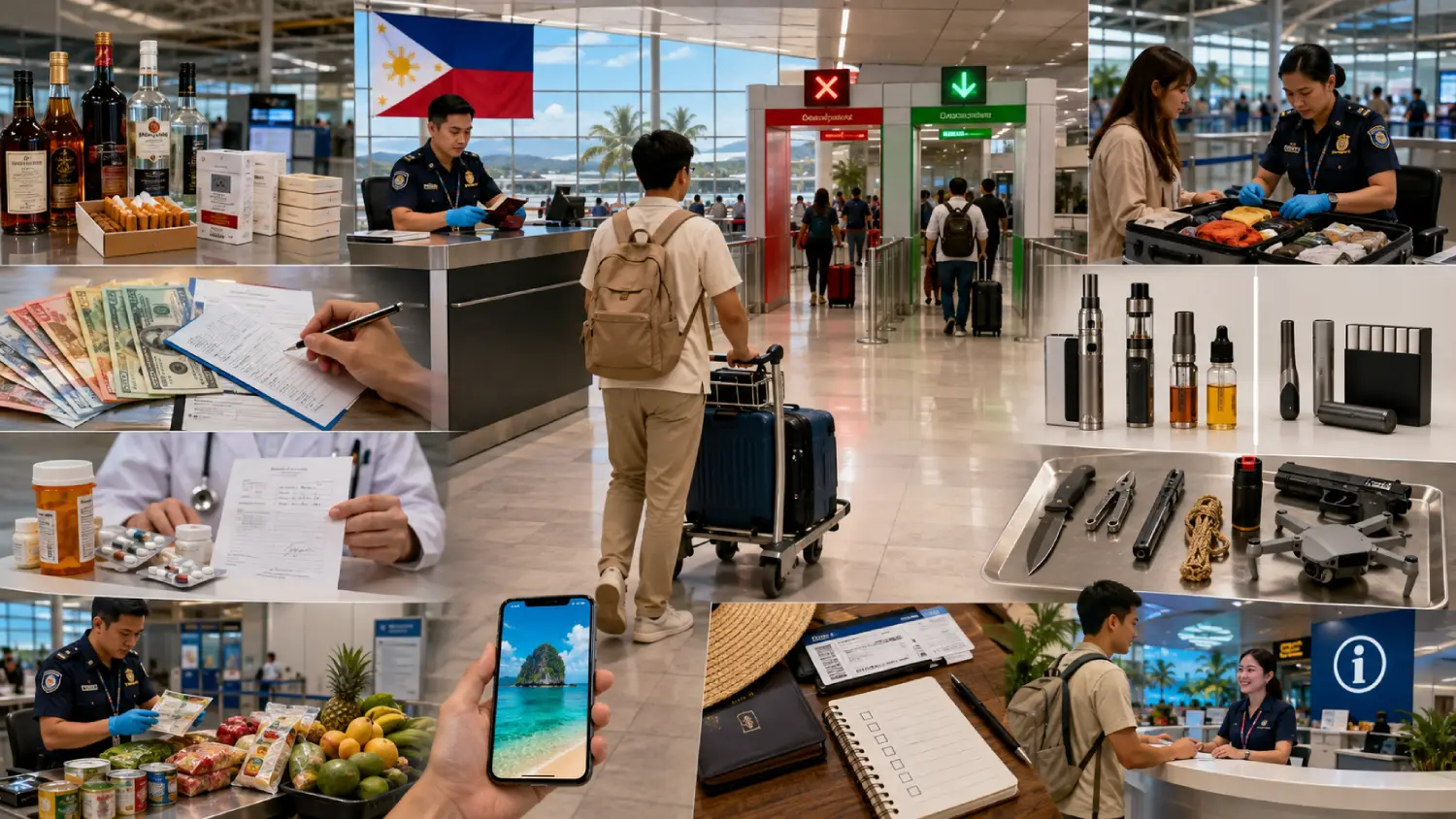
Customs rules at a glance
| Item | Can You Bring It? | Allowance or Declaration Rule | What to Do |
|---|---|---|---|
| Personal goods | Usually | Personal effects and non-commercial goods may qualify for relief; other goods valued at ₱10,000 or below are generally free from duties and taxes | Declare high-value, commercial, or restricted goods |
| Alcohol | Yes, within the allowance | Two bottles, with a combined volume no greater than 1.5 litres and total value of ₱10,000 or below | Ask Customs before exceeding either limit |
| Tobacco | Yes, within the allowance | Two reams of cigarettes, or 50 cigars, or 250 grams of pipe tobacco duty-free per traveler | Use tobacco alternative and declare excess |
| Cash | Yes | Declare foreign currency and bearer instruments above US$10,000 equivalent; pesos above ₱50,000 need prior BSP authorization and declaration | Declare the whole amount through eTravel/CDF |
| Medicines | Usually for personal treatment | Prescription quantity must match the prescription; controlled ingredients have separate rules | Carry the prescription and verify controlled substances |
| Food | Depends on product and origin | Processed food may be brought within personal-use limits; fresh, frozen, animal, and plant products may need prior clearance | Declare food and obtain agricultural permits before travel |
| Vapes/e-cigarettes | Yes, within verified personal-use limits | Up to two atomizer-device sets, 200 ml of e-juice, and 100 grams of parts/accessories without a permit | Keep categories separate and follow airline battery rules |
| Firearms and ammunition | Restricted | Legal authorization is required; restrictions also cover transit | Do not carry them without advance approval |
Rules checked on August 3, 2026. Customs, tax, health, and biosecurity requirements can change; verify the linked official guidance before travel. The limits above distinguish duty-free treatment from the separate permit-free quantities published in the Bureau of Customs Essential Guide for Travelers.
Which rules apply to your arrival?
The Philippines is not part of a wider customs union, so the same national entry rules generally apply to passengers arriving from any foreign country. Your nationality may affect special returning-resident, overseas Filipino worker, or balikbayan privileges, but ordinary visitor allowances do not increase merely because you arrived from another ASEAN country.
International baggage ultimately destined for a domestic Philippine airport must be cleared at the first Philippine port of entry. For example, a passenger landing internationally at Manila–Ninoy Aquino International Airport (MNL), Mactan–Cebu International Airport (CEB), or Clark International Airport (CRK) before taking a domestic flight should plan for Customs at that first international arrival point.
Commercial quantities, goods intended for resale, and repeated imports are not treated as ordinary traveler baggage. A low item count does not automatically make goods personal when their type, packaging, value, or frequency indicates business use.
Red channel, green channel, and declarations
All travelers and crew must register through the official eTravel Customs System and submit the required travel and customs information within 72 hours before arrival. Save the generated QR code so it is available without relying on airport internet.
Where red and green lanes are in use, choose the red or “Something to Declare” process when carrying dutiable goods, restricted items, excess currency, fresh or frozen products, or anything requiring a permit. The BOC’s 2026 guidance says QR scanning remains required for declaring travelers and passengers selected for inspection, while scanning is not required for travelers processed as having nothing to declare under the temporarily modified green-lane procedure. A green or nothing-to-declare selection does not prevent baggage inspection.
When uncertain, declare the item or ask an officer. A declaration allows Customs to assess the goods; it does not automatically mean the goods are prohibited.
Alcohol, tobacco, and personal-goods allowances
Each traveler may import two bottles of wine or liquor within the personal-use quantity limit, provided their combined volume does not exceed 1.5 litres. For duty- and tax-free treatment, the Bureau of Customs also states that the two bottles must have a total value of ₱10,000 or below. Current official guidance does not provide a simple traveler-paid allowance above this amount, so check with Customs before carrying more.
The published duty-free tobacco allowance is of these alternatives:
-
Two reams of cigarettes
-
50 cigars
-
250 grams of pipe tobacco
A newer BOC traveler flyer separately lists up to five reams or 50 packs of cigarettes as a personal-use regulatory quantity. That higher figure is not described as the duty-free allowance. Travelers carrying more than two reams should therefore declare them and confirm the tax and permit treatment instead of assuming all five reams are tax-free.
Used personal effects reasonably needed during a visit are normally treated differently from newly purchased goods or commercial stock. For other imported goods, the general duty-and-tax threshold is an FOB or FCA value of ₱10,000 or below. High-value purchases, multiple identical electronics, resale stock, and commercial quantities should be declared even when carried in personal baggage.
Cash, medicines, food, and other controlled items
Cash and monetary instruments
Foreign cash and foreign-currency bearer monetary instruments may enter or leave the Philippines without declaration up to US$10,000 or its equivalent. Above that threshold, declare the whole amount—not merely the excess—using the Currencies Declaration Form through eTravel, the eGovPH app, or Customs. This is a declaration threshold, not a legal maximum.
Philippine currency is different. A person may carry up to ₱50,000 into or out of the country. More than ₱50,000 requires prior written BSP authorization and declaration of the whole amount; the BSP grants authorization for specified purposes such as numismatics, currency awareness, or testing currency-handling machines—not an ordinary holiday budget. The rules apply per person regardless of age.
Consult the BSP cross-border currency FAQ before carrying large amounts. The declaration form asks for the source and purpose of the money. Current traveler guidance does not publish a second, higher amount at which separate proof-of-funds documents automatically become mandatory, although Customs or financial authorities may examine a declaration.
Medicines
The FDA personal-use FAQ and joint Customs–health guidance allow prescription medicines in the quantity or volume specified by the prescription. The prescription must include the physician’s Philippine professional licence number or the equivalent credential for a foreign doctor. Over-the-counter medicines are listed at up to 50 grams, while vitamins and health supplements are limited to 500 grams in total for permit-free personal import.
Dangerous drugs, controlled precursors, and medicines containing controlled substances remain subject to the Dangerous Drugs Board and Philippine Drug Enforcement Agency rules. A normal prescription does not override those controls; verify the active ingredient before departure.
Food, meat, plants, and seeds
Processed food, including cooked food, may be brought without FDA clearance up to 10 kilograms for personal use, although taxes may still apply when relevant. Fresh or frozen unprocessed food—including fresh fruit, meat, and fish—requires prior clearance from the appropriate Department of Agriculture agency even when intended for personal consumption.
The BAI meat-products traveler guidance advises passengers carrying meat or meat products to obtain the required regulatory permits or documents before arrival. Requirements can change with the product, processing method, country of origin, and animal-disease restrictions.
Plants, seeds, fresh fruit, vegetables, and planting materials are regulated by the Bureau of Plant Industry. The BPI-NPQSD plant import guidance requires a Plant Quarantine Clearance for covered personal imports before travel, with inspection and phytosanitary documents where applicable. Sealed retail packaging alone does not guarantee admission.
Vapes, e-cigarettes, and prohibited imports
Vapes and e-cigarettes are not subject to a general traveler import ban in the Philippines. The 2026 BOC traveler guide permits, for personal use and without a separate import permit, up to two sets of e-cigarette or atomizer devices, 200 millilitres of e-juice, and 100 grams of device parts or accessories. These are regulatory quantity limits, not an assurance that every product is tax-free.
Disposable vapes are not given a separate line in the official traveler guide; they fall within the broader e-cigarette/device category for practical customs purposes. Heated-tobacco devices and consumables are legally distinct from refillable or disposable vapes. They are regulated under Republic Act No. 11900, but the BOC flyer does not publish a specific passenger quantity for heated-tobacco consumables, so confirm the rule before carrying them. Snus is listed separately at up to 10 tins or 200 pieces. Philippine law sets 18 as the minimum age for purchasing, selling, or using vaporized nicotine or non-nicotine products and novel tobacco products.
Customs permission is also separate from aviation safety. Spare or loose lithium batteries must be carried in cabin baggage with terminals protected against short circuits; damaged, defective, or recalled batteries must not be transported on passenger aircraft. Check the operating airline’s rules for the device itself.
Other prohibited or restricted categories include:
-
Illegal narcotics and unauthorized controlled substances
-
Firearms, ammunition, explosives, and weapons without authorization
-
Counterfeit or pirated goods
-
Gambling devices and restricted lottery materials
-
Animals and animal products without veterinary clearance
-
Plants, seeds, soil, and regulated produce without plant-quarantine documents
-
Household pesticides without required FDA clearance
What happens if you exceed a limit or fail to declare?
Customs may assess duties and taxes on goods outside an exemption. Failure to declare dutiable goods can lead to seizure or forfeiture; when the import itself is lawful, release may be possible after paying the duties, taxes, other charges, and a surcharge equal to 30% of the goods’ landed cost. Fraud or goods imported contrary to law may also be referred for criminal proceedings.
Undeclared currency above the applicable threshold may be seized and referred to enforcement authorities for evaluation. Declaring more than US$10,000 in foreign currency is not itself an offence; failing to declare, making a false declaration, or carrying unauthorized pesos above ₱50,000 creates the problem.
Mobile internet after customs
After clearance, mobile data helps with airport transport, maps, accommodation messages, translation, and access to saved travel documents. Philippines eSIM can provide data without searching for a physical SIM counter after landing.
Need data in Philippines? Get an eSIM!
Choose the perfect data plan for your trip

Manage your eSIM in the app
Install, top up and track data.
Roafly Philippines plans are data-only and do not include a local telephone number, calls, or SMS. Hotspot use draws from the same purchased data allowance and does not have a separate hotspot quota.
Travelers comparing eSIM providers, prices, and supported networks can read Best eSIM for Philippines – Prices & Networks. For a broader comparison of airport SIM cards, local mobile operators, eSIMs, and WiFi access, see How to Get Internet in the Philippines: SIM Card, eSIM & WiFi Options.
Arrival checklist
-
Complete eTravel within 72 hours before arrival and save the QR code.
-
List high-value purchases, food, regulated goods, and excess currency accurately.
-
Keep alcohol and tobacco within the verified duty-free alternatives.
-
Carry prescriptions showing the medicine quantity and doctor’s credentials.
-
Obtain agricultural clearance before packing meat, fresh produce, plants, or seeds.
-
Keep vape devices, liquids, snus, and heated-tobacco products in separate categories.
-
Protect spare battery terminals and place loose lithium batteries in carry-on baggage.
-
Use the declaring channel or ask Customs whenever the correct treatment is unclear.
FAQs
How much alcohol can I bring into the Philippines?
Up to two bottles with a combined volume of no more than 1.5 litres. For duty-free treatment, their combined value must be ₱10,000 or below.
How many cigarettes can I bring duty-free?
Two reams per traveler. Cigarettes are an alternative to the published cigar or pipe-tobacco allowances, not an additional entitlement.
Must I declare cash over US$10,000?
Yes. Declare the whole foreign-currency amount when it exceeds US$10,000 or the equivalent, including covered bearer monetary instruments.
Can I bring prescription medicine?
Usually, when the amount matches a prescription bearing the doctor’s professional licence number or foreign equivalent. Controlled ingredients may require separate authorization.
Can I bring food in my luggage?
Processed food may qualify within the 10-kilogram personal-use limit. Meat, fresh fruit, vegetables, plants, seeds, and other fresh or frozen products may require advance agricultural clearance.
Can I bring a vape into the Philippines?
Yes, within the BOC personal-use limits: two atomizer-device sets, up to 200 ml of e-juice, and up to 100 grams of parts or accessories. Heated-tobacco products and snus are separate categories.
Final reminder
Complete the declaration before landing, keep permits and prescriptions accessible, and never assume that “personal use” means unrestricted or duty-free. The safest approach for unclear food, medicine, vape, tobacco, or high-value goods is to declare them and obtain a decision from Philippine Customs.