Globe
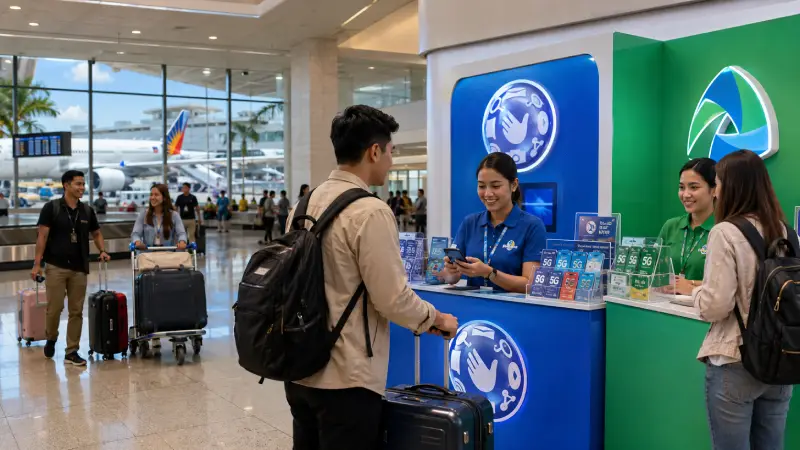
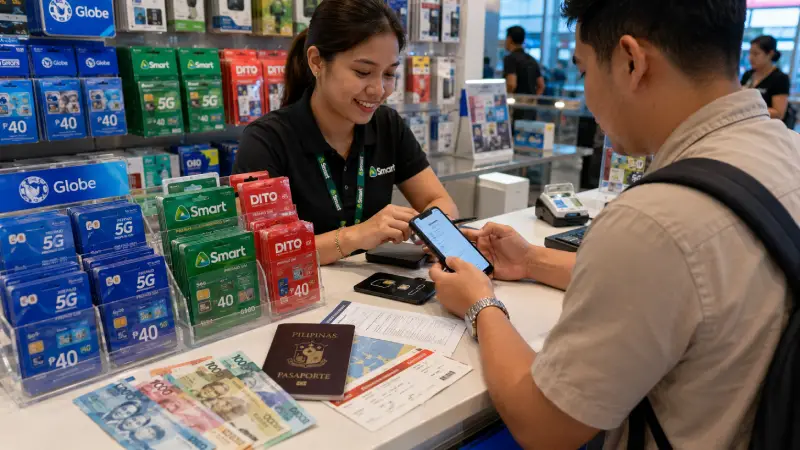
Globe’s ordinary prepaid eSIM costs ₱99 and includes 5 GB for all sites plus unlimited texts to Philippine networks for three days. It provides a Philippine mobile number, accepts international Visa, Mastercard, and JCB cards, and can use hotspot sharing. Foreign tourists must still complete Philippine SIM registration.
After activation, a visitor can add a standard prepaid promotion. practical short-trip example is GoEXTRA99, with 8 GB of all-access data and unlimited local calls and texts for seven days at ₱99. Offers can change, so confirm the inclusions inside GlobeOne before subscribing.
Globe also sells a tourist-focused eSIM with 80 GB, unlimited local calls and texts, and 30-day validity for ₱1,750, approximately $28.30 at the checked rate. It is easier to understand than assembling several recharges and includes a local number, but it still requires registration after arrival.
Smart
Smart’s current digital prepaid eSIM costs ₱99 and includes 2 GB of open-access data with no expiry after successful registration. Additional data can then be purchased through the Smart app or prepaid loading channels.
Smart also lists a Philippine Tourist eSIM for ₱1,599, approximately $25.90, with unlimited open-access data and unlimited calls and texts to local networks. However, the official store did not clearly publish its validity and showed the product as out of stock when checked. That makes it unsuitable as a guaranteed pre-arrival purchase unless availability and validity are reconfirmed.
Smart is a sensible local choice for travelers who want a Philippine number, substantial prepaid flexibility, or service across several islands. Bring a copy of your ticket and accommodation details to avoid registration delays.
DITO
DITO’s physical starter pack has a suggested retail price of ₱39. It provides 3 GB immediately, with up to 25 GB available through qualifying registration and promotional steps. Starter benefits are valid for 15 days and include unlimited local texts, unlimited DITO-to-DITO calls, and 100 minutes to other Philippine mobile networks.
Tourists can register a DITO SIM using a passport, proof of a Philippine address, and a return ticket. DITO sells through its experience stores and authorized retailers rather than operating a clearly documented tourist counter at every major arrival airport.
The low price is appealing, but check both phone compatibility and coverage for your exact route before choosing DITO, particularly for island-hopping or travel outside major urban areas.
Using a Roafly eSIM
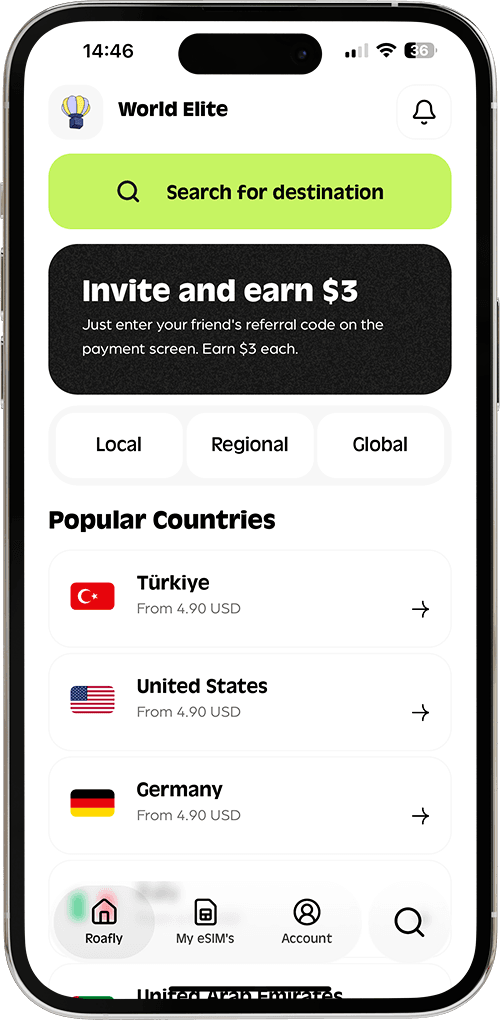
Roafly is the most convenient option for many short-term visitors because it can be purchased and installed before departure. You do not need to remove your primary SIM, visit an operator store, upload Philippine registration documents, or depend on a particular airport counter being open.
Current Philippines plans are data-only, support hotspot use across the purchased allowance, and do not require eKYC identity verification. Roafly lists both Globe and Smart for its Philippines product. Network access may be selected automatically and does not guarantee that both networks will be available at every location. The plan’s validity begins when it first connects to a supported network in the Philippines.
Install the eSIM while you still have dependable WiFi, but leave it switched off for mobile data until arrival. In the Philippines, select the Roafly line for cellular data, enable data roaming for that line, and disable data roaming on your home SIM to reduce the risk of accidental charges.
Roafly does not include a Philippine phone number, local calls, or SMS. Keep your home SIM active for bank codes and messages when your carrier permits it, and use internet-based calling or messaging over the Roafly connection. Travelers evaluating digital-plan sizes and network details can also read Best eSIM for Philippines – Prices & Networks.
A registered local SIM may still be the better deal for a month-long stay, extensive calling, or very heavy data. Roafly’s advantage is simpler preparation and arrival—not the claim that every local plan is more expensive.
Travelers who want data ready without depending on airport stock or local registration can view current Philippines eSIM options.
International roaming
Home-carrier roaming requires the least setup: keep your normal SIM active and purchase the relevant pass before departure. It can be reasonable for a-day stop, an employer-paid trip, or a plan that already includes the Philippines.
The Philippines is outside the EU and EEA, so European Roam Like at Home rules do not apply. Inclusion depends entirely on the traveler’s carrier, tariff, destination zone, and fair-use conditions.
Before relying on roaming, verify:
-
The daily or trip-pass price
-
Included high-speed data and any speed reduction
-
Whether hotspot use is included
-
Charges for outgoing and incoming calls
-
Whether a pass activates automatically after background data use
When using Roafly or a Philippine SIM, turn off data roaming for your home line. On cruise ships, also watch for maritime or satellite networks, which may be billed separately from ordinary Philippine roaming.
Mobile networks and coverage
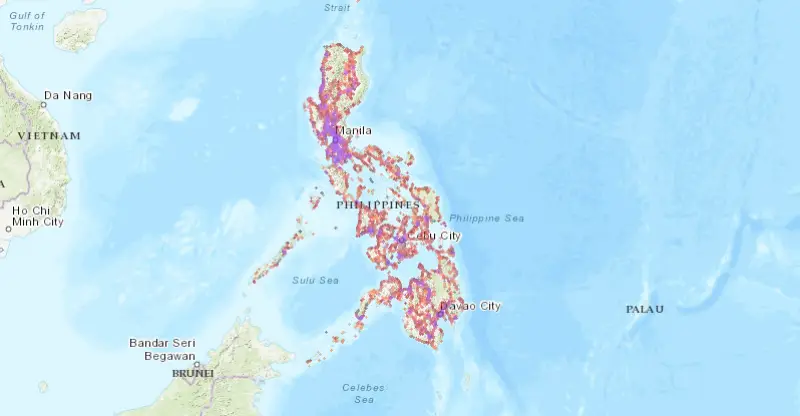
The Philippines is an archipelago, so network quality can change between cities, islands, ferry ports, mountain roads, and individual resorts. Download offline maps, hotel details, ferry tickets, and essential transport information before traveling beyond major population centers.
Globe
Globe operates nationwide 4G and expanding 5G service, with particularly strong urban availability in Metro Manila and key cities in the Visayas and Mindanao. It is a practical starting point for Manila, Cebu, Boracay, and other established tourism centers, but a coverage claim for a city does not guarantee signal inside every resort or on remote roads.
Smart
Smart also maintains broad nationwide mobile coverage and publishes tools for checking 5G availability by city or province. It is commonly considered alongside Globe for multi-island itineraries, provincial travel, and routes where relying on a smaller urban-focused network would be risky.
DITO
DITO has expanded in Metro Manila and cities including Cebu, Mandaue, Davao, Bacolod, and selected parts of nearby provinces. Its unlimited 5G promotions deliver their main benefit inside supported 5G areas, with a separate 4G allowance elsewhere. Check DITO’s coverage and compatible-device lists before purchasing for Palawan, Siargao, rural Luzon, or a complex island-hopping route.
For most travelers, dependable 4G along the full itinerary is more valuable than choosing a plan solely because it advertises 5G.
Pocket WiFi
Pocket WiFi can work for a family carrying several phones, tablets, and laptops, especially when some devices lack eSIM support. Everyone connects to portable router instead of purchasing a separate plan.
NAIA’s official shop directory lists a 24-hour pocket-WiFi and SIM retailer in Terminal 1’s departure area. That confirms airport retail presence, but not a guaranteed inbound rental package for use within the Philippines. Current daily pricing, deposits, device-loss charges, arrival pickup, battery specifications, and return arrangements were not reliably published, so rental availability is less predictable than a SIM or eSIM.
Before reserving, confirm that the device is intended for domestic Philippine use and ask for the total cost, data policy, pickup point, return deadline, deposit, replacement fee, battery duration, and number of supported devices.
Pocket WiFi has two practical weaknesses in an island destination: it must remain charged during long transport days, and everyone loses access when the person carrying the router separates from the group. For many families, phone using a hotspot is simpler unless a dedicated router is specifically needed.
Airport and public WiFi
NAIA provides several free WiFi choices across all terminals. The official New NAIA amenities page lists Globe Free Go Wi-Fi for three hours per day, Smart Wi-Fi for hour per day, and Converge WiFi for two hours per day. These services are useful for messaging accommodation, retrieving an eSIM installation email, or arranging transport.
Clark International Airport also confirms free passenger WiFi. For Mactan-Cebu, no dependable current official session limit was found, so do not build an arrival plan around a particular allowance.
Hotels, shopping malls, coworking spaces, restaurants, and cafés commonly provide WiFi in major cities. The government’s Free Wi-Fi for All program also serves selected airports, seaports, terminals, government facilities, and other public locations, although availability and performance vary by site.
Use public WiFi as a backup rather than your connection. Confirm the network name with staff, disable automatic connection to unknown networks, and use mobile data for important payments or sensitive account access when possible.
Best option by traveler type
Short holiday or first visit: Roafly is usually the simplest choice. Install it before departure and use airport WiFi if setup information needs to be retrieved.
Traveler needing a Philippine number: Choose a registered Globe, Smart, or DITO SIM. Globe and Smart have the clearest tourist-facing choices.
Long stay: A local prepaid SIM normally offers better value and local calling, but tourists should remember the standard 30-day registration validity and extension requirements.
Island-hopping trip: Start with a plan using Globe or Smart and download offline information before ferries, remote beaches, and overland transfers.
Family or group: Use Roafly hotspot sharing or a local SIM in designated hotspot phone. Choose pocket WiFi when the collection, charging, and return arrangements are clearly confirmed.
Multi-country Asian trip: Regional Asia eSIM may be more practical than installing a new country plan at every border, provided all destinations on the itinerary are included.
Phone without eSIM support: Buy a physical local SIM at an airport or official operator store and bring the complete tourist-registration documents.
FAQs
Can I buy a SIM card at Manila Airport?
Yes. Globe officially lists Traveler SIM sales in the arrival areas of all four NAIA terminals, and its Terminal 3 arrivals store provides physical SIMs and activation help. Smart airport availability is also advertised, but exact counter stock and hours should not be assumed.
Do tourists have to register Philippine SIM cards?
Yes. Locally issued physical SIMs and operator eSIMs must be registered before activation. Tourists need a passport, Philippine address evidence, and a return or ticket.
Does Roafly require Philippine SIM registration?
No. Roafly’s Philippines plan is a travel data eSIM and its product information lists no eKYC requirement. It does not provide a Philippine number.
Is a local SIM cheaper than Roafly?
It can be. Ordinary starter SIMs begin at ₱39–₱99, and domestic prepaid promotions can provide inexpensive calls, texts, and data. Roafly is generally chosen for pre-departure setup and avoiding registration rather than because every local package costs more.
Can I use my phone as a hotspot?
Roafly supports hotspot use across the purchased data allowance without a separate hotspot quota. Globe’s local prepaid eSIM also allows hotspot sharing. Local promotion rules can vary, so check the selected package before relying on tethering.
Which network is best for Palawan, Siargao, or smaller islands?
There is no universal winner for every island, municipality, or resort. Globe and Smart are the safer starting points for broad itineraries, but check recent coverage for the exact accommodation and route. Download offline maps because signal may weaken on remote roads, boat routes, and isolated beaches.
Final recommendation
For a typical- or two-week Philippines trip, set up Roafly before departure and keep your primary SIM installed for messages and verification codes. It provides data without an airport purchase, physical SIM swap, or Philippine registration process, while hotspot support makes it practical for a laptop or travel companion.
Choose a local Globe or Smart prepaid SIM instead when you need a Philippine number, unlimited local calling, or larger allowances for a long stay. DITO can be exceptionally inexpensive, but its coverage and device compatibility deserve closer checking for multi-island travel.
Airport SIMs are a valid assisted option, particularly at NAIA, Clark, and Mactan-Cebu, but current airport-specific prices and counter schedules are not published consistently enough to make them the safest arrival plan. Keep airport and public WiFi as backup rather than your main connection.


'%3e%3ccircle r='9'/%3e%3cg id='d'%3e%3cg id='c'%3e%3cg id='b'%3e%3cpath d='m-19 0 1.169 1.169L0 0l-17.831-1.169z'/%3e%3cpath id='a' d='m-.884.116.05.05L0 0z' transform='scale(19.2381)'/%3e%3cuse xlink:href='%23a' transform='scale(1 -1)'/%3e%3c/g%3e%3cuse xlink:href='%23b' transform='rotate(45)'/%3e%3c/g%3e%3cuse xlink:href='%23c' transform='rotate(90)'/%3e%3c/g%3e%3cuse xlink:href='%23d' transform='rotate(180)'/%3e%3cg transform='translate(-2.02)'%3e%3cg id='f' transform='translate(37.962)'%3e%3cpath id='e' d='M5 0 1.618 1.176l-.073 3.58-2.163-2.854-3.427 1.037L-2 0z'/%3e%3cuse xlink:href='%23e' transform='scale(1 -1)'/%3e%3c/g%3e%3cuse xlink:href='%23f' transform='rotate(120)'/%3e%3cuse xlink:href='%23f' transform='rotate(-120)'/%3e%3c/g%3e%3c/g%3e%3c/svg%3e)