Download the App and manage your eSIMs easily
Create your order quickly
See your eSIM details
Track your remaining data
Download the App and manage your eSIMs easily
Create your order quickly
See your eSIM details
Track your remaining data
Paraguay’s entry rules depend on your passport and how you arrive. As of November 9, 2026, many tourists qualify for visa-free visits, while certain visa-required nationalities can obtain a visa at Asunción’s Silvio Pettirossi International Airport. That airport option matters if you are choosing between flying in and crossing overland.

Lena Hartley
Updated Nov 9, 2026
7 min read
Save 15% on your Roafly eSIM
Stay connected on your next trip. Use the code below at checkout.
View All DestinationsJump to section
👇Save 15% on your Roafly eSIM
Stay connected on your next trip. Use the code below at checkout.
View All Destinations
Manage your eSIM in the app
Install, top up and track data.
Your route also affects yellow fever paperwork. Prepare around three things: your nationality’s entry permission, the places you are arriving from, and the immigration record you must keep until departure.
Use the table below for representative ordinary-passport examples travelling for tourism. Diplomatic and official passports can have different exemptions.
| Passport country | Tourist entry route | Stay or main condition |
|---|---|---|
| United Kingdom, Germany, France, Türkiye and Japan | Visa-free | Up to 90 days |
| United States, Canada, Australia and New Zealand | Temporary visa exemption | Up to 90 days; the exemption is currently valid until August 13, 2027 |
| Singapore, South Korea, Philippines and Malaysia | Visa-free | Up to 30 days |
| Dominican Republic | Visa-free | Up to 60 days |
| Oman, Qatar, Indonesia, Thailand and Vietnam | Visa on arrival available at Silvio Pettirossi International Airport | At least six months’ passport validity and payment of the applicable fee; follow the visa and admission conditions granted |
| India, Pakistan and China | Advance visa application | Arrange the appropriate visa through a Paraguayan embassy or consulate before travelling |
These examples are not an exhaustive list. Find your passport in the official nationality requirements, keeping the tourist-entry column separate from the rules for extensions, residence and paid activities.
The August 2027 expiry deserves attention if you are planning far ahead. US, Canadian, Australian and New Zealand tourists should use the current exemption for qualifying trips, rather than older instructions telling them to buy a visa on arrival. Travel after the exemption’s stated end date requires a fresh eligibility check.
If you need an advance visa, start the official online visa application and select the relevant Paraguayan consular office. Online submission begins the process; the consulate reviews your documents and may arrange an interview before issuing the visa.
Start at least 30 days before your intended trip. That is planning guidance, not a promised processing time.
Prepare the documents requested for your application category. These can include:
A recent passport-style photograph and a colour copy of your passport.
Evidence of employment, bank funds or other financial means.
Your accommodation booking and proposed flight or overland itinerary.
Copies of visas issued by other countries.
A criminal-record certificate from your country of residence, legalised or apostilled as required.
Invitation documents where your application uses a host in Paraguay.
There is a tourist application route without an invitation letter. Use the requirements for your selected route instead of assuming every visitor needs a Paraguayan host. Honorary consulates do not process visa applications.
The airport route in the table is available at Silvio Pettirossi International Airport (ASU). It requires a passport with at least six months’ validity and payment of the prescribed visa fee.
If you hold one of those passports but intend to enter by road or river, arrange the appropriate visa beforehand. Do not build an overland itinerary around a visa service available at ASU.
Other visa-required nationalities can seek exceptional approval for a visa on arrival in justified cases. That involves an advance application, a host in Paraguay and authorisation before travel. Simply living in a country without a Paraguayan embassy is not sufficient on its own.
Paraguay’s general entry requirement is a valid passport. Immigration officials can shorten the permitted stay when the travel document is close to expiry. The six-month minimum described above applies specifically to the visa-on-arrival route; consular applications and transit countries may impose their own document conditions.
Argentine, Bolivian, Brazilian, Chilean, Colombian, Ecuadorian, Peruvian and Uruguayan citizens travelling within the MERCOSUR framework can use an accepted, valid national identity document. Living in one of those countries does not give another nationality the same entitlement.
Keep the following accessible during the journey:
Your passport or eligible national identity document.
Your visa or advance authorisation, where required.
Your international yellow fever vaccination certificate if your route triggers the requirement.
Your accommodation address, itinerary and transport details for reference.
Save useful booking details offline before leaving. If you are deciding between roaming, a local SIM and an eSIM, compare how to get internet in Paraguay before arrival.
Bag checks and declarations are a separate part of arrival. Review Paraguay customs rules for the belongings you plan to bring.
Paraguay requires an international yellow fever vaccination certificate from foreign visitors aged 1 to 59 arriving from designated risk areas. The certificate can be physical or digital, and the vaccination must have been administered at least 10 days before travel.
The requirement concerns specified regions of Bolivia, Brazil, Colombia, Guyana and Peru. It does not automatically cover the entire territory of each country.
São Paulo is on the current list for Brazil, and Santa Cruz is listed for Bolivia. Spending time in a listed region and making an eligible short transit through it can lead to different document requirements. Match your itinerary against the current yellow fever entry rules and regional list.
The main exceptions are:
Children under one and adults aged 60 or over: outside the certificate requirement’s age range.
Transit through a risk area for up to 24 hours: covered by the published transit exception.
Medical contraindications: supported by a certificate from a medical professional or the relevant health authority, with health monitoring for six days after entry.
If the requirement applies, arriving without the certificate—or before the required 10 days have elapsed—can prevent entry. Resolve the paperwork before your journey through the region, especially when Paraguay is one stop in a longer South American trip.
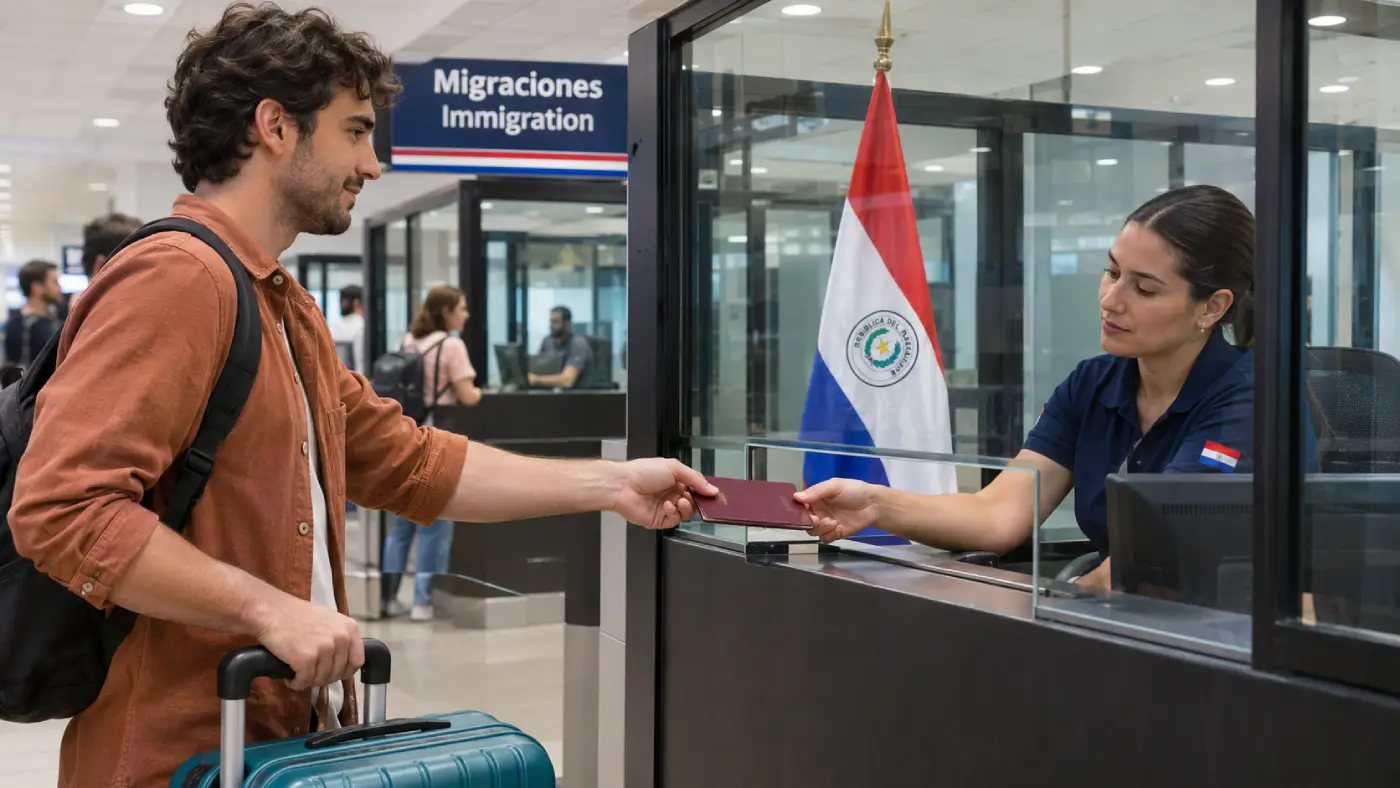
Everyone must register their entry and exit at an authorised immigration checkpoint, including at land, river and airport borders. Immigration registration is free.
At entry, check the details and permitted stay on your passport stamp or immigration card before continuing. Keep that proof for departure. Passing through a border area without completing immigration formalities can leave you without the entry record you need later.
Build the immigration stop into an overland transfer, including a short visit from a neighbouring country. Keep the documents in your day bag, and allow time to finish the formalities before meeting your onward transport. Our safety advice for Paraguay covers the separate question of planning the journey beyond the border.
Once admitted, having your accommodation contact and transfer details available makes the next step easier. You can arrange a Paraguay eSIM before departure for mobile data to access bookings and message your host after arrival.
Before your stay, familiarise yourself with Paraguay’s tourist laws, which cover conduct inside the country.
Use the departure deadline recorded at entry when planning your trip. The maximum allowance associated with your nationality is not a reason to disregard a shorter period granted on arrival.
Paraguay allows a temporary stay to be extended once, at the discretion of the National Directorate of Migration. The extension cannot exceed the period originally granted. Applications can be made in person or through the official government service.
Visa requirements for an extension can differ from those for the initial visit. Some nationalities that enter visa-free need a consular visa for an extension, so establish that requirement before relying on extra time. Prepare your valid travel document, entry record and any required visa documentation, and start the process before your authorised stay ends.
At departure, present your entry record and complete exit control. Overstaying or failing to present proof of entry can lead to penalties. Keep that final immigration step in your itinerary whether you leave by plane, bus, car or boat.
