



Cancún airport pickups, Riviera Maya fuel stops and hotel bookings involve different decisions. Agreeing on a price helps, but you still need to verify who is providing the service and what you are authorizing at payment.
Our regional safety advice for Mexico covers location-specific security questions. This guide focuses on deception during travel arrangements and how to respond without escalating a confrontation.
Airport pickups and the “your shuttle has left” story
Someone approaches while you are looking for your transfer, claims to represent the company, then tells you the driver has gone. They may offer to telephone the office and hand you a phone. The person answering confirms the story and promises that a replacement taxi will be reimbursed.
That supposed confirmation is part of the problem: you have not independently reached your provider. This specific fake transfer and reimbursement story has been described by a Cancún transport operator.
Open your original booking and contact the company yourself. Ask it to confirm the meeting point and any replacement arrangement before accepting another ride. Uniforms, badges and knowledge of a company name are insufficient verification.
Download pickup instructions for offline access. Mobile data from a Mexico eSIM can also let you open the booking and message the provider on a compatible phone.
If you still need to arrange transport, compare the service and destination before paying. Our guide to airport transfers and transport in Mexico explains the wider options.
Card payments: check each transaction
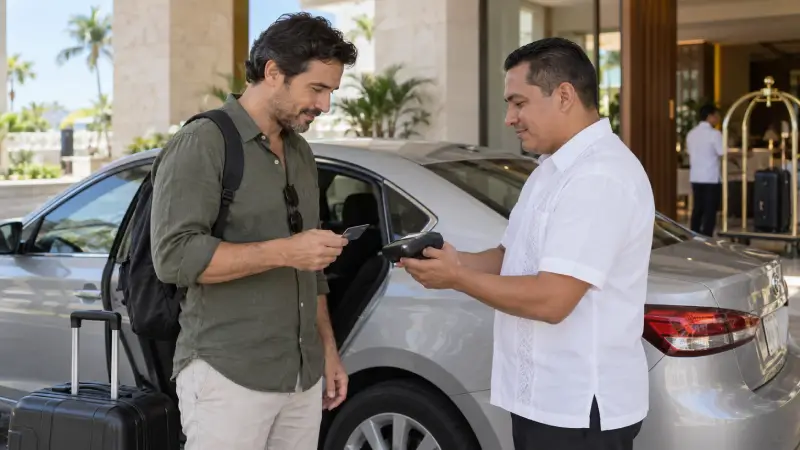
Treat the agreed fare and the payment-terminal amount as two separate checks. Confirm the currency as well as the number, and read the amount before tapping or entering your PIN.
Some travelers describe agreeing to a modest Cancún taxi fare, then discovering a much larger card charge. The circumstances differ, but the practical lesson is consistent: a verbal agreement does not tell you what the terminal actually processed.
Be particularly careful if someone asks you to cancel an app booking and pay separately, or says a payment failed while keeping the screen out of view. These changes deserve verification before another transaction.
If a terminal appears to fail:
-
Ask to see its result and request the transaction receipt.
-
Check your own banking app when possible; a missing notification does not establish that payment failed.
-
Confirm the amount again before authorizing any further attempt.
Save screenshots of the original fare, booking and transaction record. If you discover an unexpected charge, contact your card issuer through its official app or the number on your card. Explain what you agreed to and what was charged. The outcome of a payment dispute is not guaranteed.
Fake accommodation and tour bookings

The accommodation looks convincing, the photos are attractive and the package seems well organized. The deception becomes apparent after payment, when the hotel has no reservation or the seller disappears.
Mexico's consumer authority warns about ghost travel agencies, false packages and nonexistent accommodation. Several versions share the same weak point: the seller takes payment before you independently verify the service.
Contact the hotel using details you obtain separately from the seller's message. Ask it to confirm the reservation dates, guest name and booking arrangement. With a tour, establish who operates it, where it departs and exactly what the price includes.
Read the cancellation terms and confirm the business's name and contact details before paying. Pressure to send money immediately to an unexplained personal account deserves a pause. A padlock in the browser indicates an encrypted connection; it does not establish that the business is genuine.
Your advertisement, correspondence and payment receipt together show what was promised if the delivered service differs.
Timeshare offers with hidden commitments
Timeshares are legitimate products, but misleading terms, unauthorized charges and pressure to sign can turn a sales encounter into a costly dispute.
Before providing payment details, establish whether you are agreeing to a presentation, paying a reservation fee or entering a long-term contract. Look beyond the first payment: check the total cost, recurring fees, usage restrictions and cancellation procedure.
Profeco's timeshare guidance says consumers can request cancellation within five working days after signing. It also advises checking that the provider's contract is registered and avoiding clauses that waive cancellation rights.
If you want to cancel, act promptly and keep evidence of your written request to the provider. Retain the contract, payment records and the company's legal name and Mexican address. Contact Profeco if the provider does not respond appropriately.
Treat a deadline imposed by a salesperson as a reason to read more carefully. You do not need to sign while questions about the commitment remain unanswered.
Restaurant bills and unagreed tips
Read the bill before handing over your card. Check the dishes, drinks, quantities and any added service or tip line against what you ordered and agreed to.
Mexican consumer rights also protect foreign visitors: tips are voluntary, displayed prices include IVA, and you are entitled to a receipt. An expensive menu item that you knowingly ordered is a different issue from an added drink or an unagreed charge.
Clarify currency before ordering when a menu uses the dollar symbol. If something on the bill is unclear, ask staff to explain the item and correct any mistake before processing payment.
Photograph the menu price and retain the receipt when you can do so calmly. If a billing disagreement becomes threatening, prioritize leaving safely and getting assistance. Do not prolong a confrontation to prove the arithmetic.
Cash, ATMs and fuel stops
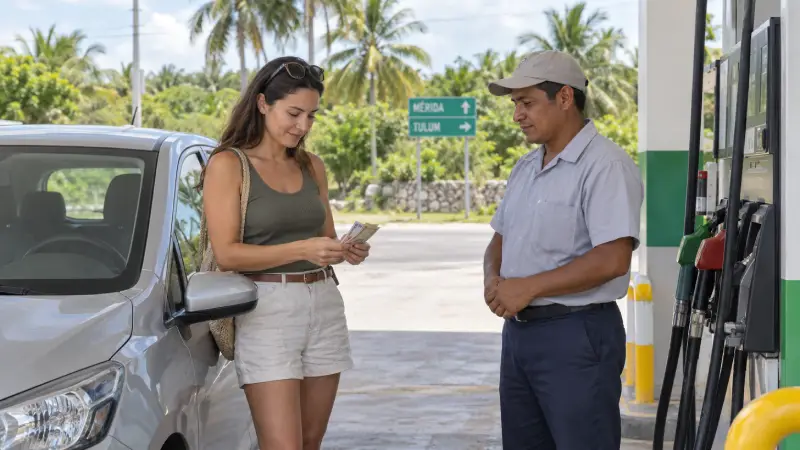
Banknote switching
One reported Yucatán payment trick involves accepting a 500-peso note, then showing a 50-peso note and claiming the customer paid too little.
Check the denomination before handing it over, say the amount and keep the exchange in view. Paying the exact agreed amount can simplify the transaction, although it cannot guarantee that nobody will dispute it.
If challenged, pause before automatically handing over more money. Explain the amount you gave without turning the disagreement into a physical confrontation.
Fuel-pump totals
Check that the pump starts at zero before fuel is dispensed, then compare the final display with the amount requested for payment. This is a useful precaution against being charged for fuel from an earlier transaction.
Watch the cash handover or card-terminal amount separately. Confirming the pump total does not confirm the subsequent payment.
ATM tampering
ATM skimming involves equipment that captures card information. Use a machine inside a bank or another established, busy location, inspect the card slot for anything unusual and cover the keypad when entering your PIN. Location alone does not guarantee that a machine is secure.
If anything seems wrong, cancel and use another machine. Contact your own bank through a trusted channel if your card is retained or you notice unauthorized activity.
Displayed withdrawal fees and optional currency conversion are costs to assess before accepting. Their presence alone does not make the ATM fraudulent.
Rental damage demands
Record the condition and payment terms when renting a vehicle or recreational equipment. Photograph existing marks, ask for them to be recorded at collection, and retain the agreed rental price and deposit conditions.
There are reports of recreational-equipment operators demanding compensation beyond the value of damage. That does not make every damage claim fabricated: the useful check is whether the alleged damage and requested amount are supported.
Ask for an itemized written claim and compare it with the collection record and contract. Clarify whether a sum is a deposit hold, an agreed charge or a new demand.
Photos may help establish the condition at collection, but they do not guarantee a refund or settle liability. If the dispute becomes coercive, seek assistance rather than continuing an argument beside the equipment.
Police impersonation and cash demands
Police impersonation and misconduct by genuine officers have both been reported in Mexico. If someone demands cash to dismiss an alleged offence, calmly request identification and a written fine where safe.
Do not offer a bribe or ignore genuine checkpoints. If threatened, prioritize safety and contact 911. Record identifying details if doing so will not increase the risk.
Threatening hotel calls and virtual kidnapping
Hotel-room callers may impersonate officials or criminal groups, or claim a relative has been kidnapped. A virtual kidnapping creates the impression of a detention that has not occurred.
End the call and contact the person concerned through a number you already have. Avoid following payment instructions or giving personal details. Report threats to the authorities. These tactics appear in the current Mexico extortion guidance.
Prepare your bookings, payments and contacts
Before departure, save your accommodation address, pickup instructions and booking confirmations offline. Keep the contact details from the original reservation accessible without searching through messages at the airport.
Decide how you will get as part of that preparation. You can compare eSIM options for Mexico when choosing a suitable data plan. Keep a separate way to make ordinary calls; a data-only eSIM does not provide that service.
If something goes wrong, match the response to the problem:
| Problem | First useful action | Records to retain |
|---|---|---|
| Unexpected card charge | Contact your card issuer through its official channel | Agreed price, transaction record and receipt |
| Booking or service dispute | Contact the provider in writing, then seek Profeco assistance if needed | Advertisement, confirmation, terms and correspondence |
| Threat or immediate danger | Get to safety and call 911 | Details you can retain without increasing the risk |
Profeco lists 55 5568 8722 and 800 468 8722 for consumer assistance in Mexico. Keep the provider's legal name and supporting records ready.
Report suspected crimes to the relevant local prosecutor's office, known as the Ministerio Público or Fiscalía. Consumer assistance, criminal reporting and a bank payment dispute serve different purposes; completing does not automatically complete the others.