

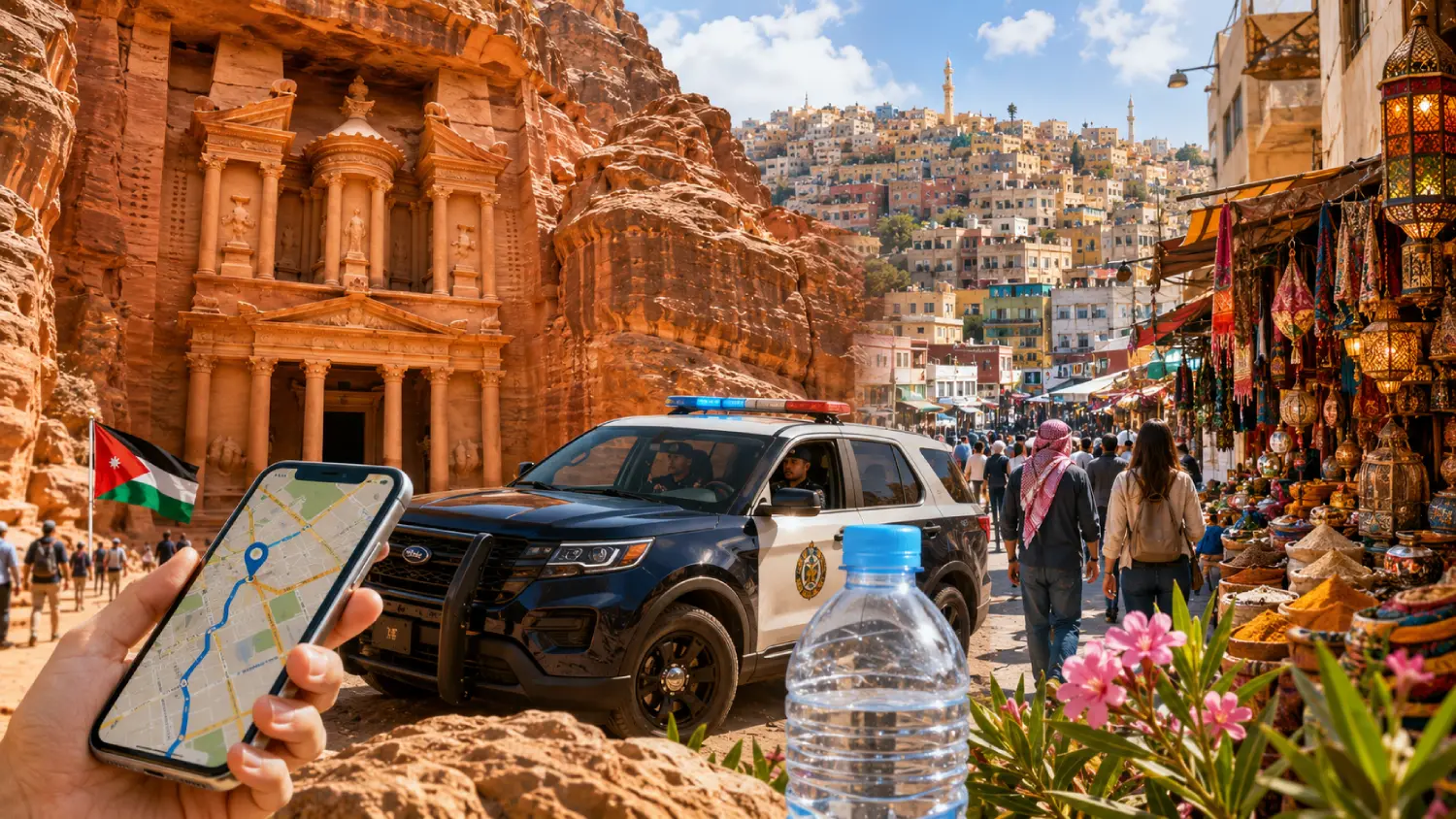

The short answer is an overwhelming yes. Jordan remains the undisputed safe haven of the Middle East. It is a country that relies entirely on tourism to keep its economy afloat, meaning the government actively protects foreign visitors.
However, the "danger" here has shifted away from terrorism and violent crime. Today, the real threats to your trip are sophisticated tourist extortion rings in major historical sites, aggressive driving culture, and intense environmental hazards. Understanding how to navigate the streets, negotiate with vendors, and respect local laws is your best armor.
Before you even pack your bags, it is absolutely critical to understand what you can actually bring into the country without getting detained. For a smooth entry, read our breakdown of Jordan Airport Customs Rules so your gear is not confiscated upon arrival.
The Geopolitical Reality: An Oasis of Calm?
Look at a map, and you will see Jordan wedged between Syria, Iraq, Saudi Arabia, and Israel/Palestine. It looks like a recipe for disaster. Yet, Jordan operates like a fortress, insulated from the chaos surrounding it.
The Jordanian military and intelligence services are among the most capable in the world. Their border security is ironclad, and internal stability is the monarchy’s absolute highest priority. As a tourist, you will notice a massive, visible security apparatus everywhere you go.
The Tourist Police Jordan has a dedicated branch of law enforcement specifically designed to protect you. The Tourist Police are stationed at every major historical site, hotel, and tourist hub. They speak English, they are highly approachable, and their primary job is to ensure you do not get scammed or harassed.
Violent crime against foreigners is exceptionally rare. The penalties for harming a tourist are so incredibly severe that local criminals almost entirely avoid targeting them. You are statistically safer walking through Amman at midnight than you are in Paris or London.
Strict Laws and Cultural Respect The biggest risk to your freedom in Jordan isn't crime; it's accidentally breaking conservative local laws. Public intoxication, public displays of affection, and criticizing the royal family are serious offenses. To avoid ending up on the wrong side of the law, review our comprehensive guide on Jordan Tourist Bans & Laws.
Map It Out: Tourist Havens vs. No-Go Zones
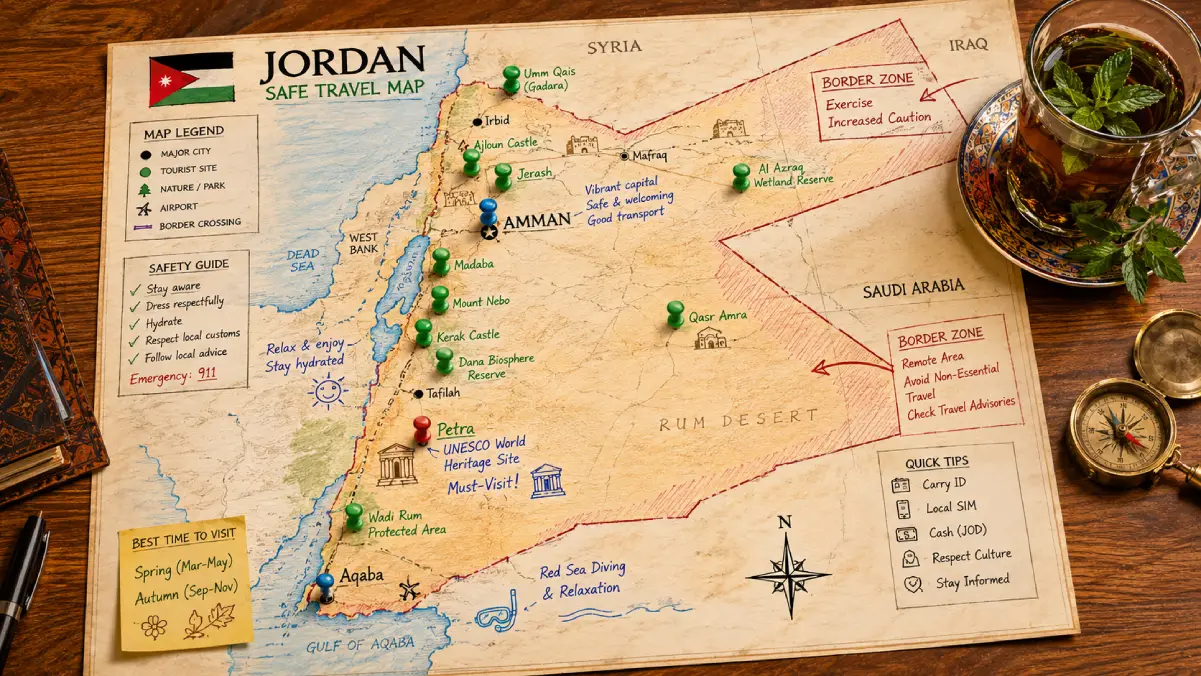
Jordan is relatively small, but the safety landscape changes dramatically depending on your GPS coordinates. Stick to the tourist trail, and you will have zero issues. Wander into the wrong border territory, and you will encounter military checkpoints and potential detention.
The Safe Zones
-
West Amman (Jabal Amman, Jabal Al Lweibdeh, Abdali): These are the modern, affluent, and highly westernized districts of the capital. They are incredibly safe, filled with cafes, and heavily policed.
-
Petra & Wadi Musa: The town surrounding Petra exists solely for tourism. Aside from aggressive vendors, it is entirely safe from physical crime.
-
Wadi Rum: The desert camps are managed by local Bedouin tribes who view guest safety as a matter of honor.
-
Aqaba & The Dead Sea: These are heavily guarded resort areas. Aqaba has a relaxed, holiday vibe where normal conservative dress codes are slightly loosened.
The Areas to Strictly Avoid
-
The Syrian Border (Within 3km): Do not travel within 3 kilometers of the Syrian border. This is a highly militarized zone, and straying here will result in immediate arrest or worse.
-
The Iraqi Border: Similar to the Syrian border, the eastern stretches of the desert near Iraq are strictly off-limits to tourists. There is no tourist infrastructure here anyway.
-
Zarqa and East Amman: These areas are not inherently dangerous, but they are highly impoverished, extremely conservative, and lack any tourist facilities. You will stand out, and the risk of petty theft or harassment increases slightly.
-
Refugee Camps (e.g., Zaatari): These are closed humanitarian zones. You cannot visit them without official government and UN clearance.
Getting Around: Desert Highways and City Traffic
Transportation in Jordan is a mixed bag. The buses are fantastic, but the local driving culture is aggressive, chaotic, and often terrifying for foreigners.
Public and Tourist Transport The safest and most reliable way to move between major cities is the JETT bus network. These air-conditioned coaches connect Amman to Petra, Aqaba, and the Dead Sea. They are cheap, secure, and driven by professionals.
Inside Amman, Uber and Careem are your best friends. The apps track your route, set a fixed price, and eliminate the need to negotiate with drivers. Using these ride-sharing apps is the number way to avoid transportation scams.
The Dark Side of Taxis Yellow city taxis in Amman are notorious for ripping off tourists. The scams are classic and relentless.
-
The Broken Meter: The driver will claim the meter is broken and demand an outrageous flat fare.
-
No Change: They will claim they do not have change for your 20 or 50 Dinar note, forcing you to overpay.
-
The Scenic Route: They will take the longest possible route to your destination to pump up the meter. Always insist on the meter before getting in. If they refuse, simply close the door and wait for the next cab.
Renting a Car: The Desert Grand Prix Renting a car is popular for driving the beautiful King's Highway. However, you must be a defensive driver. Jordanian drivers view lanes as mere suggestions and frequently tailgate at high speeds.
-
Avoid driving at night. The Desert Highway is poorly lit, and rogue camels wandering the road are a deadly, genuine hazard.
-
Watch out for massive, unmarked speed bumps on rural highways. Hitting at 80 km/h will destroy your rental car.
-
Expect regular military checkpoints. Just smile, hand over your passport, and you will be waved through in seconds.
The "Bedouin Romance" and Other Modern Scams
While you will not be mugged at gunpoint in Jordan, you might easily lose hundreds of dollars to smooth-talking hustlers. Petra is the absolute epicenter of tourist scams in 2026.
The "Jack Sparrow" Romance Scam This is the most infamous scam in Petra. Young, charismatic Bedouin men—often wearing heavy eyeliner to look like Johnny Depp in Pirates of the Caribbean—will target solo female travelers. They offer a "secret" tour of the caves or a romantic sunset tea.
This escalates into a whirlwind romance, complete with promises of love. the tourist returns home, the man will start asking for money to "buy a new horse" or "pay for a sick relative's hospital bill." Never send money to anyone you met at a tourist site.
The "Included" Horse Ride Your Petra entry ticket officially includes a short horse ride from the visitor center to the Siq entrance. Do not take it.
The handlers will insist it is free. However, you are on the horse, they will demand an exorbitant "tip" (sometimes 20-50 Dinars) to let you off. If you refuse, they will become highly aggressive and make a massive public scene. Walk the path instead.
Fake Antiques and Silver Every shop in Petra and Madaba claims to sell "authentic Roman coins" or "genuine Bedouin silver." 99% of it is cheap brass or lead imported from factories abroad.
-
Never buy high-ticket antiques without a government certificate.
-
If it leaves a green mark on your skin, it is not silver.
-
Haggling is mandatory. Never accept the first price; aim to pay about 40% of their initial offer.
Women’s Safety & Solo Travel: Navigating the Culture
Jordan is relatively progressive for the Middle East, but it remains a deeply patriarchal and traditional society. Solo female travelers are generally safe, but they will experience a different Jordan than male travelers.
The Stare and Catcalling Unwanted attention is the biggest complaint from solo female travelers. You will be stared at intensely. Catcalling, honking, and men offering "help" are common in downtown Amman and local markets.
The best defense is to ignore it completely. Do not smile politely, do not make eye contact, and keep walking with purpose. Wearing dark sunglasses helps avoid accidental eye contact, which is often misinterpreted as an invitation to approach.
The Dress Code is Your Shield Dressing modestly is not just about respect; it is your primary defense against harassment.
-
Always cover your shoulders, cleavage, and knees.
-
Loose, flowing clothing is better than tight-fitting yoga pants.
-
In luxury Dead Sea resorts or private beaches in Aqaba, bikinis are perfectly fine. But the moment you leave the hotel lobby, cover up.
Practical Rules for Women
-
Never sit in the front seat of a taxi. Always sit in the back.
-
Avoid walking alone in non-tourist neighborhoods after dark.
-
If a vendor or guide becomes too persistent, loudly saying "Khalas" (Enough) or threatening to call the Tourist Police will immediately back them off.
Desert Health: Tap Water, Scorpions, and the Sun
Your biggest physical threat in Jordan isn't a person; it's the environment. The desert is unforgiving, and the infrastructure has quirks that can make you violently ill.
The Tap Water is a Hard No Do not drink the tap water in Jordan under any circumstances. It is heavily chlorinated, often travels through aging pipes, and will absolutely ruin your stomach for a week.
Only drink bottled water. Use bottled water to brush your teeth, and be cautious with ice in cheap local restaurants. High-end hotels usually use filtered ice, but it is always safer to order drinks without it.
The Dead Sea Hazard Floating in the Dead Sea is a bucket-list experience, but the water is 34% salt. It is toxic to ingest.
-
Do not put your head underwater.
-
If a single drop gets in your eyes, it will cause blinding, agonizing pain.
-
Do not shave your legs or face for at least 48 hours before getting in, or the microscopic cuts will burn intensely.
Sunstroke and Desert Critters Dehydration and heat exhaustion take down dozens of tourists in Petra every day. The canyon traps heat, pushing temperatures to unbearable levels in the summer. Start your hikes at 6:00 AM, carry at least 3 liters of water, and wear a wide-brimmed hat.
In Wadi Rum, scorpions and camel spiders do exist, though they rarely bother humans. Always shake out your shoes in the morning before putting them on, and never walk barefoot in the sand at night.
The Ultimate Safety Tool: Staying Connected
In 2026, traveling without constant internet access is a massive safety vulnerability. You need data to order an Uber, map your walking route away from a bad neighborhood, or instantly translate a dispute with a taxi driver.
Relying on public Wi-Fi in Amman cafes or Petra visitor centers is dangerous. These open networks are prime hunting grounds for hackers looking to skim your banking details. Furthermore, getting a physical SIM card at Queen Alia Airport often involves waiting in massive lines and handing your physical passport over to be photocopied.
Need data in Jordan? Get an eSIM!
Choose the perfect data plan for your trip

Manage your eSIM in the app
Install, top up and track data.
For a complete breakdown of your connectivity options, compare the local networks in our guide on How to Get Internet in Jordan.
The smartest, most secure way to stay is to download a Jordan eSIM before your plane even touches down. You get instant access to local cellular networks the moment you land, bypassing the airport kiosks entirely. If you want to know exactly which data plan fits your itinerary, check out the Best eSIM for Jordan.
Official Travel Advisories (2026 Update)
Global government advisories generally align, praising Jordan's internal security while warning about the borders. Here is the current consensus:
-
United States (State Department): Advises exercising increased caution due to regional tensions. Explicitly prohibits travel near the Syrian border and strictly warns against visiting refugee camps without authorization.
-
United Kingdom (FCDO): Warns against all travel to within 3km of the Syrian border. Highlights the high risk of traffic accidents and advises vigilance in crowded markets and public spaces.
-
Canada: Recommends a high degree of caution. Notes that demonstrations in major cities can occur unexpectedly and advises tourists to avoid all political gatherings.
The Verdict: Is Jordan Safe?
Jordan is extraordinarily safe for travelers who use basic common sense. The country operates under a tight security umbrella, and the locals are famous for their genuine, deep-rooted hospitality. As long as you respect Islamic cultural norms, ignore the aggressive hustlers in Petra, and avoid driving recklessly in the desert, your trip will be spectacular. The real danger is simply letting down your guard to petty scams because everyone seems so friendly.
Golden Rules for 2026:
-
Download an eSIM: Never lose access to Uber, Google Maps, and emergency translation tools.
-
Dress the Part: Cover your shoulders and knees to instantly deflect 90% of street harassment.
-
Ignore the Meter, Close the Door: If an Amman taxi driver refuses to use the meter, simply walk away.
-
Never Pay for the "Free" Horse: Walk into Petra on your own two feet to avoid the extortion trap.
-
Drink Bottled Everything: Tap water is strictly off-limits for drinking and brushing teeth.
Note: Travel safety situations can change rapidly. This information is accurate as of May 2026. Always exercise street smarts and consult official advisories before your trip.