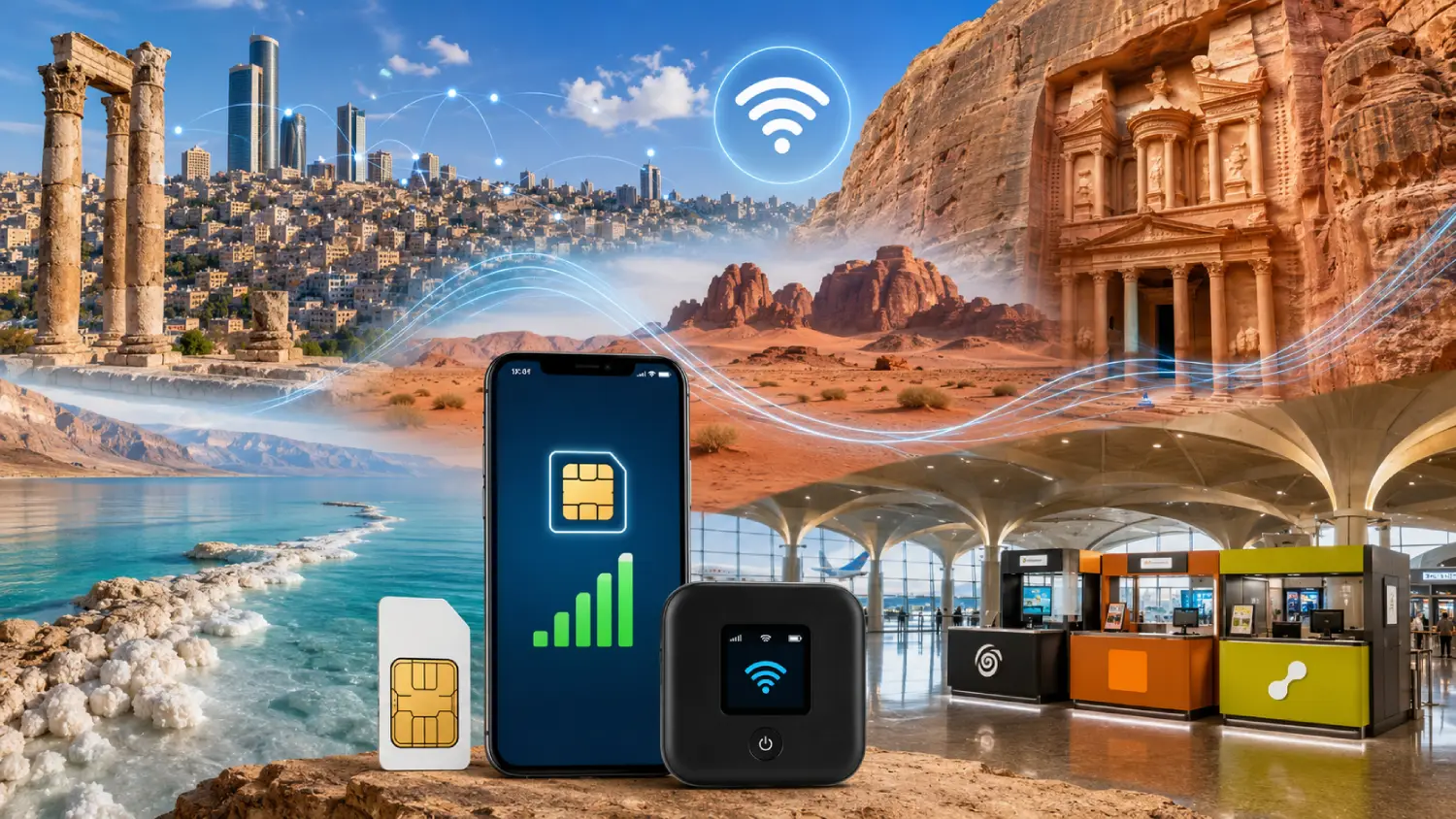
The main internet options for travelers in Jordan are airport SIM cards, local prepaid SIM cards, a travel eSIM, pocket WiFi, and public WiFi. Each option works, but the best choice depends on how long you are staying, whether your phone supports eSIM, and how much time you want to spend setting things up after landing.
Internet in Jordan: Quick Comparison
| Option | Best For | Setup Time | Passport Needed | Typical Cost | Main Advantage | Main Limitation |
|---|---|---|---|---|---|---|
| Airport SIM card | Travelers who want a local number immediately | 10–30 minutes | Yes | Around $11–$30+ depending on plan | Easy to buy after landing | Queues, registration, changing SIM |
| Local prepaid SIM card | Longer stays and high-data users | 20–45 minutes | Yes | Around $8–$30+ depending on plan | Good value in city stores | Requires visiting a store |
| Roafly eSIM | Most tourists with eSIM-compatible phones | A few minutes | No physical SIM registration at airport | From $14.90 | Install before arrival | Requires eSIM-compatible unlocked phone |
| Pocket WiFi | Groups and laptop users | Delivery or pickup required | Usually account/payment details | Around $3.30–$12 per day | Connects several devices | Extra device to charge and carry |
| Airport/public WiFi | Light emergency use | Instant | Usually no | Free | Useful on arrival | Not ideal for maps, payments, or private accounts |
Exclusive Reader Bonus!
Enjoy an extra %10 OFF your first Roafly eSIM purchase as a thank you for reading.
Airport SIM Cards in Jordan
Most international visitors arrive at Queen Alia International Airport near Amman. The airport is the easiest place to buy a SIM card immediately after landing, especially for travelers who want mobile data before meeting a driver or leaving for Amman, Petra, the Dead Sea, or Wadi Rum.
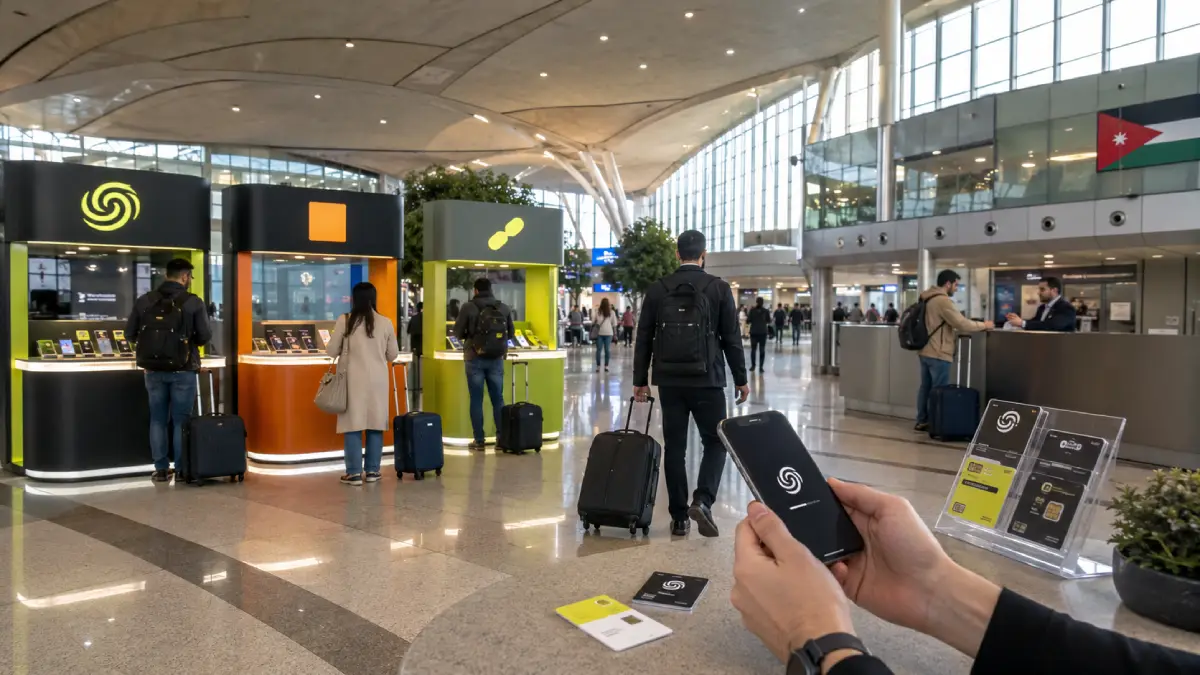
Jordan’s major mobile operators include Zain, Orange, and Umniah. Tourist SIM counters or arrivals-area options may be available at the airport, but exact packages, opening hours, and stock can change. Travelers should always check the final price at the counter before paying.
The biggest advantage of an airport SIM is convenience. The biggest downside is that airport offers may be more limited than city-store plans. Some airport packages also include local minutes, SMS, or tourist bundles that may not be necessary for travelers who only need data.
To buy a physical SIM card in Jordan, tourists should expect to show a passport for registration. This is normal and should be completed before leaving the counter. It is also worth asking the staff to activate the SIM and test mobile data before leaving the arrivals hall.
Airport SIM Card Prices in Jordan
| Provider / Option | Example Tourist or Visitor Plan | Validity | Listed / Reported Price | Approx. USD | Good For |
|---|---|---|---|---|---|
| Zain Weekly Visitors Line | 30GB, 15 international minutes, 20 local minutes, 10 local SMS | 7 days | 7.87 JOD including tax | Around $11.10 | Short trips and fast airport setup |
| Orange Visitors Line 5G | 90GB, 30 international minutes, 10 international SMS | Noted as visitor line | 21.30 JOD with tax | Around $30.05 | Higher-data visitors who want calls included |
| Umniah prepaid line example | 20GB, unlimited local minutes, 3000 SMS | 30 days | 6 JOD base package, with first-month/setup terms shown separately | Around $8.46 before extra setup/tax conditions | Budget city-store setup |
| Umniah 4G prepaid internet | 45GB prepaid internet | 30 days | 8 JOD, taxes/fees may be separate | Around $11.28 before taxes/fees | Data-heavy users with separate internet plan |
Price note: Local prices were checked on May 30, 2026. USD conversions use an approximate rate of 1 JOD = $1.41. Orange lists its visitor line at 21.30 JOD with tax, Zain lists a weekly visitor line at 7.87 JOD including tax, and Umniah lists prepaid options with separate setup, tax, or device-related conditions depending on the product.
Buying a Local SIM Card in Jordan
A local SIM card can be a practical option if you are staying in Jordan for several weeks, need a Jordanian phone number, or want a large data allowance from a local shop.

Local SIM cards are commonly available in:
| Where to Buy | Best For | What to Expect |
|---|---|---|
| Airport arrivals area | Immediate connection after landing | Convenient, but sometimes fewer package choices |
| Official operator stores | Best plan selection | Passport registration and staff-assisted activation |
| Shopping malls in Amman | Easy setup in the city | Good option after hotel check-in |
| City phone shops | Quick top-ups and local help | Make sure registration is official |
| Aqaba and tourist areas | Red Sea and southern Jordan stays | Availability may vary by area |
The process is usually simple. Bring your passport, choose a prepaid package, confirm whether tax is included, and ask the staff to activate the line. Before leaving, open a website, send a WhatsApp message, or load Google Maps to confirm that data is working.
Local SIM cards are often attractive because Jordanian operators offer generous data packages. For example, Umniah lists prepaid mobile and prepaid internet plans with 20GB, 45GB, and larger data allowances, while Orange’s visitor line includes 90GB with international minutes. Zain’s visitor offer focuses on a 7-day travel package with 30GB and included call minutes.
Local SIM Pros and Cons
| Pros | Cons |
|---|---|
| Can be good value for longer stays | Requires passport registration |
| Often includes local calls and SMS | Requires visiting a counter or shop |
| Useful if you need a Jordanian number | Physical SIM swap may be inconvenient |
| Large data packages are available | Airport prices and city prices may differ |
| Staff can help with activation | Some plans include taxes or setup fees separately |
For many travelers, the main question is not whether local SIM cards work. They do. The real question is whether the extra setup time is worth it.
A local SIM makes sense for long stays, student travel, business trips, or visitors who need local calls. For a typical 5–10 day tourism itinerary, an eSIM is usually simpler.
Roafly eSIM for Jordan
A Jordan eSIM is the easiest way to get mobile data without changing your physical SIM card. You can install it before departure, keep your home SIM in your phone, and turn on mobile data after landing.
Roafly is a strong option for Jordan because it focuses on practical travel data plans, simple setup, and balanced price-performance.
Roafly Jordan eSIM Plans
Exclusive Reader Bonus!
Enjoy an extra %10 OFF your first Roafly eSIM purchase as a thank you for reading.
| Travel Style | Recommended Data | Why |
|---|---|---|
| Weekend in Amman or Dead Sea | 5GB | Maps, WhatsApp, light browsing |
| 5–7 day classic Jordan trip | 10GB | Amman, Petra, Wadi Rum, transfers, tickets, social media |
| 10–14 day trip | 10GB–20GB | More navigation, more photos, more hotel changes |
| Road trip with Wadi Rum and Aqaba | 20GB | Hotspot, long navigation, uploads, limited camp WiFi |
| Remote work or frequent video calls | 20GB | More stable buffer for calls and laptop use |
How Much Data Do You Need in Jordan?
| Travel Style | Recommended Data | Why |
|---|---|---|
| Weekend in Amman or Dead Sea | 5GB | Maps, WhatsApp, light browsing |
| 5–7 day classic Jordan trip | 10GB | Amman, Petra, Wadi Rum, transfers, tickets, social media |
| 10–14 day trip | 10GB–20GB | More navigation, more photos, more hotel changes |
| Road trip with Wadi Rum and Aqaba | 20GB | Hotspot, long navigation, uploads, limited camp WiFi |
| Remote work or frequent video calls | 20GB | More stable buffer for calls and laptop use |
A 5GB plan is enough for travelers who mainly use mobile data outside the hotel. A 10GB plan is the safest choice for most visitors. A 20GB plan is better for self-driving trips, longer stays, or travelers who upload photos and videos frequently.
For a deeper eSIM-only breakdown, the best eSIM for Jordan guide is useful when comparing data sizes, coverage expectations, and practical setup tips.
eSIM vs Local SIM Card in Jordan
| Feature | Roafly eSIM | Local SIM Card |
|---|---|---|
| Setup before arrival | Yes | No |
| Airport queue needed | No | Often yes |
| Physical SIM swap | No | Yes, unless using local eSIM where available |
| Passport registration at airport counter | No | Yes |
| Local Jordanian phone number | No, data-only travel eSIM | Yes |
| Best for | Most short-term travelers | Long stays and local calls |
| Activation | iOS Direct Install, QR Code, Manual | Staff-assisted or app/counter setup |
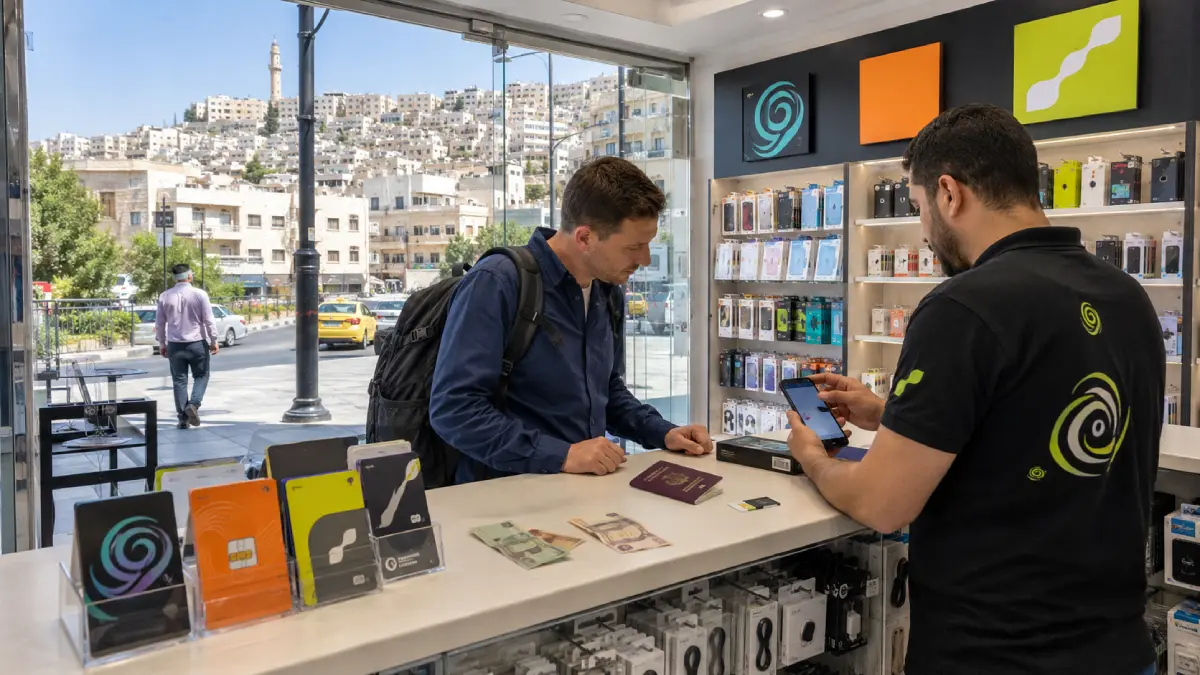
An eSIM is best for travelers who want data immediately after landing. A local SIM is better for travelers who need local calls, expect to stay longer, or want a local number for reservations and services.
For a normal Jordan itinerary, mobile data is usually more important than voice minutes. WhatsApp, Google Maps, ride-hailing apps, hotel messaging, ticket confirmations, and email all work well with data. That is why an eSIM is often the cleanest option for tourists.
Mobile Coverage in Jordan
Jordan has good mobile coverage in major cities and popular tourist routes, but the experience can vary by location, terrain, and network.
Amman generally has the strongest mobile experience. Coverage is also usually good around Jerash, the Dead Sea hotel areas, Petra, Aqaba, and main highways. In desert areas, mountain roads, canyons, and remote Wadi Rum camps, signal can be less consistent. Downloading offline maps before leaving Amman is a smart habit.
Orange Jordan’s own coverage page explains that coverage maps are estimates and that real service can vary based on signal strength, device, buildings, geography, and topography. This matters in Jordan because many trips include mountains, valleys, desert camps, and long rural drives.
Independent coverage tools also show 2G, 3G, 4G, and 5G network layers for Jordanian operators such as Zain, Orange, and Umniah, which is useful for checking general availability before traveling to specific areas.
Coverage by Travel Area
| Area | What to Expect | Travel Tip |
|---|---|---|
| Amman | Strongest and most reliable mobile coverage | Good for setup, downloads, and app updates |
| Queen Alia Airport | Mobile and WiFi options available | Activate eSIM or test SIM before leaving |
| Petra | Generally usable around town and main areas | Save tickets and maps offline |
| Wadi Rum | Coverage can vary by camp and desert location | Send driver/camp details before entering remote areas |
| Aqaba | Usually good mobile coverage in the city and resort areas | Useful for uploads and beach stays |
| Dead Sea | Generally usable near major resorts | Offline maps help on quieter roads |
| Desert highways | Coverage may drop in low-traffic areas | Do not rely only on live navigation |
Pocket WiFi in Jordan
Pocket WiFi is a portable hotspot device that creates a private WiFi network for your phone, tablet, or laptop. It can be useful for families, small groups, business travelers, and anyone who needs to connect multiple devices.
The main advantage is shared connectivity. One device can connect several phones or laptops, which may be useful for group travel. Some pocket WiFi rental companies advertise Jordan coverage, with prices starting around €3.30 per day for some global pocket WiFi options, while other hotspot rentals list around $12 per day.
The downside is convenience. A pocket WiFi device must be charged, carried, collected, delivered, or returned. If the battery dies during a full-day Petra visit or Wadi Rum tour, everyone connected to it may lose internet. It is also one more device to manage while traveling.
| Pocket WiFi Pros | Pocket WiFi Cons |
|---|---|
| Good for groups | Extra device to carry |
| Can connect laptops and tablets | Needs charging |
| Useful for work trips | Delivery or pickup may be required |
| Avoids changing SIM cards | Daily rental can become expensive |
| Shared data for multiple people | Not as simple as an eSIM for solo travelers |
Pocket WiFi is worth considering for families or business travelers. For solo travelers and couples, an eSIM is usually simpler.
Airport WiFi and Public WiFi in Jordan
Queen Alia International Airport offers free WiFi, which can help travelers contact a driver, check hotel messages, or confirm arrival details. Airport WiFi guides report free WiFi at Amman Airport, with the network often listed as QAIA Free WiFi or similar airport WiFi naming.
Airport WiFi is useful as a backup, but it should not be your main internet plan. It may be slower during busy periods, and it only helps while you are inside the airport. Once you leave for Amman, the Dead Sea, Petra, or Wadi Rum, mobile data becomes much more important.
Public WiFi is also common in many hotels, cafes, restaurants, and some tourist areas. It is fine for light browsing, but it should be used carefully. Public networks can expose travelers to security risks, especially when logging into banking apps, work accounts, or sensitive email. The U.S. travel advisory for Jordan recommends safe technology habits abroad and specifically warns against connecting to public WiFi networks.
Safer Public WiFi Habits
| Situation | Better Practice |
|---|---|
| Checking maps | Use mobile data or offline maps |
| Logging into banking apps | Avoid public WiFi |
| Uploading photos | Use hotel WiFi if trusted |
| Updating apps | Wait for secure hotel WiFi |
| Entering passwords | Prefer mobile data |
| Connecting at airports | Verify the official network name |
Public WiFi is best treated as a backup, not a replacement for mobile data.
Best Internet Option by Traveler Type
| Traveler Type | Best Option | Why |
|---|---|---|
| First-time visitor | Roafly eSIM | Simple setup before arrival |
| Short Amman trip | 5GB eSIM | Enough for maps and messaging |
| Classic Jordan route | 10GB eSIM | Best balance for Amman, Petra, Wadi Rum, Dead Sea |
| Long stay | Local SIM or 20GB eSIM | More data or local number depending on needs |
| Family trip | Pocket WiFi or multiple eSIMs | Depends on number of devices |
| Business traveler | 20GB eSIM or pocket WiFi | Better for hotspot and calls |
| Traveler needing local calls | Local SIM | Includes Jordanian phone number |
| Heavy social media user | 20GB eSIM | More buffer for uploads |
For most tourists, the easiest setup is a Roafly Jordan eSIM installed before the flight. It avoids the airport SIM queue, keeps the physical SIM slot free, and gives mobile data as soon as the phone connects after landing.
Travelers unsure about how much data they need can use a Data Usage Calculator before choosing between 5GB, 10GB, and 20GB.
Practical Tips Before You Travel to Jordan
Before flying to Jordan, check that your phone is unlocked and supports eSIM if you plan to use one. Install the eSIM while you still have stable WiFi at home or at the airport before departure. After landing, set the eSIM as your mobile data line and keep data roaming enabled for the travel eSIM if required.
Download offline Google Maps for Amman, Petra, Wadi Rum, Aqaba, and the Dead Sea. Save hotel addresses in both English and Arabic when possible. Keep screenshots of tour bookings, Petra tickets, airport transfer details, and camp reservations.
If you buy a local SIM card, test it before leaving the shop. Confirm the data allowance, validity, tax, hotspot rules, and whether the plan includes app-specific data or full general data.
If Jordan is part of a wider Middle East route, the Egypt airport SIM card and eSIM guide is also helpful for understanding how airport SIM buying can differ across the region.
Final Recommendation
The best way to get internet in Jordan in 2026 is to choose the option that matches your trip style.
A local SIM card can be useful for long stays and travelers who need a Jordanian phone number. Airport SIM cards are convenient but may involve queues, passport registration, and package differences. Pocket WiFi works for groups, but it adds another device to carry and charge. Public WiFi is helpful in emergencies, but it is not reliable enough for a full trip.
For most travelers, a Roafly Jordan eSIM is the smoothest option. It can be installed before arrival, works without a physical SIM swap, and offers clear 5GB, 10GB, and 20GB plans for different travel styles.


