

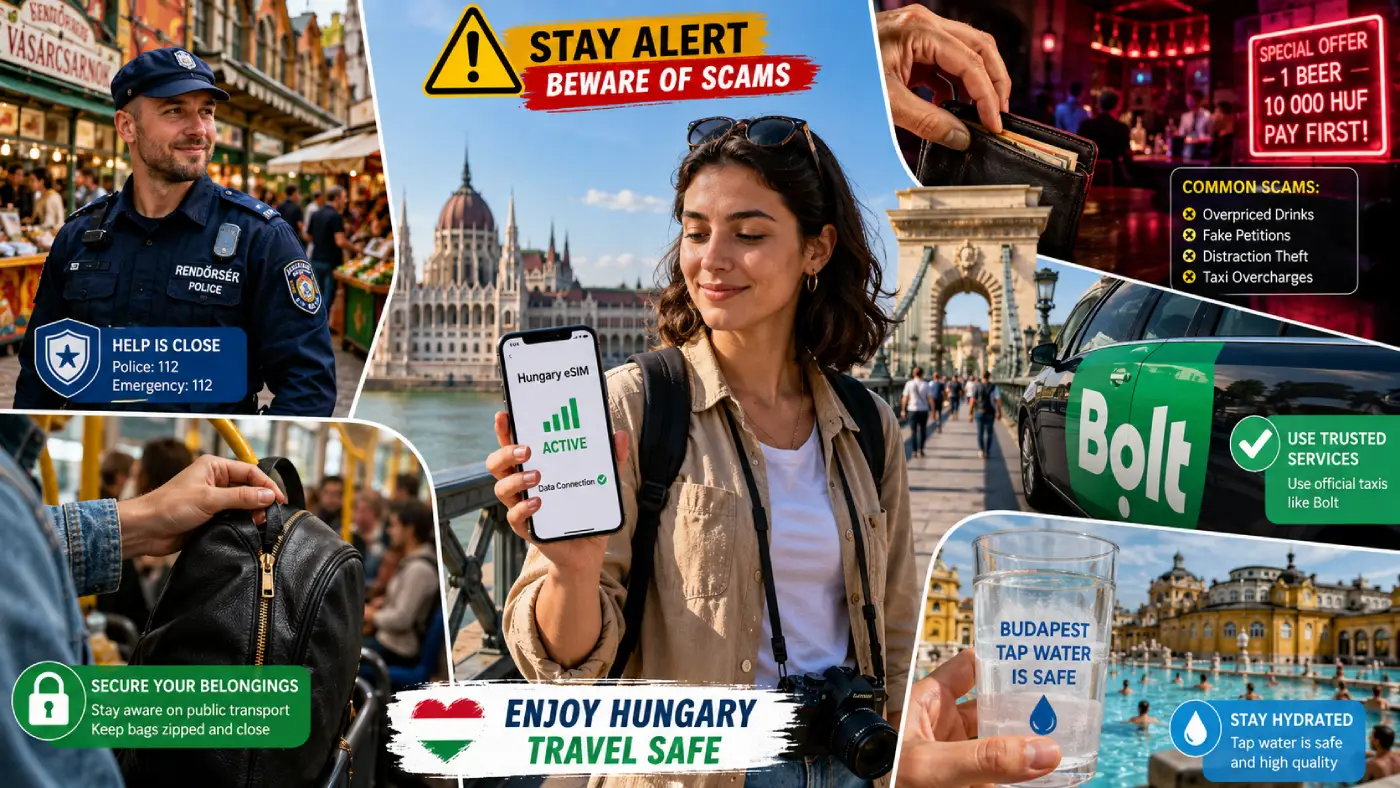

The short answer is absolutely yes. Hungary remains of the safest countries in Central Europe for violent crime, but the threat landscape has shifted entirely to financial deception. You do not need to worry about being physically harmed, but you must be incredibly vigilant about being financially exploited. The danger here is not in a dark alley, but rather at a crowded bar or in the back of an unmetered taxi.
The Current Reality: Crime, Police, and Public Order
Hungary in 2026 is a heavily policed and highly orderly society. Unlike destinations in Latin America, you will not find any presence of drug cartels, armed gangs, or violent turf wars. The country boasts an exceptionally low violent crime rate, making it a haven for travelers who want to explore without looking over their shoulder in fear of muggings.
However, the "bad reputation" Hungary occasionally gets comes from highly specialized, non-violent organized crime rings that target tourists in the capital. These groups focus purely on petty theft and elaborate social engineering scams. The police are strict and visible, particularly in central Budapest, but they are often overwhelmed by the sheer volume of minor tourist complaints during the peak summer months.
Tourists are expected to follow the law strictly, and public intoxication or rowdy behavior can lead to swift fines. The authorities have zero tolerance for public disturbance, so acting like a foolish tourist will quickly draw the wrong kind of attention. It is highly recommended to read up on local regulations, specifically the Hungary Tourist Bans & Laws, to avoid an expensive fine.
You should also be aware that the local police generally do not speak fluent English outside of the main tourist precincts. If you need to report a crime, you will often need to find a central police station or ask a hotel concierge to assist with translation. The overarching rule for 2026 is that the police will protect your physical safety, but you are responsible for protecting your cash.
Regional Breakdown: Safe Zones vs. Areas to Avoid
Budapest is physically divided by the Danube River into two distinct halves: Buda and Pest. The Buda side is residential, hilly, wealthy, and universally safe at all hours of the day and night. You can wander around the Buda Castle District or Gellért Hill past midnight with practically zero risk of anything happening to you.
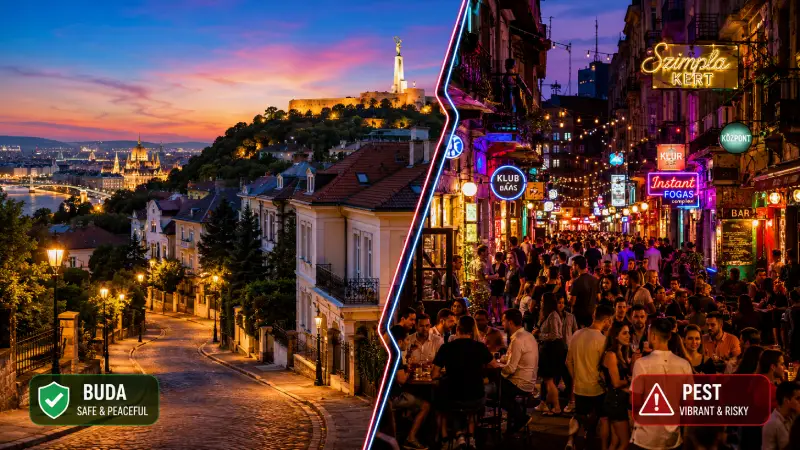
The Pest side is flat, bustling, and where 90% of the tourist action happens. District V (Belváros-Lipótváros) and District VI (Terézváros) are highly patrolled and very safe, though you must watch out for pickpockets near major monuments. District VII, the famous Jewish Quarter and home to the ruin bars, is safe from violent crime but is the absolute epicenter for drunk tourists getting robbed, scammed, or pickpocketed after 2:00 AM.
While Budapest has no "no-go" favela-style zones, there are a few areas you should avoid to prevent uncomfortable encounters.
-
District VIII (Józsefváros): The inner parts of District VIII have gentrified heavily and are fine, but the outer edges, particularly around Hős utca and Magdolna-Negyed, remain socially disadvantaged. There is no reason for a tourist to be here, and petty crime is noticeably higher.
-
District X (Kőbánya): This is a purely industrial and residential working-class district. It is not inherently deadly, but it is poorly lit at night and has a higher rate of petty theft.
-
Outer Ring Suburbs: Areas far outside the subway network are generally safe but isolating. If you get stranded here at night, finding a legitimate taxi is difficult, leaving you vulnerable to illegal drivers.
-
Keleti and Nyugati Train Stations: The immediate blocks surrounding these major transit hubs are famous hotspots for transient pickpockets, aggressive beggars, and shady money changers.
Overall, stick to the inner districts of Pest and anywhere in Buda, and you will have a completely secure trip. Just remember that the closer you are to a famous ruin bar, the closer you are to someone trying to lift your smartphone.
Transportation Safety: Taxis vs. Public Transit
Public transportation in Hungary is phenomenal, cheap, and generally very safe. The metro, trams, and buses run efficiently, and the iconic Tram 2 along the Danube is a must-do experience. However, crowded transit lines during rush hour are the primary hunting grounds for organized pickpocket rings.
You must keep your bag zipped and in front of you when riding the Metro Line M3 or Tram 4/6, as these are notorious for quick-fingered thieves. Never stand near the doors while looking down at your phone; thieves will snatch it right as the doors close. If you are arriving from the airport, familiarize yourself with the Hungary Airport Customs Rules: Alcohol, Cigarettes, and Cash Limits so you aren't delayed in transit.
Taxis are where tourists face the highest risk of being taken advantage of. Never, under any circumstances, hail a random taxi off the street or accept a ride from drivers lingering outside train stations or nightclubs. Unlicensed "freelance" taxis look identical to legitimate, but they use rigged meters that spin incredibly fast, turning a $10 ride into a $150 extortion.
-
The Safe Taxi Rules: get into a certified yellow taxi that clearly displays "minősített budapesti taxi" on the front door.
-
The Best Method: Use the Bolt app. Uber does not operate independently in Hungary in the same way it does elsewhere, but Bolt is the undisputed king of safe, trackable, and fixed-price rides.
-
Night Driving: Driving yourself is safe, but rural roads outside of Budapest are poorly lit, and Hungarian drivers can be aggressive. Furthermore, Hungary has a strict zero-tolerance policy for drinking and driving—even beer will land you in jail.
Tourist Scams (The New Threat)
In 2026, the biggest threat to your safety in Hungary is your own gullibility. Scammers here are highly sophisticated and prey on polite tourists who are afraid to say no. The scams are almost always psychological, relying on confusion, charm, or intimidation to separate you from your Euros or Forints.
The most infamous trap is the Friendly Bar Invitation, mostly operating around Váci utca and District VII. Two attractive young women will approach a solo male or group of guys, ask for directions, and suddenly suggest going to a "great local bar" nearby. inside, you order a round of drinks, the girls disappear, and a massive bouncer hands you a bill for $500. If you refuse to pay, they will physically escort you to an ATM.
Here are the other major scams to watch out for in 2026:
-
The Fake Police Officer: A stranger approaches you on the street claiming to be an undercover cop and asks to check your wallet for counterfeit bills. Real police in Hungary carry visible ID and will never ask to inspect your cash on the sidewalk.
-
Currency Exchange Traps: Booths near tourist traps advertise "0% Commission" but offer an abysmal exchange rate that robs you of 30% of your money's value. Always use a proper bank ATM and decline the machine's offer to do the conversion for you.
-
Fake Drug Sellers: Around Kazinczy Street, men will whisper offering you marijuana or cocaine. It is always a scam. They are selling dried parsley or crushed aspirin, and they target drunk tourists who cannot go to the police when they realize they have been cheated.
-
Overpriced Menus: A restaurant will have cheap prices listed on a board outside, but hand you a "tourist menu" inside with no prices. Always demand to see the prices before ordering a bottle of wine.
Women’s Safety & Solo Travel
Hungary is widely considered a highly secure destination for solo female travelers. The aggressively macho culture found in some other parts of the world is not prevalent here. Catcalling is relatively rare, and women can generally walk alone through central Budapest at night without experiencing harassment.
Nightlife safety is the main area where female travelers must be vigilant. Drink spiking is a documented issue in the mega-clubs and crowded ruin bars of District VII. Never accept a drink from a stranger unless you saw the bartender pour it, and never leave your glass unattended on a table while you go to the bathroom.
Dress codes are virtually non-existent; you can wear whatever you feel comfortable in. Hungarian summers are brutally hot, and locals dress accordingly. The exception is if you plan to visit a historic church or the massive Esztergom Basilica, where modest clothing covering your shoulders and knees is expected out of respect.
If you are a solo traveler relying on digital maps to get home safely after dark, you absolutely need a working data connection. It is highly recommended to read up on How to Get Internet in Hungary to ensure you are never stranded offline in an unfamiliar neighborhood.
Health, Tap Water & Nature
You will be happy to know that you can drink the tap water anywhere in Hungary. The water quality in Budapest is excellent, heavily regulated, and completely safe for human consumption. Do not waste your money or create plastic waste by constantly buying bottled water; just bring a refillable canteen.
Health risks are incredibly low. There are no malaria or dengue fever risks, though tick-borne encephalitis is present in the deep forests if you plan on hiking in the countryside during the summer. If you are sticking to the cities, your biggest health risk is a wicked hangover from too much local Palinka.
Hungary is entirely landlocked and sits on stable tectonic ground, meaning there is zero risk of tsunamis, major earthquakes, or hurricanes. The natural hazard to be aware of is the intense summer heatwaves that frequently push temperatures above 35°C (95°F) in July and August. Heatstroke is a very real danger for tourists walking the city streets all day, so stay hydrated and seek air conditioning during the mid-afternoon.
The Ultimate Safety Tool: Staying Connected
In 2026, the single most important safety device you can carry is a fully connected smartphone. Being able to instantly call a Bolt to escape a sketchy street, translate a menu to avoid a scam, or use Google Maps to route around a bad neighborhood is non-negotiable. Relying on spotty café Wi-Fi is dangerous, as public networks in tourist zones are notorious for data-sniffing hackers looking to steal your credit card details.
Need data in Hungary? Get an eSIM!
Choose the perfect data plan for your trip

Manage your eSIM in the app
Install, top up and track data.
A digital eSIM allows you to land in Budapest with instant, secure 5G data before you even clear customs. You will never have to pull out your wallet in a crowded train station to buy a physical SIM card, which instantly marks you as a target for pickpockets. If you want a deep dive into the top providers, check out the Best eSIM for Hungary.
For seamless, secure connectivity across the country, Hungary eSIM is your best defense against getting lost and scammed.
Official Travel Advisories
Global governments routinely assess the safety of Hungary, and their advice remains remarkably consistent for 2026. Because there is no terrorism threat or gang violence, the focus is entirely on petty theft.
-
United States (State Department): Ranks Hungary as a Level 1 destination (Exercise Normal Precautions). They highlight that violent crime is rare, but they strongly warn US citizens about financial scams, specifically the padded bar tabs and inflated taxi fares in Budapest.
-
United Kingdom (FCDO): Advises that most visits are trouble-free. They note the risk of pickpocketing on public transport and warn British tourists against buying illicit drugs, highlighting the severe penalties and high likelihood of being scammed.
-
Canada: Recommends taking normal security precautions. The Canadian government explicitly warns travelers to be aware of their surroundings at Keleti train station and on the Metro Line 3, noting these as specific hotspots for organized bag snatching.
The Verdict: Is Hungary Safe?
Hungary in 2026 is an exceptionally safe destination that simply demands a standard level of urban awareness. You will not face physical danger, but you will encounter highly organized attempts to separate you from your money if you wander blindly into tourist traps. By staying alert, researching common scams, and maintaining a healthy dose of skepticism, your trip will be entirely secure.
-
Never hail a taxi off the street. Always use the Bolt app to guarantee a licensed driver and a fixed, transparent price.
-
Decline friendly bar invitations. If beautiful strangers approach you on the street and urgently want to take you to a specific bar, walk away immediately.
-
Keep your data active. Having a secure internet connection is your lifeline for maps, translation, and emergency transport.
-
Watch your pockets on transit. Keep your bags zipped and in front of you when riding the Metro or the Tram 4/6 line.
-
Check prices before ordering. Never order a drink or a meal without explicitly seeing the price written on a menu first.
Note: Travel safety situations can change rapidly. This information is accurate as of July 2026. Always exercise street smarts and consult official advisories before your trip.