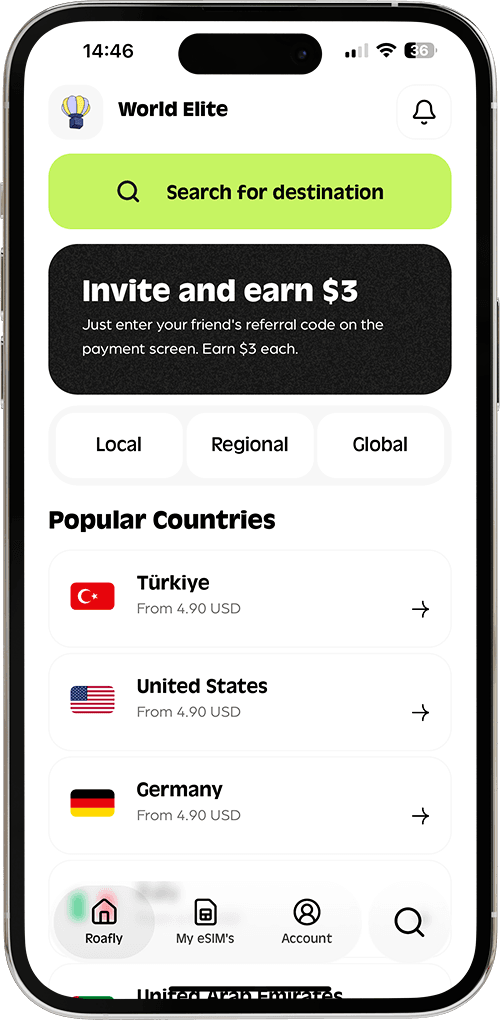


The best option depends on how long you are staying, how much data you need, and whether you want to deal with a physical SIM at all. For most travelers, the easiest setup is to activate mobile data before arrival and avoid store visits entirely. If you want a deeper breakdown of digital plans before choosing, the best eSIM for Hungary guide is a useful next read, and travelers who already know they want a digital setup can go straight to the Hungary eSIM page.
Internet options in Hungary at a glance
Hungary has several traveler-friendly ways to get, but they are not equally convenient. Airport SIMs are easy to find but usually cost more. Local prepaid SIMs can be cheaper, though they take time and often require an in-store visit. Pocket WiFi works well for groups but adds another device to charge and carry. Public WiFi is fine as a backup, not as your main connection. Roafly eSIM is the most convenient option if you want to land connected and skip the store entirely.
| Option | Where to get it | Example price in 2026 | Best for | Main downside |
|---|---|---|---|---|
| Roafly eSIM | Online before departure | From $3.90 | Most travelers, fast setup, no physical SIM | Requires an eSIM-compatible phone |
| Airport SIM | Budapest Airport Terminal 2B | Telekom Travel SIM 20 GB / 10 days: 10,000 HUF (about $29.60); 100 GB / 30 days: 15,000 HUF (about $44.40) | Travelers who want a physical SIM right after landing | Higher upfront cost |
| Local prepaid SIM | Operator stores in the city | Yettel 3 GB / 5 days: 1,500 HUF (about $4.44); Yettel 10 GB / 5 days: 3,000 HUF (about $8.88) | Budget travelers comfortable visiting a store | Setup takes time |
| Pocket WiFi | Online rental | From €3.95/day | Groups, laptops, multiple devices | Extra device, battery, rental logistics |
| Airport or public WiFi | Airport, hotels, cafés | Usually free | Light use, emergencies | Security and reliability are inconsistent |
Exchange estimates above use roughly 1 USD = 338 HUF on 8 March 2026.
Need data in Hungary? Get an eSIM!
Choose the perfect data plan for your trip

Manage your eSIM in the app
Install, top up and track data.
Buying a SIM card at Budapest Airport
If you want mobile data immediately after landing and prefer a physical SIM, Budapest Airport is the most obvious place to start. Telekom has an airport counter on the arrivals level of Terminal 2B, and Telekom’s official visitor page lists two Travel SIM options for foreign visitors: 20 GB valid for 10 days for 10,000 HUF, and 100 GB valid for 30 days for 15,000 HUF. The same official page also confirms the airport pickup point at Terminal 2B, arrivals level, ground side.

Those airport prices are not outrageous by European airport standards, but they are clearly not the cheapest way to get data in Hungary. The 20 GB option works out to roughly $29.60, while the 100 GB option is about $44.40 using the current exchange rate. That can still make sense if you are arriving late, need a physical number, or do not want to troubleshoot connectivity after landing.
The tradeoff is simple: airport SIMs optimize convenience, not value. You are paying more for immediate access and a staffed point of sale. For some travelers that is perfectly fair. For others, especially short-stay visitors who need maps, messaging, rides, and light browsing, it is more data than necessary at a higher price point.
Another detail worth knowing is that the airport option is built around a store visit. That means queueing, registration steps, and swapping your physical SIM if your phone does not support dual SIM the way you want. If you land tired, that can feel like friction you did not need. An eSIM avoids that entire process because your plan can be installed before departure and activated when you arrive.
Local tourist SIM cards in Hungary
If you want to save money and do not mind visiting a mobile store in the city, local prepaid SIMs are often better value than airport purchases. Hungary’s main operators serving travelers are Telekom, Yettel, and. Telekom markets dedicated Travel SIM products for visitors, Yettel publishes prepaid pay-as-you-go offers in English, and has an English-language foreign visitors page that directs non-Hungarian customers to stores for activation and support.

Yettel currently lists two especially useful prepaid starter options for short trips. The first is a 3 GB package with extra voice credit for 1,500 HUF, valid for 5 days. The second is a 10 GB package with extra voice credit for 3,000 HUF, also valid for 5 days. At the March 2026 exchange rate, those are roughly $4.44 and $8.88.
That makes local prepaid SIMs attractive for travelers on city breaks, especially if your stay is under a week and you do not need huge amounts of data. A 3 GB or 10 GB allowance is usually enough for navigation, WhatsApp, restaurant searches, transport apps, email, and moderate social media use. Travelers who stream heavily, tether a laptop, or upload a lot of video will burn through those allowances faster.
One also supports foreign visitors with pay-as-you-go service, but its English visitor page is more focused on in-store activation and account management than clear headline tourist pricing. In practice, that means may still be useful if there is a branch near your accommodation, but it is less transparent for travelers who want to compare and buy quickly in English before going in.
The main downside of local SIM shopping is time. You need to find a branch, communicate what you want, complete activation, and sometimes top up later if your first package is not enough. That may be fine if you are staying longer or prefer the lowest upfront cost. It is less appealing if you just want your phone working the second the plane lands.
The easiest option: Roafly eSIM for Hungary
For most travelers in 2026, eSIM is the cleanest solution because it removes the store visit entirely. Roafly’s Hungary eSIM is data-only, supports mobile hotspot, does not require eKYC, and starts its validity period when the SIM first connects to a supported network in Hungary.
Need data in Hungary? Get an eSIM!
Choose the perfect data plan for your trip
Manage your eSIM in the app
Install, top up and track data.
It works on Telenor Hungary and Vodafone, which is a practical setup for everyday travel use. The available installation methods are iOS & Android Direct Install, QR Code, and Manual setup, so most compatible devices can be activated in a few minutes. Based on the package details you shared, the current Roafly Hungary pricing is as follows:
| Roafly Hungary eSIM | Validity | Price |
|---|---|---|
| 1 GB | 7 days | $3.90 |
| 2 GB | 14 days | $5.50 |
| 3 GB | 30 days | $7.50 |
| 5 GB | 30 days | $9.90 |
| 10 GB | 30 days | $16.90 |
| 20 GB | 30 days | $24.00 |
| 50 GB | 180 days | $44.90 |
This lineup covers almost every travel style. The 1 GB and 2 GB plans work for ultra-light users who mainly need maps, messaging, and ride apps. The 3 GB and 5 GB plans are a better match for a standard city trip. The 10 GB and 20 GB plans make more sense for remote workers, longer stays, or travelers who regularly hotspot another device. The 50 GB option is especially useful for long-stay visitors, slow travelers, or anyone crossing Central Europe over a longer period and needing a large buffer.
The convenience advantage is what really matters here. You can install the eSIM before your flight, keep your primary SIM in place, and connect after landing without searching for a kiosk or swapping plastic cards. That is particularly useful if you are arriving at night, taking a taxi into Budapest, or heading straight to another city.
Roafly also fits the way many travelers actually use data now. Most people do not need a local phone number to enjoy a trip. They need Google Maps, WhatsApp, booking confirmations, translation apps, banking access, train tickets, and hotspot support. A data-only eSIM covers all of that cleanly.
If you are unsure how much data you need, a practical rule is simple. Light users can start at 3 GB. Average travelers are usually safer with 5 GB. If you plan to upload photos every day, work remotely, or tether a laptop, 10 GB or more is the safer choice. A data usage calculator can also help if your trip style is hard to estimate.
Is pocket WiFi worth it in Hungary?
Pocket WiFi still has a place, but it is a niche choice now. It is most useful for families, small groups, or travelers carrying multiple WiFi-only devices. A rental provider currently advertising Hungary service lists pocket WiFi from €3.95 per day, with delivery options before departure or on arrival.
That sounds affordable at first, but the total adds up fast. On a 7-day trip, you are looking at around €27.65 before any optional extras, insurance, or shipping. For traveler, that is often more expensive and less convenient than a simple eSIM. You also need to carry the device, keep it charged, remember to return it, and make sure your group stays close enough to the hotspot to benefit from it.
Pocket WiFi becomes more reasonable when the cost is shared across two or three people, especially if everyone needs to connect a laptop or tablet as well as a phone. Even then, it is still another travel object to manage. For solo travelers and couples, eSIM is usually the simpler answer.
Can you rely on airport and public WiFi in Hungary?

You can use WiFi in Hungary, but it works best as a backup rather than your primary connection. Budapest Airport officially provides free WiFi throughout the airport terminals, including the departure and arrival halls of Terminal 2A and 2B. That is useful for ordering a ride, sending an arrival message, or checking directions when you land.
Beyond the airport, Budapest has plenty of WiFi access in cafés, hotels, shopping areas, and tourist-heavy districts, and city guides commonly note that free hotspots are widespread across the capital. Still, public WiFi always comes with tradeoffs: performance varies, login systems can be annoying, and open networks are never ideal for banking, work accounts, or other sensitive tasks.
That is why public WiFi should be treated as a convenience layer, not your main internet strategy. It is great for saving data while you sit in a café. It is not great when you are walking between tram stops, trying to reach an apartment host, or translating a menu in a quiet neighborhood with no hotspot nearby.
Which option should you choose?
For most visitors, the answer is straightforward.
If you want the simplest setup, choose Roafly eSIM. It is the best fit for travelers who value convenience, want to stay connected from the moment they land, and do not want to spend part of their first day in a telecom store.
If you prefer a physical SIM and do not mind paying more for immediate access, the Budapest Airport Telekom counter is the fastest airport solution.
If you are on a tighter budget and you are comfortable visiting a shop in the city, a local prepaid SIM from Yettel can be very cost-effective for short stays.
If you are traveling in a group and plan to connect several devices at, pocket WiFi can still work, though it is rarely the most elegant choice.
If you need internet for a few quick tasks after arrival, airport WiFi is fine for the first few minutes, but it should not be your main plan for the whole trip.
Final thoughts
Hungary is an easy country to stay connected in, but the best method is not the same for every traveler. Airport SIMs are convenient, local prepaid plans can be cheap, pocket WiFi still works for groups, and public WiFi is useful in a pinch. But if you want the least friction, the fastest setup, and a plan you can activate before departure, Roafly eSIM is the most practical choice for 2026.