

'/%3e%3cpath id='l' d='M-26.25 0h52.5v-12h-40.5v-16h33v-12h-33v-11H25v-12h-51.25z'/%3e%3cpath id='k' d='M-31.5 0h12v-48l14 48h11l14-48V0h12v-70H14L0-22l-14-48h-17.5z'/%3e%3cpath id='b' fill-rule='evenodd' d='M0 0a31.5 35 0 0 0 0-70A31.5 35 0 0 0 0 0m0-13a18.5 22 0 0 0 0-44 18.5 22 0 0 0 0 44'/%3e%3cpath id='d' fill-rule='evenodd' d='M-31.5 0h13v-26h28a22 22 0 0 0 0-44h-40zm13-39h27a9 9 0 0 0 0-18h-27z'/%3e%3cpath id='n' d='M-15.75-22C-15.75-15-9-11.5 1-11.5s14.74-3.25 14.75-7.75c0-14.25-46.75-5.25-46.5-30.25C-30.5-71-6-70 3-70s26 4 25.75 21.25H13.5c0-7.5-7-10.25-15-10.25-7.75 0-13.25 1.25-13.25 8.5-.25 11.75 46.25 4 46.25 28.75C31.5-3.5 13.5 0 0 0c-11.5 0-31.55-4.5-31.5-22z'/%3e%3cuse xlink:href='%23a' id='o' transform='scale(31.5)'/%3e%3cuse xlink:href='%23a' id='p' transform='scale(26.25)'/%3e%3cuse xlink:href='%23a' id='r' transform='scale(21)'/%3e%3cuse xlink:href='%23a' id='q' transform='scale(15)'/%3e%3cuse xlink:href='%23a' id='s' transform='scale(10.5)'/%3e%3cg id='m'%3e%3cclipPath id='c'%3e%3cpath d='M-31.5 0v-70h63V0zM0-47v12h31.5v-12z'/%3e%3c/clipPath%3e%3cuse xlink:href='%23b' clip-path='url(%23c)'/%3e%3cpath d='M5-35h26.5v10H5z'/%3e%3cpath d='M21.5-35h10V0h-10z'/%3e%3c/g%3e%3cg id='h'%3e%3cuse xlink:href='%23d'/%3e%3cpath d='M28 0c0-10 0-32-15-32H-6c22 0 22 22 22 32'/%3e%3c/g%3e%3cg id='a' fill='%23fff'%3e%3cg id='f'%3e%3cpath id='e' d='M0-1v1h.5' transform='rotate(18 0 -1)'/%3e%3cuse xlink:href='%23e' transform='scale(-1 1)'/%3e%3c/g%3e%3cuse xlink:href='%23f' transform='rotate(72)'/%3e%3cuse xlink:href='%23f' transform='rotate(-72)'/%3e%3cuse xlink:href='%23f' transform='rotate(144)'/%3e%3cuse xlink:href='%23f' transform='rotate(216)'/%3e%3c/g%3e%3c/defs%3e%3crect width='100%25' height='100%25' x='-50%25' y='-50%25' fill='%23009b3a'/%3e%3cpath fill='%23fedf00' d='M-1743 0 0 1113 1743 0 0-1113z'/%3e%3ccircle r='735' fill='%23002776'/%3e%3cclipPath id='g'%3e%3ccircle r='735'/%3e%3c/clipPath%3e%3cpath fill='%23fff' d='M-2205 1470a1785 1785 0 0 1 3570 0h-105a1680 1680 0 1 0-3360 0z' clip-path='url(%23g)'/%3e%3cg fill='%23009b3a' transform='translate(-420 1470)'%3e%3cuse xlink:href='%23b' y='-1697.5' transform='rotate(-7)'/%3e%3cuse xlink:href='%23h' y='-1697.5' transform='rotate(-4)'/%3e%3cuse xlink:href='%23i' y='-1697.5' transform='rotate(-1)'/%3e%3cuse xlink:href='%23j' y='-1697.5' transform='rotate(2)'/%3e%3cuse xlink:href='%23k' y='-1697.5' transform='rotate(5)'/%3e%3cuse xlink:href='%23l' y='-1697.5' transform='rotate(9.75)'/%3e%3cuse xlink:href='%23d' y='-1697.5' transform='rotate(14.5)'/%3e%3cuse xlink:href='%23h' y='-1697.5' transform='rotate(17.5)'/%3e%3cuse xlink:href='%23b' y='-1697.5' transform='rotate(20.5)'/%3e%3cuse xlink:href='%23m' y='-1697.5' transform='rotate(23.5)'/%3e%3cuse xlink:href='%23h' y='-1697.5' transform='rotate(26.5)'/%3e%3cuse xlink:href='%23j' y='-1697.5' transform='rotate(29.5)'/%3e%3cuse xlink:href='%23n' y='-1697.5' transform='rotate(32.5)'/%3e%3cuse xlink:href='%23n' y='-1697.5' transform='rotate(35.5)'/%3e%3cuse xlink:href='%23b' y='-1697.5' transform='rotate(38.5)'/%3e%3c/g%3e%3cuse xlink:href='%23o' x='-600' y='-132'/%3e%3cuse xlink:href='%23o' x='-535' y='177'/%3e%3cuse xlink:href='%23p' x='-625' y='243'/%3e%3cuse xlink:href='%23q' x='-463' y='132'/%3e%3cuse xlink:href='%23p' x='-382' y='250'/%3e%3cuse xlink:href='%23r' x='-404' y='323'/%3e%3cuse xlink:href='%23o' x='228' y='-228'/%3e%3cuse xlink:href='%23o' x='515' y='258'/%3e%3cuse xlink:href='%23r' x='617' y='265'/%3e%3cuse xlink:href='%23p' x='545' y='323'/%3e%3cuse xlink:href='%23p' x='368' y='477'/%3e%3cuse xlink:href='%23r' x='367' y='551'/%3e%3cuse xlink:href='%23r' x='441' y='419'/%3e%3cuse xlink:href='%23p' x='500' y='382'/%3e%3cuse xlink:href='%23r' x='365' y='405'/%3e%3cuse xlink:href='%23p' x='-280' y='30'/%3e%3cuse xlink:href='%23r' x='200' y='-37'/%3e%3cuse xlink:href='%23o' y='330'/%3e%3cuse xlink:href='%23p' x='85' y='184'/%3e%3cuse xlink:href='%23p' y='118'/%3e%3cuse xlink:href='%23r' x='-74' y='184'/%3e%3cuse xlink:href='%23q' x='-37' y='235'/%3e%3cuse xlink:href='%23p' x='220' y='495'/%3e%3cuse xlink:href='%23r' x='283' y='430'/%3e%3cuse xlink:href='%23r' x='162' y='412'/%3e%3cuse xlink:href='%23o' x='-295' y='390'/%3e%3cuse xlink:href='%23s' y='575'/%3e%3c/svg%3e)
Which internet option fits your Brazil trip?
Start with three questions: does your current plan include Brazil, does your phone support eSIM, and do you need ordinary calls or SMS on a Brazilian number?
| Option | Cost basis | Best fit | Main limitation |
|---|---|---|---|
| Travel eSIM | Selected prepaid data package | Visitors who want to arrange mobile data before departure | Requires an unlocked, compatible device; data-only plans have no local number |
| Brazilian prepaid SIM | Physical SIM plus the chosen bundle or credit | Visitors needing a local number or using a phone without eSIM | Registration and tourist activation depend on the operator and purchase channel |
| Home-carrier roaming | Included allowance, travel pass or usage charges | Customers whose existing tariff already covers Brazil adequately | Check data limits, speeds, calls and extra charges |
| Wi-Fi | Free or included where offered; paid access elsewhere | Accommodation use and occasional connection stops | Access ends when you leave the network's range |
| Pocket Wi-Fi | Router rental and applicable delivery or return charges | Several devices travelling together | Another device to charge, carry and return |
Buying more data will not fix a phone compatibility problem or missing coverage. Resolve those two points before comparing package sizes.
Using a travel eSIM without local identity verification
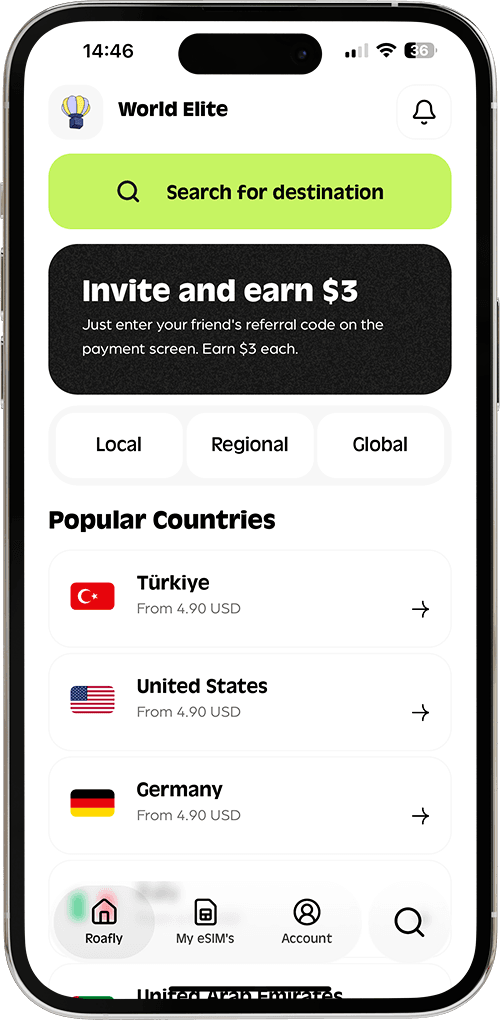
Roafly's Brazil eSIM plans provide mobile data through Claro and TIM, with no identity verification required. You do not need to upload a passport or complete Brazilian CPF registration for the Roafly eSIM.
The service is data-only, so it does not include a Brazilian phone number, ordinary mobile calls or SMS. Internet-based messaging and calls work through your apps. Keeping your existing WhatsApp account does not give the eSIM the ability to receive verification texts sent to your regular mobile number.
Hotspot sharing is supported within your purchased allowance, with no separate hotspot quota. Top-ups are available if you need more data. Your phone must be unlocked and eSIM-compatible; the availability of Claro and TIM at a particular location still depends on local network conditions.
Need data in Brazil? Get an eSIM!
Choose the perfect data plan for your trip
Exclusive Reader Bonus!
Enjoy an extra %10 OFF your first Roafly eSIM purchase as a thank you for reading.

Manage your eSIM in the app
Install, top up and track data.
Install the eSIM while you have a reliable internet connection and follow the supplied setup instructions. Before departure, check which line your phone will use for mobile data and review the roaming settings for both your travel eSIM and home SIM.
If you are still deciding between travel-eSIM companies, compare eSIM providers for Brazil. That comparison covers provider and package selection in more detail.
Can you get a local SIM without a CPF?
Yes, documented foreign-visitor activation routes exist. CPF is Brazil's tax registration number, but a missing CPF does not automatically rule out local prepaid service.
The distinction is the registration channel. An form asking for a CPF does not tell you whether the same operator can register a foreign visitor through a store or telephone service.
-
TIM: Its international visitor instructions describe activation through *144 with your passport and your accommodation address in Brazil ready.
-
Claro: Its foreign-customer activation instructions direct visitors without a CPF to a physical Claro store, bringing a passport or RNE.
In September 2026, TIM's visitor page lists a seven-day, 1.5 GB data pass for R$25. That amount covers the listed data pass; confirm the physical SIM cost and any separate retailer charges before paying. Calls and SMS on that visitor offer are charged separately.
Local prepaid service is worth considering if you need a Brazilian number, have a compatible physical-SIM phone without eSIM support, or want to compare local offers for a longer stay. Check the general-purpose data allowance carefully, including which benefits are restricted to particular apps.
Ask the store to complete registration in your own identity and test mobile data before you leave. Get the instructions for checking your balance, adding credit and renewing the package.
Our guide to buying and registering a Brazilian SIM covers the local options and registration process in more depth.
Getting when you land at São Paulo GRU
Arrange your primary connection before flying if you need maps, messages or transport booking immediately after arrival. Keep your accommodation address and transfer details available offline as well.
São Paulo Guarulhos Airport provides a useful fallback: its official Wi-Fi service offers four hours of free access in two sessions of two hours, provided through Boingo.
Use that connection to contact your accommodation, retrieve setup instructions or check your journey. Follow the airport's connection prompts, and confirm the network with airport staff if you are unsure which to use.
Buying a physical SIM and completing foreign-visitor activation are separate steps. Before relying on an airport purchase, check whether the seller can handle your registration requirements and whether the service is available when you land.
See the SIM and eSIM options at São Paulo GRU for the airport-specific buying considerations. Allow time for registration and testing before leaving the terminal if you decide to purchase on arrival.
Check your home plan before paying for another connection
Roaming can be the simplest choice if your existing tariff already includes enough usable data in Brazil. Open your carrier account and check the exact plan attached to your line.
Look at four details:
-
Whether Brazil is included and whether you must enable a travel benefit.
-
The available data allowance, speed limits and any fair-use conditions.
-
Whether calls, sent texts or background data can trigger a charge or daily pass.
-
The rules for hotspot sharing and use beyond the included allowance.
Compare the cost for your whole trip. Daily passes and prepaid data packages use different charging structures, and a pass may be poor value for traveller while already included for another.
If you use a travel eSIM for data, review your home line's roaming settings and any automatic mobile-data switching. Keeping the home line available for messages does not make every call or other use of that line free. Follow the travel eSIM's instructions for its own data-roaming setting.
Wi-Fi, laptop work and sharing a connection
Check what your accommodation actually provides before planning to work from it. Ask whether Wi-Fi reaches the room you are booking, whether there is a workspace and whether the connection can support your expected calls or uploads.
Recent feedback about the specific property is more useful than a general promise of “free Wi-Fi.” Consider asking the host for a recent connection test if reliable video meetings are essential.
Mobile hotspot can provide a backup when the local mobile signal is usable. Laptop updates, cloud synchronisation and video meetings all consume the same purchased allowance, so pause unnecessary background transfers when sharing a limited data package.
Public Wi-Fi is useful for short tasks, but a Wi-Fi-only trip requires planning around connection stops. Download maps and save booking details before going out.
Does pocket Wi-Fi make sense?
Consider a rented router when several phones, tablets or laptops need to connect while the group stays together. Compare it with sharing a phone's hotspot before adding another device to your luggage.
Check the full rental quote, delivery destination, return arrangements, daily high-speed allowance and any reduced-speed policy. Arrange delivery before departure where required; do not assume that a Brazil-compatible rental includes collection at a Brazilian airport.
Everyone sharing the router needs to remain within its Wi-Fi range. Separate connections are more practical if your group regularly splits up.
Check coverage for the places beyond your city stops
Your itinerary matters more than a nationwide coverage headline. A connection that works at a hotel in Manaus does not establish what will work at a river lodge, just as coverage in a town does not describe every road leading away from it.
If your trip includes Amazon river travel, Pantanal accommodation or long rural drives, ask your host or tour operator which network works at the exact locations you will visit. Download the relevant maps and agree on meeting points before heading out.
Anatel's coverage guidance explains that coverage maps are predictions. Terrain, buildings and whether you are indoors affect the signal you actually receive. Use the maps as a planning tool and confirm essential connectivity locally.
Roafly's listed Claro and TIM access gives you the supported network options shown in the plan. It does not guarantee reception at every stop or access to another operator wherever those networks are unavailable.
Before you leave for Brazil
-
Confirm that your phone is unlocked and supports the SIM format you intend to use.
-
Check your existing Brazil roaming entitlement before buying additional service.
-
Install your travel eSIM on a reliable connection, or identify the local operator's visitor-registration route.
-
Save your accommodation address, transfer details and useful maps offline.
-
Review mobile-data and roaming settings for each active line.
-
If you need a Brazilian number, select a service that explicitly includes.
Test your connection before leaving the airport or SIM store. Open a map, send a message and make sure the phone is using the intended data line.