

'/%3e%3cuse xlink:href='%23a' transform='rotate(45 400 250)'/%3e%3cuse xlink:href='%23a' transform='rotate(67.5 400 250)'/%3e%3cpath id='b' fill='%2385340a' d='M404.31 274.41c.453 9.054 5.587 13.063 4.579 21.314 2.213-6.525-3.124-11.583-2.82-21.22m-7.649-23.757 19.487 42.577-16.329-43.887'/%3e%3cuse xlink:href='%23b' transform='rotate(22.5 400 250)'/%3e%3cuse xlink:href='%23b' transform='rotate(45 400 250)'/%3e%3cuse xlink:href='%23b' transform='rotate(67.5 400 250)'/%3e%3c/g%3e%3cuse xlink:href='%23c' transform='rotate(90 400 250)'/%3e%3cuse xlink:href='%23c' transform='rotate(180 400 250)'/%3e%3cuse xlink:href='%23c' transform='rotate(270 400 250)'/%3e%3ccircle cx='400' cy='250' r='27.778' fill='%23f6b40e' stroke='%2385340a' stroke-width='1.5'/%3e%3cpath id='h' fill='%23843511' d='M409.47 244.06c-1.897 0-3.713.822-4.781 2.531 2.136 1.923 6.856 2.132 10.062-.219a7.333 7.333 0 0 0-5.281-2.312zm-.031.438c1.846-.034 3.571.814 3.812 1.656-2.136 2.35-5.55 2.146-7.687.437.935-1.495 2.439-2.067 3.875-2.094z'/%3e%3cuse xlink:href='%23d' transform='matrix(-1 0 0 1 800.25 0)'/%3e%3cuse xlink:href='%23e' transform='matrix(-1 0 0 1 800.25 0)'/%3e%3cuse xlink:href='%23f' transform='translate(18.862)'/%3e%3cuse xlink:href='%23g' transform='matrix(-1 0 0 1 800.25 0)'/%3e%3cpath fill='%2385340a' d='M395.75 253.84c-.913.167-1.563.977-1.563 1.906 0 1.062.878 1.906 1.938 1.906a1.89 1.89 0 0 0 1.563-.812c.739.556 1.764.615 2.312.625.084.002.193 0 .25 0 .548-.01 1.573-.069 2.313-.625.36.516.935.812 1.562.812 1.06 0 1.938-.844 1.938-1.906 0-.929-.65-1.74-1.563-1.906.513.18.844.676.844 1.219a1.28 1.28 0 0 1-1.281 1.281c-.68 0-1.242-.54-1.282-1.219-.208.417-1.034 1.655-2.656 1.719-1.622-.064-2.447-1.302-2.656-1.719-.04.679-.6 1.219-1.281 1.219a1.28 1.28 0 0 1-1.281-1.281c0-.542.33-1.038.843-1.219zm2.09 5.69c-2.138 0-2.983 1.937-4.906 3.219 1.068-.427 1.91-1.27 3.406-2.125 1.496-.855 2.772.187 3.625.187h.031c.853 0 2.13-1.041 3.625-.187 1.497.856 2.369 1.698 3.438 2.125-1.924-1.282-2.8-3.219-4.938-3.219-.426 0-1.271.23-2.125.656h-.031c-.853-.426-1.698-.656-2.125-.656z'/%3e%3cpath fill='%2385340a' d='M397.12 262.06c-.844.037-1.96.207-3.563.688 3.848-.855 4.697.437 6.407.437h.03c1.71 0 2.56-1.292 6.407-.438-4.274-1.282-5.124-.437-6.406-.437h-.031c-.802 0-1.437-.312-2.844-.25z'/%3e%3cpath fill='%2385340a' d='M393.75 262.72c-.248.003-.519.005-.813.031 4.488.428 2.331 3 7.032 3h.03c4.702 0 2.575-2.572 7.063-3-4.7-.426-3.214 2.344-7.062 2.344h-.031c-3.608 0-2.496-2.421-6.22-2.375zm10.1 6.94a3.848 3.848 0 0 0-3.846-3.846 3.848 3.848 0 0 0-3.847 3.846 3.955 3.955 0 0 1 3.847-3.04 3.952 3.952 0 0 1 3.846 3.04z'/%3e%3cpath id='e' fill='%2385340a' d='M382.73 244.02c4.915-4.273 11.11-4.915 14.53-1.709.837 1.121 1.373 2.32 1.593 3.57.43 2.433-.33 5.062-2.236 7.756.215-.001.643.212.856.427 1.697-3.244 2.297-6.577 1.74-9.746a13.815 13.815 0 0 0-.67-2.436c-4.7-3.845-11.11-4.272-15.81 2.138z'/%3e%3cpath id='d' fill='%2385340a' d='M390.42 242.74c2.777 0 3.419.642 4.7 1.71 1.284 1.068 1.924.854 2.137 1.068.213.215 0 .854-.426.64s-1.284-.64-2.564-1.708c-1.283-1.07-2.563-1.069-3.846-1.069-3.846 0-5.983 3.205-6.41 2.991-.426-.214 2.137-3.632 6.41-3.632z'/%3e%3cuse xlink:href='%23h' transform='translate(-19.181)'/%3e%3ccircle id='f' cx='390.54' cy='246.15' r='1.923' fill='%2385340a'/%3e%3cpath id='g' fill='%2385340a' d='M385.29 247.44c3.633 2.778 7.265 2.564 9.402 1.282 2.136-1.282 2.136-1.709 1.71-1.709-.427 0-.853.427-2.564 1.281-1.71.856-4.273.856-8.546-.854z'/%3e%3c/svg%3e)
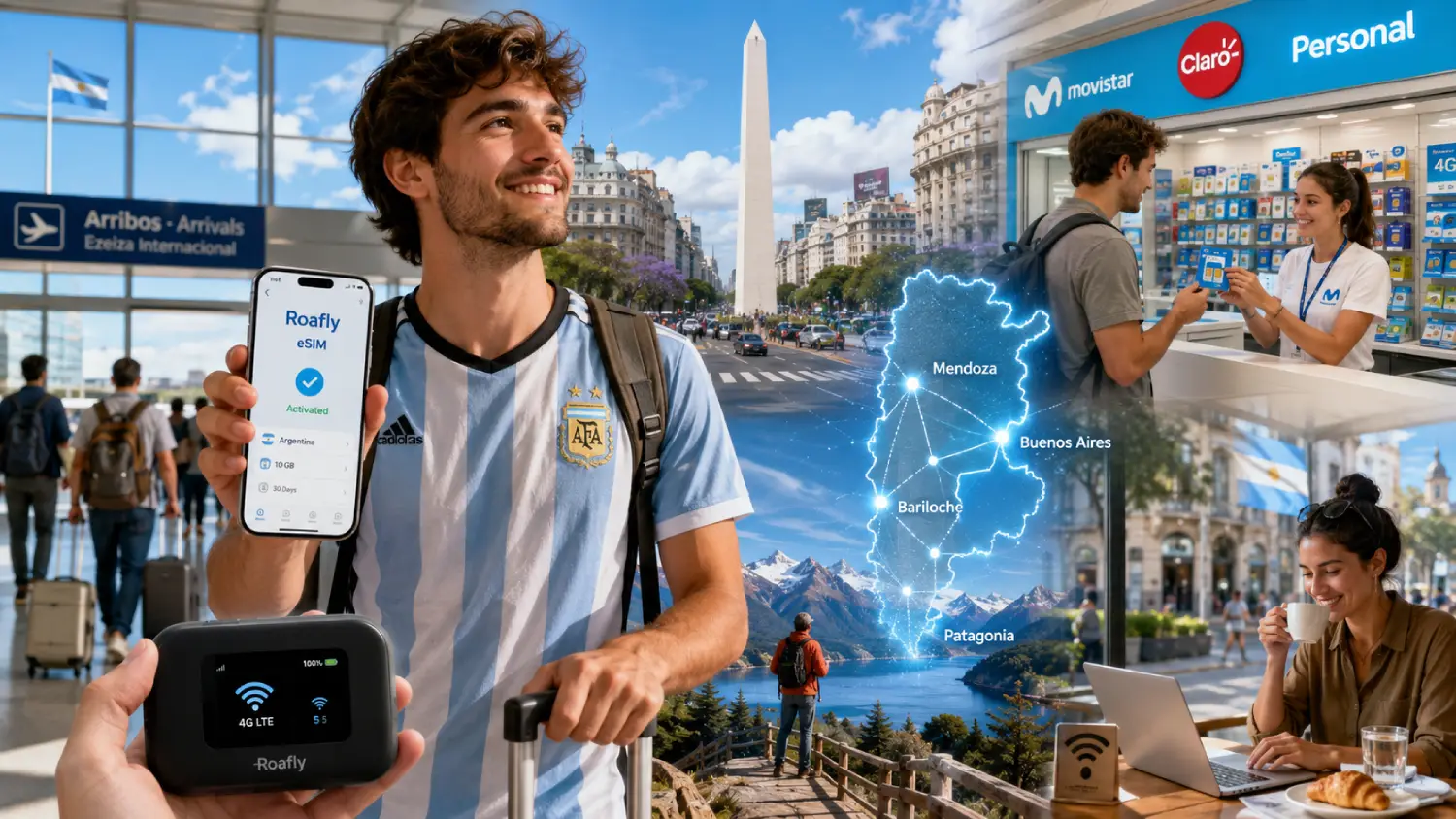
Argentina has three main mobile operators: Claro, Movistar, and Personal. All three offer prepaid connectivity options, while 4G remains the main network for travel use and 5G is still more limited to selected urban areas.
Internet Options in Argentina at a Glance
| Option | Typical Cost | Best For | Main Advantage | Main Limitation |
|---|---|---|---|---|
| Airport SIM card | Around $4+ for basic tourist packs, depending on availability | Travelers who want a physical SIM after landing | Staff-assisted setup | Availability and opening hours can vary |
| Local tourist SIM | Around $4–$15+ depending on operator and data size | Longer stays, local number needs | Good value for large data packs | Requires store visit and ID registration |
| Roafly eSIM | From $4.90 | Most short-term travelers | Install before arrival, no physical SIM | Requires eSIM-compatible phone |
| Pocket WiFi | Usually higher daily rental cost | Groups with several devices | Shared connection | Extra device, battery, pickup/return |
| Airport and public WiFi | Free | Backup, messaging, light browsing | No SIM needed | Not ideal for banking, maps on the move, or remote travel |
Prices are listed in USD or approximate USD equivalents using July 2026 exchange conditions. Local Argentine peso prices can change frequently because of currency fluctuations.
Need data in Argentina? Get an eSIM!
Choose the perfect data plan for your trip
Exclusive Reader Bonus!
Enjoy an extra %10 OFF your first Roafly eSIM purchase as a thank you for reading.

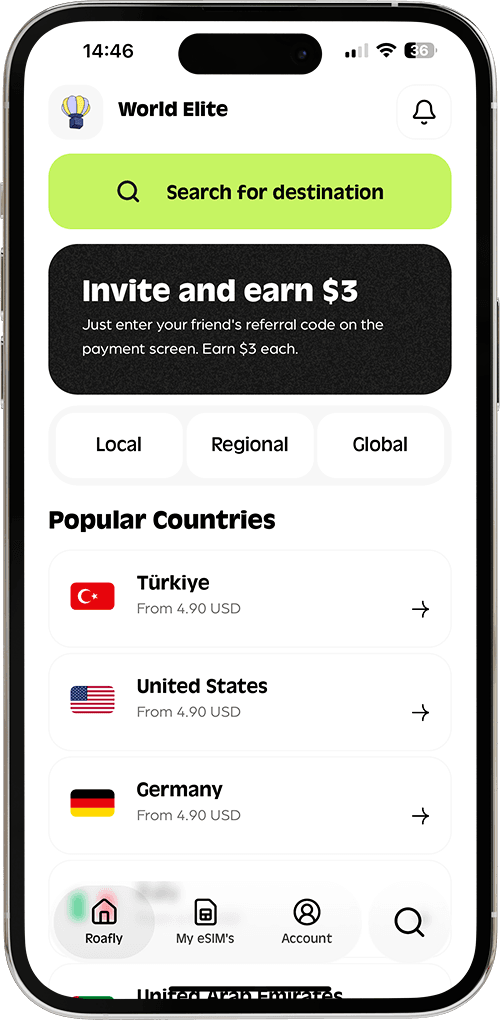
Manage your eSIM in the app
Install, top up and track data.
Buying a SIM Card at Argentina Airports
Buenos Aires Ezeiza International Airport is the main international arrival point for Argentina. For many travelers, it feels natural to look for a SIM card as soon as they exit customs. Airport SIM cards can work, but they are not always the smoothest option.
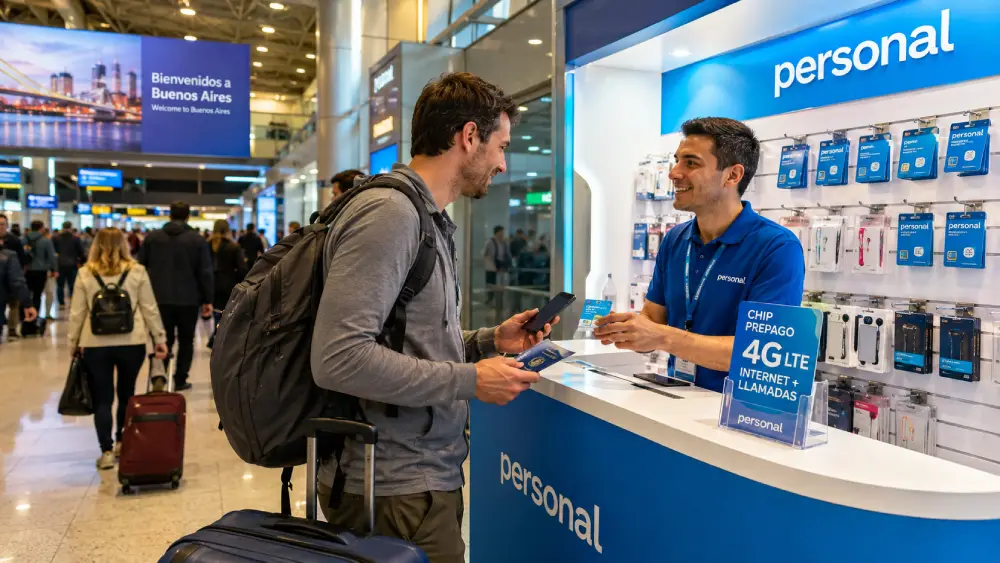
At Ezeiza, the airport SIM option has commonly been linked to Personal Flow rather than a wide choice of operators. Recent airport guides note that the Personal Flow shop has been located around the departures area, near check-in counter 40, with card payments and staff-assisted activation. The same guide reported a tourist prepaid offer of 3 GB for 30 days at ARS 3,800, listed at about $4 at the time of observation.
The important detail is not the price. It is availability. Airport SIM counters can change location, close early, run out of stock, or have different packages from city stores. Travelers arriving late at night, early in the morning, or during busy holiday periods may not want to depend on buying a SIM at the airport.
An airport SIM is most useful for travelers who:
- need a physical SIM card,
- want staff to handle activation,
- do not mind showing a passport,
- and are comfortable comparing prepaid packs in Spanish.
For a smoother arrival, many travelers now activate mobile data before the flight or use airport WiFi long enough to arrange transport.
Local Tourist SIM Cards in Argentina
Local prepaid SIM cards can offer good value, especially for visitors staying several weeks. They are sold through official operator stores, kiosks, and authorized resellers. Foreign travelers usually need to show a passport or valid ID so the line can be registered.

Claro Tourist SIM
Claro is of Argentina’s major operators and has a dedicated tourist SIM option. Argentina’s official tourism site describes Claro’s tourist prepaid package as including 25 GB for 30 days, with WhatsApp and social media benefits, at approximately $15.
Claro’s own tourist SIM page also describes the offer as a Chip Turista Prepago with WhatsApp plus a 25 GB pack for 30 days. The purchase process is based on visiting a Claro customer service center and asking for the tourist prepaid chip.
This can be a strong option for data-heavy travelers who are staying in place long enough to visit a store. The downside is convenience. It requires time, ID verification, and store availability.
Movistar Tourist SIM
Movistar also supports prepaid SIM cards for foreign tourists. Its tourist SIM page explains that visitors can get a prepaid SIM from kiosks or sales points, activate it through WhatsApp support, submit the required information, and then choose a suitable pack.
Movistar prepaid pricing changes often. Current prepaid recharge information shows examples such as 2.5 GB for month with recharges from ARS 8,000, plus WhatsApp and Movistar-line calling benefits. Using a July 2026 exchange rate near 1 USD = 1,489 ARS, that recharge level is roughly $5.40.
Movistar is also relevant because Roafly Argentina eSIM packages work on the Movistar network, giving travelers a way to connect without visiting a store or swapping a physical SIM.
Personal Prepaid SIM
Personal is another major operator and is often associated with airport SIM availability at Ezeiza. Its prepaid page lists examples of monthly prepaid pack pricing, including a pack priced at ARS 13,000 final with automatic 30-day recurrence. At the July 2026 exchange rate, that is approximately $8.70.
Personal can be useful in many urban and central regions, but travelers heading deep into Patagonia or remote rural areas should check coverage carefully before relying on a single operator. Coverage in Argentina varies strongly by province, road, mountain area, and national park.
Using a Roafly eSIM in Argentina
For most travelers, an eSIM is the easiest way to get internet in Argentina in 2026. It removes the need to find a store, wait at an airport counter, remove a physical SIM card, or deal with local activation steps after a long flight.
Roafly’s Argentina eSIM plans are data-only and work on the Movistar network. Mobile hotspot is available, eKYC is not required, and the validity period starts when the eSIM connects to a supported network in Argentina.
Roafly Argentina eSIM packages include:
Need data in Argentina? Get an eSIM!
Choose the perfect data plan for your trip
Exclusive Reader Bonus!
Enjoy an extra %10 OFF your first Roafly eSIM purchase as a thank you for reading.
Manage your eSIM in the app
Install, top up and track data.
The 1 GB plan is suitable for light use such as maps, messaging, rideshare apps, and occasional browsing. The 3 GB and 5 GB plans fit typical city trips where hotel WiFi covers streaming and large downloads. The 10 GB and 20 GB plans are better for longer stays, remote work backup, hotspot use, or travel routes that include multiple cities.
Roafly supports simple setup methods including Direct Install, QR Code, and Manual installation. For an eSIM-compatible phone, the best practice is to install the eSIM before departure and turn it on after landing in Argentina. This gives travelers working data as soon as the phone connects to the local network.
Travelers comparing options in more detail can also read the best eSIM for Argentina guide before choosing a package.
Coverage in Argentina: What Travelers Should Expect
Argentina is a large country, and network experience is not the same everywhere. Buenos Aires, Córdoba, Rosario, Mendoza, Salta, Bariloche, and other major cities generally have reliable mobile data. Tourist-heavy areas usually have usable 4G, especially around city centers, airports, hotels, restaurants, and transport hubs.
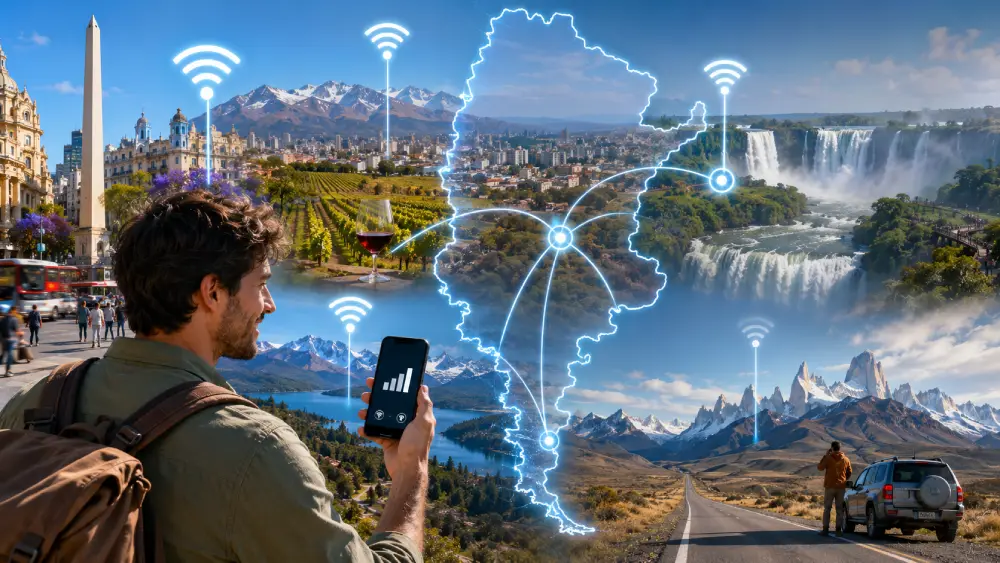
Remote routes are different. Long-distance bus roads, mountain regions, national parks, glaciers, and parts of Patagonia can have weak signal or no signal at all. This is normal in a country with large rural areas and dramatic geography.
OpenSignal’s Argentina mobile network report found that Personal led several categories, including availability and 4G coverage experience, while Claro performed strongly for consistency. Movistar remained of the three major operators and continues to be widely used in key travel destinations.
For travel planning, this means:
- Buenos Aires and major cities are usually straightforward.
- Patagonia requires more caution and offline preparation.
- National parks may have limited signal.
- Long road trips should not depend on live maps.
- Download offline maps before leaving the city.
- Keep accommodation addresses, tickets, and transport details saved offline.
- A good mobile plan helps, but no provider can guarantee uninterrupted signal across every remote part of Argentina.
Pocket WiFi in Argentina
Pocket WiFi is a small portable router that creates a private WiFi network using a local mobile connection. It can be useful for families, small groups, photographers, or business travelers who need to connect multiple devices at the same time.
The advantage is simple sharing. device can connect phones, laptops, and tablets. The connection also avoids draining phone’s battery through hotspot use all day.
The disadvantages are practical. A pocket WiFi device must be charged, carried, protected, and returned if it is rented. It may also cost more than a prepaid SIM or eSIM, especially for solo travelers. Coverage still depends on the mobile network inside the device, so it does not solve rural dead zones.
Pocket WiFi makes the most sense when:
- three or more people need shared connection,
- several laptops or tablets will be used daily,
- a group wants central data plan,
- or a traveler does not have an eSIM-compatible phone.
For most solo travelers, a Roafly eSIM with hotspot available is usually simpler than carrying another device.
Airport WiFi and Public WiFi in Argentina
Free WiFi is common in Argentina’s main tourist areas. Airports, hotels, cafés, restaurants, shopping malls, coworking spaces, and museums often provide WiFi. Buenos Aires also has a municipal public WiFi network.
Argentina’s official tourism site notes that Buenos Aires offers BA WiFi across more than 1,200 antennas in over 1,000 high-traffic locations, including parks, plazas, libraries, museums, hospitals, subway stations, and Metrobus stops. It also notes that sessions can be renewed and speeds are generally enough for messaging, email, maps, and light browsing.
Public WiFi is useful, but it should be treated as a backup rather than the main connection. It is not ideal for banking, private work files, account logins, or last-minute transport issues. A café connection is helpful when sitting down, but it does not help much while looking for a taxi, navigating a new neighborhood, translating a menu, or contacting a hotel from the street.
The safest approach is to use mobile data for essential travel tasks and public WiFi for low-risk activities such as reading, browsing, and app updates.
Best Internet Option by Traveler Type
Short City Trip
For a 3–5 day trip to Buenos Aires, Mendoza, or Córdoba, a small eSIM plan is usually enough. Travelers using hotel WiFi at night and mobile data during the day can often manage with 1 GB to 3 GB, depending on navigation and social media use.
A Roafly 1 GB or 3 GB package works well for light to moderate use. Heavy video uploads or constant hotspot use will need more.
Two-Week Argentina Route
A trip that includes Buenos Aires, Iguazú Falls, Mendoza, Bariloche, or El Calafate needs a more flexible data plan. Maps, transport apps, hotel messaging, restaurant searches, and translation tools can use more data than expected.
For this route, 5 GB to 10 GB is a safer choice. Travelers who share hotspot with a laptop or tablet should consider 10 GB or 20 GB.
Digital Nomads and Remote Workers
Remote workers should not depend on mobile data alone. Accommodation WiFi, coworking spaces, and mobile data should work together. Mobile data is best for backup, tethering during transit, and emergency calls when hotel WiFi fails.
A 10 GB or 20 GB eSIM is a practical backup layer. For heavy video calls and cloud uploads, use fixed WiFi whenever possible and keep mobile data for mobility.
Patagonia and Remote Travel
For Patagonia, offline preparation matters as much as the plan itself. Download offline maps, save booking confirmations, keep emergency numbers available, and avoid assuming signal will exist on every road or trail.
A mobile plan is still useful in towns such as Bariloche, El Calafate, El Chaltén, Ushuaia, and Puerto Madryn, but coverage can drop outside populated areas.
How Much Data Do Travelers Need in Argentina?
Data usage depends heavily on travel style. Messaging and maps use relatively little data. Video, cloud backups, TikTok, Instagram Reels, and hotspot use can consume data quickly.
A practical estimate:
- 1 GB: messaging, maps, email, light browsing for a short trip.
- 3 GB: light city travel for up to week.
- 5 GB: moderate use with social media and daily navigation.
- 10 GB: two-week trips, heavier browsing, occasional hotspot.
- 20 GB: longer stays, remote work backup, frequent hotspot, heavy app use.
Travelers who are unsure should choose slightly more data than they expect to need. Running out of data during a transfer, late arrival, or rural route is more inconvenient than having a little left over.
Final Recommendation
For travelers who want the simplest way to get internet in Argentina in 2026, an eSIM is usually the most convenient choice. Airport SIM cards and local tourist SIMs can offer good value, but they require time, documents, store access, and variable activation steps. Pocket WiFi can help groups, while public WiFi is best kept as a backup.
Roafly’s Argentina eSIM plans provide a practical balance of price, setup ease, Movistar network access, hotspot support, and 30-day options for different travel lengths.
Check the latest Argentina eSIM plans before your trip and install your mobile data before landing.