


Germany’s Christmas markets reward getting the dates right. Plan your main market trip between 27 November and 23 December 2026, when the featured markets in all five cities below overlap. Nuremberg is our starting point for a traditional market break; pairing it with Munich gives you a manageable four-night trip with time for both cities.
Cologne suits a stay built around several different markets, while Dresden makes Saxon crafts and Christstollen the focus. Berlin deserves particular attention if your holiday falls after Christmas, when several of the famous markets elsewhere have already closed.
Which German Christmas market city should you choose?
Match your travel dates to a specific market, not just a city name. Cologne illustrates why: its cathedral market ends before Christmas, while the Heumarkt section of Heinzels Wintermärchen continues into January.
| City and market | Season dates | Best reason to go | Important exception |
|---|---|---|---|
| Nuremberg — Christkindlesmarkt, Hauptmarkt | 27 Nov–24 Dec 2026 | Traditional stalls, Lebkuchen and a compact old-town visit | Closes at 14:00 on 24 Dec |
| Dresden — Striezelmarkt, Altmarkt | 25 Nov–24 Dec 2026 | Saxon Christmas crafts and Dresdner Christstollen | Opens at 16:00 on 25 Nov; closes at 14:00 on 24 Dec |
| Munich — Christkindlmarkt, Marienplatz | 20 Nov–24 Dec 2026 | Christmas markets combined with a broader city break | Closed 22 Nov; closes at 14:00 on 24 Dec |
| Cologne — Cathedral Christmas Market, Roncalliplatz | 16 Nov–23 Dec 2026 | Cathedral backdrop and an earlier start to the season | Closed 22 Nov |
| Cologne — Heinzels Wintermärchen, Heumarkt | 23 Nov 2026–10 Jan 2027 | A market and ice rink after Christmas | Closed 24–25 Dec; the separate Alter Markt section ends 23 Dec |
| Berlin — WeihnachtsZauber, Gendarmenmarkt | 23 Nov–31 Dec 2026 | Christmas shopping and dining after 25 Dec | Shorter hours on 24 Dec; New Year’s Eve requires its own event information |
These dates apply to the named markets. Other markets, ice rinks and seasonal attractions in the same city can follow different calendars.
Five cities, five different Christmas trips

Nuremberg: make the market the centre of your stay
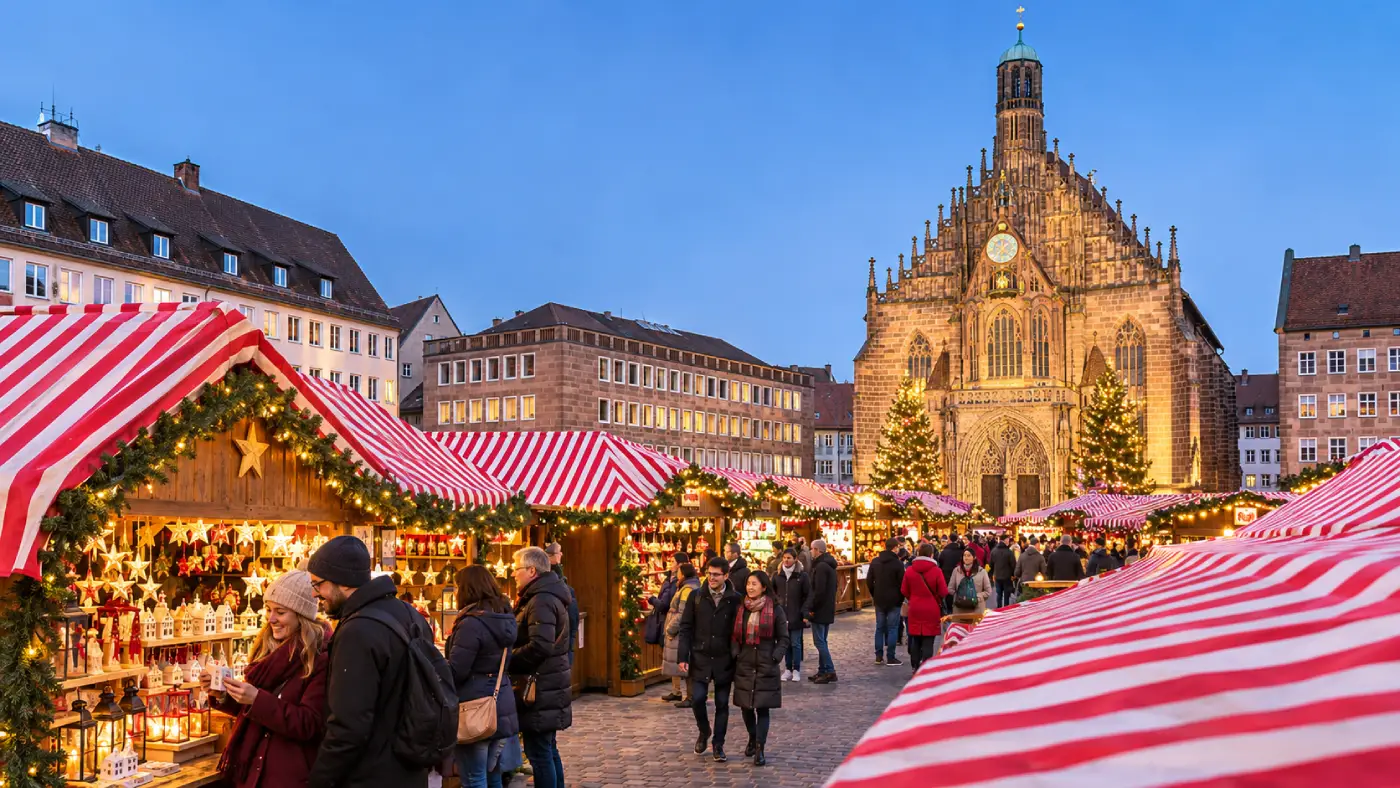
Nuremberg’s Christkindlesmarkt fills Hauptmarkt with wooden stalls under red-and-white cloth roofs. Lebkuchen, small grilled Rostbratwürste and traditional decorations give it a clear local identity. Look for Rauschgoldengel, the shimmering angels associated with the market, alongside ornaments and handmade gifts.
Two nights work well here. Spend your first evening getting your bearings, then return in daylight to browse the craft stalls before another evening visit. That gives you time to explore the old town without treating the market as a brief stop between trains.
Families can also visit the Kinderweihnacht at Hans-Sachs-Platz, where activities include baking and traditional rides. The main market normally opens from 10:00 to 21:00. On opening day, 27 November, the Christkind’s prologue takes place at 17:30 and the market stays open until 22:00.
Dresden: come for the crafts and Christstollen
Dresden’s Striezelmarkt is the strongest match in this selection if regional Christmas crafts are your main interest. Erzgebirge woodwork and handmade Herrnhuter stars sit alongside Dresdner Christstollen, with the market’s large Christmas pyramid rising above Altmarkt.
Give the stalls some daylight as well as an evening visit. Fine wooden details and handmade decorations deserve more than a quick look while you are eating or carrying drinks. Staying around the Altstadt also makes it easier to return to your room between sightseeing and the market.
Entry is free. After its later opening on the first day, the market runs from 10:00 to 21:00 through 23 December. Dresden suits a two- or three-night stay when you want the market to share the trip with the historic centre, rather than adding another distant city.
Munich: combine Marienplatz with a city break
Munich’s main Christkindlmarkt spreads around Marienplatz beneath the Neues Rathaus. The nearby Kripperlmarkt adds a more specialised browsing stop, with nativity figures, miniature buildings and accessories for Christmas cribs.
Munich earns its place in a short itinerary because the market sits within the city you are already exploring. Leave the middle of the day for sightseeing or an indoor break, then return to Marienplatz for the evening. The main market opens from 10:00 to 21:00 Monday to Saturday and until 20:00 on Sundays, apart from the exceptions in the table.
Use public transport to reach it. Marienplatz has direct U-Bahn and S-Bahn access, and the organiser advises visitors that parking is unavailable around the square. Staying centrally or on a direct transit line is more useful for this trip than arranging a rental car.
Cologne: visit more than one market
Cologne’s cathedral market on Roncalliplatz delivers the dramatic setting: craft and food stalls beneath a canopy of lights, with the cathedral beside them. It also opens earlier than the other featured markets, making it a useful choice for a mid-November visit.
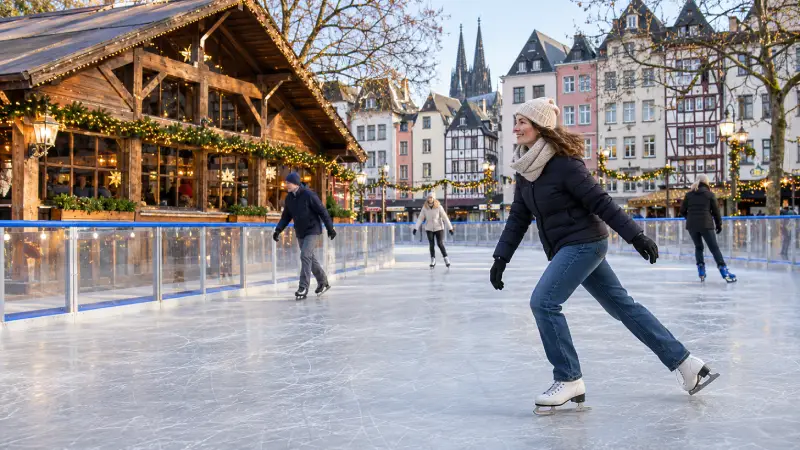
The cathedral market’s ordinary hours are 11:00–21:00 Sunday to Wednesday, 11:00–22:00 Thursday and Friday, and 10:00–22:00 Saturday. Leave time on another day for Heinzels Wintermärchen, whose themed lanes and ice rink give the visit a different focus.
Be precise about which part of Heinzels you want. Alter Markt ends on 23 December; Heumarkt continues into January. Heumarkt opens daily at 11:00, closing at 22:00 through 30 December and at 21:00 from 31 December, apart from its closed days.
Cologne makes sense as a single-city trip when you would rather spend several evenings exploring different markets than change hotels.
Berlin: keep the market in a post-Christmas holiday
WeihnachtsZauber takes place on Gendarmenmarkt in 2026. Its heated craft tent, artisan demonstrations and dining areas suit a visit that alternates outdoor browsing with time under cover.
The market normally opens from 11:00 to 22:00, extending to 23:00 on Fridays and Saturdays. Christmas Eve hours are 11:00–18:00. Standard admission is €2, with free entry Monday to Friday from 11:00 to 14:00 except on 24, 25, 26 and 31 December. Children under 12 enter free.
Berlin is the clearest choice here if your market visit must fall on Christmas Day or shortly afterwards. Treat 31 December as a separate booking decision: the 2026 New Year’s Eve programme and ticket details are awaiting publication, so the standard market admission price should not be used to budget for that celebration.
When to go—and what changes after Christmas
Our preference for a first trip is to spend several nights in one city or combine two nearby bases. Five cities in five days would put too much of the holiday into stations, luggage storage and hotel changes. Allow yourself an afternoon and an evening in each main market city, with a second visit if crafts or photography are a priority.
Christmas Eve needs different expectations. Dresden, Nuremberg and Munich end their main markets early that afternoon. Christmas Day is therefore a poor arrival date for a trip centred on those markets. Berlin remains an option, while Cologne’s Heumarkt resumes on 26 December after its two-day closure.
If you stay through 24–26 December, book the meals you particularly want and use each restaurant or attraction’s own holiday hours. An open market does not establish the opening hours of the rest of the city.
A four-night Munich and Nuremberg trip
Split four nights evenly between Munich and Nuremberg, with your market visits inside the shared late-November-to-23-December window. Two nights in each place give you an evening on arrival and another after a full day, without changing hotels every morning.