


Leave the car out of your Dublin city stay, then rent for the days when your route spreads into coastal villages, rural accommodation and countryside stops. Cliffs of Moher alone does not make a rental essential: bus connections can work, provided the return timetable leaves enough time to visit.
The main rules below apply to the Republic of Ireland; cross-border differences are covered separately.
| Quick question | Short answer |
|---|---|
| Which side do you drive on? | Keep left; enter roundabouts by turning left. |
| What car would we choose? | A compact automatic with enough luggage space for an ordinary paved-road trip. |
| What documents matter? | Your original valid licence, any required IDP or translation, and the rental company’s identification and payment documents. |
| Which speed units apply? | Kilometres per hour in the Republic; miles per hour in Northern Ireland. |
| What is easy to overlook? | The M50’s barrier-free toll and who is responsible for paying it. |
| What should you prepare offline? | Maps covering the whole route, accommodation details and the rental return location. |
Do You Need a Car in Ireland? Dublin, Galway and the West Coast
Dublin city days are usually easier without a rental. Walking, Dublin Bus, Luas and DART cover different parts of a city-based visit, while keeping a car adds parking and collection logistics.
Beyond the city, a coastal viewpoint, village lunch stop and rural guesthouse can make a car worthwhile. Include the final approach from the nearest bus stop when assessing a car-free route.
| Your trip | Our recommendation |
|---|---|
| Central Dublin, museums and city sightseeing | Stay car-free and collect a vehicle when leaving the city, if needed. |
| Galway with Cliffs of Moher excursion | Compare the bus timetable with the time you want at the cliffs. |
| Connemara, Dingle or several Wild Atlantic Way stops | Consider a rental for the regional exploring days. |
| Dublin followed by a countryside stay | Compare a partial rental with keeping a car for the entire holiday. |
Cliffs of Moher shows why both halves of a bus journey matter. In the published Route 351 timetable, leaving Galway’s Eyre Square at 08:20 gets you to the cliffs at 10:49. Returning at 14:30 reaches Galway at 16:59, leaving around three hours and forty minutes at the attraction.
Taking the 11:35 departure instead brings you there at 14:05. That leaves 25 minutes before the 14:30 return; waiting for the next listed departure at 18:45 creates a much longer afternoon.
These examples use TFI Local Link Limerick Clare’s September 2025 timetable, checked on 14 September 2026. Verify your travel date and return service before setting out; the timetable excludes Christmas Day.
Several stops away from that bus corridor, especially with luggage and rural accommodation, create a stronger case for driving.
Where to Pick Up Your Rental Car and Which Car to Choose
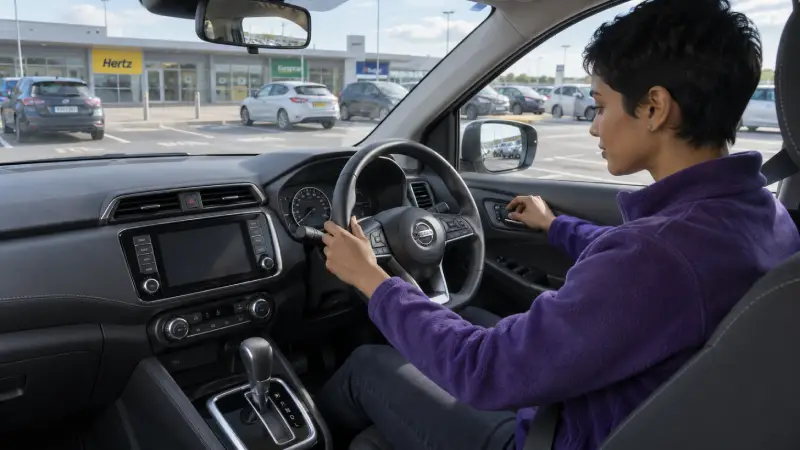
Collecting a car after your Dublin stay avoids paying to leave it parked during city sightseeing. Compare the full arrangements at an airport and a city branch: opening hours, the journey to the desk, vehicle availability and the return location all matter.
Enterprise has rental desks in Dublin Airport’s arrivals halls. Shannon offers another starting point if your flights and itinerary favour the west: Budget’s desk is in the arrivals hall, with road access towards Clare, Limerick and Galway.
Returning elsewhere can reduce backtracking; price the-way rental before booking flights around it.
Our default choice for a paved-road holiday would be the smallest automatic that comfortably fits the passengers and bags. An automatic removes gear-changing from the work of adapting to left-side traffic. Compact dimensions also help when judging clearance beside walls and parked vehicles.
Book the transmission explicitly and assess boot space realistically. Two large cases can change the suitable car category, and “or similar” describes a vehicle class rather than a promise of exact model.
Before collection, save the booking and return address and arrange your mobile connection. Comparing the best eSIMs for Ireland can help you choose a data plan before you need to load directions outside the rental office.
Licence Requirements, Insurance and Rental Deposits
Bring your original, current driving licence for the vehicle you intend to drive. EU/EEA licence holders can drive while their licence remains valid. Visitors with other valid foreign licences can generally drive during a temporary visit of up to 12 months, with International Driving Permit requirements depending on the issuing country.
Your IDP must accompany the underlying national licence. Rental companies can impose additional document, translation, age and driving-experience requirements. Resolve those conditions for every named driver before paying.
Enterprise Dublin Airport, for example, sets a minimum rental age of 25 and requires a physical licence. Its payment conditions require an accepted credit card in the renter’s name. Those are supplier conditions, not a universal minimum age or payment rule for Ireland.
Keep three amounts separate when comparing quotes:
-
Rental total: the booked price, taxes and required charges, plus any extras you select.
-
Security deposit: money held or collected under the rental terms and refundable subject to the final account.
-
Damage excess: the amount you may remain responsible for under the applicable damage waiver.
The deposit can be much smaller than your potential damage liability. Enterprise Dublin Airport’s terms, checked on 14 September 2026, specify a €250 deposit but a damage-waiver excess of €2,000 for manual Mini and Economy cars. Other categories have different excess amounts.
Third-party liability insurance, damage waivers and excess-reimbursement policies serve different purposes. With separate reimbursement cover, you may have to pay the rental company first and claim from your insurer afterwards. Establish what happens to tyres, glass, keys, towing and administrative charges under your selected protection.
Compare the final rental price and required card capacity together. Fuel, parking, tolls, additional drivers and a different return location can also affect the trip’s cost.
Driving on the Left: Turns, Roundabouts and Speed Limits
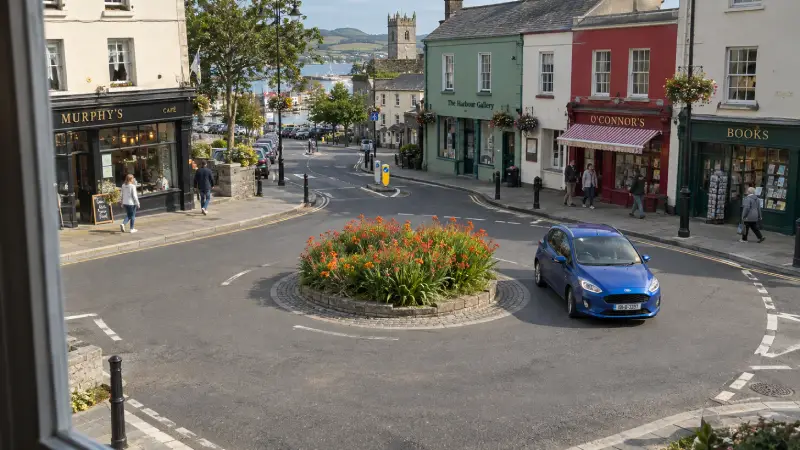
Keeping left deserves particular attention after a break, when leaving a quiet car park or when turning an empty road. Take a moment to identify your lane before moving away.
Left turns: approach in the appropriate left lane and turn into the left-hand side of the new road. Watch for cyclists alongside you and pedestrians crossing.
Right turns: position in the correct lane, allow for opposing traffic and follow the junction’s markings into the new road. Avoid cutting across the corner or drifting into the lane.
Traffic lights: there is no general permission to turn left or right on red. Stop behind the line. Under the Irish traffic-light rules, a separate green arrow can permit movement in its direction while the main light remains red, provided the way is clear.
At roundabouts, enter to the left and give way to traffic already circulating. Read the lane arrows early. Where markings do not direct otherwise, exits up to the straight-ahead position normally use the left approach lane; exits beyond it normally use the right. Signal for your intended movement, then indicate left to leave without misleading drivers at an earlier exit.
Speed limits in the Republic are shown in km/h. Many rural local roads changed from 80 to 60 km/h on 7 February 2025. The associated black-striped rural speed-limit sign means 60 km/h or below where that change applies.
Treat the displayed limit as a ceiling. Narrow bends, limited visibility and wet surfaces may require considerably less speed. Follow the signs on the road you are using, including temporary limits, rather than applying remembered figure to every road marked “N” or every town.
Everyone should be belted before moving, and children need suitable restraints. Plan pub visits for after you have finished driving; Ireland’s alcohol-sale and tourist rules also matter if you are buying drinks to take back to your accommodation.
Narrow Country Roads, Coastal Stops and Winter Driving
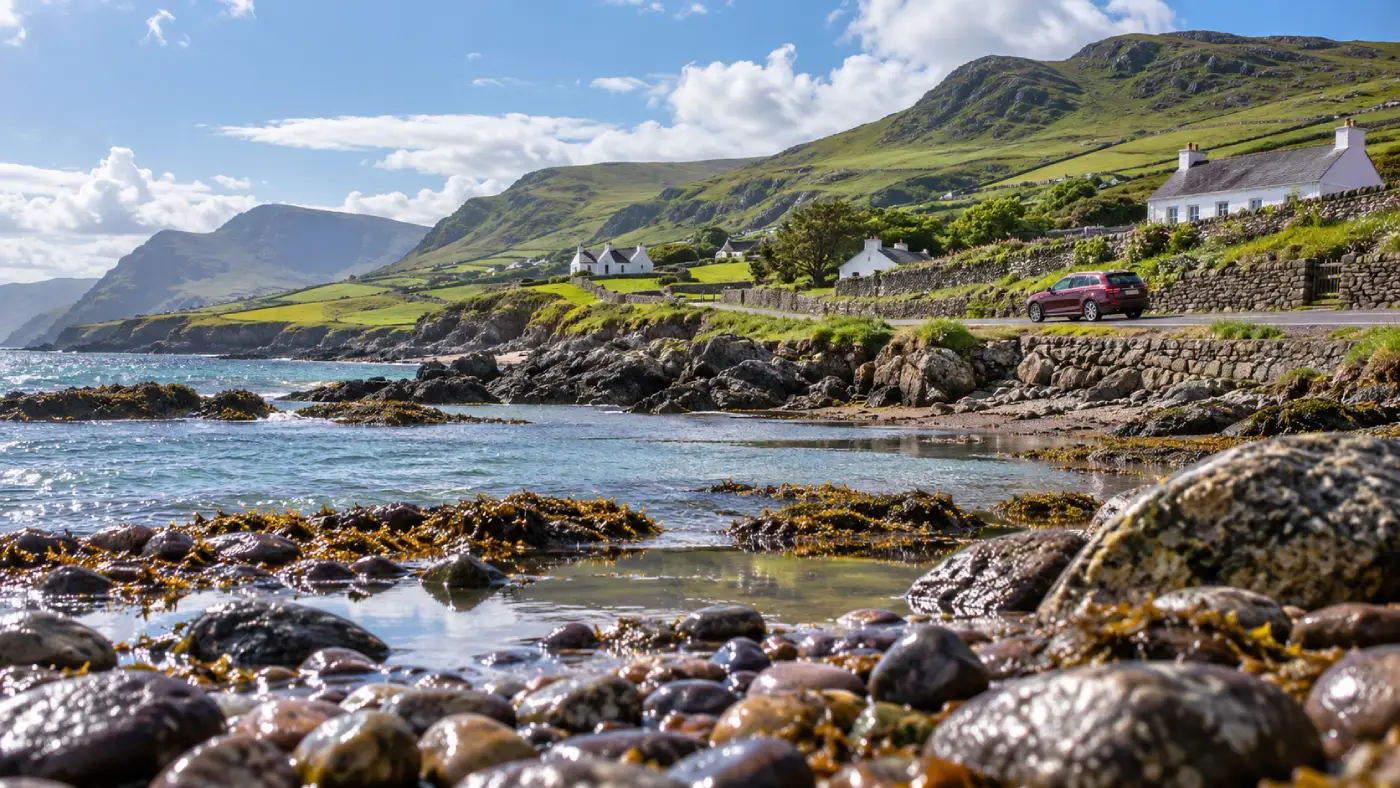
Ireland’s motorways and narrow rural lanes demand different pacing. Along the west coast, the distance between stops can look modest while bends, villages and meeting traffic make the journey slower than expected.
Leave enough space to judge the left edge of the car. Stone walls and hedges can sit close to the road, so forcing through a narrow gap to avoid delaying another driver is a poor trade. Slow early and use an appropriate wider space when vehicles need room to pass.
Build scenic stops around actual parking places. Keep gateways and passing spaces clear, and avoid stopping on a bend to take a photograph. If the viewpoint has no safe stopping place, continue to the next suitable opportunity.
Shorter winter days make a compact route more useful than a long list of stops. Aim to complete unfamiliar rural stretches in daylight, and allow room to change plans when wind, rain or poor visibility affects the coast. Never use a navigation suggestion as proof that a flooded or closed road is passable.
Standard paved countryside routes do not by themselves call for an SUV. Match the vehicle to your luggage, confidence and intended roads.
M50 Tolls, Parking and Returning Your Rental Car
Dublin’s M50 has a barrier-free toll point between Junction 6 and Junction 7. Cameras record the registration plate, so there is no booth where you stop to pay. Using another section of the M50 without passing that point does not trigger this particular toll.
Ask at collection whether the rental company settles M50 tolls and bills you, or whether you must pay directly. If payment is your responsibility, the deadline is 8pm on the following day. Use the official eFlow rental-car guidance and payment route, enter the registration accurately and keep the receipt.
Parking needs its own small plan. Find out whether your accommodation includes a space and save the car-park entrance, which may differ from the front-door address. Street restrictions and payment hours depend on the location; read the sign beside the space.
Apply the same travel-safety precautions in Ireland at scenic car parks as in cities: lock the vehicle, keep luggage out of sight and take passports, devices and other valuables with you.
At collection, photograph existing damage and have it recorded. At return, follow the agreed fuel policy and retain photographs showing the vehicle’s condition, fuel level and where you left it. Allow time for the handover and any transfer back to the terminal. With an unattended return, retain the drop-off instructions and evidence of when you returned the keys.
Taking a Rental Car to Northern Ireland
Northern Ireland adds three separate questions: whether the rental permits the journey, which road rules apply and whether everyone travelling has the required entry permission.
Read the cross-border terms for your actual booking, including any fee, protection conditions and return restrictions. Enterprise Dublin Airport’s terms checked in September 2026 allow travel to Northern Ireland without a cross-border charge. That policy should not be assumed for another supplier or for returning the vehicle there.
Traffic still keeps left after the border, but speed signs change to mph. Make sure you know which unit your dashboard displays before interpreting a roadside number.
Northern Ireland is part of the UK, so review the UK ETA or visa requirements for each passenger. British and Irish citizens are exempt from ETA requirements; other exemptions depend on status. The exemption for eligible people legally resident in Ireland is different from visiting Ireland as a tourist.
Also verify mobile-plan coverage for both jurisdictions. An Ireland-labelled data package should not be assumed to cover Northern Ireland.
Navigation, Offline Maps and Road Information
Download maps covering the entire planned driving area before leaving a reliable connection. Include the journey back to the rental depot and any border-crossing section you intend to drive.
GPS positioning and mobile data do different jobs. Your phone can determine its position without a mobile-data connection, while downloaded maps provide the local map information. Google Maps can guide an offline drive within the downloaded area, but live traffic information and alternative routes are unavailable offline.
Use data for the changing parts of the day: traffic, messages from your accommodation and opening or access updates. On a compatible unlocked phone, an Ireland eSIM can provide that connection where its supported network is available. Keep the offline map as your backup.
Save the correct parking entrance as well as the destination name. Before an unfamiliar rural approach, compare the suggested final stretch with your host’s arrival instructions and the signs on the ground.
Set directions while parked. Let a passenger handle changes, or stop somewhere suitable before using the phone.