

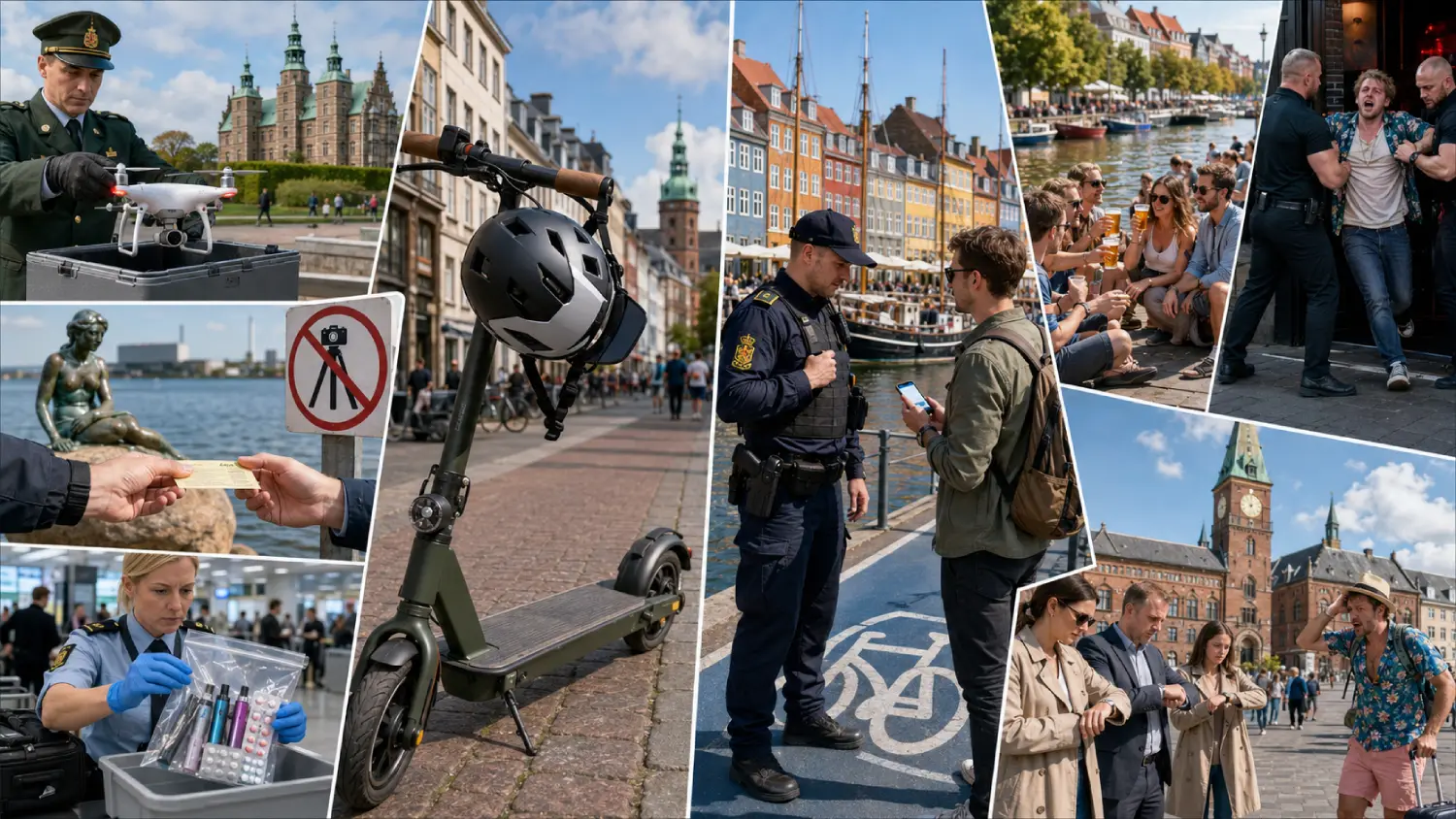

While the Danish people are famously relaxed, their legal system is absolutely uncompromising when it comes to public safety and order. Ignorance of local regulations is never an excuse in the eyes of the Danish police. Whether you are navigating the intricate bicycle lanes of Copenhagen or packing your prescription medications, you need to know exactly what is legally permitted.
E-Scooter Traps: Mandatory Helmets & Heavy Fines
Electric scooters have become a highly popular way to explore cities like Copenhagen and Aarhus, but they are heavily policed. The Danish government has clamped down hard on e-scooter chaos to protect pedestrians and riders alike. Wearing a helmet is mandatory by law when operating any motorized e-scooter in Denmark.
If you are caught riding an e-scooter without a helmet, you will be hit with an immediate fine of 1,500 DKK (roughly €200 or $220). Police actively patrol tourist hotspots and will not hesitate to issue tickets to foreigners. Many tourists assume rental scooters exempt them from this rule, but the responsibility to find and wear a helmet falls entirely on the rider.
Beyond the helmet mandate, e-scooter riders must adhere to the exact same traffic laws as cyclists. Breaking these rules will quickly compound your fines.
-
Riding Under the Influence: The legal Blood Alcohol Concentration (BAC) limit is 0.5. Riding an e-scooter drunk carries a minimum fine of 1,000 DKK.
-
Pavement Riding: It is strictly illegal to ride an e-scooter on the pavement or pedestrian walkways. You must use designated bicycle lanes.
-
Passenger Bans: Riding with two people on a single scooter is illegal and highly dangerous, carrying its own separate fine.
-
Speed Limits: Scooters are legally capped at 20 km/h. Modifying a private scooter to go faster will result in confiscation and severe penalties.
Cycling Fines: Do Not Mess With Danish Bike Lanes
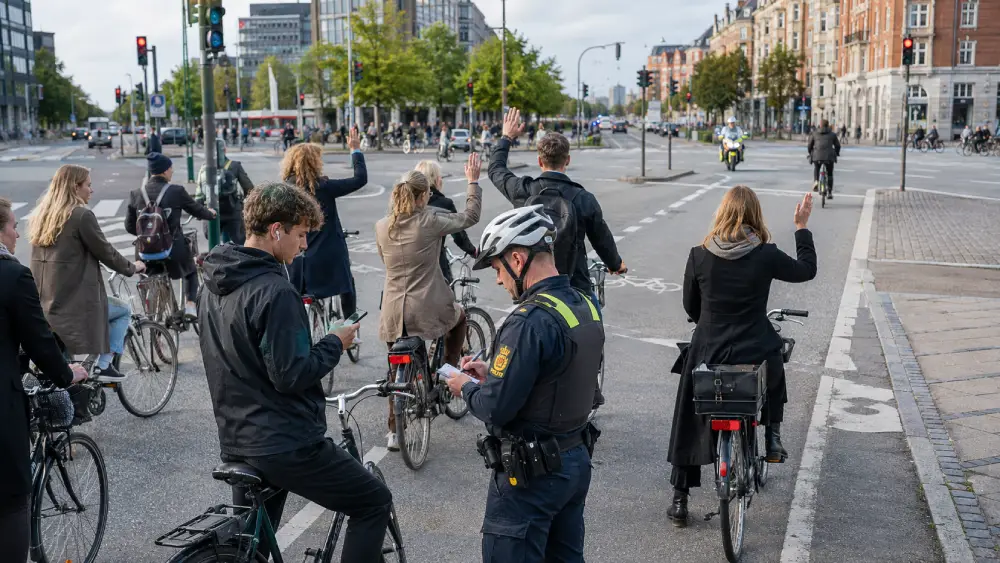
Denmark is world-renowned for its cycling infrastructure, but this comes with a strict set of unwritten and written rules. The bicycle lane is treated like an active highway. As a pedestrian, stepping into the bike lane without looking is of the most dangerous and culturally offensive things you can do.
If you decide to rent a bicycle, you must understand that the police regularly conduct sting operations to catch rule-breakers. Using a handheld mobile phone while cycling is strictly forbidden and carries a harsh fine of 1,000 DKK. You must also use standard hand signals before stopping or turning to avoid causing high-speed pileups.
Failing to properly equip your bicycle will also cost you dearly, especially during the darker winter months. You must follow these strict requirements:
-
Missing Lights: Riding without front and rear lights after dark will result in a 700 DKK fine.
-
Cycling on Pedestrian Crossings: You must dismount and walk your bike across zebra crossings. Riding across them is a 1,000 DKK fine.
-
Red Light Jumping: Running a red light on a bicycle will cost you 1,000 DKK, and Danish locals will loudly publicly shame you for doing it.
Vaping Bans & Strict Medication Imports
Denmark takes public health very seriously, and its laws regarding nicotine and prescription drugs are tightly controlled. Flavored e-liquids are completely banned in Denmark, a law that came into full effect in April 2021. You will find tobacco-flavored vapes available for legal purchase inside the country.
Additionally, selling vapes via platforms to consumers or through vending machines is entirely illegal. While vaping is allowed in open public spaces like parks, it is heavily restricted in restaurants, bars, public transport, and schools. Always look for signage, as breaking indoor smoking and vaping bans will result in immediate ejection and fines.
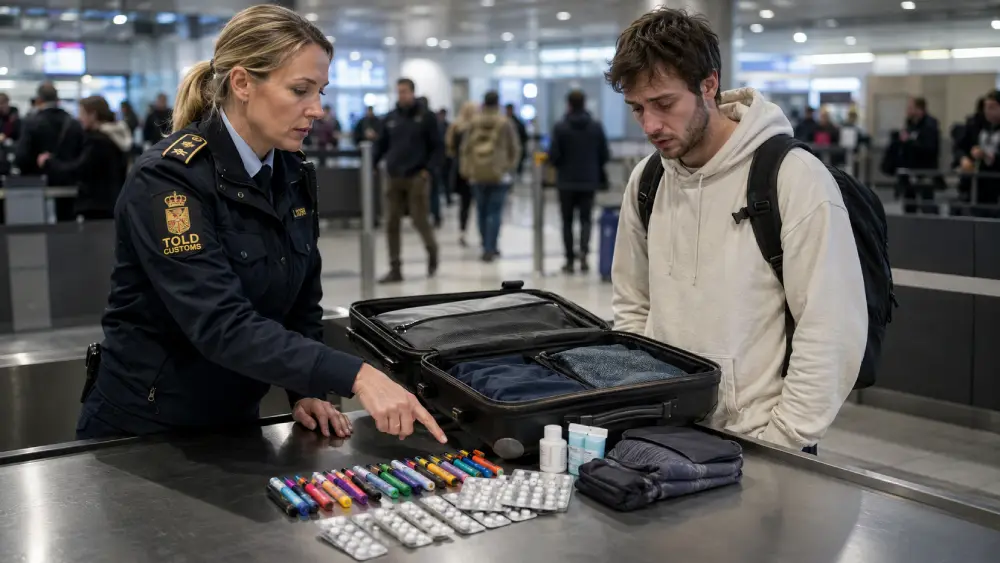
When it comes to bringing personal medication into the country, the rules were recently updated. According to the Danish Medicines Agency, as of January 1, 2026, new regulations govern how private individuals can import medicines. While standard personal medicine is generally fine, euphoriant substances and ADHD medications face intense scrutiny.
-
The 14-Day Limit: You are allowed to bring a maximum of 14 days' worth of medicines containing euphoriant substances (like certain ADHD meds).
-
Required Proof: You must carry the original doctor's prescription and potentially the purchase receipt to prove the medicine was obtained legally.
-
Doping Bans: Medicines containing doping substances are strictly illegal unless you have explicit medical documentation proving they are for disease treatment.
-
Customs Checks: Failing to declare restricted items can lead to police involvement. Before you pack your bags, make sure to read our complete guide on Denmark Airport Customs Rules.
The Copyrighted Mermaid & Tripod Permits
Denmark embraces free expression and tourism photography, but commercializing certain landmarks can trigger unexpected legal battles. The most famous example is The Little Mermaid statue, which is heavily protected by copyright laws enforced by the heirs of sculptor Edvard Eriksen. While snapping a personal photo is perfectly legal, using that image for commercial purposes without permission is a direct violation of copyright.
Furthermore, setting up professional photography gear in public spaces is not a free-for-all. Using a tripod on the public streets of Copenhagen requires official authorization from the City of Copenhagen's municipality. If you block foot traffic with large light stands or tripods without a permit, municipal authorities will force you to pack up.
Museums and cultural institutions also enforce strict anti-tripod policies to protect foot traffic and artwork.
-
Museum Bans: Major galleries like the National Gallery of Denmark (SMK) explicitly prohibit the use of tripods, flash photography, and lighting equipment.
-
Public Domain Rules: Under Danish copyright law, artists must be deceased for at least 70 years before their work enters the public domain. Photographing recent artwork for anything other than private use is restricted.
-
The Round Tower: Filming inside historic sites like the Round Tower requires advanced written approval and a filming permit.
Public Drinking is Legal (Until You Are Obnoxious)
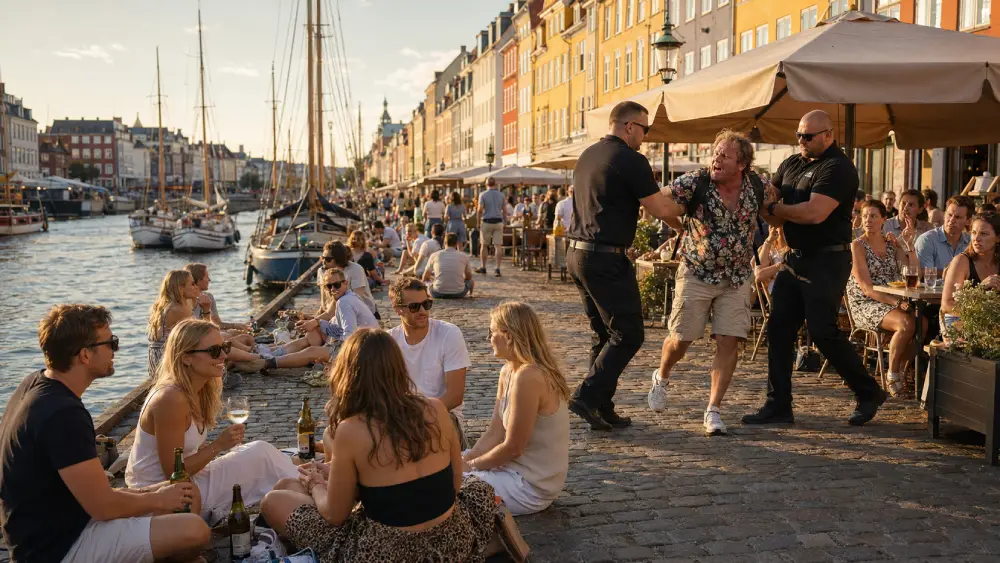
Unlike many North American countries, public drinking is entirely legal and socially acceptable in Denmark. During the summer, you will see thousands of locals enjoying cold beers and wine in parks, along the canals, and on the streets. It is a cherished part of the Danish lifestyle and perfectly safe to participate in.
However, this freedom comes with a very clear caveat: disturbing public law and order is a criminal offense. The police are highly tolerant of public drinking, but they have zero tolerance for aggressive behavior, extreme intoxication, or excessive noise. If you become loud, obnoxious, or start harassing passersby, you will be arrested for public disturbance.
There are also specific age restrictions regarding the purchase of alcohol that confuse many foreign visitors.
-
Under 16.5% ABV: You must be at least 16 years old to purchase beer or wine in a supermarket or kiosk.
-
Over 16.5% ABV: You must be 18 years old to purchase hard liquor and spirits in shops.
-
Bars & Nightclubs: You must be 18 years old to be served any alcohol stronger than a 2.8% light beer in a bar or restaurant.
-
ID Checks: Authorities conduct random sting operations on shops. Always carry a valid photo ID, as vendors will check your age rigorously.
"Janteloven": The Cultural Taboo of Flaunting Wealth
To truly respect Danish culture, you must understand the unwritten social code known as Janteloven (The Law of Jante). This cultural framework dictates that egalitarianism and humility are paramount, and no individual is better or more important than the collective. Flaunting wealth, acting arrogant, or demanding special VIP treatment is considered the ultimate cultural faux pas.
In Denmark, a CEO and a janitor are treated with the exact same level of respect. Elitism is heavily frowned upon. For instance, hiring a private chauffeur or loudly bragging about your income will not impress anyone; it will simply cause locals to view you as a snob. The key to being accepted in Denmark is to blend in and remain low-key.
Additionally, the Danish respect for efficiency translates into a severe obsession with punctuality. Being late is not just a minor inconvenience—it is an insult.
-
Strict Punctuality: If you are invited to a dinner party or a business meeting at 7:00 PM, you must arrive exactly at 7:00 PM. Not 6:50 PM, and definitely not 7:10 PM.
-
Calling Ahead: If you are running even 5 minutes late due to an emergency, it is mandatory to call ahead and apologize.
-
Personal Space: Danes value their privacy. Keep at least two arm's lengths of distance during conversations and avoid asking deeply personal questions about religion or income.
-
Compliments: Over-the-top compliments are often viewed with suspicion. Danes prefer direct, factual, and honest communication over excessive flattery.
The Drone Crackdown: No Flying in the City
Capturing aerial footage of Denmark’s stunning castles and coastlines sounds appealing, but the country operates under incredibly strict European aviation laws. According to the Danish Civil Aviation and Railway Authority, flying a drone in busy urban areas is strictly limited to professional purposes. Tourists are generally banned from launching drones within city limits, over crowds, or near residential zones.
If you bring a drone weighing more than 250 grams or capable of flying faster than 50 km/h, it must be officially registered. You must hold a valid drone awareness accreditation to legally operate it. Ignoring these rules can lead to the immediate confiscation of your expensive equipment and a hefty police fine.
Even in rural, permitted areas, you must adhere to rigorous distance and altitude limits to avoid violating national security and privacy laws.
-
Maximum Altitude: You cannot fly your drone higher than 100 meters from the ground.
-
Airport Proximity: You must maintain a strict distance of 5 kilometers from any airport or airfield.
-
Military & Royal Sites: Stay at least 150 meters away from royal residences, military installations, embassies, and prisons.
-
Infrastructure Distance: You must keep a 150-meter buffer from public roads, private buildings, and accident sites.
Stay Connected to Stay Safe
Navigating foreign laws, translating parking signs, and figuring out complex municipal boundaries requires constant access to the internet. Relying on spotty public Wi-Fi in Copenhagen is a fast way to find yourself lost in a restricted drone zone or accidentally violating a local regulation. Having a reliable mobile data connection allows you to instantly check Google Maps, verify official government portals, and contact your embassy in case of a legal emergency.
Need data in Denmark? Get an eSIM!
Choose the perfect data plan for your trip
To protect yourself from massive data roaming charges and the security risks of public networks, getting a local digital SIM is essential. Denmark eSIM helps you avoid scams at the airport and instantly connects you to the strongest local networks the moment your plane lands. This ensures you can access digital train tickets, pay parking fines via the EasyPark app, and stay legally compliant throughout your trip.
For a deeper dive into your connectivity options, make sure to read our comprehensive guide on How to Get Internet in Denmark. If you want to skip the research and just find the fastest mobile data deals available right now, check out our direct comparison in Best eSIM for Denmark.
Summary Checklist (Don't Be That Tourist)
-
Wear your e-scooter helmet: Helmets are legally mandatory; riding without triggers an instant 1,500 DKK fine.
-
Respect the bike lanes: Never walk in the bicycle lanes, and never cycle on pedestrian crossings or pavements.
-
Leave the flavored vapes at home: tobacco-flavored e-liquids are legally sold in Denmark; public indoor vaping is heavily restricted.
-
Check your ADHD meds: Euphoriant prescriptions are strictly limited to a 14-day supply and require official doctor documentation.
-
Ground the drone in the city: Flying drones in busy urban areas is banned for tourists; keep 150 meters away from all buildings.
-
Don't flaunt or flex: Respect the egalitarian "Law of Jante" by avoiding loud, boastful behavior and treating everyone as your equal.
-
Be aggressively punctual: Arriving late to any meeting or social event is considered a deep personal insult.
Note: Travel laws and fines can change. This information is accurate as of July 2026. Always consult official local authorities before your trip.
