

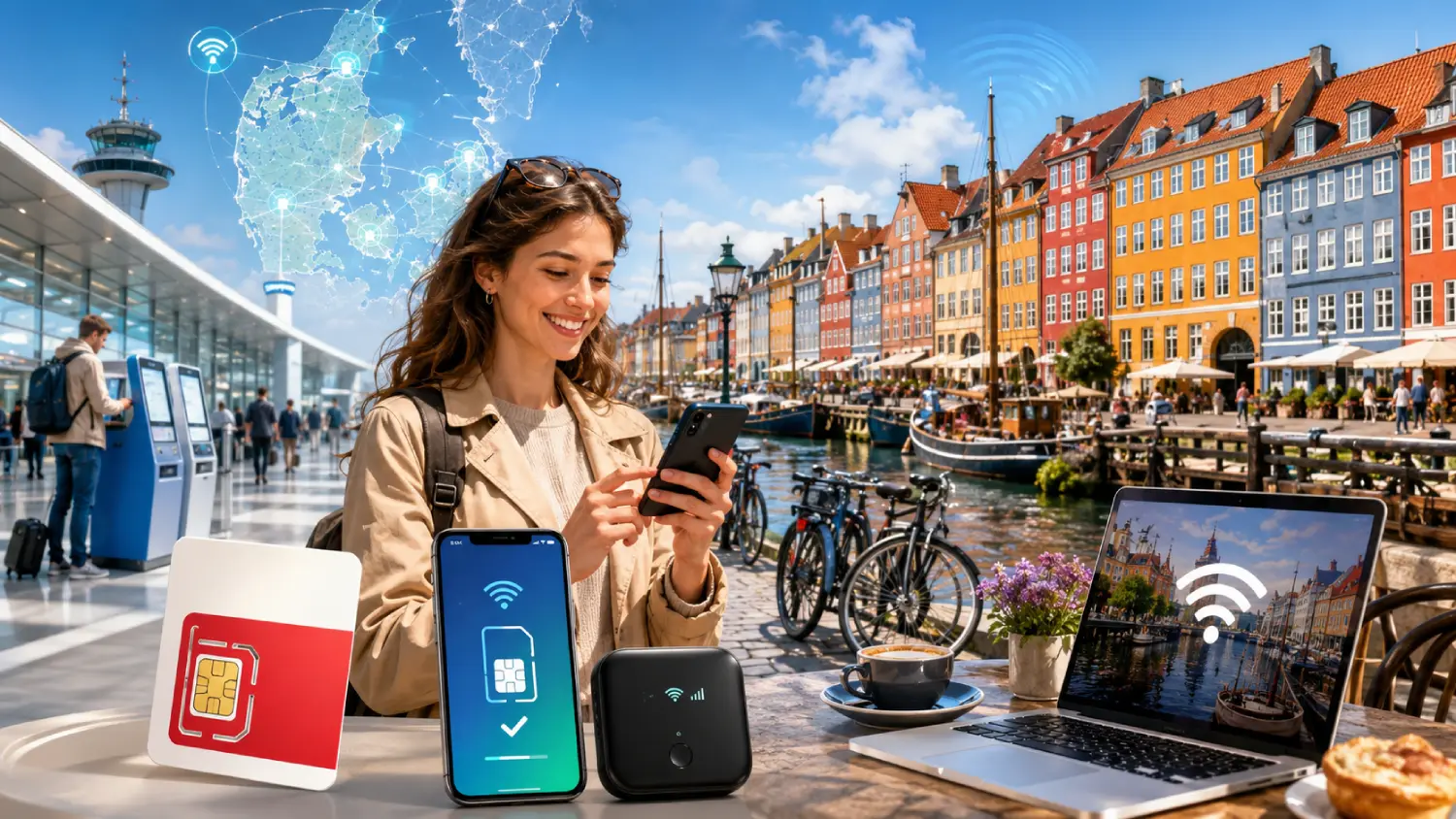

For most visitors in 2026, the most practical setup is simple: install an eSIM before arrival, keep mobile data ready for maps and transport, and use hotel or airport WiFi as a backup.
Internet Options in Denmark: Quick Comparison
Denmark is of the easier European countries for mobile internet. Prices are generally reasonable, 4G coverage is widely available, and 5G is common in major cities. The main difference is convenience. Airport SIM cards are fast to buy but not always the best value. Local SIM cards can be cheap but require store visits and setup. eSIMs are the smoothest option if your phone supports them.
| Internet Option | Best For | Typical 2026 Cost | Setup Time | Main Advantage | Main Limitation |
|---|---|---|---|---|---|
| Airport SIM card | Travelers who need a physical SIM immediately | Around 29–199 DKK, roughly $4.40–$30.40 | 10–30 minutes | Available after landing | Limited selection and airport pricing |
| Local prepaid SIM | Longer stays and heavy local data users | From around 19 DKK, roughly $2.90 | 30–60 minutes | Very low local prices | Requires finding a store and changing SIM |
| Roafly Denmark eSIM | Most tourists, business travelers, short trips | From $3.90 | A few minutes | No physical SIM, install before arrival | Requires eSIM-compatible phone |
| Pocket WiFi | Families or groups with several devices | From about €3.95/day, roughly $4.30/day | Delivery or pickup required | Connects multiple devices | Extra device to carry and charge |
| Airport and public WiFi | Backup use | Free | Instant | Useful at airport, hotels, cafés | Not reliable for navigation outdoors |
Price note: DKK to USD estimates use an approximate July 2026 exchange rate of about 1 USD = 6.54 DKK. Exchange rates can change daily.
Need data in Denmark? Get an eSIM!
Choose the perfect data plan for your trip
Exclusive Reader Bonus!
Enjoy an extra %10 OFF your first Roafly eSIM purchase as a thank you for reading.

Manage your eSIM in the app
Install, top up and track data.
Buying a SIM Card at Copenhagen Airport
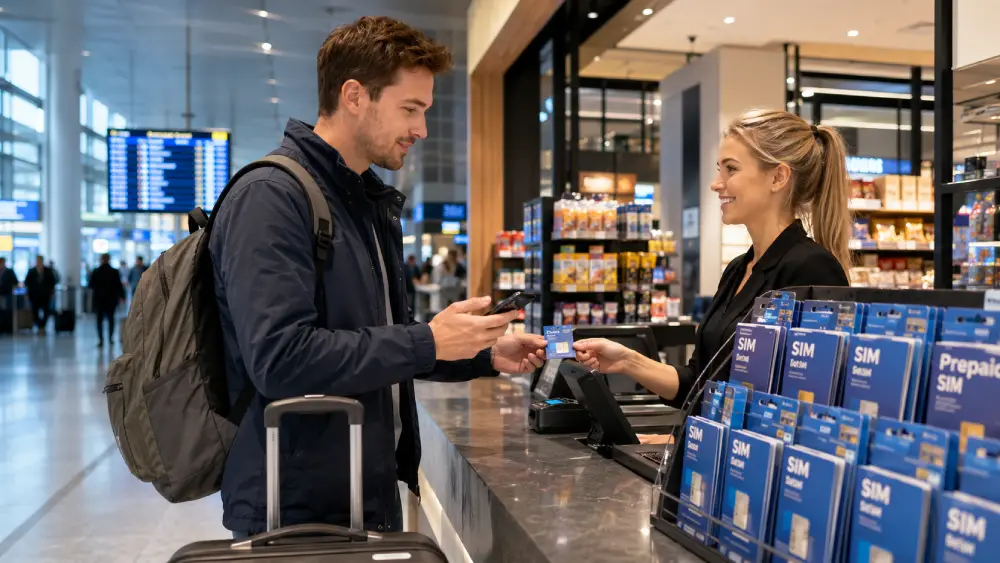
Copenhagen Airport is the main arrival point for most international travelers visiting Denmark. You can get at the airport in two ways: use the official airport WiFi or buy a physical prepaid SIM card before heading into the city.
The airport’s official WiFi network, CPH Airport Free Wi-Fi, is available before and after security and at the gates. It is free and does not require a password, which makes it useful for checking your hotel address, messaging your driver, or opening your eSIM installation email after landing.
For physical SIM cards, airport options are usually more limited than what you find in central Copenhagen. Travel-focused reports for 2026 list prepaid SIM availability at Copenhagen Airport through places such as convenience stores, vending machines, and SIM sales points near the metro station. Reported airport SIM prices typically range from 29 DKK to 199 DKK, depending on the data package and seller. That is roughly $4.40 to $30.40.
A common airport setup is a Lyca Mobile or Lebara SIM sold through airport retail points. Some packages are inexpensive, but availability can vary by terminal, arrival time, and stock. If you land late at night, need staff support, or want a specific data package, the airport is not always the most predictable place to buy a SIM.
Copenhagen Airport SIM Card Prices in 2026
| Airport Option | Reported 2026 Price | Approx. USD | What to Expect |
|---|---|---|---|
| Basic airport SIM or starter SIM | Around 29–49 DKK | Around $4.40–$7.50 | Entry-level SIM, limited data or requires top-up |
| Mid-range prepaid SIM | Around 99 DKK | Around $15.10 | Better data allowance for short stays |
| High-data airport SIM | Up to around 199 DKK | Around $30.40 | Larger data package, often bought from vending machines or airport sellers |
Airport SIM cards are convenient, but they are not always the best fit for every traveler. You may need to remove your home SIM, find a SIM ejector pin, activate the plan manually, and check whether EU roaming is included if your trip continues to Sweden, Germany, Norway, or another nearby country.
A Denmark eSIM avoids most of these steps because you can install it before your flight and switch it on after landing.
Local Tourist SIM Cards in Denmark
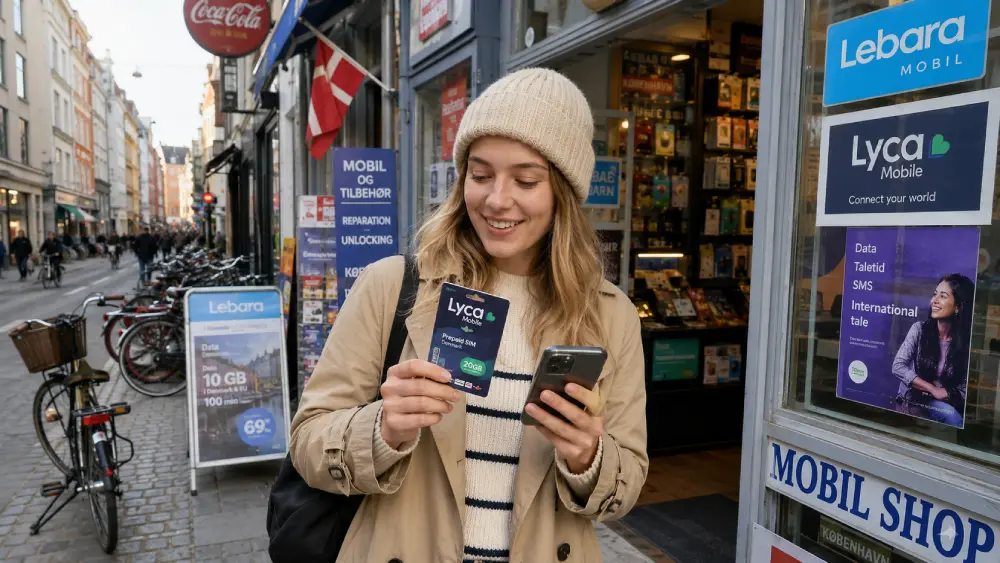
Local prepaid SIM cards in Denmark can be very affordable. They are often sold in convenience stores, kiosks, supermarkets, and mobile shops. Travelers commonly find prepaid SIM options from providers such as Lyca Mobile and Lebara in places like 7-Eleven, Circle K, Føtex, Bilka, kiosks, and electronics stores.
The lowest advertised monthly plans can start at around 19 DKK, which is roughly $2.90. This makes Denmark of the cheaper countries in Northern Europe for basic prepaid mobile data. The trade-off is that local SIM cards are designed mainly for people already in Denmark. Some plans are marketed as monthly packages, and some may be easier to manage with a Danish payment method, local app, or account.
For short-term tourists, the key questions are:
- Does the SIM work immediately without a Danish CPR number?
- Can you activate it in English?
- Does the package include enough data for navigation, WhatsApp, train tickets, and hotel bookings?
- Does it include EU roaming if you are visiting multiple countries?
- Can you top up easily with an international card?
Lyca Mobile Denmark advertises prepaid SIM card deals starting from 19 DKK per month, with physical SIM and eSIM options. listed plan includes 5 GB data, 5 hours of calls, 4 GB EU roaming data, and 5G for 19 DKK.
Lebara Denmark also lists entry-level mobile plans from 19 DKK per month, including 5 GB in Denmark, 5 hours in Denmark, 3 GB in the EU, and international calling minutes.
Local Prepaid SIM Prices in Denmark in 2026
Need data in Denmark? Get an eSIM!
Choose the perfect data plan for your trip
Exclusive Reader Bonus!
Enjoy an extra %10 OFF your first Roafly eSIM purchase as a thank you for reading.
Manage your eSIM in the app
Install, top up and track data.
For most tourists visiting Copenhagen for three to five days, 5 GB or 10 GB is a comfortable choice. For a week or more across Copenhagen, Aarhus, Odense, Skagen, or the Danish islands, 10 GB to 20 GB gives more breathing room.
Roafly supports easy installation methods including Direct Install, QR Code, and Manual setup. That means you can choose the method that fits your phone and travel timing. iPhone users can usually install very quickly with Direct Install, while QR Code setup is practical if you are installing from a laptop or another device.
For travelers comparing Denmark connectivity options before a trip, the Best eSIM for Denmark guide is a helpful next read because it focuses specifically on eSIM selection, coverage, and travel use cases.
Denmark Mobile Coverage: What to Expect
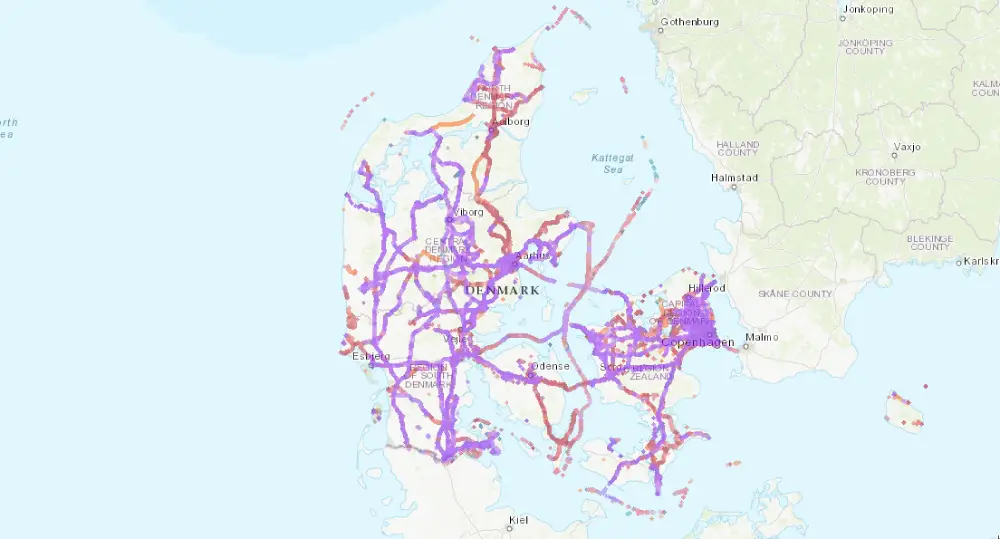
Denmark has strong mobile coverage in cities, towns, transport corridors, and most populated areas. Copenhagen, Aarhus, Aalborg, Odense, Esbjerg, Roskilde, and major rail routes generally have reliable 4G and 5G access. Coverage can be more variable in rural coastal areas, ferry routes, forests, and smaller islands, but Denmark is still of the easier countries for mobile connectivity.
OpenSignal’s Denmark mobile network report from February 2026 found that TDC led Denmark for overall coverage experience, with a score of 9.3 out of 10, and also retained the 5G coverage experience award. The same report placed 3 lower for geographic coverage, while still active as of Denmark’s major mobile networks.
This matters for travelers because network quality is not about speed. Coverage is especially important when you are using maps outside Copenhagen, taking trains between cities, cycling along the coast, driving to Møns Klint, or visiting smaller towns.
In practical terms:
- Copenhagen and major cities are easy for mobile data.
- Train routes and highways are usually well covered.
- Rural beaches, ferries, and islands may have weaker signal.
- Indoor signal can vary in older buildings, basements, museums, and metro stations.
A phone that supports modern European 4G and 5G bands will usually perform well. If you are using an older phone from outside Europe, check that it supports common LTE bands used in the region before relying on it as your connection.
How Much Mobile Data Do You Need in Denmark?
Denmark is a digital-first travel destination. You may need mobile data for public transport tickets, train schedules, restaurant reservations, hotel check-in, navigation, translation, banking verification, and messaging. Even if you plan to use hotel WiFi, mobile data is useful every time you step outside.
A light user can manage with 1–3 GB for a short trip. This means messaging, email, maps, and basic web searches. A regular tourist should choose 5–10 GB for a city break because maps, photos, social media, and travel apps use more data than expected. Heavy users should consider 20 GB or more, especially when using hotspot, video calls, cloud backups, or remote work tools.