

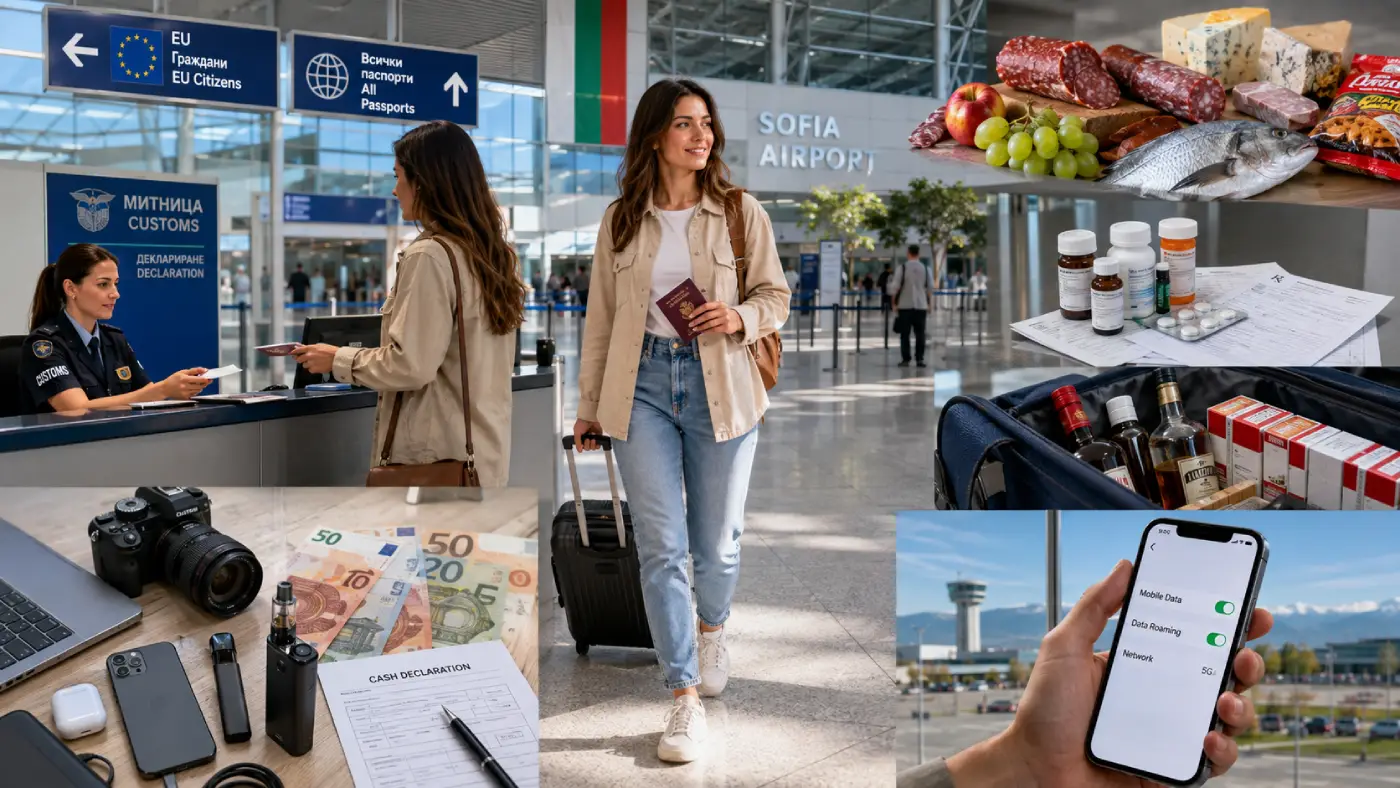

Your safest approach is to identify where you first enter the EU, check the rules for your transport mode, keep supporting documents with controlled medicines, and declare goods or cash whenever the applicable rule requires it.
What you can bring into Bulgaria at a glance
| Item | Current rule | Best action |
|---|---|---|
| Alcohol | Allowances differ for EU and non-EU arrivals | Check origin before packing |
| Cigarettes and tobacco | Non-EU limits depend on transport mode | Use the correct air or land limit |
| Food | Meat and dairy are restricted from most non-EU countries | Leave restricted animal products behind |
| Medicines | Personal quantities are generally allowed; controlled drugs need documents | Carry supporting medical paperwork |
| Cash | €10,000 or more triggers declaration rules | Check whether automatic or on-request declaration applies |
| Vapes | No separate passenger e-liquid quota is published | Do not apply cigarette limits to vapes |
| Other goods | Non-EU duty-free value limits apply | Keep receipts for valuable new purchases |
The key distinction is customs origin, not nationality. Flying directly into Bulgaria from the United States, Turkey or another non-EU country places you under third-country entry rules, while travel from another EU Member State is generally treated as movement within the EU customs area.
Rules checked on August 10, 2026. Requirements can change; verify the linked official guidance before travel.
EU and non-EU arrivals have different customs allowances
If Bulgaria is your first EU entry point from a non-EU country, the third-country passenger allowances apply. Bulgarian Customs lists a duty- and tax-free value allowance for other goods of up to €430 for air and sea travelers and €300 for travelers using other forms of transport.
These value limits cover categories such as gifts, new electronics, perfumes and other purchases that are not subject to their own specific alcohol or tobacco allowance. A single item cannot be divided between travelers’ allowances simply to bring its value below the threshold.
If you first enter the EU through another Member State before continuing to Bulgaria, customs formalities for goods arriving from outside the EU generally take place at that first EU entry point. A connecting flight does not automatically move the customs obligation to Bulgaria.
Travel from another EU Member State follows a different system. Personal goods already in free circulation within the EU are not subject to the same €430 or €300 third-country allowance, although excise products such as alcohol and tobacco still have personal-use rules.
The Bulgarian National Customs Agency passenger allowance guidance is the relevant official reference when you are bringing expensive new purchases from outside the EU.
Food, meat, dairy, fruit and plants
Food rules are especially important when you arrive from outside the EU. Meat, milk and products containing them generally cannot be brought into the EU in personal luggage from most third countries because of animal-health controls.
That restriction includes many products travelers might otherwise consider harmless, such as meat snacks, sausages, cheese and food containing significant meat or dairy ingredients. Factory sealing alone does not make an otherwise restricted animal product admissible.
There are limited country and product exceptions. Travelers arriving from the Faroe Islands or Greenland may bring less than 10 kg of meat, milk or their products, while some infant and medical foods can qualify for specific exemptions when official conditions are satisfied.
Other animal products have different limits:
-
Fishery products are generally allowed up to 20 kg or the weight of fish if that fish is heavier.
-
Honey, snails and certain other animal products are generally limited to 2 kg.
-
Powdered infant milk, infant food and certain foods required for medical reasons can qualify up to 2 kg when the conditions are met.
-
Rules differ for travel between EU Member States and for several specifically exempt European territories.
Check the European Commission personal food import guidance before packing animal products from a non-EU country.
Plants and fresh produce are controlled separately. From non-EU countries, plants for planting, most fruit and vegetables, and cut flowers generally require a phytosanitary certificate before they may enter the EU.
Pineapples, coconuts, durians, bananas and dates are among the specifically exempt fruits. For seeds, plants, flowers or other fresh produce, use the European Commission plant-health guidance rather than relying on packaging or supermarket labeling.
Medicines and controlled substances
Ordinary medicines for personal treatment are generally treated differently from prohibited or controlled drugs. Bulgarian Customs states that medicinal products may be carried in the quantity and type required for the traveler’s personal needs.
The more important issue is the active ingredient. A medicine that is routine in your home country may contain a narcotic or psychotropic substance that falls under Bulgarian controlled-drug rules.
For foreign visitors temporarily staying in or transiting Bulgaria, medicines containing controlled narcotic substances covered by the relevant Bulgarian lists may be possessed for treatment in quantities no greater than a 30-day treatment supply.
Bulgarian Customs also requires an official document issued by the competent authority in the country where the treatment was prescribed. Its published guidance states that tetrahydrocannabinols are not allowed in medicinal products under this particular traveler provision.
Before departure, check the documentation requirement if your medicine involves:
-
ADHD medication containing a controlled stimulant;
-
strong opioid or narcotic pain medication;
-
sedatives or other controlled psychotropic substances;
-
cannabis-derived products or medicines containing controlled cannabinoids.
A pharmacy label or ordinary prescription may not satisfy a requirement for a document from a competent national authority. The Bulgarian Customs guidance on medicines containing narcotic substances should be checked for controlled medicines before travel.
Alcohol and cigarette allowances
Travelers over 17 entering Bulgaria from outside the EU receive specific duty-free allowances for tobacco and alcohol. Tobacco limits vary according to transport mode, so an allowance quoted for a flight should not be applied to a land-border arrival.
For air travelers, the allowance is up to 200 cigarettes, 50 cigars, 100 cigarillos or 250 g of smoking tobacco. These are alternatives that may also be combined proportionally rather than four separate full allowances.
Travelers entering through other forms of transport have lower tobacco quantities: 40 cigarettes, 10 cigars, 20 cigarillos or 50 g of smoking tobacco.
The non-EU alcohol allowance for travelers over 17 permits either 1 liter of alcohol over 22% ABV or 2 liters of alcoholic beverages at or below 22% ABV. Proportional combinations are possible within that category.
In addition, the exemption includes:
-
4 liters of still wine;
-
16 liters of beer.
Different rules apply when excise goods are carried from another EU Member State for genuine personal use and transported by the individual concerned. Bulgarian Customs lists personal-use quantities of up to 800 cigarettes, 200 cigars, 400 cigarillos or 1 kg of smoking tobacco.
For qualifying intra-EU alcohol movements, the published quantities include up to 10 liters of stronger CN 2208 alcoholic beverages, 20 liters of intermediate products, 90 liters of wine with no more than 60 liters of sparkling wine, and 110 liters of beer.
These intra-EU figures are not a general duty-free shopping allowance. Their relevance depends on the goods being for personal use and on the circumstances of the movement between Member States.
Cash declarations at the Bulgarian border
Carrying €10,000 or more is not itself prohibited. The important distinction is whether you are crossing the EU’s external border through Bulgaria or moving between Bulgaria and another EU Member State.
When entering or leaving the EU through Bulgaria with €10,000 or more in cash, or the equivalent in another currency, you must complete a cash declaration and present it to customs.
Where red and green customs corridors are available, Bulgarian Customs instructs travelers who must make this external-EU cash declaration to use the red corridor.
Travel between Bulgaria and another EU Member State is handled differently. When carrying €10,000 or more on an intra-EU movement, the amount must be declared upon request by a customs officer under Bulgaria’s national rules.
For declaration purposes, cash is broader than banknotes and coins. The official definition also includes certain bearer negotiable instruments and specified forms of high-purity gold.
Separate Bulgarian rules can also apply to certain precious metals, gemstones and articles made from them. Use the Bulgarian Customs cash declaration guidance when traveling with large amounts of money or qualifying valuables.
Vapes and other personal goods
Bulgarian passenger allowance guidance publishes quantitative limits for cigarettes, cigars, cigarillos and smoking tobacco but does not publish a separate traveler quantity for personal vape devices or e-liquids. The cigarette allowance should therefore not be converted into an assumed number of disposables, cartridges or milliliters of e-liquid.
Electronic cigarettes and liquids are subject to Bulgarian excise controls in commercial contexts. That makes the distinction between ordinary personal baggage and bulk or commercial quantities important, especially when traveling with multiple unopened devices or significant stocks of liquid.
For phones, laptops, cameras and similar belongings, the practical customs question is usually whether the goods are ordinary personal effects or new purchases that fall within the third-country value allowance. Keep receipts when you are carrying high-value new items whose purchase status may not be obvious.
If you are unsure whether goods require declaration, ask customs instead of treating the green channel as automatic permission. Passing through green does not prevent inspection or remove a declaration obligation that otherwise applies.
Customs rules cover whether an item may cross the Bulgarian border. Restrictions on possession, operation or use after entry are separate local-law questions; this is particularly relevant for devices such as drones and for rules governing where tobacco or vape products may be used.
Mobile internet after customs
Once border formalities are complete, activating your Bulgaria eSIM can provide mobile data without affecting any customs requirement. Roafly plans are data-only, and hotspot use draws from the purchased data allowance rather than a separate hotspot quota.
Need data in Bulgaria? Get an eSIM!
Choose the perfect data plan for your trip

Manage your eSIM in the app
Install, top up and track data.
For provider, plan and coverage comparisons, use Best eSIM for Bulgaria.
For the broader choice between eSIMs, physical SIM cards, roaming and WiFi, see Internet in Bulgaria: eSIM, SIM & Roaming.
Bulgaria customs checklist before you travel
Before departure, make the checks that match your route and what you are carrying:
-
Confirm whether Bulgaria is your first EU entry point or whether you will clear customs in another EU country first.
-
Use the correct tobacco and alcohol allowances for your origin and transport mode.
-
Leave restricted meat and dairy products behind when arriving from most non-EU countries.
-
Check phytosanitary certificate requirements before packing plants, seeds, flowers, fruit or vegetables from outside the EU.
-
Verify controlled-medicine ingredients and obtain the required competent-authority document when applicable.
-
Check the declaration procedure if you are carrying €10,000 or more in cash or equivalent instruments.
-
Keep receipts for valuable new purchases and ask customs when the declaration status of an item is unclear.
The biggest errors usually come from applying the wrong origin rules: using an intra-EU limit for a third-country arrival, assuming an air-passenger tobacco allowance applies at a land border, or treating a personal medicine exemption as permission for a controlled ingredient. Identify your actual route first, then apply the rule for that route.