


Internet options in Bulgaria at a glance
Bulgaria adopted the euro on January 1, 2026, so current mobile prices should now be compared in euros.
| Option | Typical cost | Best for | Watch out |
|---|---|---|---|
| Roafly eSIM | See live pack | Easy short trips | Data |
| Local prepaid SIM | About €7.67–€12.99+ | More local data | Purchase/setup varies |
| Home-carrier roaming | Often included for EU/EEA plans | Existing SIM convenience | Fair-use limits |
| WiFi options | Free to rental-priced | Backup or several devices | Not always portable |
Local prepaid data can be inexpensive, but the lowest price is not always the easiest option if you need to visit a shop or configure a new SIM.
Need data in Bulgaria? Get an eSIM!
Choose the perfect data plan for your trip
Exclusive Reader Bonus!
Enjoy an extra %10 OFF your first Roafly eSIM purchase as a thank you for reading.

Manage your eSIM in the app
Install, top up and track data.
Airport SIM cards

Vasil Levski Sofia Airport is the main international gateway for many visitors. The airport’s current passenger information does not publish a dependable tourist SIM package, counter price or clearly documented mobile-shop offer that travelers can plan around.
That makes an airport SIM a poor option to rely on before landing. If you find a SIM reseller in the terminal, check the operator, total starter price, included data, validity and top-up method before paying.
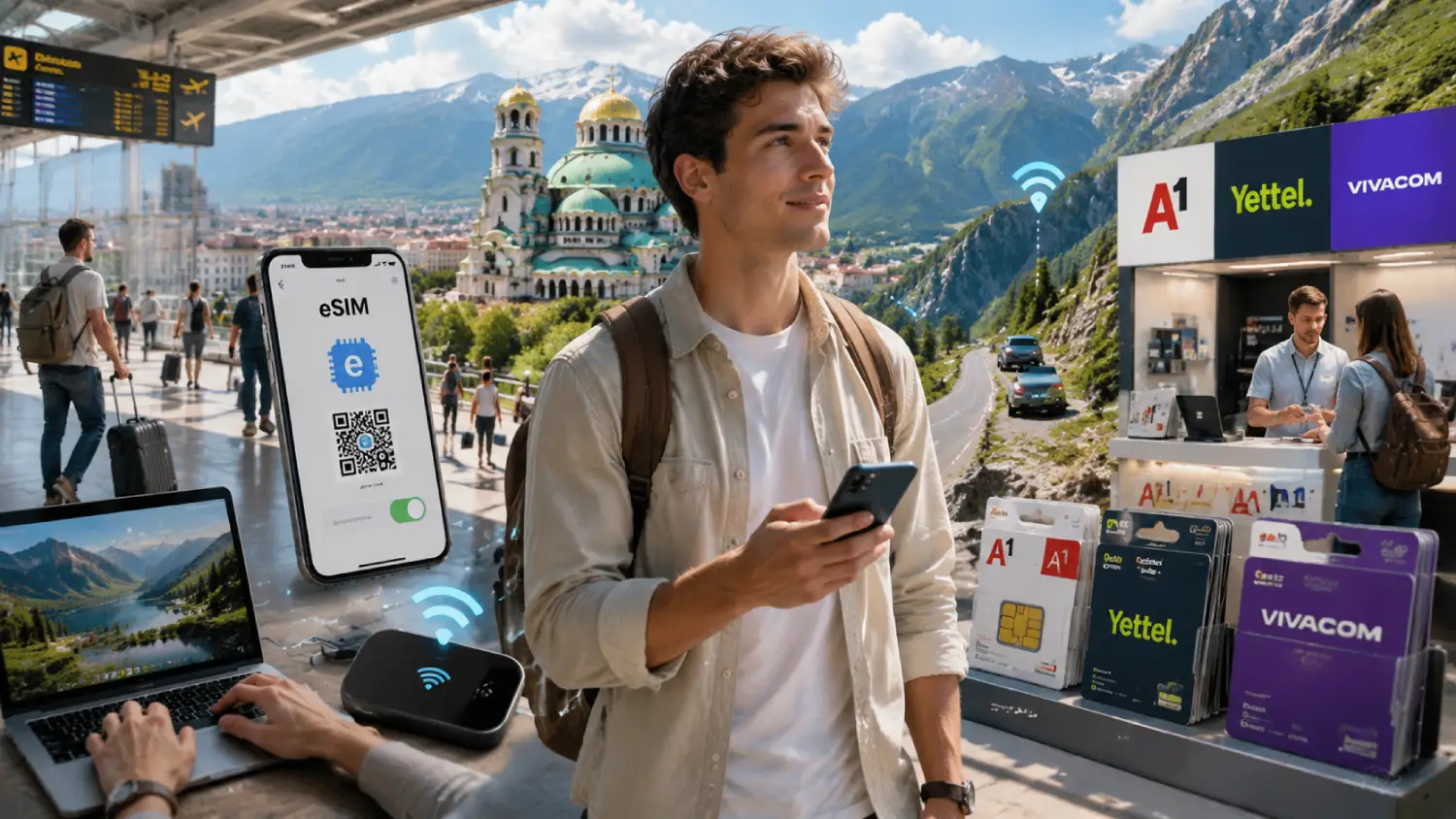
If you want a physical Bulgarian SIM, a more predictable approach is to use an official A1, Vivacom or Yettel sales point after reaching Sofia or your destination. If immediate connectivity matters for maps, ride-hailing or accommodation messages, arrange roaming or an eSIM before the flight.
Sofia Airport maintains current passenger-service information on its official airport website.
Local prepaid and tourist SIM cards
Bulgaria has three major consumer mobile brands: A1, Vivacom and Yettel. Short-term visitors can access prepaid services, including data-focused options that do not require a long-term subscription.
Representative offers checked on August 9, 2026 include:
| Operator / product | Data and validity | Total price | Format | What to know |
|---|---|---|---|---|
| A1 Prepaid Data 15 GB | 15 GB + 5 GB for 25 days | €7.67 | SIM or eSIM | Bulgaria-only data product |
| Yettel 25 GB prepaid eSIM | 25 GB for 30 days | €10.23 | eSIM | Data; Bulgaria |
| Vivacom Data2Go | 80 GB at max speed, up to 28 days | €12.99 | Prepaid SIM | Data-focused starter |
The main difference is not simply the number of gigabytes. A1’s current starter includes a limited promotional period of unlimited data before the regular allowance applies, while Yettel offers an prepaid eSIM that avoids a store visit. Vivacom’s Data2Go stands out for a larger headline allowance and includes a separate EU-roaming allocation under its current terms.
These prices and promotions can change, so confirm the live offer before purchase rather than choosing solely from an older screenshot or travel guide.
If you need a Bulgarian number and voice calls, look beyond data-only tourist products. Operators also maintain voice-capable prepaid services, but the included minutes, registration process and validity differ from their data-only products.
For an in-store purchase, carry your passport or national identity document and ask which identification is accepted for the specific prepaid product. Also confirm when the allowance expires, whether the starter includes a local number, and what happens when you top up.
Using a Roafly eSIM
A Roafly eSIM is most useful when you want to arrange mobile data before traveling and avoid searching for a physical SIM after landing. You can keep your primary SIM installed, which is useful if you still need access to your usual number for messages or account verification.
Roafly country plans for Bulgaria are data-only. They do not provide a Bulgarian phone number, ordinary voice calls or SMS, so travelers who specifically need local calling should consider a voice-capable prepaid SIM instead.
Hotspot and tethering are supported across the purchased Roafly data allowance, with no separate hotspot quota. That makes it practical to connect a laptop or share data with another device without renting an additional pocket WiFi unit.
Roafly lists A1, Vivacom and Telenor as local networks for Bulgaria. Telenor is the legacy network label; travelers in Bulgaria will now encounter the network under the Yettel brand.
Actual performance still depends on local signal, your device, network conditions and the plan environment. An unlocked eSIM-compatible device is required.
For a deeper comparison of the travel-eSIM choice, see Best eSIM for Bulgaria.
Travelers who want data arranged before departure can choose Bulgaria eSIM instead.
Mobile coverage in Bulgaria
For ordinary city trips in Sofia, Plovdiv, Varna or Burgas, mobile connectivity is generally straightforward. The bigger coverage question appears when your itinerary moves into mountain regions, rural roads or sparsely populated areas.
Terrain matters in places such as the Rila, Pirin, Rhodope and Balkan mountain ranges. Valleys, forested areas, tunnels and remote hiking routes can produce a very different signal experience from central Sofia or a Black Sea resort.
For road trips or hiking days:
-
Download offline maps before leaving a city or hotel connection.
-
Check your planned route, not just national coverage claims.
-
Save accommodation details offline before heading into rural areas.
-
Expect signal variation in mountains, tunnels and isolated roads.
-
Do not depend on mobile data alone for remote hiking navigation.
With Roafly, the supplied Bulgaria network listing includes A1, Vivacom and Telenor/Yettel. Network performance can still vary by location, device and conditions, so a strong connection in Sofia does not guarantee the same result on a mountain road.
Other ways to get
Home-carrier roaming
Bulgaria is in the EU, so travelers with eligible SIMs from EU/EEA countries can normally use calls, texts and mobile data under the Roam Like at Home framework. Fair-use rules can still limit roaming data on unlimited or unusually cheap domestic plans, so check your allowance before traveling.
For travelers from the United States, Canada, the UK or other markets, Bulgaria is not automatically included in a free-roaming arrangement. Your carrier may offer a daily or monthly travel pass, but the price and data conditions depend on your home plan.
Bulgaria also borders countries with different roaming treatment. Greece and Romania are inside the EU roaming area, while Serbia, North Macedonia and Türkiye should not be assumed to have the same treatment. Near borders, check which network your phone has selected before using large amounts of data.
Pocket WiFi
Pocket WiFi can make sense for a family or work group that wants several devices connected through unit. However, there is no sufficiently consistent nationwide tourist rental system to make it the default recommendation for Bulgaria.
If you rent, confirm delivery or pickup, deposit requirements, the actual data policy and return arrangements. For many travelers, tethering from a phone with a suitable allowance is simpler.
Airport and public WiFi
Treat WiFi as a backup rather than your main travel connection. Sofia Airport publishes WiFi information for its lounge facilities, but its public passenger pages do not clearly document a current terminal-wide free-WiFi policy with consistent access terms.
Hotels, cafés and other venues can still provide useful WiFi for downloads and messaging. On an unfamiliar public network, verify the network name when possible, avoid sensitive account activity on unknown networks and disable automatic reconnection afterward.
Which option should you choose?
-
Shortest, easiest trip: Choose a Roafly eSIM if you want data arranged before departure and do not need a Bulgarian number.
-
Already covered by EU roaming: Keep your existing SIM if your home plan gives you enough Bulgarian roaming data under its fair-use allowance.
-
Lowest-cost local data: Compare current A1, Yettel and Vivacom prepaid starters; local plans can offer substantial data for relatively little money.
-
Need a Bulgarian number or local calls: Choose a voice-capable local prepaid SIM rather than a data-only Roafly plan.
-
Road trip or mountain itinerary: Prioritize route coverage and offline preparation rather than choosing by price or headline data allowance.
-
Several devices: Use Roafly tethering or a suitable local SIM before adding the cost and return logistics of pocket WiFi.
Final recommendation
For most visitors spending a few days or a couple of weeks in Bulgaria, arranging an eSIM before departure is the simplest way to arrive with mobile data ready. Bulgarian prepaid SIM is the stronger alternative when you want a local number, calls, very large data allowances or a longer-term local setup.
Before buying anything, EU/EEA travelers should check their existing roaming allowance first. Whatever option you choose, download offline maps before mountain drives or hikes and verify your selected network when traveling close to Bulgaria’s non-EU borders.