

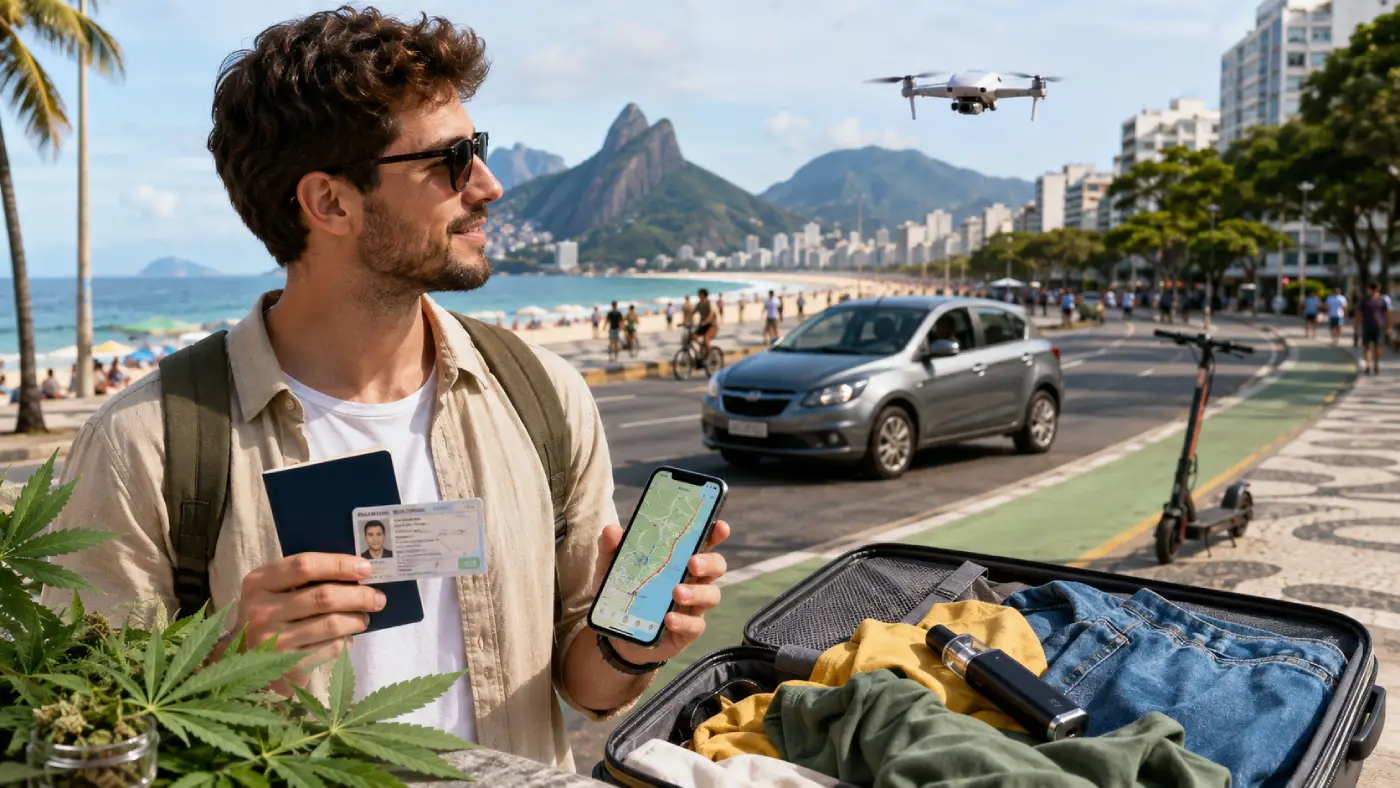
Brazil tourist laws at a glance
| Topic | Current status | What visitors need to know | Safest action |
|---|---|---|---|
| Vapes and e-cigarettes | Use is not generally banned; import and sale are prohibited | Personal possession is not prohibited, but use is banned in enclosed collective spaces | Do not bring a vape into Brazil; do not use indoors |
| Cigarette smoking | Restricted in enclosed collective spaces | Federal smoke-free rules cover enclosed public and collective areas | Smoke where clearly permitted |
| Cannabis | Personal possession is decriminalized in limited circumstances, not legalized | Up to 40 g or six female plants creates a presumption of personal use, but the substance can still be seized | Do not treat the 40 g threshold as permission to possess or use cannabis |
| Other illegal drugs | Personal possession remains subject to Brazil’s drug law | The cannabis ruling does not automatically apply to cocaine, MDMA or other controlled drugs | Do not possess or use illegal drugs |
| Foreign driving licence | Allowed under international agreements and reciprocity, generally for up to 180 days | Required documents depend partly on the agreement covering your licence; Vienna Convention drivers must carry an IDP with their foreign licence | Carry your valid licence, IDP where required, ID and proof of entry |
| Alcohol and driving | Zero-tolerance enforcement | Driving after drinking can trigger serious traffic consequences; refusal of testing is also regulated | Do not drink before driving |
| E-scooters | National vehicle classification, local circulation rules | Small self-propelled devices meeting federal specifications can be regulated locally for where they may travel | Check the municipality’s rules before riding |
| Drones | Permitted subject to aviation and airspace rules | Brazil introduced a new drone framework in June 2026; aircraft type, operation, risk, location and airspace access all matter | Check ANAC and DECEA requirements before every flight |
The pattern is important: Brazil often regulates different parts of the same activity separately. A product can be lawful to possess but unlawful to import or sell, while a drone can be lawful to own but not lawful to fly at a particular place or without the required aviation steps.
Rules checked on September 2, 2026. Laws, local restrictions and penalties can change; verify the linked official guidance before travel.
Vaping in Brazil: possession is different from import and use
Brazil’s vape rules are frequently oversimplified as “vaping is illegal.” ANVISA’s electronic-cigarette guidance makes a more important distinction: individual use is not generally prohibited, and possessing a device for personal consumption is not itself prohibited. However, Brazil prohibits the manufacture, sale, distribution, advertising and importation of electronic smoking devices.
For visitors, three separate rules matter:
-
Bringing into Brazil: importation is prohibited, including devices brought by travelers for personal use in accompanied baggage.
-
Possessing after arrival: possession for personal consumption is not generally prohibited under ANVISA’s rule.
-
Using: electronic smoking devices cannot be used in enclosed collective spaces such as restaurants, bars, classrooms, cinemas and public transport.
Heated-tobacco devices also fall within ANVISA’s electronic smoking-device framework rather than escaping the rules simply because they heat tobacco instead of liquid.
The border question belongs to customs rather than domestic-use law. For baggage and import treatment, see Brazil Customs Rules: Vapes, Food, Cash & Duty-Free.
Brazil’s broader smoke-free rules also restrict conventional smoking in enclosed collective spaces. ANVISA explains that the prohibition can cover places that are enclosed by a roof or awning and walls, partitions or similar barriers; a venue does not necessarily become a permitted smoking area merely because it feels partly open-air.
Cannabis is decriminalized for personal possession, not legalized
Brazil’s Supreme Federal Court changed the legal treatment of marijuana possession for personal use in 2024. Under the STF’s ruling and published guidance, possession of marijuana for personal consumption is not treated as a criminal offense, and up to 40 grams of cannabis or six female plants creates a rebuttable presumption that the possession is for personal use.
That does not mean cannabis became legal. The substance may still be seized, and administrative measures can still apply. The 40 g threshold is also not an automatic safe harbor: evidence about the circumstances of possession can affect whether conduct is treated as personal use or suspected trafficking.
For a visitor, the practical rule is therefore simple: do not interpret “40 grams” as an allowance to buy, carry or consume marijuana freely. It is a legal criterion for distinguishing personal possession from trafficking, not a general permission to possess cannabis.
The decision is also specific to marijuana. Brazil’s drug legislation continues to regulate unauthorized possession of other controlled substances, and the cannabis ruling should not be generalized to cocaine, MDMA, crack or other drugs.
Public use should likewise not be treated as permitted simply because personal possession of marijuana is no longer criminalized in the same way. Decriminalization and unrestricted lawful use are different questions.
Driving in Brazil: foreign licence rules changed in late 2025
Visitors can generally drive in Brazil for up to 180 days from entry when their foreign licence is recognized through an applicable international convention, bilateral agreement or reciprocity arrangement.
A significant procedural change took effect on December 9, 2025. CONTRAN Resolution 1,020/2025 sets the current framework for foreign driving documents and requires drivers covered by the 1968 Vienna Convention to carry an International Driving Permit together with their valid foreign licence.
A qualifying foreign driver should be ready to carry:
-
a valid foreign driving licence;
-
an International Driving Permit together with that licence where the applicable rules require it;
-
an identification document;
-
proof showing the date of entry into Brazil.
Country-specific agreements can change the documentary requirements, so the exact rule can depend on where your licence was issued. The practical mistake is assuming that a rental company handing over a vehicle proves you have every document required by Brazilian traffic law.
Brazil also applies strict drink-driving rules. The safest visitor rule is zero alcohol before driving rather than trying to calculate whether a small amount might fall below an enforcement threshold. Refusing an applicable alcohol test is separately regulated under Brazilian traffic law.
Brazil’s Traffic Code also classifies holding or manually operating a mobile phone while driving as a very serious traffic violation. That restriction can matter even during temporary stops in traffic; putting the phone down before driving is the safest approach.
E-scooters are nationally classified but locally controlled
Brazil has national definitions for electric bicycles, self-propelled individual mobility devices and mopeds, but that does not create nationwide answer to where every rental e-scooter may be ridden.
Under federal CONTRAN rules, a self-propelled individual mobility device can fall within the category when it meets specified limits for factors such as motor power, maximum design speed, width and wheelbase. Equipment outside those limits may fall into another vehicle classification with additional requirements.
The more important point for tourists is local control. Municipal traffic authorities can regulate where these devices circulate, including roads, cycle infrastructure and other designated spaces.
Do not assume that because a rental app unlocks a scooter, riding it on a particular street, sidewalk, promenade or beachfront path is automatically permitted. Check the municipality’s current traffic rules for the city you are visiting.
Brazil changed its drone rules in June 2026
Brazil introduced a new civil-drone framework on June 16, 2026. ANAC’s RBAC 100 replaced the previous RBAC-E 94 framework for operations within its scope, while ANAC Resolution 806 created rules for unmanned aircraft up to 250 grams and also covers certain model-aircraft operations above 250 grams.
That means weight alone does not determine which ANAC rule applies. A drone above 250 g does not automatically fall under RBAC 100 in every circumstance, because Resolution 806 also reaches some model-aircraft operations conducted under its specified conditions. Visitors need to identify the aircraft and operation first, then apply the relevant ANAC framework.
For unmanned aircraft up to 250 grams operating within the conditions established by Resolution 806, operations can be permitted under ANAC rules up to 120 metres above ground, subject to airspace requirements and any other applicable restrictions. The pilot remains responsible for safe operation, and a park, heritage site, private property or other location can still restrict takeoff, landing or photography.
Operations governed by RBAC 100 follow a risk-based framework rather than being determined by aircraft weight. Depending on the operation, registration, pilot qualification and other requirements can apply.
Airspace permission is another layer. DECEA uses SARPAS for access requests, so satisfying an ANAC aviation requirement does not automatically authorize flight through controlled or restricted airspace. Visitors should check both the applicable ANAC rule and DECEA’s official drone flight-authorization service before launching.
This is situation where dependable mobile data has a practical use: SARPAS, airspace information and local maps may need to be checked while traveling. Brazil eSIM can help with connectivity, but having internet access does not replace any aviation approval or site permission.
Brazil law and etiquette checklist
-
Do not pack a vape or heated-tobacco device for import into Brazil, even if it is for personal use.
-
Keep smoking and vaping out of enclosed collective spaces unless an official rule clearly permits the location.
-
Do not interpret cannabis decriminalization or the 40 g threshold as legalization.
-
Carry the driving documents required for your licence’s country and applicable international agreement rather than relying on the rental desk’s document check.
-
Do not drink before driving, and keep your phone out of your hands while operating a vehicle.
-
Check municipal rules before using an e-scooter on streets, cycleways, promenades or sidewalks.
-
Check ANAC, DECEA and any site-specific restrictions before launching a drone, even if it weighs 250 grams or less.
-
Treat requests about dress, photography or behavior at churches, Indigenous territories, protected areas and private venues as site rules or etiquette unless an official authority identifies a specific legal restriction.
What matters most before your trip
The biggest Brazil-specific traps are category mistakes. Vape possession is not the same question as vape importation; cannabis decriminalization is not legalization; and drone weight alone does not tell you whether a flight is authorized.
Before traveling, leave prohibited vape imports out of your baggage, carry the full set of documents required if you plan to drive, and check the applicable ANAC, DECEA and site rules before every drone flight. Those are the actions most likely to prevent avoidable legal misunderstandings during a trip to Brazil.