

What you can bring into Brazil at a glance
| Item | Current rule | Best action |
|---|---|---|
| Vapes and e-cigarettes | Import prohibited, including personal baggage | Leave devices and refills at home |
| Food and agricultural goods | Allowed, conditional or prohibited by product | Check MAPA rules before packing |
| Personal medicines | Usually allowed for personal use | Carry a prescription for controlled medicine |
| Alcohol | Up to 12 liters within exemption rules | Stay within quantity and value limits |
| Tobacco | Specific cigarette, cigar and tobacco limits | Check each quantitative limit |
| Cash | More than US$10,000 equivalent must be declared | Complete the e-DBV |
| Other purchases | US$1,000 allowance by air or sea | Declare taxable goods above the allowance |
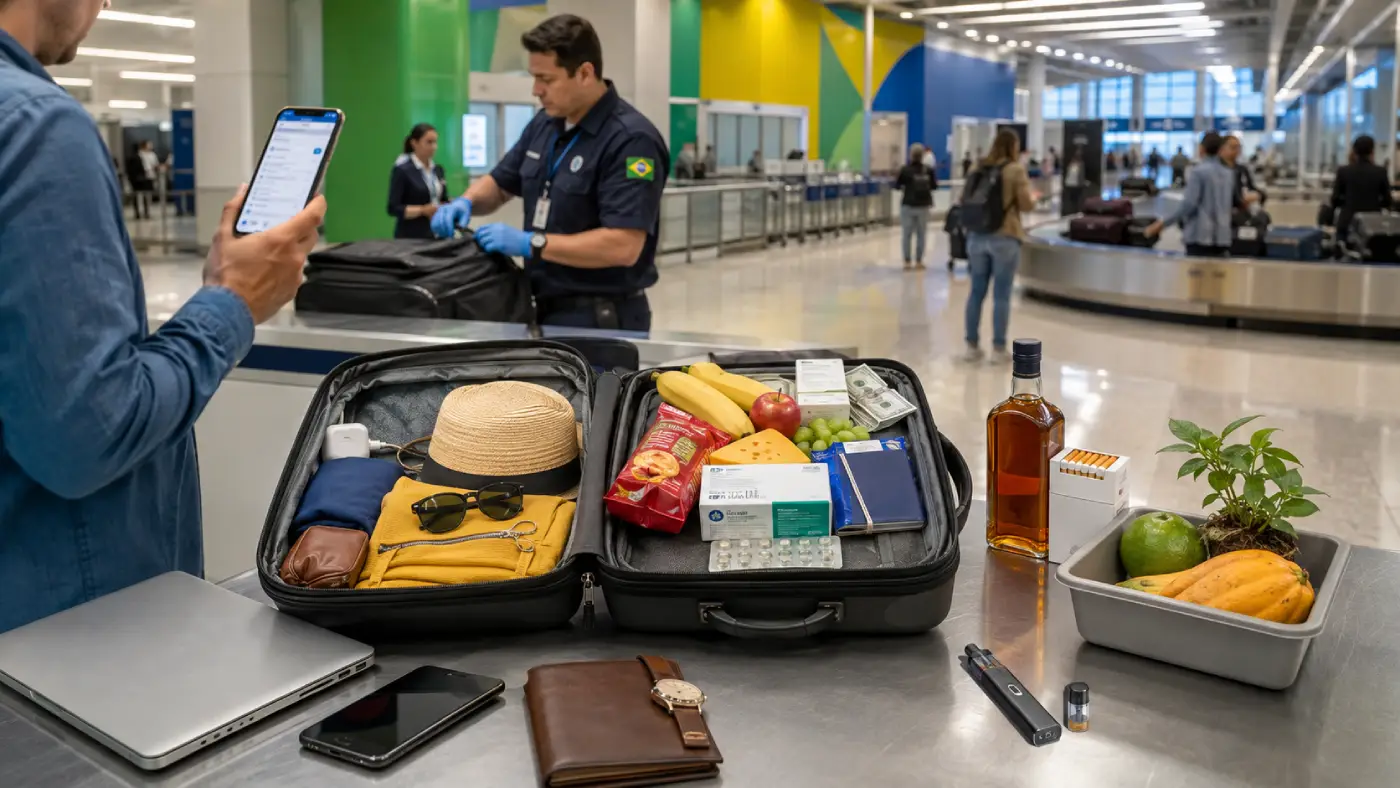
Brazil does not apply blanket rule to every food, medicine or personal item. The product, quantity, intended use and sometimes its origin determine whether it may enter, needs documents or must be declared. The Brazilian Federal Revenue duty-free guidance sets the main passenger allowances.
Rules checked on August 26, 2026. Requirements can change; verify the linked official guidance before travel.
Vapes and e-cigarettes cannot be brought into Brazil
Brazil’s Anvisa prohibits the import of electronic smoking devices, and the rule expressly covers products brought by travelers for their own use in accompanied baggage. The prohibition includes electronic smoking devices as well as accessories, parts and refills.
That means you should not pack disposable vapes, refillable devices, pods, cartridges or other refills for entry into Brazil. Heated-tobacco devices that fall within Anvisa’s electronic smoking device definition are also covered. Do not treat these products as part of Brazil’s ordinary tobacco allowance.
Anvisa’s current electronic cigarette guidance explains the national prohibition. This is an import rule: questions about possession or use after entry belong to Brazil’s local laws rather than airport customs.
Emerging oral nicotine products such as nicotine pouches are regulated separately from electronic smoking devices. Do not assume the vape prohibition automatically establishes the traveler-import treatment for every non-electronic nicotine product.
Food, plants and animal products need product-by-product checks
Brazil’s 2026 agricultural baggage rules divide goods into prohibited products, products that may enter when specific requirements are met, and products classified as permitted. As a result, “all food must be declared” and “factory sealed means allowed” are both too broad.
Check the exact item and its origin against the Brazil Ministry of Agriculture and Livestock traveler list.
Important categories include:
-
Fresh produce: Fresh or dried fruit, vegetables and other plant products may require phytosanitary documentation and compliance with Brazilian entry conditions.
-
Meat and fish: Raw meat and fish, along with homemade meat or fish products, are prohibited in traveler baggage.
-
Dairy: Certain commercially manufactured dairy products, including many cheeses, can enter when MAPA’s packaging, labeling, origin and sanitary requirements are satisfied; products subject to inspection must be declared and presented to Vigiagro.
-
Processed foods: Some industrially processed plant products fall into MAPA’s permitted category and do not require declaration solely for federal agricultural inspection.
Prepared meals and snacks can also fall within agricultural controls when they contain fresh plant material or animal-origin ingredients. Being served on an aircraft does not by itself make a product admissible into Brazil.
When MAPA classifies a product as conditional, follow the listed documentation and declaration requirements. If you cannot confidently determine how an agricultural item is classified, MAPA advises declaring it rather than guessing. Products expressly classified as permitted do not require declaration merely for federal agricultural inspection.
Brazil’s duty-free allowance, alcohol and tobacco limits
For accompanied baggage, travelers entering Brazil by air or sea have a US$1,000 exemption quota for qualifying taxable goods that are not already exempt as personal-use items. The corresponding quota for entry by land, river or lake is US$500.
These exemptions are individual and cannot be pooled between family members. Brazilian Federal Revenue currently grants the baggage exemption at 30-day intervals.
Purchases made abroad, including goods bought in foreign duty-free shops or departure duty-free stores, count toward the normal accompanied-baggage quota. Air travelers also have a separate US$1,000 exemption for purchases made at the arrival duty-free shop at their first Brazilian airport of disembarkation.
For normal accompanied baggage, the current quantitative limits include:
-
12 liters of alcoholic beverages;
-
10 packs of foreign-made cigarettes containing 20 cigarettes each;
-
25 cigars or cigarillos; and
-
250 grams of tobacco.
Travelers under 18 cannot bring alcohol or tobacco as baggage.
For ordinary taxable goods that remain within the baggage regime, a 50% import tax applies to the value exceeding the applicable exemption. Quantitative limits are different: if alcohol or tobacco goods exceed their permitted baggage quantity, Brazilian Federal Revenue states that the goods exceeding the quantitative treatment fall under the Common Import Regime — Regime Comum de Importação. Do not assume a quantity excess can simply be cleared by paying the normal baggage tax.
Medicines for personal use
Ordinary medicines intended for your own use during the trip can generally enter without an e-DBV when the medicine is not prohibited from import or use in Brazil and the quantity is compatible with personal treatment.
Controlled medicines require a more specific check because the active ingredient determines the applicable rule. Anvisa’s accompanied baggage guidance states that medicines subject to special control under Portaria 344/1998 should be accompanied by a medical prescription.
Before traveling with a controlled medicine:
-
Check the active ingredient against Anvisa’s current controlled-substance rules.
-
Carry the medical prescription when special control applies.
-
Confirm whether prior authorization is required instead of assuming a prescription alone is enough.
Some controlled substances are prohibited from import, while particular categories may enter through an exceptional authorization process for personal treatment. Brazil therefore does not have universal rule covering every prescription or controlled medicine.
Cash, phones and other personal goods
Brazil requires a declaration when a traveler enters with more than US$10,000 in cash, or the equivalent in another currency. This is a declaration threshold, not a legal maximum on the amount you may carry.
The rule applies to national or foreign paper currency. Checks and traveler’s checks are not included in this particular cash threshold. Declare qualifying cash through the e-DBV before completing customs clearance.
Personal-use goods receive different treatment from ordinary purchases. Clothing, hygiene items and other belongings clearly compatible with the circumstances of the trip can be exempt. Brazilian Federal Revenue gives examples such as used camera, used wristwatch and used mobile phone.
A laptop or tablet is not automatically treated as a manifestly personal-use item under the same rule and may count toward the baggage quota. A newly purchased phone can qualify as personal when it is the traveler’s phone and is already in use during the trip, but activating a second phone does not automatically give it the same treatment.
Non-residents bringing temporary personal or professional goods with a total value above US$3,000 that will leave Brazil again should check the temporary-admission procedure and declare them through the e-DBV when required.
How to declare goods with Brazil’s e-DBV
Travelers with declarable goods use Brazil’s Electronic Declaration of Traveler Goods, or e-DBV. The official e-DBV service can be completed, including before arrival.
Use the declaration when required for taxable goods above the applicable allowance, more than US$10,000 in cash, goods subject to temporary admission or other items specifically covered by declaration requirements.
For air arrivals, completing an e-DBV does not always mean you must automatically go to the Goods to Declare channel. Check the receipt issued after filing:
-
If the receipt shows Liberação Direta, Brazilian Federal Revenue says you do not need to present yourself to customs solely because you filed the declaration.
-
If the receipt instructs you to present the declaration or goods, follow that direction and use the appropriate customs channel or inspection point.
-
Agricultural, health or other regulated goods may still need presentation to the responsible authority when their specific rules require it, regardless of the customs release instruction.
At entry points where channel arrangements differ, follow the directions provided locally and the instructions on your declaration. Brazilian Federal Revenue’s traveler FAQ explains the current e-DBV and baggage procedures.
Do not select Nothing to Declare when taxable baggage should have been declared. For taxable goods that should have been declared under the baggage regime, Brazilian Federal Revenue can apply the relevant import tax plus a fine equal to 50% of the value exceeding the applicable exemption.
Mobile internet after customs
Once customs is clear, mobile data keeps maps, messages and booking apps available; activate your Brazil eSIM after arrival if that option fits your phone and travel plans. Roafly plans are data-only, and hotspot use draws from the purchased data allowance without a separate hotspot quota.
For provider and plan comparisons, use Best eSIM for Brazil.
For airport SIMs, local prepaid options, eSIMs and practical CPF questions, Brazil Tourist SIM Card: CPF Rules & Prices covers the wider connectivity choices.
Brazil customs checklist before you fly
-
Leave vapes, electronic smoking devices, pods and refills at home.
-
Check food, plant and animal products in MAPA’s current traveler list instead of relying on packaging alone.
-
Verify controlled-medicine ingredients and obtain any required prescription or prior authorization.
-
Keep purchases within the applicable passenger quota and check alcohol and tobacco quantity limits separately.
-
Complete the e-DBV for more than US$10,000 in cash or any other item requiring declaration.
-
After filing an e-DBV, follow the clearance instruction on its receipt and any separate MAPA or Anvisa inspection requirement.