

'/%3e%3cuse xlink:href='%23a' transform='rotate(144 450 300)'/%3e%3cuse xlink:href='%23a' transform='rotate(216 450 300)'/%3e%3cuse xlink:href='%23a' transform='rotate(288 450 300)'/%3e%3c/svg%3e)
This guide compares the best eSIM options for Hong Kong, explains what “real” network coverage means in practice, and helps you pick a 30-day plan that fits your travel style without paying for data you won’t use. We’ll break down how providers like Roafly, Airalo, Saily, Yesim, AloSIM, and Holafly differ on price, partner networks, and usability—so you can land in Hong Kong with working data in minutes instead of wasting time at airport SIM counters.
Why Travelers Prefer eSIMs in Hong Kong
Hong Kong has near-universal 4G coverage and fast-expanding 5G infrastructure. From dense urban areas to underground MTR stations, mobile connectivity is generally excellent. However, convenience does not always mean affordability, especially for short-term visitors.
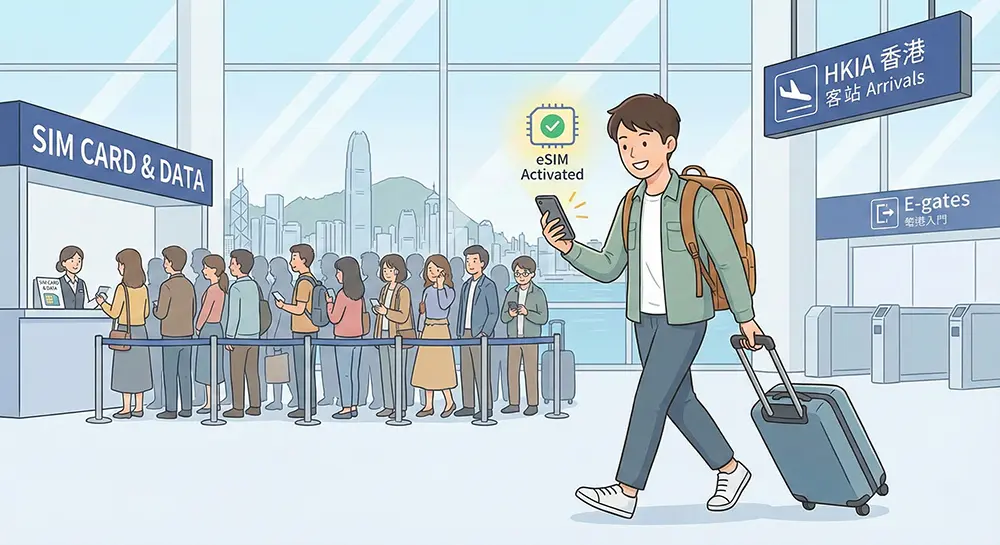
Physical SIM cards usually involve:
-
Passport registration
Hong Kong requires real-name registration for all SIM cards, meaning you must present your passport and complete identity verification before activation. This adds friction, particularly after a long flight or during peak travel hours. -
Queues at airport kiosks
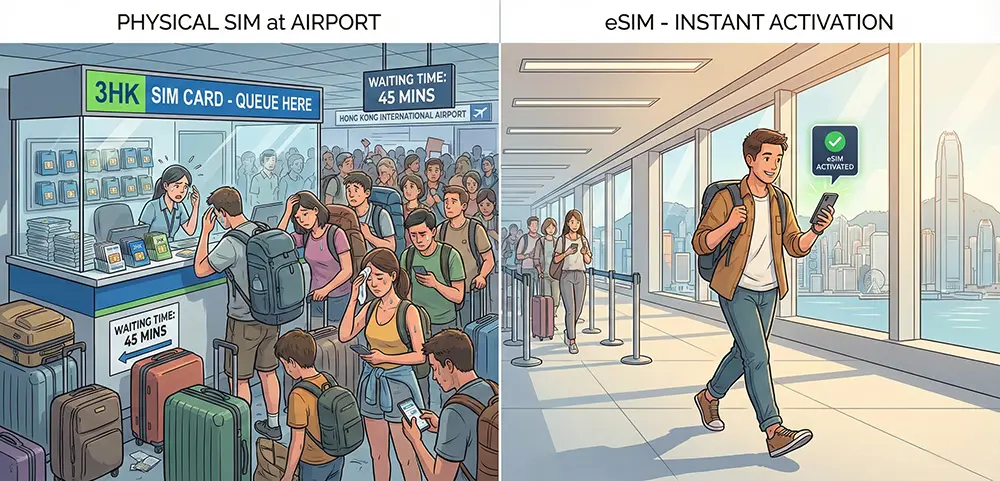
SIM counters at Hong Kong International Airport are often crowded, and waiting times can easily exceed 20–30 minutes. Availability may also be limited late at night or during busy travel seasons. -
Higher tourist pricing
Airport SIM plans are typically priced higher than alternatives, with limited data allowances or speed-restricted “unlimited” plans that are not always clearly explained at purchase.
International roaming works well in Hong Kong, but costs can escalate quickly. Daily roaming fees and per-megabyte charges often end up costing more than the flight itself, especially for travelers who rely heavily on navigation, messaging apps, and cloud services.
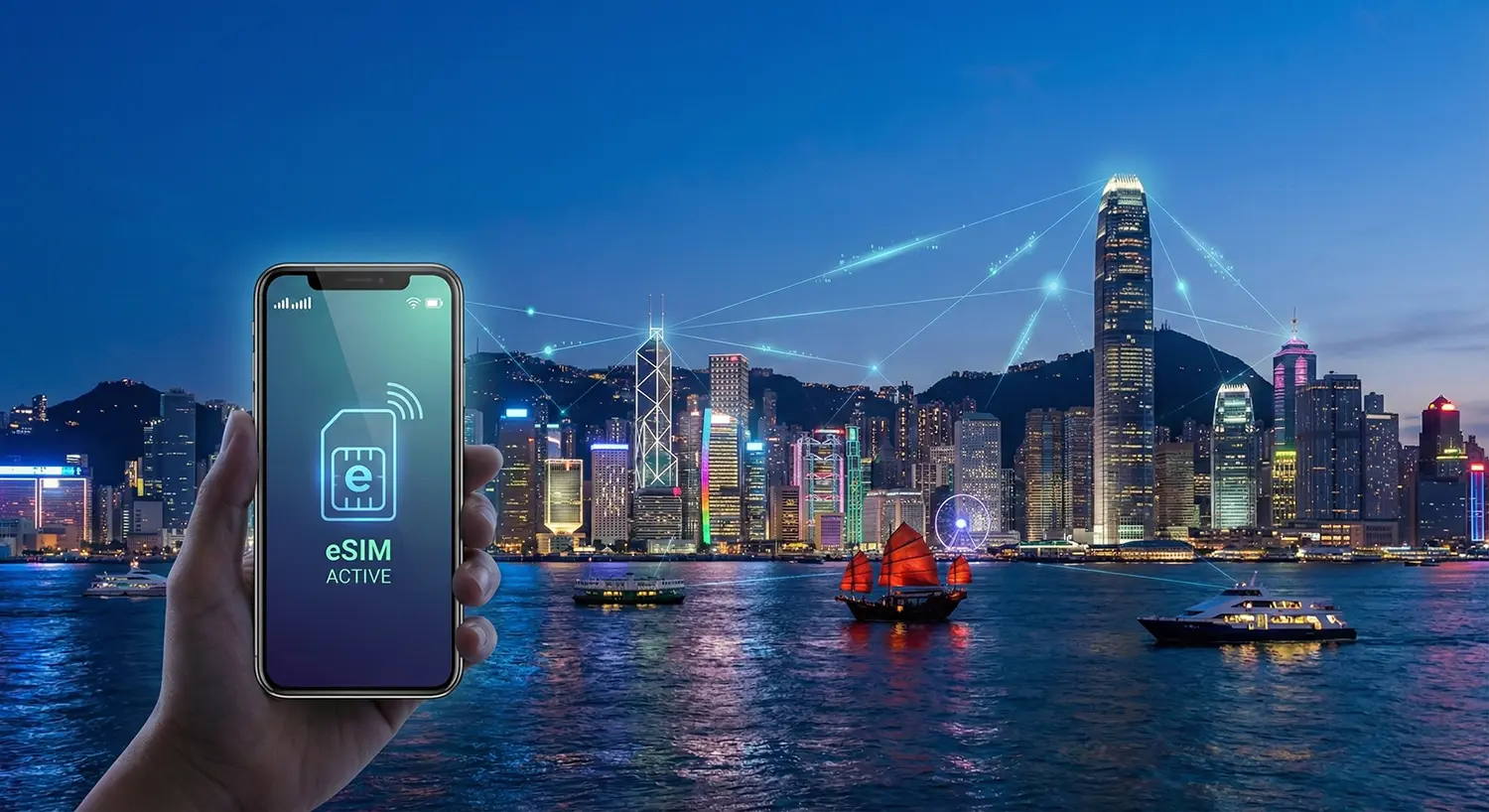
An eSIM removes these friction points entirely. You can purchase your plan, install it in minutes, and connect automatically to local Hong Kong networks as soon as you land—without paperwork, physical SIM swaps, or unexpected charges.
Best eSIM Providers for Hong Kong Compared (30-Day Plans)
The table below compares major Hong Kong eSIM providers using the same 기준:
-
30-day validity
-
Prices in USD
-
Transparent data allowances
| Provider | 5 GB | 10 GB | 20 GB | Local Networks |
|---|---|---|---|---|
| Roafly | $9.90 | $14.00 | $20.00 | 3 (Hutchison), SmarTone, CSL/1010 |
| Airalo | $12.00 | $18.00 | $29.00 | 3 (Hutchison) |
| Saily | $11.99 | $15.99 | – | Not specified |
| Yesim | – | $18.00 | $30.00 | 3 (Hutchison), SmarTone |
| AloSIM | $11.50 | $18.00 | $26.00 | 3 (Hutchison) |
| Holafly | – | – | Unlimited (7 days) $29.90 | Not specified (FUP applies) |
All prices listed above are accurate as of December 18, 2025. eSIM pricing and network partnerships may change over time, so we recommend checking the latest details on the provider’s official website before purchase.
This structure makes thing clear: price alone is not the factor. Network access and flexibility matter just as much in Hong Kong.
Roafly Hong Kong eSIM: Best Balance of Price and Network Access
Roafly stands out in Hong Kong by combining multi-network connectivity with some of the lowest 30-day eSIM prices on the market. Unlike many providers that rely on a single operator, Roafly connects to all three major Hong Kong network groups—3 (Hutchison), SmarTone, and CSL/1010—while still undercutting competitors at every comparable data tier.
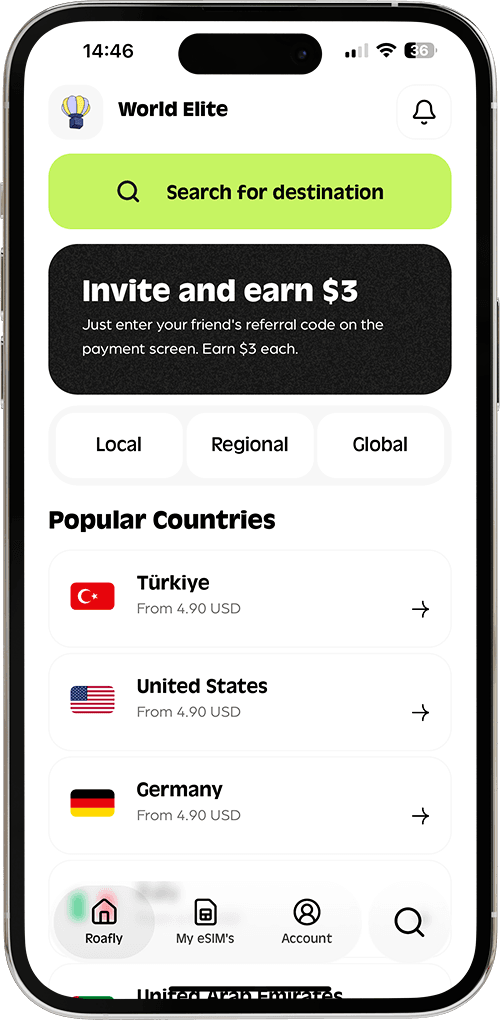
Need data in Hong Kong? Get an eSIM!
Choose the perfect data plan for your trip

Manage your eSIM in the app
Install, top up and track data.
This dual advantage is important in real-world use. Your phone automatically switches to the strongest available signal depending on location, congestion, and coverage conditions, instead of being locked to network. At the same time, Roafly’s pricing remains consistently lower than single-network alternatives, even at higher data allowances.
In practice, this means better signal reliability across Hong Kong Island, Kowloon, and the New Territories—without paying a premium for network flexibility. For travelers who want both performance and value in a 30-day plan, this balance is what sets Roafly apart.
Roafly’s Hong Kong eSIM 30-day plans are straightforward:
-
No daily caps
-
No speed throttling
-
No fair usage policy
Installation options include:
-
iOS Direct Install
-
QR code
-
Manual setup
For most travelers, the 10 GB or 20 GB plans provide the best value, especially for navigation, messaging, and work-related usage.
Airalo and AloSIM: Single-Network Reliability
Airalo and AloSIM both rely on the 3 Hong Kong (Hutchison) network. Coverage is generally reliable, particularly on Hong Kong Island and in Kowloon.
The main difference is pricing. Airalo becomes significantly more expensive at higher data tiers, while AloSIM stays more competitive at 20 GB.
These options work well if:
-
You stay mostly in central areas
-
You do not need network switching
-
You prefer familiar global brands
Saily and Yesim: Mid-Range Options with Trade-Offs
Saily offers attractive pricing at lower data tiers, especially around 10 GB. However, the lack of publicly stated local network partners makes it harder to evaluate real-world performance in advance.
Yesim clearly lists its networks, using 3 (Hutchison) and SmarTone. While coverage is solid, pricing at higher data levels is less competitive compared to Roafly.
Both providers are suitable for light to moderate usage but may not be ideal for heavy data users.
Holafly Unlimited Plans: Convenience with Limitations
Holafly markets an unlimited data plan for Hong Kong, valid for 7 days. While this sounds appealing, it comes with a Fair Usage Policy.
After a certain threshold, speeds may be reduced, which can affect:
-
Video calls
-
Hotspot usage
-
Navigation in busy areas
Holafly is best suited for very short stays where simplicity matters more than long-term value.
Airport SIM Cards in Hong Kong: Worth It?
Hong Kong International Airport offers several physical SIM card options for arriving travelers. SIM kiosks and convenience store counters are operated by major local providers such as CSL, SmarTone, and China Mobile Hong Kong, and they are easy to find in the arrivals area.
Typical Airport SIM Pricing
At the airport, prepaid tourist SIM cards are usually sold in Hong Kong dollars and converted pricing typically looks like this:
-
Entry-level prepaid SIMs generally start around USD 10–15, depending on the data allowance and validity period
-
Common tourist bundles range from 12 GB to 24 GB, often valid for to four weeks
-
Some plans include local voice minutes, which most short-term visitors rarely use
While these prices are not extremely high, they are still less flexible than eSIM alternatives, especially for travelers who want a specific data amount or longer validity.
What You Still Need to Do
Even with competitive pricing, airport SIM cards come with a few unavoidable steps:
-
Register with your passport
Hong Kong enforces real-name SIM registration, so every physical SIM must be linked to your passport before it becomes active. -
Physically swap SIM cards
You need to remove your existing SIM, insert the new, and restart your phone. This can be inconvenient if you rely on your primary number for messages or authentication.
In addition, airport selections are limited to what is available at the counter at that moment, leaving little room for comparing plans calmly.
Compared to this, eSIMs are generally cheaper per gigabyte, faster to activate, and more flexible. You can purchase and install your plan, avoid registration queues, and connect to local networks immediately after landing—without handling a physical SIM card.
Understanding Hong Kong Mobile Networks (What Actually Matters)
Hong Kong’s mobile infrastructure is built around three main network groups. On paper, coverage looks similar across providers, but real-world performance can vary depending on location, building density, and congestion. Understanding these differences helps explain why multi-network eSIMs perform better in practice.
3 Hong Kong (Hutchison Group)
The Hutchison Group operates under multiple brand names, including 3, 3HK, and Hutchison, all of which refer to the same underlying network infrastructure.
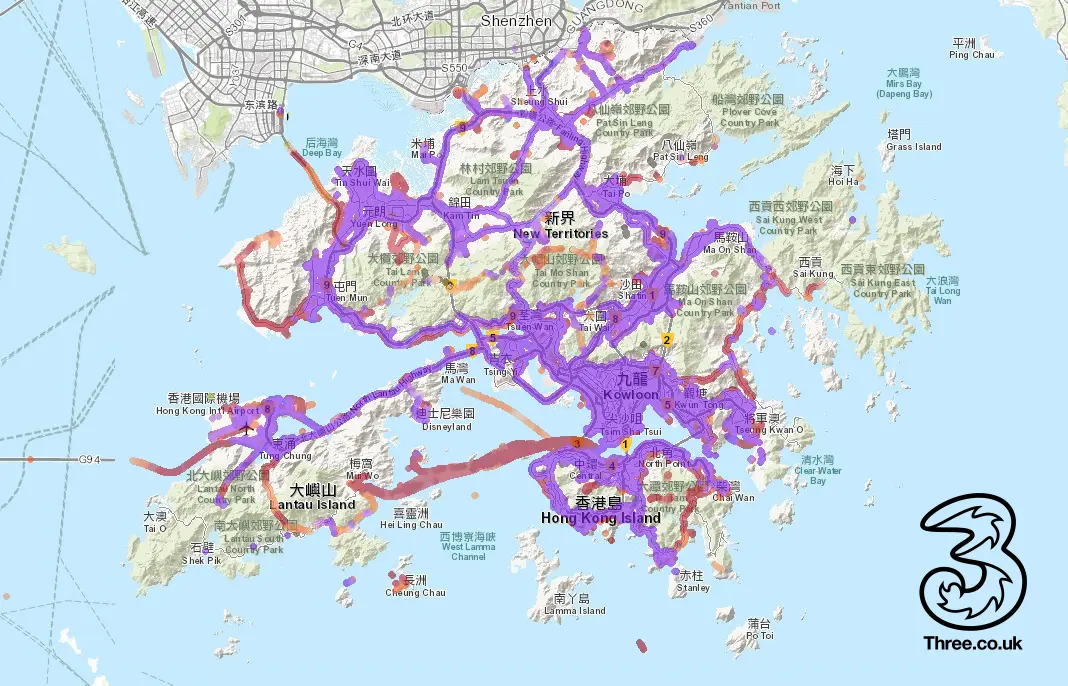
Coverage highlights:
-
Strong citywide coverage across Hong Kong Island, Kowloon, and most residential areas
-
Reliable outdoor performance and good average speeds
-
Widely used by international roaming partners and global eSIM providers
3 Hong Kong performs well for general travel use, navigation, messaging, and browsing. In very crowded areas or deep indoor environments, speeds can fluctuate during peak hours, which is where network switching becomes useful.
SmarTone
SmarTone is often considered of the most consistent networks in Hong Kong, particularly when it comes to indoor and underground coverage.
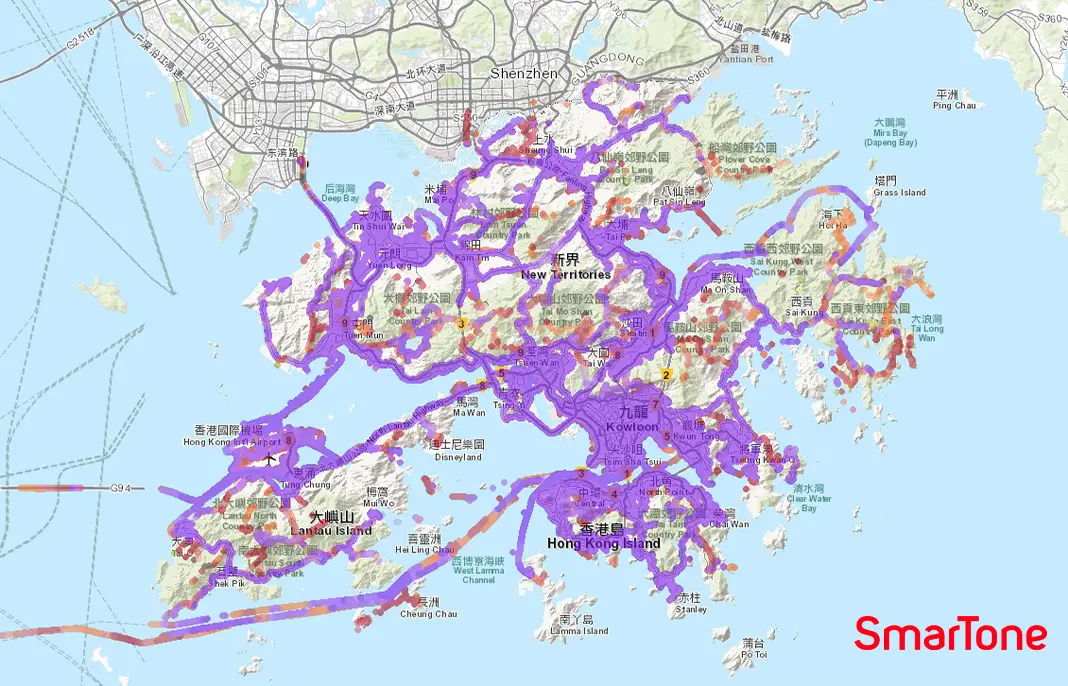
Coverage highlights:
-
Strong performance inside shopping malls, office buildings, and hotels
-
Reliable signal in MTR stations and underground passages
-
Stable speeds even during busy periods
SmarTone is especially valuable for business travelers and users who spend a lot of time indoors or moving through transit-heavy areas. Its reliability complements other networks well in a multi-network setup.
CSL / 1010
CSL and its premium sub-brand 1010 share the same high-end network infrastructure. This network is known for its consistency and strong performance in commercial and high-density zones.
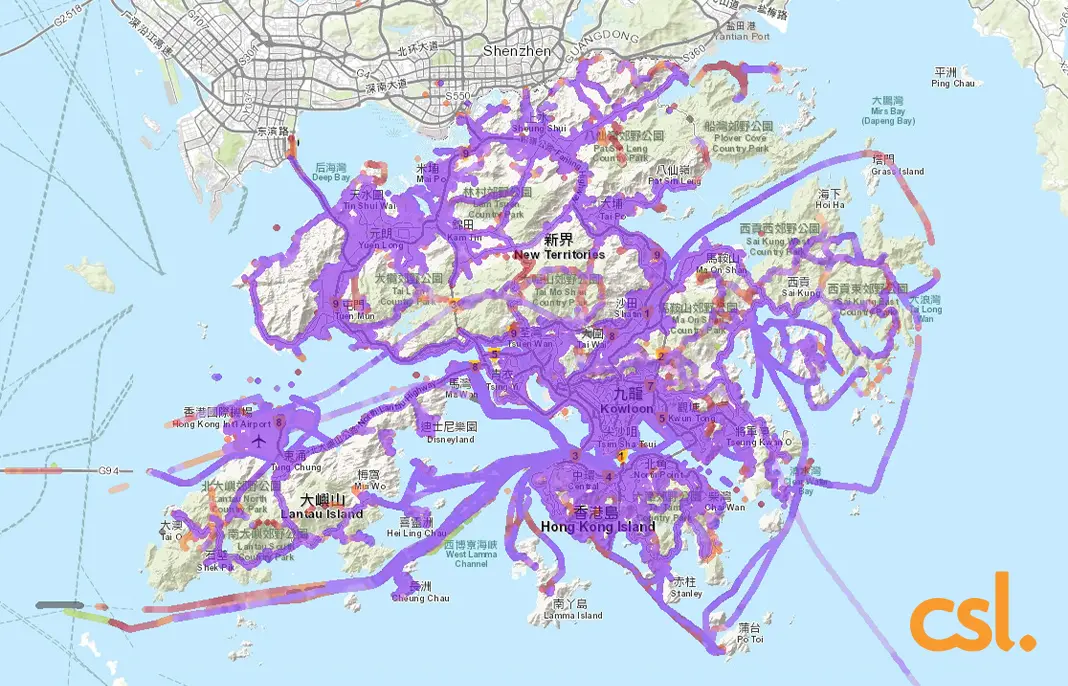
Coverage highlights:
-
Excellent coverage in business districts and commercial centers
-
Strong network stability in high-rise office environments
-
Consistently good speeds under heavy network load
CSL/1010 is particularly noticeable in Central, Admiralty, Tsim Sha Tsui, and other high-traffic business areas, where network congestion can affect lower-tier networks.
Why Multi-Network Access Makes a Difference
Many travelers assume all eSIMs behave the same, but this is not the case in Hong Kong. eSIMs locked to a single network depend entirely on that operator’s coverage and congestion levels at any given moment.
Multi-network eSIMs can automatically switch between 3 (Hutchison), SmarTone, and CSL/1010, choosing the strongest available signal based on location and conditions. This becomes especially important when moving between districts, riding the MTR, entering large buildings, or navigating crowded areas during peak hours.
In a city as dense and vertical as Hong Kong, this flexibility directly translates into more stable connectivity and fewer dropped connections.
How Much Data Do You Need in Hong Kong?
Hong Kong is a data-intensive city. Navigation apps, cloud services, and constant connectivity add up quickly.
-
5 GB works for light usage
-
10 GB suits most tourists
-
20 GB is ideal for remote work and hotspot use
If unsure, a data usage calculator can help estimate your needs before buying.
eSIM Compatibility and Installation
Most modern smartphones support eSIM, including:
-
iPhone XS and newer
-
Samsung Galaxy S20 and newer
-
Google Pixel models
With providers like Roafly, activation takes a few minutes and works instantly after landing.
Final Thoughts: Choosing the Right eSIM for Hong Kong
Hong Kong rewards travelers who choose flexibility and strong network access. While several eSIM providers work well, options with multi-network connectivity and transparent pricing stand out for longer stays.
Roafly offers a strong price-to-performance balance for 30-day travel, especially for users who move frequently around the city.
Check the latest eSIM Hong Kong packages and choose a plan that fits your trip.