

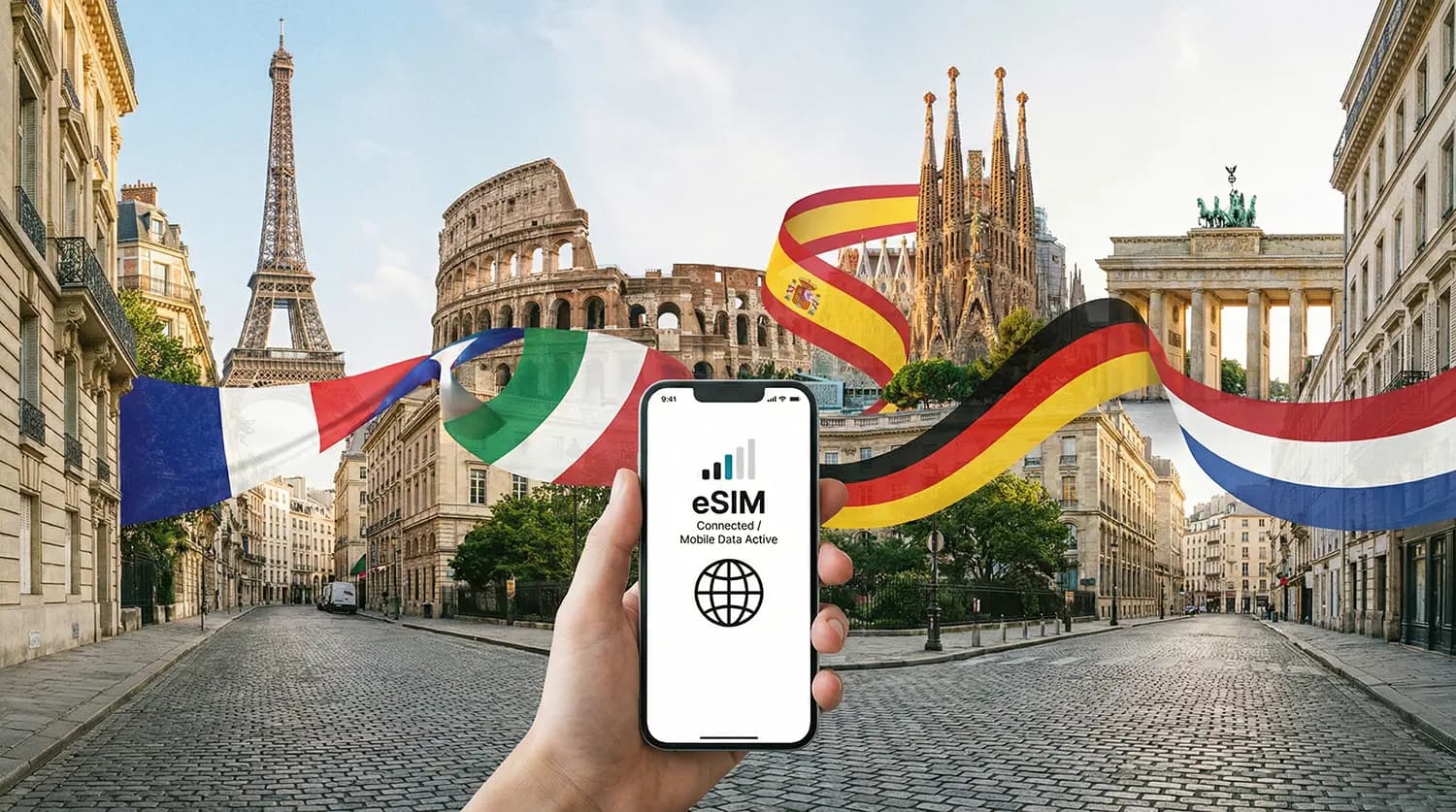

A Europe eSIM solves this by offering a single digital data plan that works across dozens of countries, activates instantly on compatible devices, and remains valid throughout your journey. Leading providers such as Roafly, Airalo, Saily, Roamless, and Jetpac now offer Europe-wide eSIM plans designed specifically for multi-country travel, allowing users to stay connected without changing SIM cards, visiting local stores, or relying on expensive roaming options.
Why a Europe eSIM makes sense for travelers
-
One plan across multiple countries
Europe trips often involve crossing borders every few days. A Europe eSIM works across dozens of countries under a single plan, so you stay connected without buying a new SIM card in each destination. -
No roaming surprises or fair-use limits
While EU roaming exists, many local SIMs apply fair-use caps or reduce speeds outside the home country. Europe eSIMs are built for cross-border use, with clearly defined data allowances and validity. -
Better value than airport SIM cards
Airport SIM cards are convenient but usually overpriced. Europe eSIMs are purchased, activated digitally, and often cost less for the same or higher data amounts. -
Instant digital activation
Europe eSIMs can be installed before departure and activate automatically upon arrival. There is no need to visit phone shops, wait in queues, or deal with language barriers. -
No physical SIM swapping
Since eSIMs are digital, you keep your physical SIM in place. This allows you to receive calls or SMS on your main number while using mobile data from the eSIM. -
Designed for how Europe is actually traveled
Trains, short flights, and road trips are common in Europe. A Europe eSIM switches networks automatically as you move between countries, keeping your connection uninterrupted.
Need data in Europe? Get an eSIM!
Choose the perfect data plan for your trip

Manage your eSIM in the app
Europe eSIM price comparison (30-day plans)
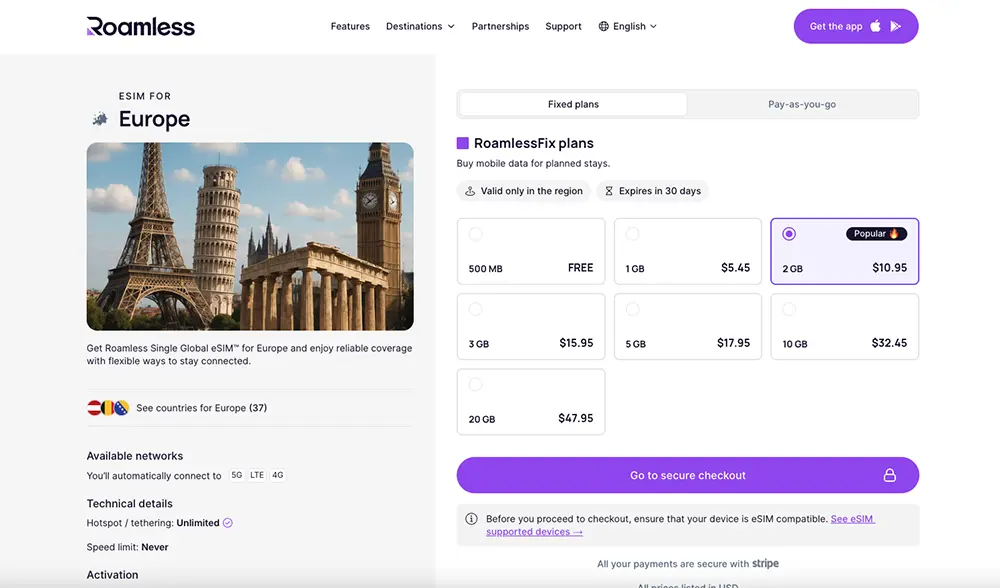
The table below compares popular Europe eSIM providers based on data allowance, price (USD), and number of supported countries. All listed plans are valid for 30 days.
| Provider | 5GB (30 days) | 10GB (30 days) | 20GB (30 days) | Unlimited | Countries covered |
|---|---|---|---|---|---|
| Roafly | $12.90 | $19.90 | $29.90 | — | 34 |
| Airalo | $20.00 | $37.00 | $49.00 | — | 42 |
| Saily | $19.49 | $28.79 | — | — | 35 |
| Roamless | $17.95 | $32.45 | $47.95 | — | 37 |
| Jetpac | $14.99 | $19.99 | $40.00 | — | 32 |
| Kolet | $18.49 | $25.49 | $38.49 | — | 44 |
| Holafly | — | — | — | $27.30 (7 days) | 33 |
Prices are in USD. All plans are valid for 30 days.
Prices collected on 25 December 2025. Supported countries, network partners, and pricing may change over time depending on the provider.
Roafly Europe eSIM
Overview
Roafly positions itself as a value-first Europe eSIM built for travelers who move across multiple countries and want predictable costs without sacrificing coverage. Its Europe plans are straightforward fixed-data packages (5GB, 10GB, 20GB), all valid for 30 days, and designed to cover the most common European travel routes rather than inflating country counts at the expense of price.
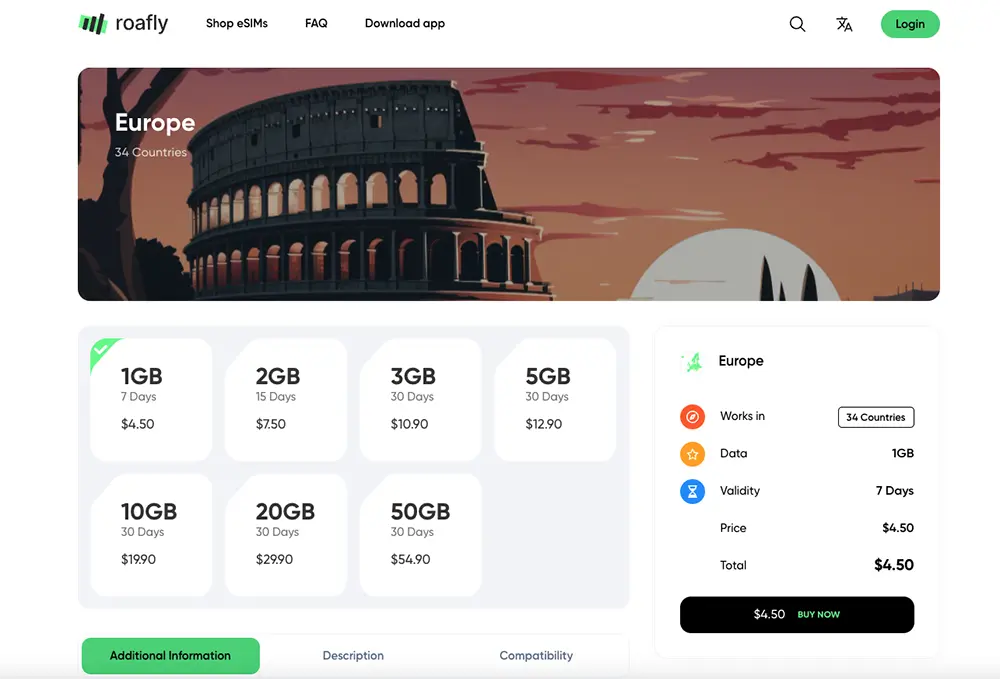
What sets Roafly apart is the price-to-performance balance. When compared side by side with other Europe eSIM providers, Roafly consistently delivers significantly lower prices at the same data tiers, while still supporting a solid 34 European countries—more than enough for typical itineraries that include Western Europe, Central Europe, and major transit hubs.
Need data in Europe? Get an eSIM!
Choose the perfect data plan for your trip
Manage your eSIM in the app
Installation is intentionally simple. Travelers can activate Roafly via iOS Direct Install, QR code, or manual setup, making it suitable even for users who are new to eSIMs. installed, the eSIM automatically connects to supported partner networks as you cross borders, with no need for reconfiguration.
Pros
-
Excellent price-to-data ratio
Roafly undercuts most competitors at every fixed data tier, making it of the most cost-efficient Europe eSIM options available. -
30-day validity on all plans
Ideal for longer trips, slow travel, or multi-country routes without worrying about short expiration windows. -
Covers the majority of popular Europe destinations
34 supported countries is more than sufficient for most travelers visiting EU and nearby European states. -
Simple, flexible installation options
iOS Direct Install, QR code, and manual setup are all supported. -
Predictable fixed-data model
No “unlimited” fair usage uncertainty or hidden throttling policies.
Cons
-
Data-only eSIM
Roafly does not include a phone number for calls or SMS, which may matter for travelers who rely heavily on traditional voice services.
Best for
Roafly is best for travelers who want maximum value for money on Europe trips lasting up to a month, especially those visiting multiple countries and preferring clear data limits over “unlimited” plans with fair usage restrictions.
Airalo Europe eSIM
Overview
Airalo is of the most established eSIM brands on the market and is widely known among international travelers. Its Europe eSIM plans use a fixed-data, 30-day validity model and support a relatively large 42-country coverage, making it suitable for complex itineraries that include less common destinations.
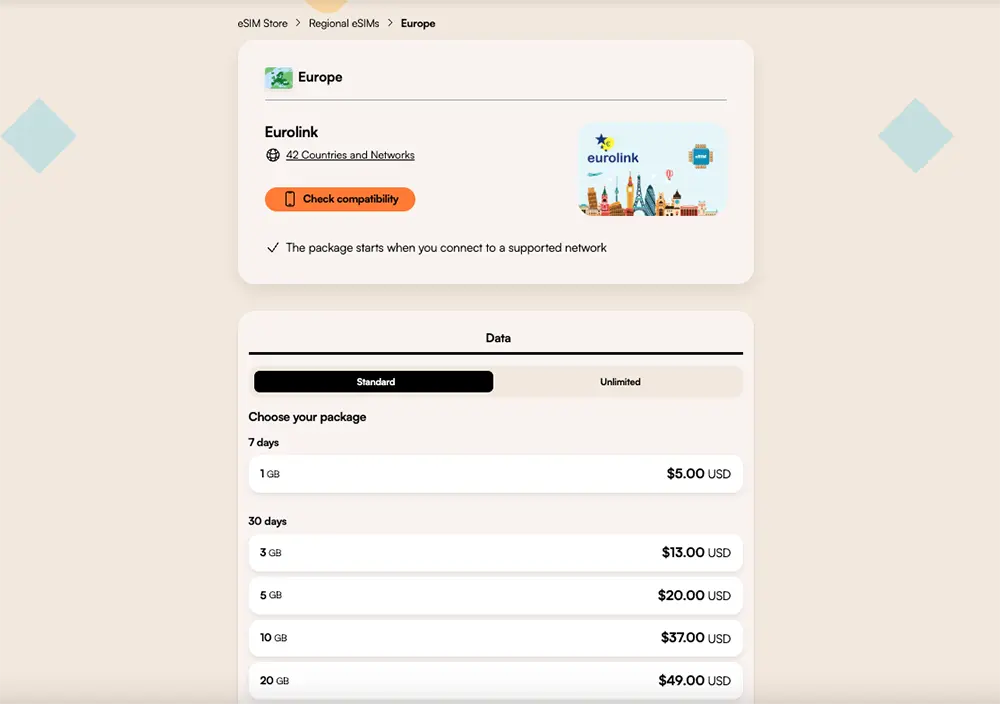
However, Airalo’s main drawback is pricing. Compared to newer value-focused providers, its Europe plans are consistently more expensive at every data tier, especially for travelers who need 10GB or more. While the service is reliable, the cost difference becomes difficult to justify for longer trips.
Airalo relies heavily on its mobile app for installation and plan management, which works smoothly but offers little advantage beyond convenience.
Pros
-
Wide Europe coverage (42 countries)
-
Trusted, well-known brand
-
Easy app-based installation and management
Cons
-
Significantly more expensive than competitors
-
Data-only, no phone number included
Best for
Airalo is best for travelers who prioritize brand recognition and wide coverage over price efficiency, and who are comfortable paying a premium for a familiar name.
Holafly Europe eSIM
Overview
Holafly is best known for its unlimited data Europe eSIM plans, which appeal to travelers who prefer not to track their data usage. For Europe, Holafly typically offers short-validity plans (such as 7 days) with coverage in 33 European countries, making it a popular choice for brief trips or city breaks.
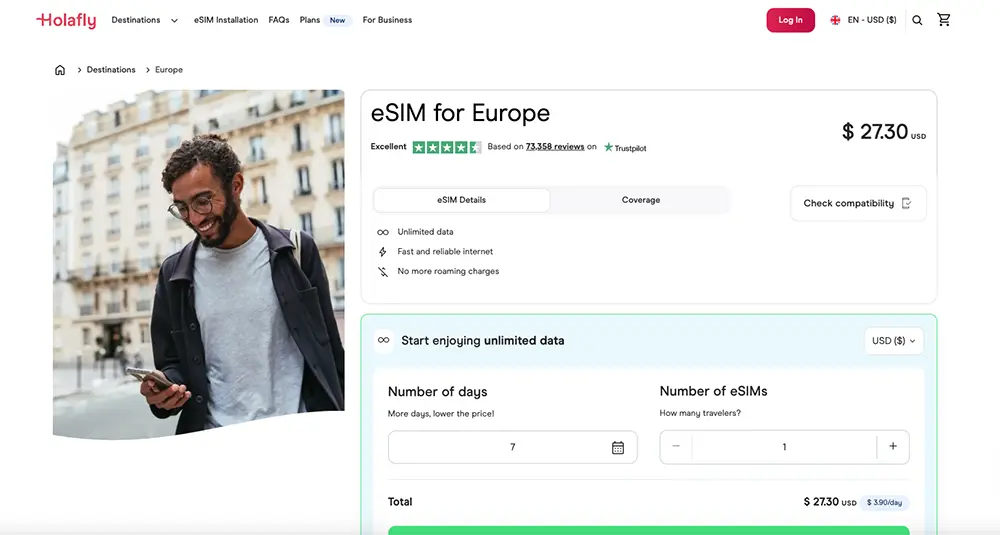
However, Holafly’s “unlimited” model comes with important caveats. Like most unlimited eSIM offerings, it operates under a Fair Usage Policy (FUP). After a certain threshold, speeds may be reduced, especially during peak hours or heavy usage. This makes the experience less predictable compared to fixed-data plans.
Holafly also focuses on simplicity rather than flexibility. Plans are priced higher on a per-day basis, and longer trips quickly become expensive compared to 30-day fixed-data alternatives.
Pros
-
Unlimited data without upfront caps
-
Simple setup and fast activation
-
Suitable for short Europe trips
Cons
-
Fair Usage Policy may reduce speeds
-
Short validity compared to most competitors
-
Data-only, no phone number included
Best for
Holafly is best for short trips (5–7 days) where convenience and unlimited usage matter more than long-term value or speed consistency.
Saily Europe eSIM
Overview
Saily is positioned as a mid-range Europe eSIM provider, sitting between premium-priced brands and value-focused alternatives. Its Europe plans follow a fixed-data model with 30-day validity, covering 35 European countries—enough for most standard itineraries across Western and Central Europe.
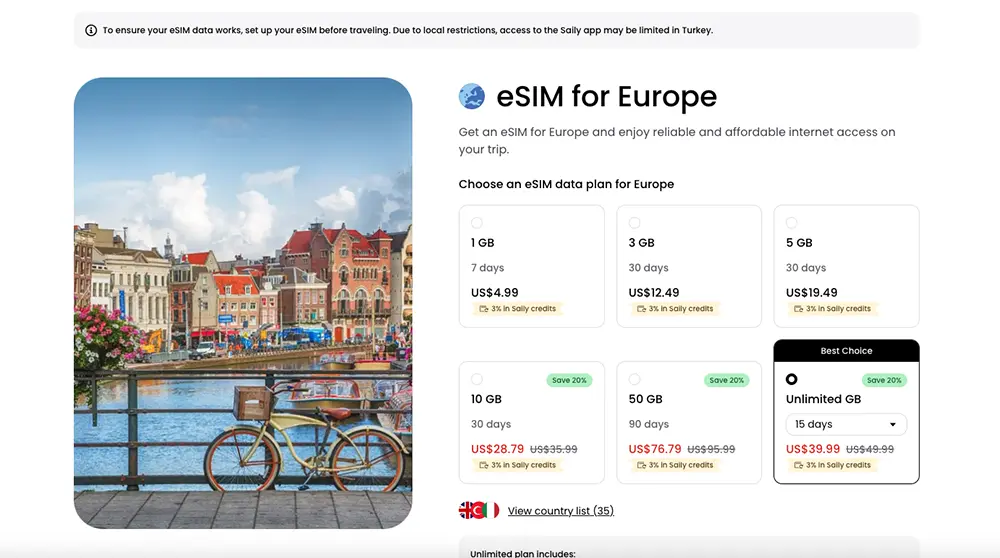
Compared to larger, more established players, Saily’s pricing is more balanced, especially at the 10GB tier. That said, it still struggles to compete with the strongest price-to-data offers on the market, particularly for travelers who want the lowest possible cost per gigabyte. Saily does not offer unlimited plans, instead focusing on predictable data allowances.
Installation is straightforward and fully digital, with support for QR-based activation and app-assisted setup. The experience is simple and functional, though not especially differentiated.
Pros
-
Balanced pricing compared to premium brands
-
30-day validity on Europe plans
-
Solid coverage across 35 European countries
-
Predictable fixed-data plans without FUP concerns
Cons
-
No unlimited data options
-
Data-only service, no phone number included
-
Price-to-GB ratio not the strongest in the segment
Best for
Saily is best for travelers looking for a reliable, no-frills Europe eSIM with reasonable pricing and predictable usage, without paying top-tier premiums.