Download the App and manage your eSIMs easily
Create your order quickly
See your eSIM details
Track your remaining data
Download the App and manage your eSIMs easily
Create your order quickly
See your eSIM details
Track your remaining data
Most short-stay visitors from outside the EU, EEA and Switzerland enter Spain either visa-free or with a Schengen visa obtained before departure. Your passport and residence status determine the route. Spain also requires documents supporting your visit, including evidence of sufficient funds.

Lena Hartley
Updated Nov 5, 2026
8 min read
Save 15% on your Roafly eSIM
Stay connected on your next trip. Use the code below at checkout.
View All DestinationsJump to section
👇Save 15% on your Roafly eSIM
Stay connected on your next trip. Use the code below at checkout.
View All Destinations
Manage your eSIM in the app
Install, top up and track data.
As checked on 5 November 2026, the Entry/Exit System (EES) is operating, while ETIAS is not yet in operation and is not accepting applications. Keep that distinction in mind when preparing for your trip: border registration and advance travel authorisation are different processes.
Start with the passport you will use to travel. The examples below cover ordinary passports and short tourist visits; diplomatic or special passports and rights as an EU citizen’s family member can change the requirements.
| Passport or citizenship group | Examples | Tourist entry route |
|---|---|---|
| EU, EEA and Swiss citizens | France, Germany, Ireland, Norway, Switzerland | No tourist visa; travel with a valid national identity card or passport under the applicable free-movement rules. |
| Visa-exempt non-EU nationals | United States, United Kingdom (British citizens), Canada, Australia | Visa-free visits of up to 90 days in any 180-day period across the Schengen area. |
| Visa-required non-EU nationals | India, China, Türkiye | Obtain a Schengen visa before departure. The visa’s authorised stay, validity dates and entry limit apply, within the short-stay framework. |
These are representative examples. The official visa-required and visa-exempt nationality lists cover the remaining countries and relevant passport exceptions.
Residence documents can also affect the route. Holding a valid residence permit or long-stay visa issued by another Schengen state generally allows a short visit to Spain without a separate Spanish tourist visa, subject to the applicable entry conditions. Carry that document together with your passport.
Your country of residence and your nationality are separate details. Living in a visa-exempt country does not, by itself, give you the same entry rights as its citizens.
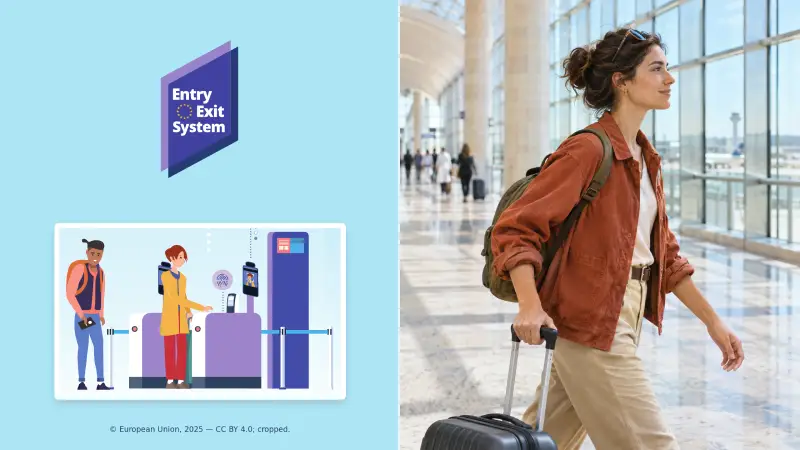
EES is the border-record system. It became fully operational on 10 April 2026 and records eligible non-EU short-stay visitors’ entries and exits at the external Schengen border. Registration can involve your passport details, a facial image and fingerprints.
You do not need to obtain an EES travel approval before departure. Follow the registration instructions at the border and allow time for the process, particularly on your first crossing under the system. Schengen residents who are exempt from EES should carry proof of that status.
ETIAS will be a pre-travel authorisation for eligible visa-exempt visitors. It will not replace the Schengen visa for people who require one. Although its announced launch window is the last quarter of 2026, it has not started accepting applications as of the date checked above.
Recheck the official EES and ETIAS status before travelling if your departure is later. An announced launch window alone is not a reason to pay a third-party website for an application.
Visitors who are not EU, EEA or Swiss citizens normally need to check two separate passport dates:
Issue date: your passport must have been issued within the ten years before entry.
Expiry date: it must remain valid for at least three months after your intended departure from the Schengen area.
Use the date you leave the Schengen area for the second calculation. Continuing from Spain to France or Portugal does not end your Schengen stay.
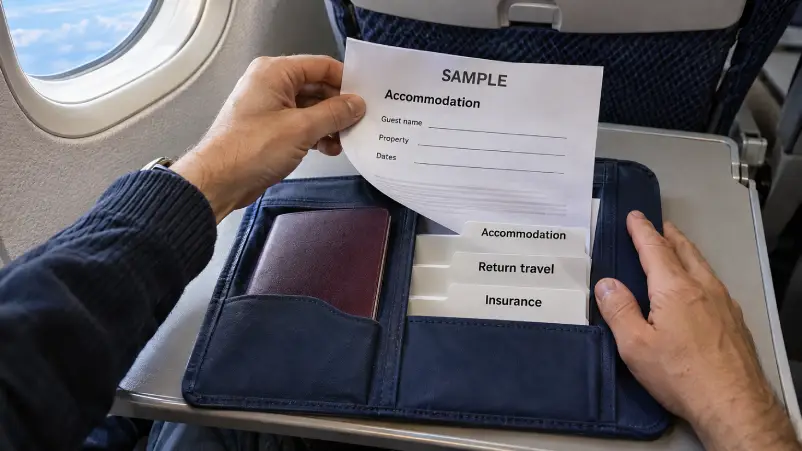
Keep your passport and any required visa or residence document accessible, together with:
Your return or onward ticket.
Accommodation confirmations and the address where you will stay.
Evidence of sufficient funds for the visit.
Documents explaining the purpose and itinerary of your trip, if requested.
Hotel guests can use their booking confirmation as accommodation evidence. If staying with friends or relatives, arrange the appropriate documentation with your host before travelling. Spain’s formal carta de invitación supports a private accommodation arrangement; the other entry conditions still apply.
Travel medical insurance is part of a Schengen visa application and must cover emergency medical care, hospitalisation and repatriation. Keep the policy documentation with the rest of your travel paperwork.
Store secure copies separately from the originals. Once you arrive, use practical precautions for keeping your belongings safe in Spain, including your passport and the phone holding your reservations.
Visitors subject to Spain’s standard non-EU entry conditions must be able to show €122.10 per person per day in 2026, with a minimum of €1,098.90 per person regardless of the length of the visit.
The minimum floor matters on short trips:
| Length of stay | Required funds per person |
|---|---|
| 7 days | €1,098.90 |
| 10 days | €1,221.00 |
| 14 days | €1,709.40 |
These figures follow Spain’s 2026 financial-means requirement. Count both the arrival and departure dates when calculating the stay.
The amount is an entry threshold for available resources, not a recommended daily spending budget. Border officers may ask you to demonstrate that you have those resources; you do not have to carry the entire amount in cash.
If using a credit card as evidence, bring supporting bank-issued documentation showing the available funds or credit. The published rule excludes internet bank statements, so relying solely on a banking-app screenshot is a poor plan. Prepare suitable evidence before leaving home.
Apply through Spain when it is your only Schengen destination or, for a tourist trip visiting several countries, the country where you will spend the most time. If the stays are equal, apply through the country you will enter first.
The application normally belongs with the consulate responsible for your country of legal residence, or its designated visa application centre.
You can lodge an application up to six months before travel and should submit it at least 15 days before departure. Normal processing takes 15 days, but a more detailed examination can take up to 45 days. Leave room for finding an appointment as well as processing.
Prepare the application form, passport, photograph, travel medical insurance, accommodation and itinerary details, financial evidence, and documents supporting your intention to leave after the visit. The consulate may request additional documents.
The standard adult visa fee is €90. Reduced fees, exemptions and nationality-specific arrangements exist, and an application centre may charge an additional service fee.
Once the visa is issued, read its validity dates, permitted number of entries and authorised duration of stay before finalising the journey.
The usual short-stay ceiling is 90 days in any rolling 180-day period. Count back 180 days from each day of your planned stay and include your visits to other Schengen countries.
Spending 20 days in France and then 10 days in Spain uses 30 days of the same allowance. Crossing into Spain does not start a separate Spanish allocation.
Visa holders must also respect the duration printed on their visa. If it authorises 30 days, the general 90-day ceiling does not increase that permission. Similarly, a multiple-entry visa valid for a year does not authorise a continuous year-long tourist stay.
Longer stays require the appropriate immigration status. If an exceptional event prevents departure, contact the Spanish immigration authorities before your authorised stay expires.
Your first Schengen airport matters. On a journey from outside Schengen through Paris to Madrid, entry checks normally take place in Paris. The onward flight to Spain remains within the Schengen area, and the same short-stay allowance continues.
Connecting between two non-Schengen flights while remaining in an airport’s international transit area is different. Some nationalities need an airport transit visa even if they stay airside.
If your connection requires you to enter Spain—for example, to collect luggage landside, leave the airport or take a domestic flight—you must meet Spain’s entry requirements. An airport transit visa alone does not authorise that entry.
Download your accommodation confirmation, itinerary and tickets so you can open them without a connection. Compare providers and data allowances in our best eSIM for Spain guide while arranging mobile data for live maps, booking changes and contact with your accommodation.
Check Spain’s customs rules before packing food, alcohol, gifts or other goods. Immigration permission and the rules for what you bring in are separate checks.
With an unlocked, eSIM-compatible phone, you can arrange a Roafly Spain eSIM before departure for mobile data after arrival. Keep your hotel address saved offline too, then plan getting from the airport into the city before landing.
Include the local rules for tourists in Spain in your preparations for the stay, alongside your entry documents and arrival plans.
