

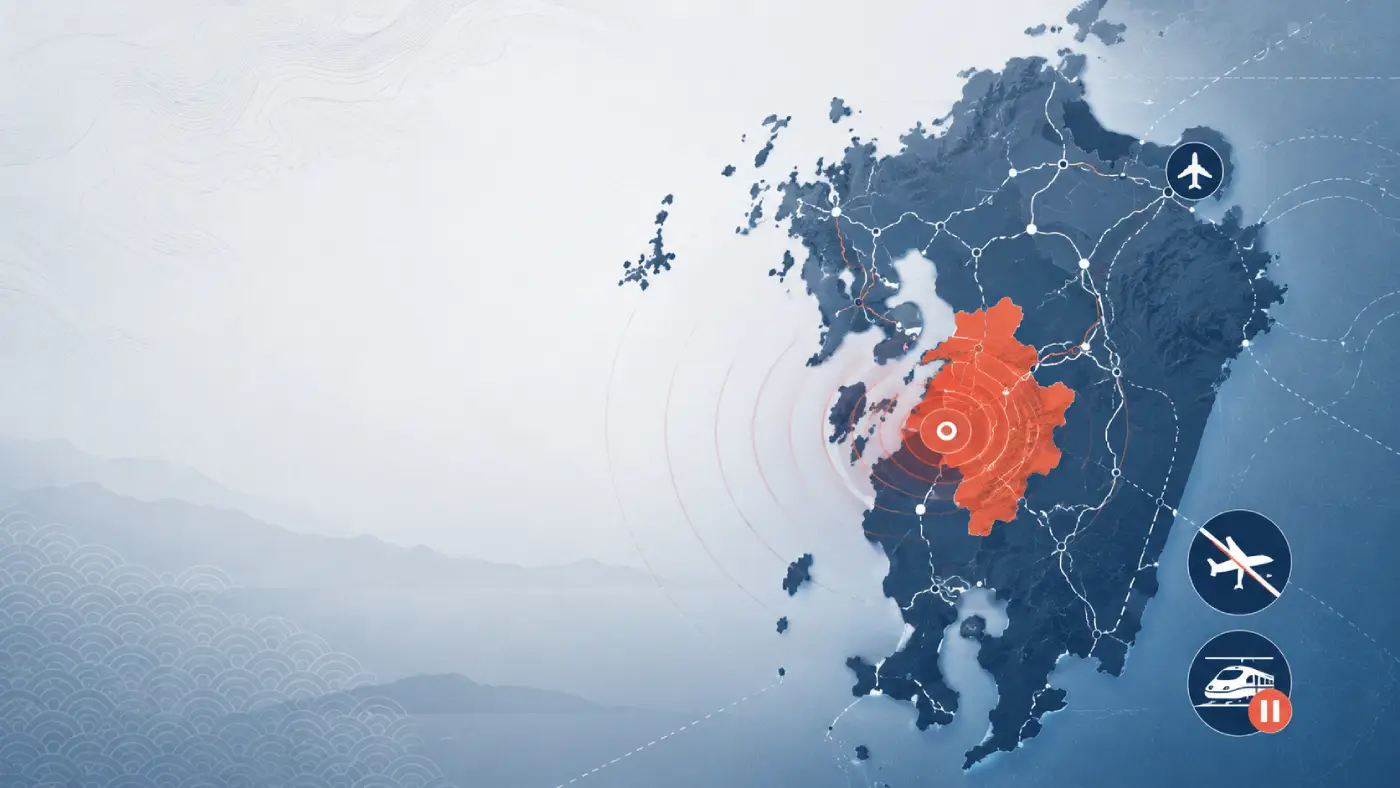

Travelers visiting Tokyo, Kyoto or Osaka should not assume that all of Japan is affected. The most serious reported disruption is concentrated in Kumamoto Prefecture and surrounding parts of Kyushu.
What happened in Kumamoto on July 28?
The earthquake struck Kumamoto Prefecture during the afternoon of July 28. Initial reports placed its magnitude at 7.1, although earthquake measurements may be revised as Japanese authorities analyze additional data.
Damage has been reported to buildings, roads and other infrastructure. Rescue operations are continuing in parts of the prefecture, while aftershocks remain possible. Travelers should not enter damaged buildings or approach emergency-response areas, even when a road or attraction appears accessible.
A tsunami advisory issued after the earthquake was subsequently lifted. Travelers should still monitor the latest information from the Japan Meteorological Agency and immediately follow evacuation instructions if a new warning is issued.
Which parts of Japan are affected?
The main affected area is Kumamoto Prefecture in central Kyushu, particularly communities around Kumamoto, Yatsushiro and the earthquake’s epicentral area.
Travelers should expect the greatest uncertainty in:
-
Kumamoto City and nearby communities
-
Yatsushiro and southern Kumamoto Prefecture
-
Aso and routes connecting the airport with surrounding destinations
-
Rail and road journeys across central Kyushu
-
Attractions, hotels and tours in areas undergoing safety inspections
Tokyo, Kyoto and Osaka are hundreds of kilometers away and are not part of the immediate disaster area. Fukuoka, Kagoshima, Nagasaki, Miyazaki and Oita are also separate destinations, but transport services connecting them with Kumamoto may experience delays, cancellations or equipment inspections.
Do not cancel a trip elsewhere in Japan solely because of the earthquake. Check the exact prefecture, city, airport and rail line involved.
Is Kumamoto Airport open?
The runway at Aso Kumamoto Airport (KMJ) was closed following the earthquake. The airport’s official notice stated that the runway was closed as of 4:00 PM on July 28 because of the earthquake’s effects. Travelers should not travel to the airport until their airline confirms that their flight will operate.
Check the latest notice from Aso Kumamoto Airport and then verify your individual flight directly with the airline. Airport reopening does not necessarily mean that every scheduled flight will operate immediately; aircraft positioning, crew availability and terminal inspections can continue to affect services.
Passengers whose flights are cancelled should ask their airline about rebooking from Kumamoto before independently arranging travel from Fukuoka, Kagoshima or another airport. Ground transportation to an alternative airport may also be disrupted.
Are Kyushu trains running?
Bullet train and local rail services in Kyushu were suspended or disrupted after the earthquake while operators inspected tracks, bridges, tunnels and trains. A derailment was also reported in the Yatsushiro area, increasing the likelihood that some routes will require extended safety checks.
Travelers should confirm:
-
Whether the Kyushu Shinkansen is operating on their exact section
-
Whether replacement buses are available
-
Whether their reserved train has been cancelled
-
Whether connecting local trains are running
-
Whether station access is restricted
A rail line may reopen partially. Do not assume that service resuming between two stations means the full Fukuoka–Kumamoto–Kagoshima route is operating normally.
What should travelers in Kumamoto do now?
Stay away from damaged buildings, cracked walls, fallen power lines, blocked roads and river or coastal areas subject to official restrictions. Aftershocks can cause additional damage to structures that initially appear stable.
Keep shoes, identification, medication, water and a charged phone beside you. Ask your hotel where its designated evacuation area is and whether the building has been inspected. Do not use elevators after a strong aftershock unless staff confirm they are safe.
Follow these steps before attempting to travel:
-
Confirm your accommodation remains open and accessible.
-
Check your flight or train with the operating company.
-
Review local evacuation and road-closure notices.
-
Allow considerably more time than usual.
-
Keep receipts for replacement transport and accommodation.
-
Contact your travel insurer before making expensive alternative arrangements when possible.
The Japan National Tourism Organization’s safety information includes emergency guidance and access to the Japan Visitor Hotline, which offers assistance in English, Chinese and Korean.
Should travelers cancel upcoming trips to Kyushu?
Travelers due to enter Kumamoto Prefecture within the next 24–72 hours should contact their airline, hotel and rail operator before departure. Postponement may be sensible when the itinerary depends on Kumamoto Airport, central Kyushu rail services or accommodation inside an area undergoing emergency inspections.
Trips to other parts of Japan do not automatically need to be cancelled. Even within Kyushu, conditions can differ significantly by prefecture and transport corridor.
Make decisions using the status of your exact destination rather than broad social-media claims that “Japan is closed” or that all of Kyushu is unsafe.
Staying connected during the disruption
Mobile and power disruptions may affect some parts of the earthquake zone. Save hotel details, tickets, maps, emergency contacts and insurance documents offline. A portable battery is useful, but conserve power and avoid relying on a single navigation or messaging app.
Travelers preparing for Japan can consider arranging a Japan eSIM before arrival so they can access airline, railway and emergency updates after landing. An eSIM does not guarantee service during a network or power outage, so offline copies of essential information remain important.
This article will be updated when Kumamoto Airport, Kyushu rail operators and Japanese authorities confirm further operational changes.