



In 2026, travelers mainly have five options: buying a SIM card at Manas Airport, visiting a local mobile operator store, using an eSIM before arrival, renting pocket WiFi, or relying on airport and public WiFi. Here is the practical breakdown.
Best ways to get internet in Kyrgyzstan
| Internet option | Best for | Typical cost | Main advantage | Main drawback |
|---|---|---|---|---|
| Airport SIM card | Travelers who want a local number immediately | Around $1.50–$18, depending on operator and package | Works after landing | Kiosk hours and package availability can vary |
| Local SIM card in Bishkek or Osh | Long stays and heavy data users | Often 100–200 KGS for SIM setup, plus data plan | Very cheap local data | Passport registration required |
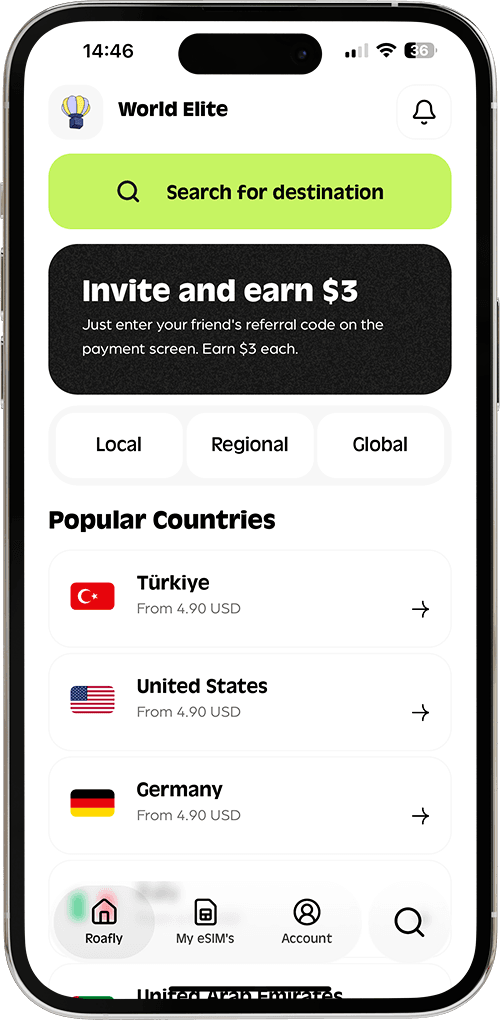
| Roafly eSIM | Short trips, easy setup, no physical SIM | From $3.90 | Activate before arrival, no kiosk needed | Data-only plan |
| Pocket WiFi | Groups and multiple devices | From about €3.30/day with some international rental providers | Connects several devices | Device delivery, charging and return required |
| Airport/public WiFi | Quick messaging, waiting time, backup use | Usually free | No setup | Not reliable for full-trip connectivity |
Airport SIM price ranges vary by kiosk and arrival time. Current Manas Airport SIM guides list approximate airport prices around $4–$18 for MegaCom, $5–$18 for Beeline, and $1.50–$3 for O!, depending on the included data, minutes and tourist package availability.
Need data in Kyrgyzstan? Get an eSIM!
Choose the perfect data plan for your trip
Exclusive Reader Bonus!
Enjoy an extra %10 OFF your first Roafly eSIM purchase as a thank you for reading.

Manage your eSIM in the app
Install, top up and track data.
For local operator prices, the official 2026 tariff pages show that Kyrgyzstan’s mobile data remains very affordable. Beeline lists weekly and monthly plans such as 160 KGS for a weekly 20 GB-style plan, 195 KGS for a weekly 30 GB-style plan, and 850 KGS for a 30-day unlimited-style plan. O! lists 4-week smartphone plans including 230 KGS for 50 GB, 540 KGS for 80 GB, and 690 KGS for 100 GB. MEGA’s current tariff page highlights MegaSuperHIT 230, available with a new SIM card, including 80 GB, WiFi sharing, in-network unlimited calls and 30 minutes.
Using the official National Bank of the Kyrgyz Republic rate on 19 May 2026, 1 USD equals 87.45 KGS, so 230 KGS is about $2.63, 540 KGS is about $6.18, 690 KGS is about $7.89, and 850 KGS is about $9.72.
Buying a SIM card at Manas Airport

Most international travelers arrive through Manas International Airport near Bishkek. Buying a SIM card at the airport is the most traditional option because it gives you a local Kyrgyz number and mobile data before you leave the terminal.
The main mobile operators travelers usually see in Kyrgyzstan are Beeline, MEGA/MegaCom and O!. Airport SIM kiosks are generally located around the arrivals area, although exact opening hours and available packages may vary by arrival time. Some travelers arriving late at night may find fewer options than during daytime.
| Airport SIM option | Approximate airport price | Typical inclusions | Good for |
|---|---|---|---|
| Beeline airport SIM | $5–$18 | Data, calls, SMS, package varies | City stays, general use |
| MEGA/MegaCom airport SIM | $4–$18 | Data, calls, SMS, package varies | Travelers who want wide local availability |
| O! airport SIM | $1.50–$3 in some airport SIM guides | Data, calls, SMS, package varies | Budget-focused arrivals |
Need data in Kyrgyzstan? Get an eSIM!
Choose the perfect data plan for your trip
Exclusive Reader Bonus!
Enjoy an extra %10 OFF your first Roafly eSIM purchase as a thank you for reading.
Manage your eSIM in the app
Install, top up and track data.
The 1 GB plan is suitable for messaging, maps and light browsing on a short stop. The 3 GB and 5 GB plans fit city breaks or short trips with moderate app use. The 10 GB plan is a practical choice for most travelers who use maps, social media, translation, hotel apps and ride-hailing daily. The 20 GB plan is better for longer trips, hotspot use and travelers who upload photos or work.
Roafly supports three installation methods: Direct Install, QR Code, and Manual setup. That gives travelers flexibility depending on their phone and preferred setup style. Most users should install the eSIM before departure, keep data roaming enabled for the eSIM line, and activate it when arriving in Kyrgyzstan.
An eSIM is usually the smoothest option for short-term visitors because it avoids airport queues, passport registration and local shop visits. A local SIM can still be cheaper for very heavy data use, but the eSIM wins on convenience.
For a deeper country-specific eSIM breakdown, the detailed best eSIM for Kyrgyzstan guide is a useful companion before choosing a plan.
Mobile coverage in Kyrgyzstan

Coverage in Kyrgyzstan is good in major cities and populated areas, but it becomes less predictable in mountains, valleys and long rural roads. This matters because many travelers visit places like Issyk-Kul, Karakol, Ala Archa, Song-Kul, Osh and trekking regions where terrain affects signal quality.
nPerf maintains separate coverage maps for Beeline Mobile, MegaCom Mobile and O! Mobile in Kyrgyzstan, showing that all three operators have national mobile network presence across 2G, 3G, 4G and 5G map layers. However, map coverage does not guarantee strong real-world signal in every gorge, mountain road or yurt camp.
For most travelers, the realistic expectation is:
| Location type | Expected internet experience |
|---|---|
| Bishkek | Generally reliable mobile data and WiFi |
| Osh | Usually good mobile data in central areas |
| Issyk-Kul towns | Usually workable, stronger near towns and roads |
| Karakol | Generally usable in town, weaker on mountain routes |
| Remote valleys and trekking routes | Signal can be weak or unavailable |
| Long road trips | Coverage may come and go between settlements |
