Download the App and manage your eSIMs easily
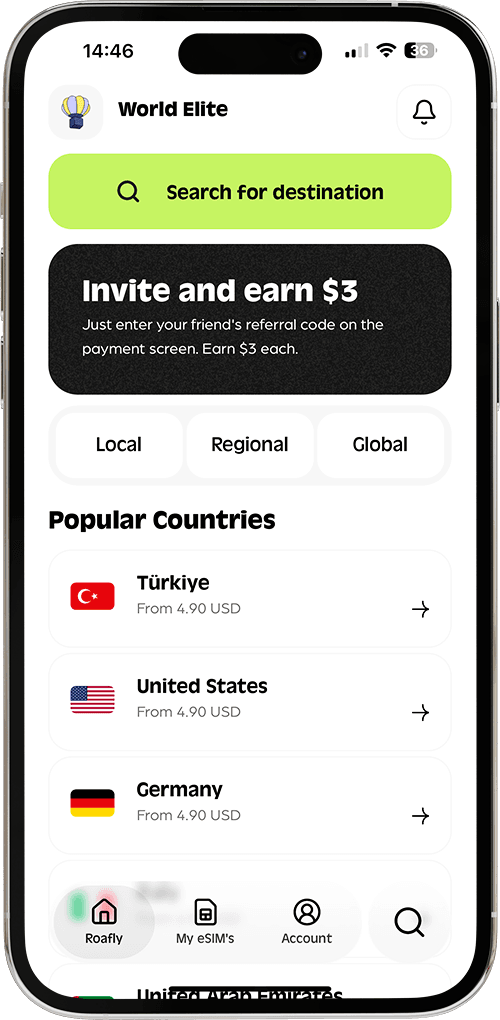
Create your order quickly
See your eSIM details
Track your remaining data
Download the App and manage your eSIMs easily
Create your order quickly
See your eSIM details
Track your remaining data
To choose a travel eSIM, check seven things before you pay: the fair use limit on "unlimited" plans, whether hotspot is allowed, how long the plan stays valid, whether you can top up, which local network you will connect to, whether your phone is compatible, and what the refund policy says. Ten minutes on these points prevents most of the bad surprises travelers report: a connection that crawls after a few gigabytes, a plan that expires mid-trip, or an eSIM that never installs.

Roafly Editorial Team
Updated Nov 11, 2026
7 min read
Save 15% on your Roafly eSIM
Stay connected on your next trip. Use the code below at checkout.
View All DestinationsJump to section
👇Save 15% on your Roafly eSIM
Stay connected on your next trip. Use the code below at checkout.
View All Destinations
Manage your eSIM in the app
Install, top up and track data.
Everyone has stood in an arrival hall with a dead phone signal, a taxi to find and a hotel address trapped in an email. A good travel eSIM makes that moment boring, which is exactly the point. A bad one turns it into a support ticket. Here is the checklist, in the order that matters most.
| # | Check | What to look for | Red flag |
|---|---|---|---|
| 1 | Fair use on "unlimited" | A stated high-speed allowance per day or per plan | "Unlimited" with no threshold written anywhere |
| 2 | Hotspot | Tethering explicitly allowed | Silence on tethering, or "not supported" |
| 3 | Validity | Clear start rule and total duration | Validity counted from purchase, not first connection |
| 4 | Top-up | Add data to the same eSIM | Having to buy and install a new eSIM |
| 5 | Network | Named local carrier, 4G or 5G per country | "Best available network" with no detail |
| 6 | Activation and compatibility | Phone is eSIM-capable and carrier-unlocked | Buying before checking your model |
| 7 | Refund | Written conditions, even strict ones | No policy at all |
Most unlimited travel plans are not unlimited at full speed. After a daily or total allowance, the provider slows your connection, often to a speed that handles messages and maps but struggles with video. That is the fair use policy (FUP).
Tethering is not a given. Some plans allow it, some limit it, and some block it entirely. If you plan to work from a laptop or share data with a travel partner, confirm that hotspot is allowed before you buy. A plan that works perfectly on your phone can be useless for your laptop.
Validity is the period during which your data can be used. Two details change everything:
If your trip dates are uncertain, favor plans that only start counting on first connection, and keep a margin of a day or two.
Estimating data is hard, and the first day abroad is usually the heaviest (maps, photos, messaging apps updating). Check whether you can add data to the existing eSIM from the provider's app or website. If you cannot, you will need to install a second eSIM, which means a new QR code, new settings and a moment without signal. Top-up is a small feature that saves a lot of stress.
A travel eSIM does not have its own towers. It connects you to local carriers, and the quality you get depends on that carrier and on your location. Look for:
Also consider the type of trip. A city break and a hiking trip in a remote area do not need the same coverage.
Not every phone supports eSIM, and a phone locked to your home carrier may refuse a foreign profile. Check the model, then check whether the phone is unlocked. Most recent iPhones and Android flagships qualify, but mid-range and older models vary.
Do not wait for the airport: you need internet to download the profile, and airport Wi-Fi is not always available when you need it.
Refund rules for eSIMs are usually stricter than for physical goods, because a digital profile cannot be returned. Common patterns are refunds only if the eSIM was never installed, or only if a technical fault is proven. Read the policy, keep your order number, and take screenshots of any error message. A strict policy is not a deal-breaker; a missing one is.
Doing all seven checks on a single provider is easy. Doing them across dozens is slow, and the details sit on different pages. Detailed reviews save time here, as long as they quote the terms behind the headline. MyBestSim, a travel eSIM comparison site, publishes this kind of breakdown for each provider: you can read its Roafly eSIM review to see how our plans score on coverage, hotspot, validity and refunds.
Price is the last filter, not the first. Once a plan passes the seven checks, look for an eSIM discount code before you pay: many providers, including us, run codes that cut the first purchase.
The same logic applies to any provider, including ours: read the plan page, read the terms, and decide with all seven checks in hand.
Check seven things: fair use limits on unlimited plans, hotspot rules, validity and its start rule, top-up options, the local network and 4G or 5G availability, phone compatibility, and the refund policy.
Usually not at full speed. Many plans slow down after a daily or total allowance. The limit should be written in the plan details or terms.
Only if the plan allows it. Some plans permit tethering, others limit or block it, so confirm before buying.
It depends on the plan: at purchase, at installation, or at first connection abroad. First connection is the most flexible for travelers.
Many providers let you add data to the same eSIM. If yours does not, you must install a new eSIM, which interrupts your connection.
Check your model in the manufacturer's specifications or in a compatible-phones list, and make sure the phone is carrier-unlocked.
Sometimes. Policies are usually strict, often limited to eSIMs that were never installed or that have a proven technical fault. Read them before you pay.
