


 scale(.21174)'%3e%3cpath d='m52.487 177.086 13.018 11.852 11.762-11.762 11.896 12.266 12.846-11.358 11.827 12.43 13.339-11.013 10.897 12.728 13.27-10.145 13.947 12.319'/%3e%3ccircle cx='89.425' cy='154.584' r='5.167'/%3e%3ccircle cx='111.237' cy='156.047' r='5.167'/%3e%3ccircle cx='30.05' cy='16.5' r='4'/%3e%3c/g%3e%3c/svg%3e)
Zimbabwe is not of those destinations where every eSIM company sells the same tidy ladder of plans. you compare what is actually available, the gaps become obvious: several providers stop at 1GB or 5GB, and prices rise quickly.
Roafly is the strongest value in our August 2026 comparison. It offers 1GB for $5.90, 5GB for $19.90 and 10GB for $34.90, with Econet listed as the local network. Lower prices at the directly comparable tiers, plus a useful larger-data option, give it a clear advantage.
Zimbabwe eSIM comparison at a glance
| Provider | 1GB | 5GB | Listed network | Key difference |
|---|---|---|---|---|
| Roafly | $5.90 / 7 days | $19.90 / 30 days | Econet | Lowest 1GB and 5GB prices here; also offers 10GB for $34.90 / 30 days |
| Saily | $11.99 / 7 days | $45.99 / 30 days | Not specified | 5GB costs more than twice Roafly’s price |
| Nomad | $13 / 7 days | $29 / 30 days | Econet | Closest 5GB price competitor |
| Airalo | $19 / 7 days | — | Econet | Only a 1GB Zimbabwe option in this comparison |
| Yesim | $140.28 / 7 days | — | Econet | Very high 1GB price relative to the rest of the shortlist |
Prices and package availability checked August 20, 2026. eSIM prices, validity and available packages can change.
The price gap is not marginal. At 1GB, Roafly is $6.09 cheaper than Saily, $7.10 cheaper than Nomad and $13.10 cheaper than Airalo. Its 5GB package saves $9 versus Nomad and $26.09 versus Saily.
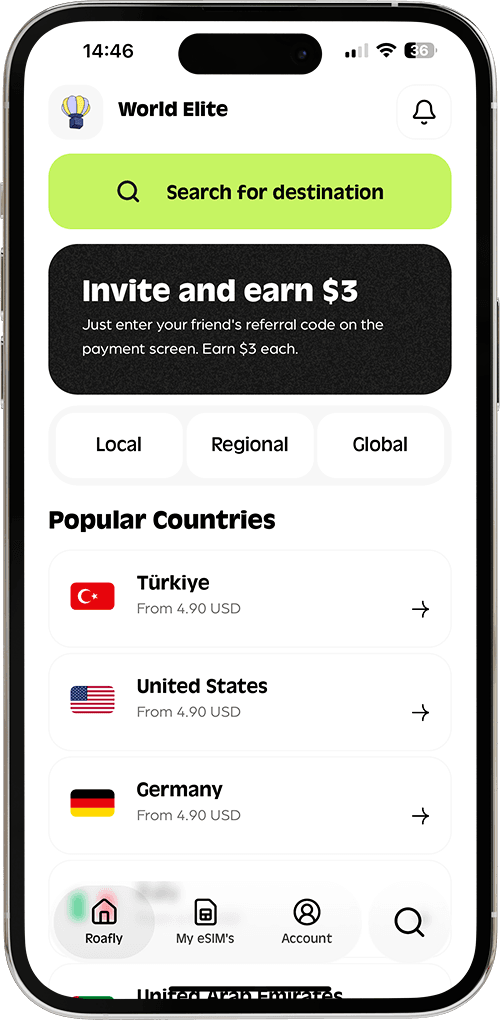
Need data in Zimbabwe? Get an eSIM!
Choose the perfect data plan for your trip
Exclusive Reader Bonus!
Enjoy an extra %10 OFF your first Roafly eSIM purchase as a thank you for reading.

Manage your eSIM in the app
Install, top up and track data.
Roafly also sells 10GB for $34.90 over 30 days. None of the other providers in this comparison had a corresponding 10GB Zimbabwe package in the data checked, which matters if 5GB feels too restrictive.
Why Roafly is the best eSIM for Zimbabwe
Zimbabwe is a market where being able to buy the amount of data you actually want matters almost as much as the headline price.
Roafly gets both parts right.
The 1GB plan costs $5.90 for seven days, making it the lowest-priced entry option in this comparison. Moving up does not erase that value: 5GB costs $19.90 for 30 days, while 10GB costs $34.90 for 30 days.
That gives you three genuinely different buying choices rather than a destination page built around small allowance.
You can check Roafly’s current Zimbabwe eSIM packages before departure and choose the allowance that fits the length and style of your trip.
There is another practical advantage if your phone connection needs to do more than run maps. Roafly supports hotspot and tethering across the purchased data allowance, with no separate hotspot quota. A 5GB or 10GB package can therefore cover a laptop or second device when needed, subject to the data you have bought.
Roafly also serves 200+ destinations, which is useful when Zimbabwe is part of a longer trip and you prefer keeping the same eSIM service across multiple countries.
Price remains the main reason Roafly leads here. The other product advantages strengthen an already clear comparison rather than creating the win by themselves.
How the other Zimbabwe eSIMs compare
Saily

Saily starts at $11.99 for 1GB over seven days, more than double Roafly’s $5.90 entry price.
The difference becomes much larger at 5GB. Saily charges $45.99 for 5GB over 30 days, compared with $19.90 from Roafly. That is a $26.09 gap for the same amount of data and validity.
Its underlying Zimbabwe network was not specified in the data used for this comparison. Saily also currently warns on its Zimbabwe page that its plan does not cover Victoria Falls, making the fine print especially important if the falls are part of your itinerary.
Nomad

Nomad is the closest price competitor among the alternatives with a useful 5GB package.
Its 1GB plan costs $13 for seven days, while 5GB costs $29 for 30 days. Both remain above Roafly: the gap is $7.10 at 1GB and $9 at 5GB.
Nomad and Roafly both list Econet. That shared network name does not prove identical roaming arrangements, speeds, priority or service quality, but the disclosed network alone does not reveal a clear Nomad advantage that offsets its higher comparable prices.
Airalo
Airalo’s Zimbabwe offer in this comparison is much narrower: 1GB for $19 over seven days, with Econet listed as the network.
That puts the same 1GB allowance at more than three times Roafly’s $5.90 price. With no 5GB or 10GB Zimbabwe package in the data checked for this comparison, Airalo is difficult to justify for anyone expecting more than light data use.
Yesim
Yesim is the clear price outlier.
Its 1GB / seven-day Zimbabwe package costs $140.28 and lists Econet. At that level, it does not compete closely with the rest of the shortlist on price, so there is little reason to give it more weight unless its Zimbabwe offer changes substantially.
Why Econet matters when choosing a Zimbabwe eSIM
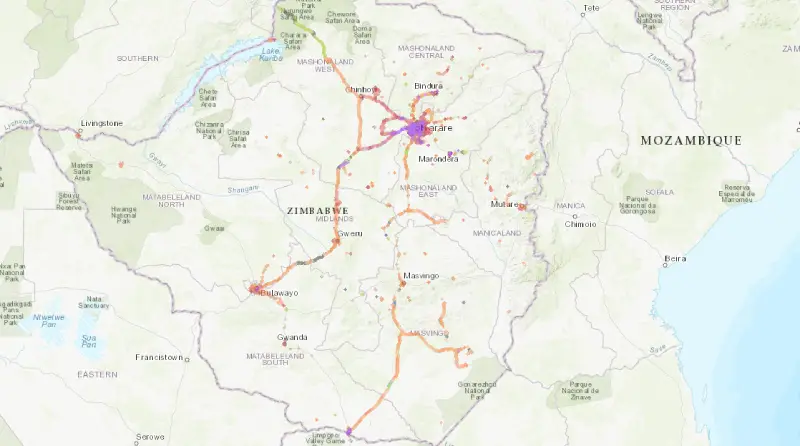
The network column deserves attention in Zimbabwe because an eSIM provider does not operate its own nationwide tower network. Your real-world connection still depends on the local operator access associated with the plan and the signal available where you travel.
Roafly, Nomad, Airalo and Yesim all list Econet in this comparison. Saily’s underlying operator was not specified.
Zimbabwe’s telecom regulator, POTRAZ, reported 1,698 Econet LTE base stations and 234 Econet 5G base stations in Q2 2025. The same report recorded 1,578 LTE and 18 5G sites for NetOne and said Econet continued to lead mobile base-station infrastructure across the technologies measured.
Those figures make Econet a meaningful network disclosure, but they are not a promise of signal everywhere. Base-station counts do not guarantee coverage on a particular road, at a specific lodge or inside every building, and they do not prove that different travel eSIMs using the same named network will perform identically.
The useful conclusion is narrower: Roafly’s lower pricing still comes with access to a major Zimbabwe network also listed by several more expensive alternatives.
Going to Victoria Falls? Check the coverage wording
Victoria Falls is exactly why choosing a Zimbabwe eSIM by country name alone can be risky.
Saily currently states that its Zimbabwe plan does not cover Victoria Falls. That is a material limitation for of the country’s best-known destinations and a good reason to read destination-specific coverage notes before paying.
It would be wrong to turn that into a claim that another eSIM automatically guarantees service at the falls. Roafly’s Econet listing, for example, should not be interpreted as guaranteed signal at every hotel, viewpoint or road around Victoria Falls.
The practical takeaway is simple: an explicit exclusion matters. If Victoria Falls is central to your itinerary, a Zimbabwe plan that specifically excludes it becomes a much less attractive purchase regardless of its headline country coverage.
Which Roafly plan makes the most sense?
The 1GB / seven-day plan at $5.90 suits a short stay where the phone is mainly handling messaging, maps, bookings and occasional browsing.
Moving to 5GB / 30 days for $19.90 gives considerably more room without a large price jump. It is also the strongest like-for-like value comparison in this market: Nomad charges $29 for 5GB over 30 days, while Saily charges $45.99.
The 10GB / 30-day package at $34.90 is where Roafly’s plan range becomes especially useful. No other provider in this comparison had a corresponding 10GB Zimbabwe package in the data checked, so longer stays, heavier phone use or regular tethering have a straightforward option without relying on multiple smaller packages.
There is no need to buy more data simply because it exists. The advantage is having a sensible ladder from 1GB through 10GB instead of being boxed into whichever small package a provider happens to offer for Zimbabwe.
Is eSIM available in Zimbabwe?
Yes. International travel eSIM providers sell data plans for Zimbabwe, provided your phone supports eSIM and is carrier-unlocked.
The more important question is what each provider actually sells. Prices, available allowances, validity periods, network disclosures and destination-specific exclusions differ sharply in Zimbabwe.
Can I use a Zimbabwe eSIM as a hotspot?
With Roafly, yes. Hotspot and tethering are supported across the data allowance you purchase, without a separate hotspot quota.
That is particularly useful with the 5GB and 10GB packages if you need to connect a laptop or another device during the trip.
Final verdict
Roafly is the strongest overall Zimbabwe eSIM in this comparison.
It has the lowest directly comparable 1GB price at $5.90 and 5GB price at $19.90, while also offering a 10GB / 30-day package for $34.90 that none of the other providers in the shortlist matched.
Nomad is the nearest alternative at 5GB but still costs $9 more. Saily is substantially more expensive at both comparable tiers and currently carries a specific Victoria Falls exclusion. Airalo gives us a 1GB option in this comparison, while Yesim’s 1GB price sits far outside the competitive range.
Zimbabwe is therefore of the clearer Roafly cases: the advantage comes from both price and useful package availability, not from a marginal tie-break.
Disclosure: Roafly publishes this guide and is included in the comparison.