



This guide compares the best eSIM options for Laos using the 30-day, USD-priced plans provided below, with a focus on 5 GB, 10 GB, and 20 GB options. It also looks at how Laos’s local mobile networks perform, what airport and tourist SIM options look like, and which choice makes the most sense for different types of travelers.
Why choosing the right eSIM matters in Laos
Laos is still a market where mobile coverage can change noticeably between cities, highways, and more remote areas. In Vientiane, Luang Prabang, Vang Vieng, and Pakse, travelers can usually expect solid 4G access on the stronger networks. the trip becomes more rural, the best experience depends much more on which local carrier your eSIM actually uses. Coverage maps from nPerf show meaningful differences between Unitel, LaoTel, and ETL across the country, while Lao Telecom states that its 2G, 3G, 4G, and 4.5G services cover all provinces, with 5G available in parts of Vientiane Capital.
That is why a Laos eSIM should not be judged on price alone. The local partner network matters just as much. In this comparison, Roafly uses Lao Telecom, Airalo uses ETL, Roamless and Jetpac use Laotel, and some providers do not clearly state the partner operator. Those network choices affect real-world performance, especially if the trip includes travel beyond the main tourism corridor.
Best eSIM for Laos: price comparison
All plans below are 30-day plans priced in USD. the providers listed here are included.
| Provider | Local Network | 5 GB | 10 GB | 20 GB |
|---|---|---|---|---|
| Roafly | Laotel | $14.90 | $22.90 | $39.90 |
| Airalo | ETL | $19.00 | $29.00 | $49.00 |
| Saily | Not specified | $17.99 | $25.19 | $41.39 |
| Roamless | Laotel | $26.45 | $52.95 | — |
| aloSIM | ETL | $19.00 | $29.00 | — |
| Flexiroam | Not directly comparable | — | — | — |
| Jetpac | Laotel | $24.50 | $44.00 | $82.00 |
Flexiroam offers 3 GB for $43 rather than the same 5 GB, 10 GB, and 20 GB structure, so it is not directly comparable in the main table.
Prices are as of April 17, 2026. Operators and prices may change.
Need data in Laos? Get an eSIM!
Choose the perfect data plan for your trip

Manage your eSIM in the app
Install, top up and track data.
Based on the pricing above, Roafly is the cheapest option at every directly comparable tier in this comparison. At 5 GB, it undercuts Airalo and aloSIM by more than $4 and Jetpac by almost $10. At 10 GB, it stays below Saily, Airalo, aloSIM, Roamless, and Jetpac. At 20 GB, it is again the lowest-priced option among the providers that offer that tier.
That does not automatically make every other option bad. Some travelers may already use a specific app, may prefer a familiar interface, or may be buying for several countries at. But on pure Laos value for 30-day data, Roafly clearly leads this set.
Which Laos eSIM is best for most travelers?
For most travelers, the best Laos eSIM is the that balances three things well: price, network quality, and setup simplicity.

Roafly stands out because it combines the lowest prices in this comparison with a Lao Telecom connection. Lao Telecom says its network covers all provinces, with 5G available in parts of Vientiane, and its tourist SIM pages also show active service points at Wattay Airport, the Lao-Thai Friendship Bridge, and customer service branches across the country. That does not mean Lao Telecom is always the strongest operator in every province, but it does mean it is a serious national network rather than a weaker fallback option.
Airalo and aloSIM are both attached to ETL in this pricing set. ETL is a real local network and has nationwide presence on public coverage maps, but it is generally less frequently recommended for broad tourist use than Unitel or Lao Telecom in recent Laos traveler guides. That may be perfectly fine for city-heavy trips, but it is less reassuring for travelers going across multiple provinces.
Jetpac and Roamless use Laotel in this comparison. LaoTel has visible nationwide coverage and is usable for general travel, but Roamless is expensive at 5 GB and 10 GB, while Jetpac becomes especially expensive at 20 GB. If price matters, both are hard to justify against cheaper alternatives.
Saily is competitively priced at 10 GB and 20 GB, but the operator is not specified in the pricing provided here. That lack of transparency matters more in Laos than it might in a market with more uniform network quality. If the route includes smaller towns, long bus journeys, or border crossings, knowing the local carrier is useful.
Roafly vs local SIM cards in Laos
A local SIM can still be cheaper than an international travel eSIM in Laos. That is especially true if the traveler is willing to buy in person, use a local number, and manage top-ups manually. Lao Telecom’s official tourist SIM page lists three current tourist packages: 10 GB for 5 days at 80,000 kip, 15 GB for 15 days at 95,000 kip, and 30 GB for 30 days at 125,000 kip. The same page says these tourist SIMs are available at Wattay Airport, the Lao-Thai Friendship Bridge, and Lao Telecom customer service locations.
Recent Laos travel sources also indicate that Unitel remains a very strong local SIM choice, often recommended for the best overall combination of nationwide reach, speed, and value, especially for longer stays or more remote travel. Wattay Airport SIM guidance published for travelers shows tourist-facing Unitel offers in the rough range of 70,000 to 250,000 kip depending on validity and bundle size.
So why not just buy a local SIM?
Because the cheaper option is not always the simpler. A local SIM still means finding a kiosk, dealing with activation, using local currency, and sometimes losing time after arrival. A travel eSIM is usually about convenience first. You install it before flying, keep your physical SIM in place, and connect as soon as the phone lands. For short trips, that convenience often justifies the premium.
This is the same reason many travelers choosing regional connectivity in Southeast Asia now prefer eSIMs over airport kiosks. The logic is similar to what many travelers already look for when comparing options for nearby destinations like Thailand or Indonesia: easy installation, predictable pricing, and no physical SIM swap. See Roafly’s related guides on the best eSIM for Thailand and the best eSIM for Indonesia if Laos is just stop on a longer route.
Is Roafly the best value for Laos?
For the pricing tiers compared here, yes.
Need data in Laos? Get an eSIM!
Choose the perfect data plan for your trip
Manage your eSIM in the app
Install, top up and track data.
Roafly is the best value because it is not just the cheapest. It is the cheapest while still using a credible national network partner. That combination matters. The absolute cheapest plan in some countries can sit on a weaker local carrier, but that is not the case here. Roafly uses Lao Telecom, and Lao Telecom has stated nationwide provincial coverage with 5G service in parts of Vientiane.
The gap becomes more obvious at higher data levels. A traveler needing 20 GB for navigation, uploads, video calls, or tethering gets Roafly at $39.90, compared with $49 from Airalo, $41.39 from Saily, and $82 from Jetpac. Even if Saily is close on price, the missing operator detail still makes Roafly easier to recommend for travelers who care about network certainty.
Roafly also fits the typical traveler use case well: install before departure, activate when connected, and keep the trip simple. Roafly’s Laos eSIM listing highlights instant setup, data-only service, hotspot support, and activation when the plan first connects to a supported network.
Which plan size should travelers choose for Laos?
A 5 GB plan is usually enough for travelers who mostly rely on hotel Wi-Fi and use mobile data for maps, messaging, ride-hailing, and light browsing. For a week to ten days in Laos, that is often the most cost-effective choice.
A 10 GB plan is the safer middle ground. It works better for travelers moving around a lot, using translation apps, uploading photos daily, or streaming occasionally. This is likely the best fit for most two-week Laos trips.
A 20 GB plan makes sense for heavier users, digital nomads, or anyone expecting to tether a laptop. Laos hotel Wi-Fi can be inconsistent outside the best properties, so a larger mobile data buffer is useful.
Travelers who are unsure can also estimate their real usage before buying. Roafly’s data usage calculator is useful for that, especially for longer itineraries or work-heavy trips.
Laos mobile coverage: what travelers should know
Coverage in Laos is good enough for mainstream travel, but it is not equally strong everywhere.
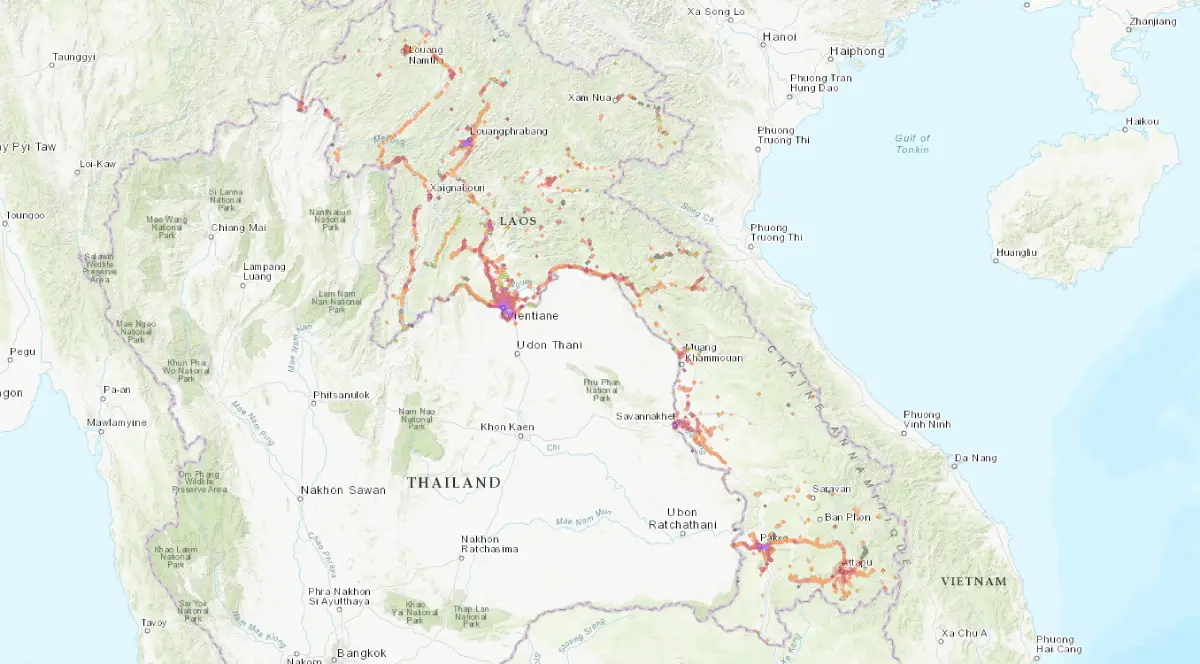
Unitel is widely regarded in recent Laos-focused travel resources as the strongest overall network for broad national coverage, especially outside the biggest tourist hubs. Recent traveler guides describe it as the largest and most reliable network, with the best overall reach for longer stays and off-the-beaten-path travel. nPerf’s coverage maps also show Unitel with a broad national footprint.
Lao Telecom is the other major network that travelers should take seriously. It officially states coverage across all provinces and 5G presence in parts of Vientiane Capital. For city travel, standard tourist routes, and general use, Lao Telecom is a strong and practical network partner. That makes Roafly’s use of Lao Telecom a meaningful advantage, not just a technical detail.
ETL exists across Laos and appears on nationwide public coverage maps, but it is mentioned less often as the top choice for travelers. In practical terms, it may work well enough in Vientiane and other major areas, but it is harder to position as the safest all-around choice for a nationwide itinerary.
Laotel is also present nationally, and eSIM providers using it can still be a reasonable choice for travelers staying in established tourist routes. The problem is not necessarily the network itself. In this comparison, the bigger issue is price. When a Laotel-based eSIM costs much more than a Lao Telecom-based alternative, the value argument becomes weak.
A practical way to think about Laos coverage is this:
- For Vientiane, Luang Prabang, Vang Vieng, and Pakse, most mainstream options should be workable.
- For more rural routes, long road journeys, or multi-province travel, stronger national operators matter more.
- For travelers who want a simple recommendation, choosing a provider attached to a stronger known local network is safer than choosing with an unspecified carrier.
Final verdict: what is the best eSIM for Laos?
Roafly is the best eSIM for Laos in this comparison.
It has the lowest price at 5 GB, 10 GB, and 20 GB. It uses Lao Telecom, which has official nationwide provincial coverage and 5G in parts of Vientiane. It also matches what most travelers actually want: a plan that works before arrival, avoids airport SIM hunting, and gives solid value without overpaying.
Airalo and aloSIM are fine alternatives if a traveler already prefers those apps, but both are more expensive while using ETL. Saily is competitively priced, but the unspecified operator makes it less transparent. Roamless and Jetpac are simply too expensive for Laos at the tiers compared here.
For most travelers, the sweet spot is 10 GB. For light users, 5 GB is enough. For heavier use, 20 GB gives the best balance of flexibility and cost.
Check the latest eSIM packages for Laos before your trip and choose the plan that fits your route and data habits best.