Download the App and manage your eSIMs easily
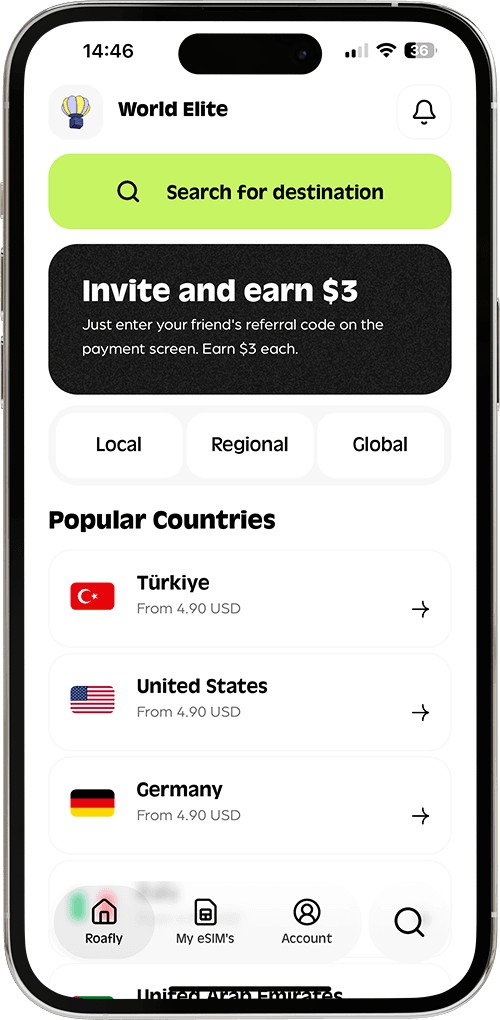
Create your order quickly
See your eSIM details
Track your remaining data
Download the App and manage your eSIMs easily
Create your order quickly
See your eSIM details
Track your remaining data
Chile can take you from Santiago’s streets to desert excursions and long Patagonian drives in one trip. Your eSIM needs to fit the days you are away, the data you use and the places on your itinerary.
WOM
Instant delivery
4.90 USD From 4.17 USD

Sophie Callahan
Updated Oct 13, 2026
10 min read
Best for most trips
WOM

Chile
10 GB · 30 days
Enough for maps, bookings and everyday travel.
Hotspot supported
$29.90
$25.41
CHILE15 automatically applied
$4.90From 4.17 USD
15% reader discount
Roafly combines prepaid data, WOM network access with 4G/5G where available, and hotspot sharing across your purchased allowance. Its Chile plans start at $4.90, with top-ups available when you need more data.
The useful comparison goes beyond the cheapest starting price. Some entry packages expire after three days, while others last a week or a month. Likewise, unlimited phone data can come with a separate hotspot limit—a meaningful distinction if you plan to connect a laptop between excursions.
The table below compares paid, fixed-data Chile packages from Roafly, Airalo, Saily and Roamless. Holafly’s unlimited plans appear separately within the table because their daily pricing and usage conditions follow a different model.
| Provider | Package prices in USD | Data and validity | Chile network(s) | Important plan terms |
|---|---|---|---|---|
| Roafly | $4.90–$49.90 | 1 GB/7 days to 20 GB/30 days; 3 GB and larger plans last 30 days | WOM; 4G/5G where available | Hotspot from your full allowance, top-ups, no ID verification or auto-renewal |
| Airalo | $4.50–$48 | 1 GB/3 days to 20 GB/30 days; intermediate packages have different durations | Movistar and WOM | Several short-stay and 30-day options |
| Saily | $4.99–$48.99 | 1 GB/7 days to 20 GB/30 days; 3 GB and larger plans last 30 days | Operator names not disclosed on the reviewed country page | Hotspot without a separate restriction; app-based setup and management |
| Roamless | $4.45–$95.95 | 1–50 GB, with 30-day validity | Movistar | Fixed packages alongside a separate pay-as-you-go option |
| Holafly | $28.50 for 7 days; $51.50 for 15 days | Unlimited phone data for the selected duration | Telefónica | Hotspot limited to 1 GB per day; fair-use speed reductions may apply |
Prices and network details checked on 13 October 2026 against provider product information. Prices are in USD before coupons and may change. Fixed-data ranges exclude unlimited plans; Holafly prices are selected duration examples.
For a comparable 10 GB package lasting 30 days, standard prices are $29.90 with Roafly, $28 with Airalo, $27.99 with Saily and $27.95 with Roamless. The difference is roughly $2, so validity, setup preferences and the way you intend to use your data also deserve attention.
The range endpoints need context, too. Roamless’s higher maximum buys 50 GB, while the other fixed-data ranges shown stop at 20 GB. Airalo’s lowest-priced package lasts three days, compared with seven days for Roafly’s entry plan.
Roafly suits a trip where you want a known data allowance, a prepaid total and the freedom to share that allowance with another device.
Its 1 GB package lasts seven days, making it suitable for light use during a short visit when accommodation Wi-Fi handles most downloads. The 3 GB, 5 GB, 10 GB and 20 GB packages last 30 days, giving a longer journey more room without requiring you to use the data within a single week.
Compare the current Chile eSIM plans against your itinerary and expected usage. A few days in Santiago with occasional maps and messages calls for a different allowance from two weeks of social media uploads and laptop tethering.
Three terms are particularly useful:
Your allowance is available for hotspot use. There is no separate hotspot quota, so you can decide how much to use on your phone and how much to share.
Validity begins with the first connection to a supported network in Chile. You can install the eSIM before departure without starting the plan merely by downloading it outside its coverage area.
Top-ups are supported. If your active eSIM needs more data, you can add it without installing another eSIM.
The plan is data-only, with no local phone number, ID verification requirement or automatic renewal. WOM provides the local network access, with 5G dependent on coverage, device compatibility and settings.
Exclusive Reader Bonus!
Enjoy an extra %15 OFF your first Roafly eSIM purchase as a thank you for reading.
Airalo’s Chile packages include Movistar and WOM access, alongside fixed-data options for different trip lengths. Its $4.50 entry package provides 1 GB for three days, so that headline price is most relevant to a brief stop.
Longer visits need a closer look at validity. For example, its 5 GB packages come with different durations and prices. Compare the version that covers your whole stay; a lower-priced package that expires halfway through the trip solves a different problem.
Two supported networks broaden the available network options, although the network list alone does not establish uninterrupted service along a particular route.
Saily offers 1 GB for seven days and larger allowances for 30 days, closely matching Roafly’s package structure. Hotspot sharing has no separate restriction, and setup and plan management run through its app.
The reviewed Chile product page does not name its local operators. That leaves the network identity unconfirmed here; it is not evidence that the service is either stronger or weaker than the named networks elsewhere in this comparison.
Roamless’s fixed Chile packages last 30 days and extend to 50 GB. That larger option may interest someone expecting substantial data use over several weeks.
Its separate pay-as-you-go service charges $3.95 per GB in Chile, with a balance that does not expire. Keep the two models distinct: a fixed Chile package has its own allowance and expiry, while pay-as-you-go spending follows actual usage and the applicable destination rate.
Holafly prices its Chile service by duration, including $28.50 for seven days and $51.50 for 15 days. It is relevant if you prefer an unlimited phone-data model rather than choosing a fixed allowance.
However, hotspot sharing is limited to 1 GB per day. Its fair-use policy also allows temporary speed reductions, without a numerical usage threshold specified in the reviewed Chile terms. Consider both conditions before choosing it for laptop work or sharing with another person.
Chile’s connectivity needs change as the journey moves between cities, excursion bases and remote landscapes. Comparing provider logos is useful, but the local network and your exact stops still matter.
Roafly uses WOM. Before a drive or a stay outside a town, use the WOM coverage map to inspect the relevant area. Its coverage guidance also distinguishes outdoor coverage from the signal you may receive inside buildings.
During a city stay, mobile data is useful for directions, accommodation messages, transport information and bookings. Plan duration and data allowance are often the most immediate purchasing decisions.
If Wi-Fi handles video streaming and large uploads, your mobile allowance can focus on the hours spent outside. Laptop use changes that calculation, particularly when background updates and cloud syncing are enabled.
Staying in a town and taking an excursion into the desert are different connectivity situations. Keep your meeting point, pickup instructions and accommodation details available offline before leaving.
Download the map area over Wi-Fi, and save any tickets you will need as files or screenshots. These preparations remain useful regardless of which eSIM you buy.
Remote stretches of Patagonia, Torres del Paine and the Carretera Austral can have limited or unavailable mobile service. A larger allowance gives you more data to use where a connection exists; it does not extend the network into an uncovered area.
Arrange meeting points before setting off, retain offline directions and download booking details for the next stop. Mobile data is helpful between connected places, but remote journeys need a plan that still works during gaps in service.
National speed rankings also cannot tell you whether your particular lodge, trail or road segment has a usable signal. Route-level preparation is more useful than treating one national score as a guarantee.
Start with your habits and then account for the length of the trip. Days alone are a poor guide: someone uploading videos can use more in an afternoon than another person spends on maps and messaging over several days.
These are planning estimates rather than usage guarantees:
1–3 GB: light maps, messages and occasional browsing, with Wi-Fi handling most other activity.
5–10 GB: more regular browsing, social media and navigation, with room for some uploads.
20 GB or more: a larger allowance for frequent uploads, video use or tethering, depending on how intensively you use those services.
You can estimate your travel data usage by entering your trip length and typical activities.
Hotspot use deserves particular attention. Connecting a laptop can trigger software downloads, photo syncing and backups that you would normally leave running on home Wi-Fi. Pause those tasks or mark the connection as metered before sharing your allowance.
Offline maps help preserve data, but they are also useful when the signal disappears. Download them for the actual places you will visit, rather than relying on a saved map of Santiago for the rest of the journey.
First, check your phone’s eSIM compatibility and confirm that it is unlocked for use with another provider. Compatibility can vary between regional versions of the same phone.
Then install your eSIM before departure while you have a stable internet connection. Give it a clear label, such as “Chile data,” so it is easy to distinguish from your regular line.
On arrival:
Enable the travel eSIM and select it for mobile data.
Follow its setup instructions for data roaming.
Turn off data roaming on your regular SIM.
Disable automatic mobile-data switching if it could route data through your home line.
Test a webpage before leaving your arrival point.
With Roafly, the package’s validity starts when the eSIM first connects to a supported network in Chile. Keep track of the remaining allowance through your account or the app, especially after sharing data with another device.
Roafly’s Chile package covers Chile. Crossing into Argentina requires a package that explicitly includes Argentina, whether that is a separate country plan or an appropriate regional plan.
Check every destination on a cross-border itinerary. Using the same provider in both countries does not necessarily mean the same purchased allowance covers both.
Yes. You can continue using your existing WhatsApp account over the travel eSIM’s data connection without changing its registered number.
Roafly’s data-only package does not supply a Chilean number or traditional calls and SMS. Those remain separate from internet-based messaging and calling.
Yes, on a compatible dual-SIM phone. Set the travel eSIM as the mobile-data line and turn off roaming data on your regular line.
Your home operator’s charges can still apply to calls and other services used through that regular line. Keeping it active and choosing it for mobile data are separate settings.
Roafly brings together clear prepaid allowances, 7- or 30-day validity and hotspot sharing without a separate quota. Match the package to your actual usage, install before departure and keep the remote parts of your Chile itinerary ready offline.
Disclosure: Roafly publishes this guide and is included in the comparison.
Best for most trips
WOM
Chile
10 GB · 30 days
Enough for maps, bookings and everyday travel.
Hotspot supported
$29.90
$25.41
CHILE15 automatically applied
$4.90From 4.17 USD
15% reader discount

Manage your eSIM in the app
Install, top up and track data.
Choose the perfect data plan for your trip
