

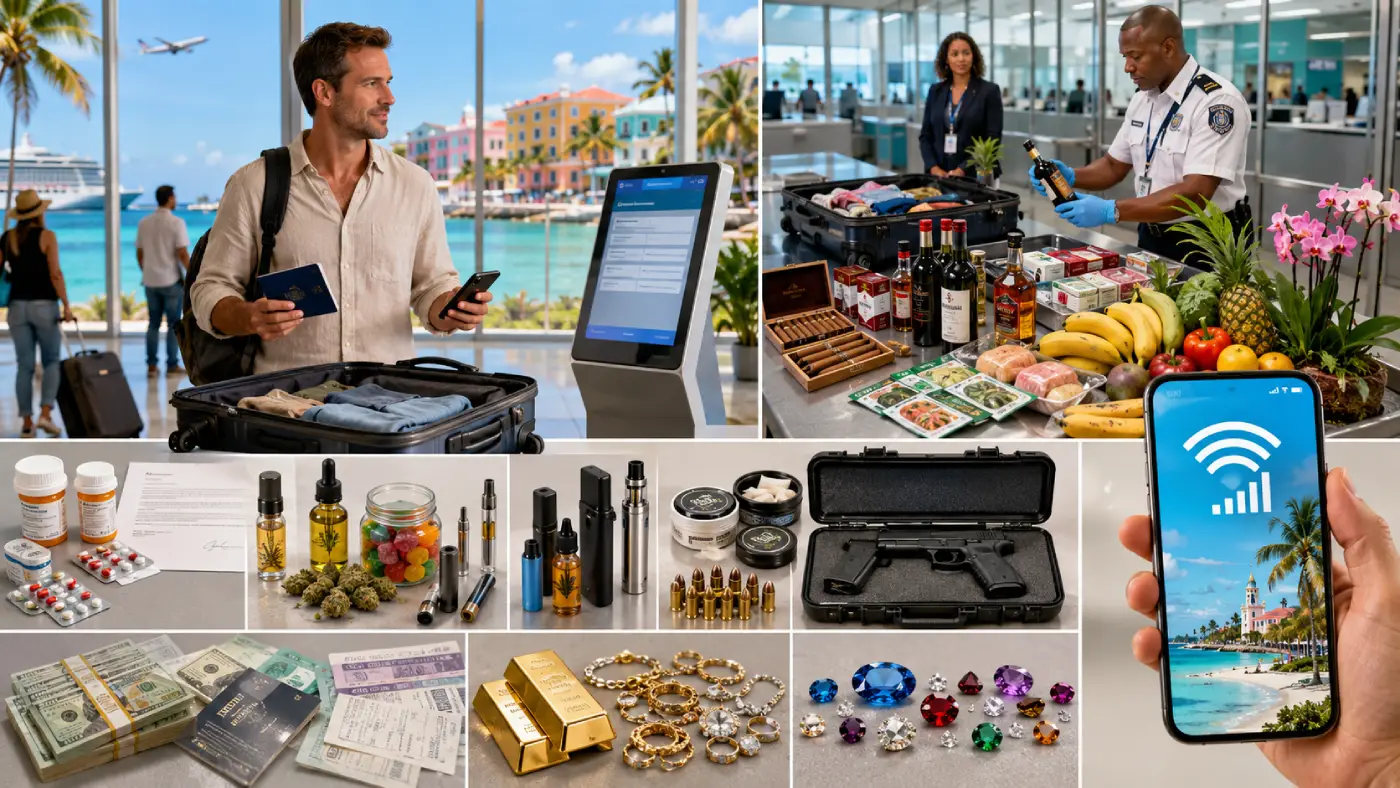
What you can bring into The Bahamas at a glance
| Item | Current rule | Best action |
|---|---|---|
| Personal baggage and gifts | Used belongings need an oral declaration; other goods may require C17 | Declare purchases and keep receipts |
| Food and plants | All food must be declared; permits or restrictions may apply | Check the product before packing |
| Alcohol and tobacco | Separate adult duty-free allowances apply | Stay within the published categories |
| Cash and instruments | Values equivalent to $10,000 or more are declarable | Report the full amount |
| Medicines and cannabis | A doctor’s letter is advised; no traveler cannabis allowance is published | Carry medical documents and seek written guidance |
| Vapes and nicotine products | No official personal traveler allowance is published | Confirm directly with Customs |
| Firearms and ammunition | Firearms are restricted and require prior authorization | Do not pack them without approval |
The table separates duty-free treatment from permission to import. An item can fall within a monetary exemption yet still require health, agriculture, police or other regulatory approval.
Rules checked on August 25, 2026. Requirements can change; verify the linked official guidance before travel.
Food, fruit, vegetables and plants must be declared
The Bahamas Customs traveler FAQ says all food products must be declared. This includes food intended for your own meals, gifts for friends or relatives and products packed for a resort stay. A sealed wrapper does not remove the declaration requirement.
Pay particular attention to:
-
Fruit, vegetables and plant material: Import permits are required for fruits, vegetables, plants and flowers.
-
Meat, dairy and animal products: These can be subject to sanitary restrictions, taxes or product-specific permits.
-
Packaged foods: Commercial packaging may make identification easier, but it does not guarantee admission.
Fresh produce creates the clearest risk. Customs identifies restrictions on fruits, vegetables and some dairy products, while the official BAHFSA plant and plant-product permit service covers items such as seeds, cut flowers, fruits, vegetables, wood and other plant materials.
For packaged snacks, coffee, tea, confectionery or special-diet products, keep the original ingredient label. Let the customs officer decide whether an item can enter instead of relying on advice from a hotel, airline or forum.
Chicken, beef and other animal products may be taxable or controlled even when intended for personal use. If bringing meat, dairy, fresh produce or plants is important to your trip, obtain a product-specific answer from BAHFSA before departure.
Visitor exemptions, alcohol and tobacco allowances
International visitors receive an exemption of up to $100 on dutiable articles brought into The Bahamas. The exemption is intended for accompanied goods; it does not turn commercial quantities, prohibited products or permit-controlled items into ordinary personal baggage.
Current Bahamas Customs arriving-passenger guidance gives adults these additional duty-free allowances:
-
Up to one quart of spirits.
-
Up to one quart of wine.
-
Up to one pound of tobacco, 200 cigarettes or 50 cigars.
Treat the tobacco quantities as alternatives, not cumulative allowances. Customs uses “adults” but does not publish a numerical age on its current arriving-passenger page, so this guide does not substitute a separate age threshold.
The current Customs page expressly lists spirits and wine. It does not provide a separate beer quantity. Declare beer rather than assuming it can replace wine or spirits within the published allowance.
Goods above an allowance may attract customs duty and taxes, but payment is not a universal solution. Controlled goods can still require permission, and an officer may treat multiple identical products or boxed electronics as commercial rather than personal.
Used clothing, toiletries, a personal phone, laptop and camera normally fit the used-personal-belongings process. New gifts, purchases and extra boxed devices should be disclosed, particularly when their combined value exceeds the visitor exemption. Keep valid receipts because Customs requires them for declared items.
Prescription medicines and cannabis products
Bring medication intended for the person using it. The Embassy of The Bahamas in Washington recommends carrying a doctor’s letter stating that the medicine is required for an existing health condition and presenting it to Bahamas Customs if questioned.
Original labeled packaging, a copy of the prescription and a quantity consistent with the trip make the medicine easier to identify. These precautions do not override ingredient restrictions. Contact Customs or the responsible health authority before travel if the medicine contains a controlled drug, requires refrigeration, involves injections or is not commonly prescribed internationally.
Cannabis needs separate treatment. Current official traveler guidance does not publish a personal-baggage allowance or a procedure allowing visitors to import their own supply on the strength of a foreign prescription or medical card.
Do not pack marijuana, THC gummies, cannabis oils or cannabis vape cartridges unless Bahamas Customs and the responsible cannabis authority confirm in writing that the specific product may be imported and identify the required authorization. CBD products should not be presumed exempt simply because they were sold legally or without a prescription in another country.
The existence of a Bahamian medical-cannabis framework does not by itself authorize a foreign visitor to cross the border with cannabis products purchased abroad. This section concerns import at the border; rules governing dispensing, possession or use after entry are separate domestic-law questions.
Vapes, e-liquid and nicotine pouches
Bahamas Customs does not currently publish a personal traveler allowance specifically for nicotine vapes, disposable e-cigarettes, refillable devices, e-liquid, heated-tobacco products or nicotine pouches. The cigarette and loose-tobacco allowance should not automatically be applied to those categories.
Official traveler guidance also does not state a blanket personal-import ban covering every nicotine-only vape product. That documentation gap is not the same as unrestricted permission. Travelers carrying a vape should request current guidance from Customs, keep the quantity clearly consistent with personal use and avoid mixing nicotine products with anything containing THC, CBD or another cannabis derivative.
Customs permission and aviation safety are separate. A carrier may require a lithium-battery vape device to remain in cabin baggage and may prohibit charging or using it. Confirm the baggage rule with the operating airline even if Customs confirms that the product may enter.
Firearms, ammunition and other restricted goods
The official prohibited and restricted imports list identifies firearms and fireworks as restricted unless special authorization has been granted by the Commissioner of Police.
Ordinary air travelers should not pack firearms or ammunition without written approval arranged before travel. Check every carry-on, checked bag and reused shooting or hunting bag for loose rounds before leaving home. Discovery at the airport is not cured by the general $100 visitor exemption or by offering to pay duty.
The same principle applies to any product requiring approval from another regulator: personal use does not automatically make a controlled item admissible.
Cash, valuables and the C17 declaration process
Carrying a large amount of money is not itself described as prohibited, but declaration becomes mandatory at the published threshold. Bahamas Customs requires disclosure when cash and negotiable instruments have a value equivalent to $10,000 or more.
“Cash” includes coins and banknotes in any currency. Negotiable instruments include cheques, traveler’s cheques, promissory notes, money orders and bearer instruments. The threshold is a declaration trigger, not a maximum amount that may enter.
Customs also lists loose or uncut precious stones and jewelry intended for trade when their value is equivalent to $10,000 or more. Precious metals in bullion are listed separately without a clearly stated value threshold in the traveler FAQ. Declare bullion rather than assuming the cash threshold applies to it.
For arriving international visitors, the current baggage process is:
-
Give an oral declaration when traveling with used personal belongings.
-
Complete a Baggage Declaration C17 through the Exempt App when carrying other items.
-
Retain valid receipts for goods being declared.
-
Disclose cash, instruments and controlled goods that meet the relevant rule.
Do not describe ordinary purchases as used personal belongings simply to avoid the form. Gifts, newly bought electronics, commercial-looking quantities and goods intended for somebody else should be disclosed accurately.
The official guidance does not make a C17 compulsory for every visitor carrying used personal effects. Conversely, an oral answer does not replace a required declaration, permit or supporting document.
Mobile internet after customs
Once clearance is complete, mobile data can help with hotel directions, ferry schedules and messages between islands. Activate your Bahamas eSIM after arrival if you prefer to connect without visiting a local SIM counter.
Roafly country plans are data-only. Hotspot use is supported across the purchased data allowance without a separate hotspot quota.
For airport counters and prepaid options from the two local operators, Bahamas SIM Card for Tourists: BTC vs ALIV Prices explains the local-SIM route. For an eSIM provider, plan, price and network comparison, use Best eSIM for the Bahamas.
Bahamas customs checklist before you fly
-
Inventory food, gifts, new purchases and regulated products in every bag.
-
Leave cannabis, THC and uncertain CBD products at home unless written approval is confirmed.
-
Keep prescriptions, a doctor’s letter and medicine labels together.
-
Save receipts and obtain necessary permits before departure.
-
Check all baggage for firearms, ammunition and loose rounds.
-
Ask Customs directly about vapes or nicotine products without a published allowance.