

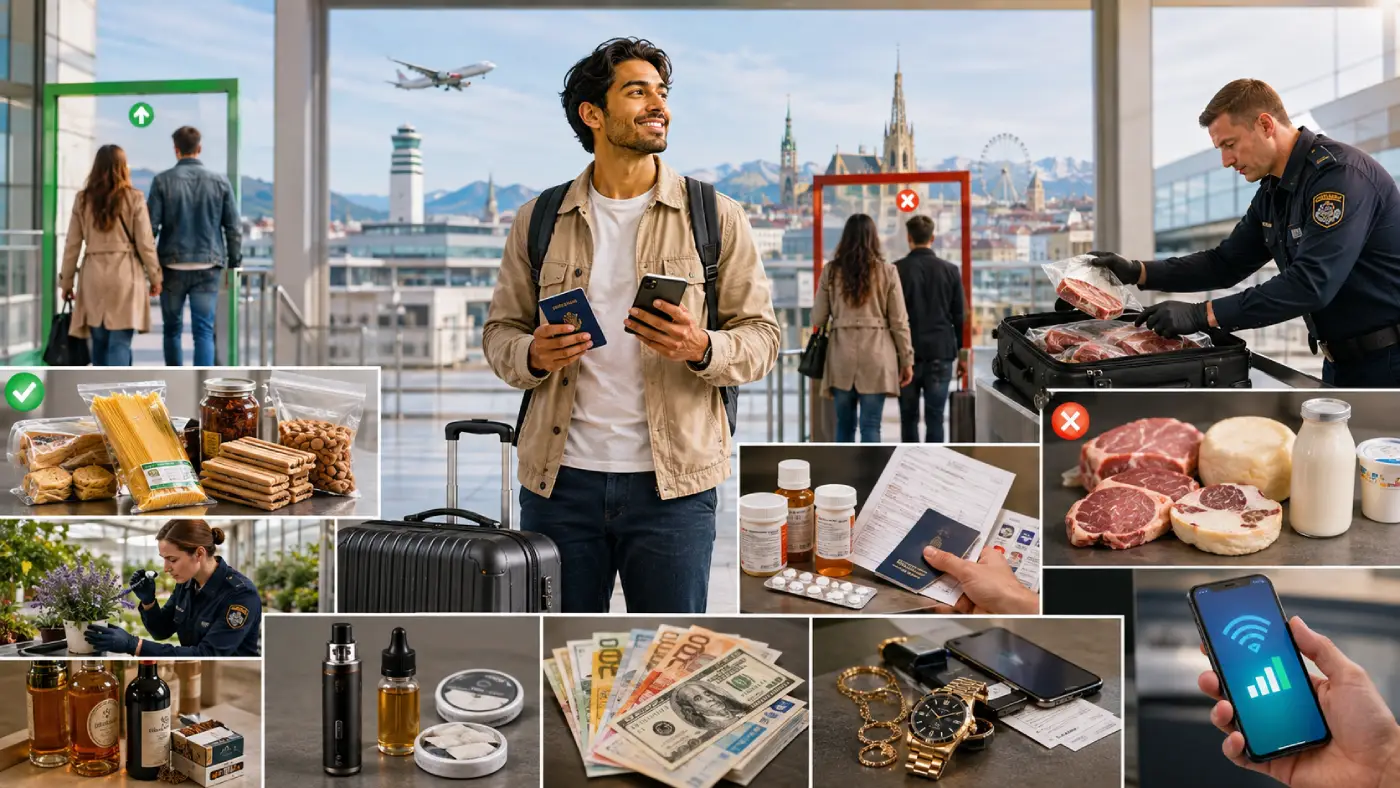

What you can bring into Austria at a glance
| Item | Current rule | Best action |
|---|---|---|
| Other goods from outside the EU | €430 by air; €300 by other transport | Total your purchases and keep receipts |
| Alcohol from outside the EU | Limited duty-free quantities; age 17+ | Check each drink category separately |
| Tobacco from outside the EU | 200 cigarettes or an equivalent alternative; age 17+ | Do not add full alternatives together |
| Meat and dairy from most non-EU countries | Personal imports are generally prohibited | Leave them behind |
| Medicines | Personal needs allowed for travelers residing abroad | Carry proof of medical need |
| Cash | €10,000 or more triggers reporting rules | Declare or disclose as required |
| Plants and fresh produce | Certificate usually required from non-EU countries | Avoid carrying uncertified products |
The decisive question is not simply whether Austria is in the Schengen Area. Customs treatment depends on the EU customs territory, the origin of the goods and where your baggage enters the customs process.
Rules checked on 25 August 2026. Requirements can change; verify the linked official guidance before travel.
Customs rules for EU and non-EU arrivals
Goods bought within the EU can generally move into Austria in personal luggage without additional customs charges. Alcohol and tobacco must still be for personal use. Quantities above Austria’s indicative levels may require evidence that the goods are not commercial.
Those indicative levels include 800 cigarettes, 400 cigarillos, 200 cigars, 1 kilogram of smoking tobacco or 800 heated-tobacco sticks. For alcohol, they include 10 liters of spirits, 20 liters of other alcoholic drinks up to 22%, 90 liters of wine—no more than 60 liters sparkling—and 110 liters of beer.
These are not ordinary shopping allowances for arrivals from outside the EU. Non-EU travelers receive much smaller exemptions under the Austrian Ministry of Finance’s current duty-free guidance.
For other non-commercial goods, the total duty-free value is €430 per air traveler or €300 when arriving by road, rail or other transport. Travelers younger than 15 receive a €150 allowance. Allowances cannot be pooled to make expensive item duty-free for a group.
The United Kingdom is treated as non-EU, except for Northern Ireland under applicable customs arrangements. Some territories connected to EU countries also have special status, so an EU passport or airline route alone does not determine the rule.
Food, meat, dairy and plants
Food rules are far stricter when entering from outside the EU. Travelers generally cannot bring meat, milk or products containing them from most non-EU countries. Vacuum packing, shop packaging or a duty-free receipt does not cancel the prohibition.
Limited exceptions under the European Commission’s personal-import rules include:
-
Fishery products up to 20 kilograms or fish when that fish weighs more.
-
Honey and certain other animal products up to a combined 2 kilograms.
-
Powdered infant milk, infant food and medically required special food below 2 kilograms when shelf-stable, commercially packaged and unopened unless currently in use.
Animal products carried between EU countries for personal consumption are generally permitted, although temporary disease-control measures can change the position. Andorra, Iceland, Liechtenstein, Norway, San Marino and Switzerland receive specific animal-product exemptions even though their broader customs status is not identical.
Fresh fruit, vegetables, cut flowers, seeds and other plant products from non-EU countries normally require a phytosanitary certificate. Small quantities are not automatically exempt. Pineapples, bananas, durians, dates and coconuts are the five listed fruits that do not need that certificate.
The Austrian Federal Office for Food Safety confirms that these controls also apply to private travelers. If inspection is required in Austria, plant-health controls are available at Vienna, Linz and Graz airports and may need advance notification.
Bringing medicines into Austria
Austrian law restricts medicine imports, but travelers who reside abroad may carry medication required for their own personal needs or for an accompanying pet. Pack what is reasonably connected to the trip and carry a prescription or medical statement when the product is prescription-only.
Medicines containing narcotic or psychotropic substances require greater care. Current Austrian Ministry of Health guidance distinguishes the documentation by length of stay:
-
For stays of up to five days, no additional certificate is required, but evidence of personal medical need remains necessary.
-
For stays longer than five days and up to 30 days, carry a prescription from your doctor; Austria recommends the Annex X form.
-
The amount must not exceed what you require for 30 days. Longer stays should be arranged with a doctor in Austria.
Do not assume that legality or over-the-counter availability at home guarantees entry. Check the active ingredient, not the brand name, particularly for strong pain medication, stimulants, sedatives and cannabis-derived treatments.
Alcohol, tobacco, vapes and nicotine products
Travelers aged 17 or older arriving from outside the EU may use the following alcohol and tobacco exemptions:
-
Either 200 cigarettes, 100 cigarillos, 50 cigars or 250 grams of smoking tobacco, including a proportional combination.
-
Either 1 liter of spirits above 22% alcohol or 2 liters of alcoholic drinks at or below 22%, including a proportional combination.
-
In addition to that alcohol choice, 4 liters of still wine and 16 liters of beer.
Purchases made in an airport duty-free shop still count toward the destination allowance. Exceeding an exemption does not mean the goods are automatically admissible after payment; declare them and let customs determine the correct treatment.
Heated-tobacco sticks are handled differently from the standard cigarette alternatives for non-EU arrivals. They fall within the general value allowance, with an indicative ceiling of 800 sticks or 250 grams of contained tobacco.
Austria introduced new rules for e-liquids and nicotine pouches on 1 April 2026. The Austrian Ministry of Finance’s nicotine-product notice confirms that import, wholesale and sale are now regulated and that these products fall within a new excise framework.
This is regulation rather than a general personal vape ban. However, the current English traveler guidance does not publish a separate milliliter or pouch allowance. Do not apply the cigarette allowance to e-liquids or nicotine pouches. Keep quantities clearly consistent with personal use and contact Austrian customs before departure if the amount or value is significant.
Battery placement and cabin-liquid limits are aviation-security rules, not customs allowances. Check those separately with your airline and departure airport.
Cash and high-value goods
Anyone entering or leaving the EU with €10,000 or more in cash must declare the entire amount at the EU border. The threshold is not a maximum: larger sums may be carried when correctly declared.
The definition includes banknotes, coins, bearer instruments such as traveler’s checks, qualifying gold coins and high-purity gold bars, nuggets or clumps. Currency equivalents are combined when testing the threshold.
The Austrian Ministry of Finance’s cash-control guidance explains the declaration process and warns that undeclared cash may be detained or seized and penalties may apply.
When entering Austria from another EU country, €10,000 or more must be disclosed truthfully if Austrian customs asks. This differs from the proactive written declaration required when crossing the EU’s external border.
New jewelry, watches, electronics and luxury goods bought outside the EU count toward the general goods allowance. Keep receipts and, for expensive belongings taken from home, consider carrying proof of prior ownership.
What to declare and which customs channel to use
Use the red channel when carrying goods above an allowance, goods not intended for personal use or items subject to an import restriction. If an airport or border point has no separate red exit, approach customs and make the declaration proactively.
Use the green channel when nothing in your luggage requires declaration. Walking through green functions as a declaration choice, but it does not prevent customs officers from inspecting you or your baggage.
If your journey began outside the EU and you merely changed planes inside the EU while your checked luggage was transferred, Austria may still process the baggage as a non-EU arrival. When you collect luggage and clear customs at an earlier EU airport, follow the process at that first clearance point.
When uncertain, choose red. A valid exemption can still be applied after you present the goods, while silently choosing green removes the opportunity to clarify the rule before inspection.
Mobile internet after customs
Once you have cleared customs, an Austria eSIM can provide mobile data without requiring a visit to an airport SIM counter. Roafly country plans are data-only, and hotspot use comes from the purchased data allowance without a separate hotspot quota.
For comparisons between providers, plans, prices and listed networks, read Best eSIM for Austria.
To compare airport SIM cards, local prepaid options, roaming, Wi-Fi and eSIM setup, use How to Get Internet in Austria.
Austria customs checklist before you travel
-
Confirm where your checked baggage will first clear EU customs.
-
Total the value of purchases made outside the EU and retain receipts.
-
Remove prohibited meat, dairy and uncertified plants from your luggage.
-
Check active ingredients and prepare documents for prescription or controlled medicines.
-
Review alcohol, tobacco and nicotine products by category rather than treating them as allowance.
-
Declare cash and restricted or excess goods, and use the red channel whenever uncertain.