Download the App and manage your eSIMs easily
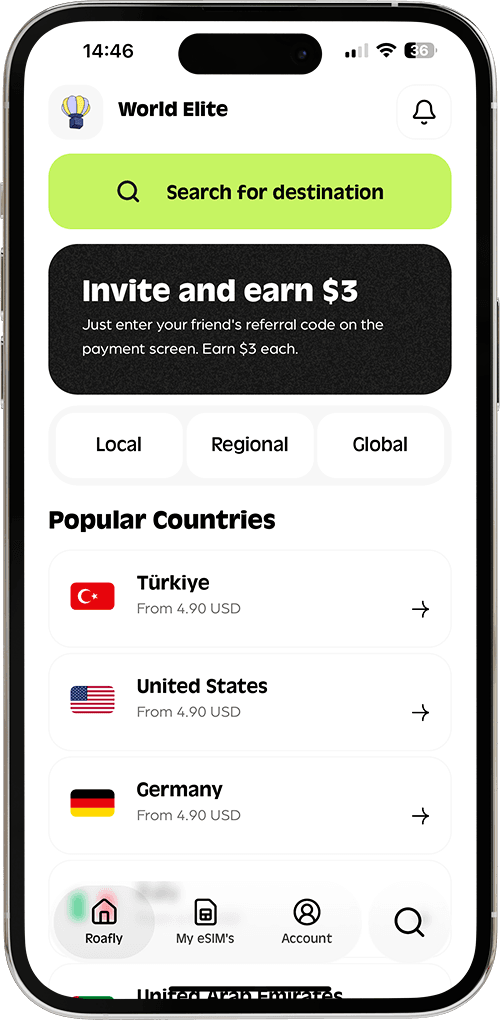
Create your order quickly
See your eSIM details
Track your remaining data
Download the App and manage your eSIMs easily
Create your order quickly
See your eSIM details
Track your remaining data
New Zealand is widely considered one of the most breathtaking destinations on the planet. From the geothermal wonders of Rotorua and the rolling hills of the Shire in the North Island to the dramatic fjords of Milford Sound and the Southern Alps in the South Island, the country offers a diverse range of landscapes that demand to be explored.
One NZ
Instant delivery
From 4.90 USD

Lena Hartley
Updated Jan 8, 2026
9 min read

Jump to section
👇Best for most trips
One NZ

New Zealand
10 GB · 30 days
Enough for maps, bookings and everyday travel.
Hotspot supported
$16.90
From 4.90 USD
However, navigating this "Land of the Long White Cloud" (Aotearoa) requires reliable connectivity. Whether you are navigating a campervan through remote mountain passes, booking extreme sports activities in Queenstown, or simply uploading stunning photos to Instagram, having a stable internet connection is not a luxury—it is a necessity.
In the past, staying connected meant facing exorbitant roaming charges from your home carrier or waiting in long queues at Auckland International Airport to buy a physical SIM card. Today, the landscape has changed. eSIM technology allows travelers to download a digital data plan instantly, often at a fraction of the cost of roaming.
In this comprehensive guide, we will analyze the best eSIM for New Zealand in 2026, comparing top providers like Roafly, Airalo, and others to help you choose the perfect plan for your Kiwi adventure.
Choose the perfect data plan for your trip
New Zealand is a country built for road trips. Unlike visiting a single city like Paris or Tokyo where Wi-Fi is abundant, a trip to New Zealand involves moving between widely separated locations. GPS navigation is essential, especially when driving on the left side of the road in rural areas where signage might be sparse.
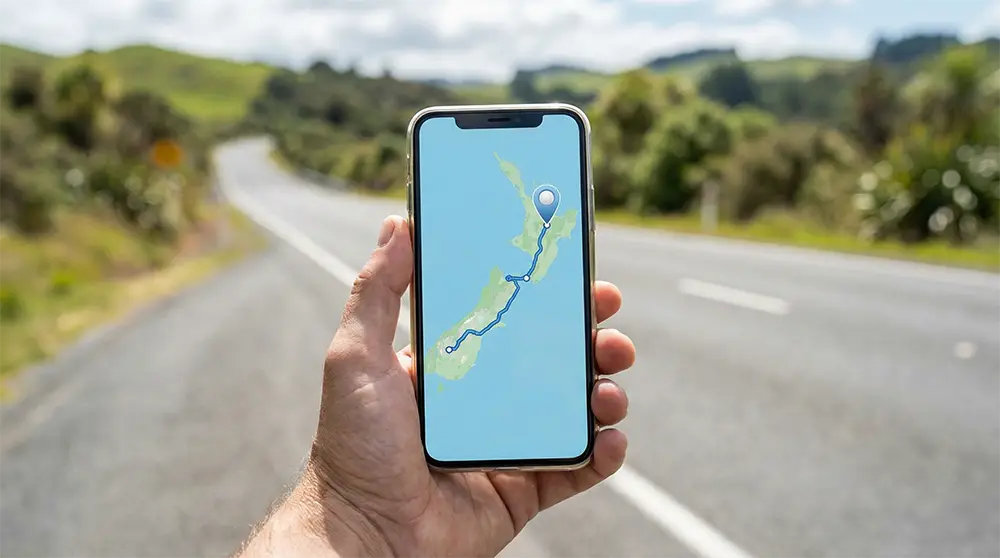
While major cities like Auckland, Wellington, and Christchurch have excellent 5G and 4G coverage, the real challenge arises when you venture into the countryside. This is where the choice of network matters immensely. The two primary network infrastructures in New Zealand are One NZ (formerly Vodafone) and Spark.
Choosing an eSIM that connects to one of these premium networks ensures that you stay connected in more places. Budget roaming options that rely on third-tier agreements often drop the signal as soon as you leave the city limits. Furthermore, free public Wi-Fi in New Zealand can be inconsistent. While libraries and some cafes offer it, relying on it for your entire trip is impractical and risky for secure transactions like banking.
For a broader look at connectivity options, including physical SIMs and pocket Wi-Fi, you can check our dedicated guide on how to get internet in New Zealand.
To help you make an informed decision, we have compiled a detailed price comparison of the leading eSIM providers for New Zealand. We have analyzed the cost per Gigabyte (GB) across popular data tiers: 5GB, 10GB, and 20GB. All plans listed below are valid for 30 days, which is the standard duration for most tourist visas.
| Provider | Network | 5GB Price | 10GB Price | 20GB Price | Notes |
| Roafly | Vodafone (One NZ) | $11.90 | $16.90 | $28.90 | Best Value for 5GB, 10GB & 20GB |
| Airalo | Spark | $14.50 | $25.00 | $39.00 | Higher cost per GB |
| Saily | N/A | $13.99 | $23.99 | $37.99 | Network not specified |
| Roamless | Spark | $13.95 | $22.95 | $38.95 | Pay-as-you-go model available |
| AloSIM | Vodafone (One NZ) | $15.00 | $26.00 | $39.00 | Similar coverage to Roafly, higher price |
| Jetpac | Vodafone (One NZ) | $15.00 | $17.00 | $40.00 | 10GB currently on discount |
| Holafly | Multiple | N/A | N/A | N/A | 7 Days Unlimited for $27.30 (Check FUP) |
Disclaimer: Prices gathered on January 8, 2026. Prices are in USD.
Roafly stands out as the most cost-effective option for travelers planning a standard 2-week to 1-month trip. At $11.90 for 5GB, it is significantly cheaper than the closest competitor. For heavy users, the 20GB plan at $28.90 offers unbeatable value, costing over $10 less than Airalo or AloSIM for the same amount of data. Roafly utilizes the Vodafone (One NZ) network, which is widely regarded for its high speed and extensive coverage, particularly in the North Island and major South Island hubs.
Airalo is a well-known player in the eSIM market. Their New Zealand packages use the Spark network. While Spark has excellent rural coverage, Airalo's pricing is considerably higher in 2026. Their 10GB plan costs $25.00, which is nearly 50% more expensive than Roafly's equivalent plan. It remains a reliable option, but budget-conscious travelers may find better value elsewhere.
Jetpac is an interesting contender, particularly due to their aggressive discounting on specific tiers. Their 10GB plan is currently priced at $17.00, making it a very strong competitor in the mid-range data category. However, their 5GB and 20GB prices are higher than the market average. Like Roafly, they utilize the Vodafone network.
Holafly operates on a different model, offering unlimited data rather than fixed data caps. Their 7-day unlimited plan costs $27.30. While "unlimited" sounds appealing, travelers should be aware of Fair Usage Policies (FUP). Often, after using a certain amount of high-speed data per day (usually 2GB or 3GB), speeds may be throttled to 2G or 3G levels, which can make loading maps or videos difficult. This option is best for short, data-intensive trips where throttle limits won't be an issue.
Many travelers wonder if it is cheaper to simply buy a physical SIM card upon arrival at Auckland (AKL), Christchurch (CHC), or Queenstown (ZQN) airports.
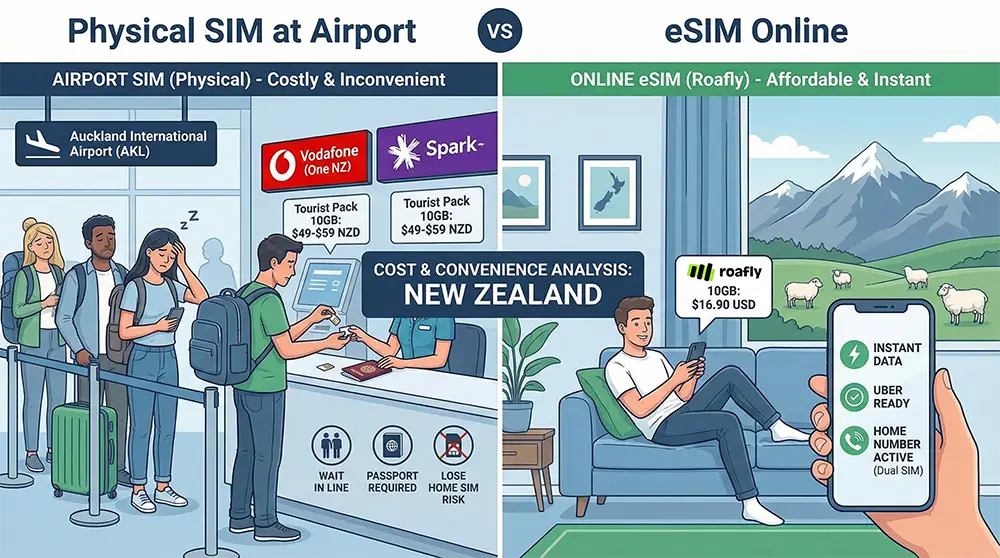
Buying a SIM card at the airport is almost always more expensive than buying in the city or purchasing an eSIM online. Kiosks for Vodafone (One NZ) and Spark at international arrivals offer "Travel SIM" packs. As of early 2026, a typical tourist pack offering 10GB of data can cost between $49 and $59 NZD (approximately $30 to $36 USD).
Comparing this to the digital options, buying a 10GB eSIM from Roafly for $16.90 USD represents a savings of roughly 50% compared to airport prices.
Beyond the price, there is the convenience factor.
Local SIM: Requires you to land, clear customs, find a kiosk, wait in line, present your passport, and physically swap out your home SIM card (risking losing it).
eSIM: Can be installed while you are still at home. As soon as your plane lands in Auckland, you simply turn on your line and have instant internet access to call an Uber or check your accommodation emails.
Using a local physical SIM usually means you have to remove your primary SIM card, meaning you cannot receive SMS verification codes (OTPs) from your bank or keep your home phone number active for emergencies. An eSIM allows you to keep your home number active for calls/texts while using the New Zealand eSIM for data.
New Zealand's geography presents unique challenges for cellular networks. Mountains, fjords, and dense forests can block signals.
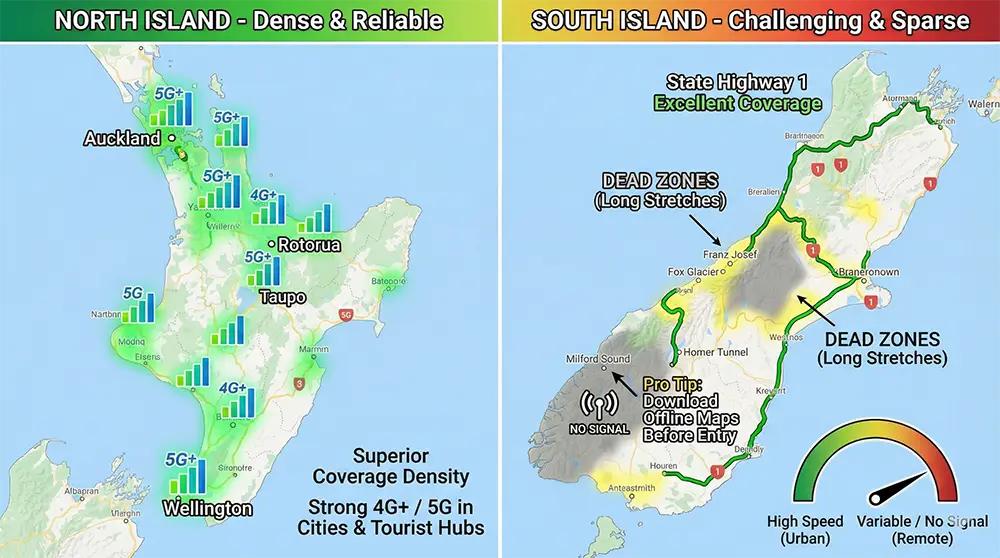
The North Island generally has superior coverage density. If you are visiting Auckland, Rotorua, Taupo, Wellington, or the Bay of Islands, you will likely experience strong 4G+ or 5G speeds with any major provider (Vodafone or Spark).
The South Island is where the network choice becomes critical.
State Highway 1: The main route down the east coast (Picton to Christchurch to Dunedin) has excellent coverage.
The West Coast: Areas near glaciers (Franz Josef, Fox Glacier) have coverage in the towns, but long stretches of the road between them are dead zones.
Milford Sound: This is a notorious dead zone. Regardless of whether you use Roafly, Airalo, or a local Spark SIM, you will likely lose signal before you enter the Homer Tunnel and will not regain it until you return. Pro Tip: Download offline maps (Google Maps or Maps.me) before heading to Milford Sound or Aoraki/Mount Cook.
Vodafone (One NZ), utilized by Roafly, has heavily invested in 5G rollout. In urban centers, speeds are comparable to broadband. In rural areas, the connection usually drops to a stable 4G.
Selecting the right amount of data depends heavily on your travel style.
The "Light" Traveler (5GB Plan)
Ideal for: 1-2 week trips.
Usage: Checking Google Maps, using WhatsApp for text/calls, light Instagram usage, booking tickets.
Verdict: With Roafly’s 5GB plan at $11.90, this is perfect for those who want to disconnect a bit but stay safe.
The "Standard" Traveler (10GB Plan)
Ideal for: 2-3 week road trips.
Usage: Frequent GPS navigation, Spotify streaming (medium quality), uploading daily Stories, video calling home.
Verdict: 10GB provides a comfortable buffer. At $16.90, it is the sweet spot for most tourists.
The "Heavy" User (20GB Plan)
Ideal for: 1 month+ or Digital Nomads.
Usage: Tethering/Hotspotting to a laptop, watching YouTube/Netflix, heavy social media uploading, working remotely.
Verdict: If you are working while traveling in a campervan, you need this. 20GB for $28.90 is extremely competitive.
If you have never used an eSIM before, the process is surprisingly simple. Modern iPhones (XR and newer), Samsung Galaxy S series (S20 and newer), and Google Pixel phones are all compatible.
Purchase Your Plan: Go to the Roafly New Zealand page and select your desired data package.
Receive Activation Details: You will receive a QR code via email.
Install the eSIM:
iOS: Settings > Cellular > Add eSIM > Use QR Code.
Android: Settings > Network & Internet > SIMs > Add More > Download a SIM.
Label Your Lines: Label your new plan as "New Zealand" or "Travel" and your main line as "Primary".
Arrival Settings:
Turn Data Roaming ON for the New Zealand eSIM.
Turn Data Roaming OFF for your Primary SIM (to avoid fees).
Set "Cellular Data" to use the New Zealand eSIM.
Troubleshooting Tip: If your data doesn't work immediately upon landing, toggle Airplane Mode on and off. If that fails, check your APN settings in the cellular menu (instructions are usually provided in your confirmation email).
Traveling to New Zealand is a once-in-a-lifetime experience for many. The last thing you want to worry about is finding a Wi-Fi cafe to download directions to your next campsite. By preparing ahead with an eSIM, you save money compared to airport kiosks and gain the freedom of instant connectivity.
Based on current 2026 market rates, Roafly offers the most competitive pricing for standard data packages, particularly for the popular 5GB and 20GB tiers, backed by the reliability of the Vodafone (One NZ) network. While competitors like Airalo and Jetpac offer viable alternatives, the price-to-performance ratio currently leans heavily in Roafly's favor.
Ready to start your Kiwi adventure? Check the latest eSIM packages for New Zealand and secure your connection before you fly.
Best for most trips
One NZ
New Zealand
10 GB · 30 days
Enough for maps, bookings and everyday travel.
Hotspot supported
$16.90
From 4.90 USD

Manage your eSIM in the app
Install, top up and track data.
Choose the perfect data plan for your trip
Manage your eSIM in the app
Install, top up and track data.
