

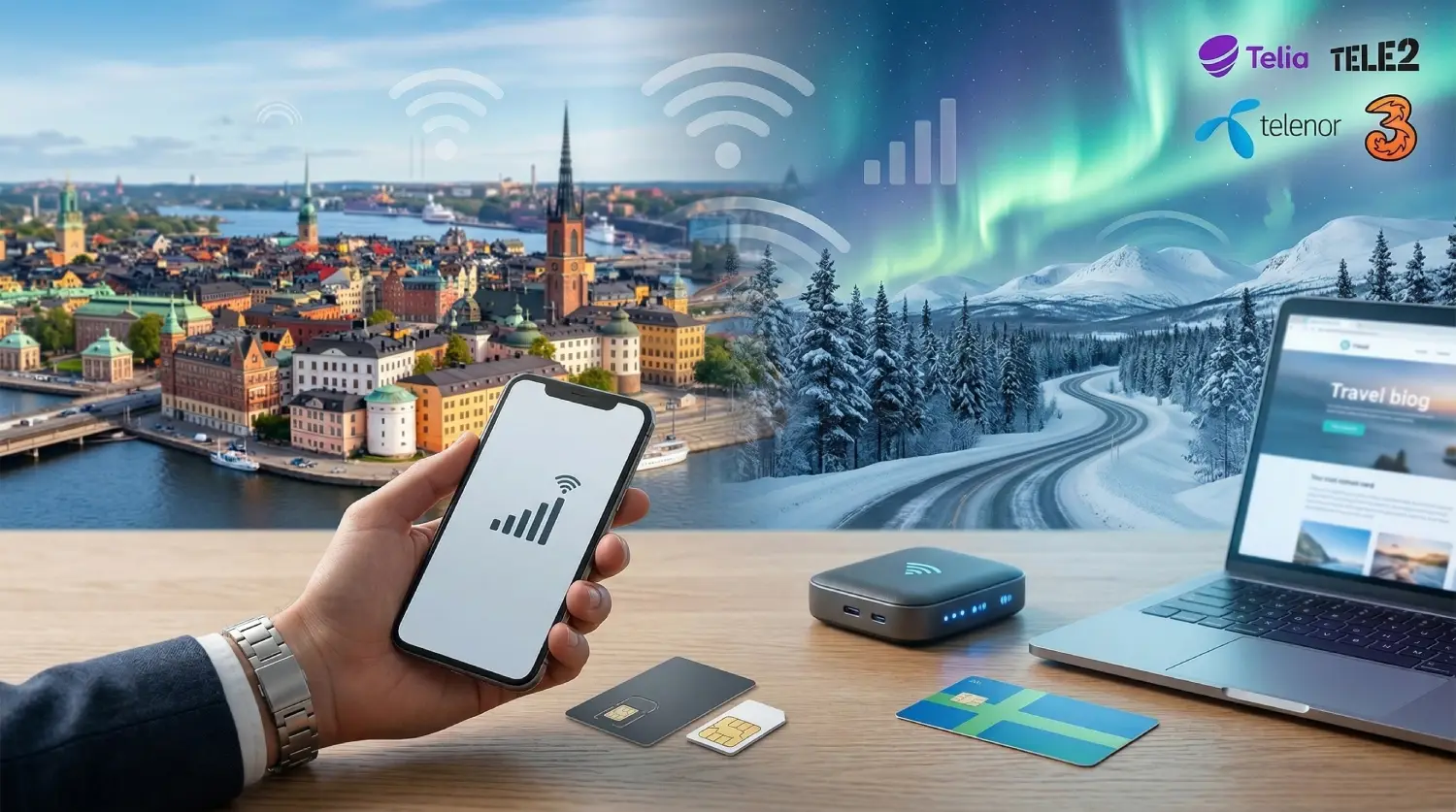

Quick snapshot: the best internet option depends on your trip
If you want the simplest setup before you even leave the arrivals hall, an airport prepaid SIM can work—especially if you prefer paying in SEK and want a Swedish number. If you want zero store visits and instant activation, an eSIM is usually the smoothest choice. For groups or laptops, pocket WiFi can still make sense. And for light usage, Sweden’s public WiFi is often solid, but it’s not something you should rely on for everything.
Sweden also requires prepaid SIM registration with identity verification, so bring your passport if you plan to buy a physical SIM.
Comparison table: Sweden internet options side by side
| Option | Typical upfront cost | Setup time | Best for | Watch-outs |
|---|---|---|---|---|
| Airport prepaid SIM (kontantkort) | ~$16–$33 for common 5–20 GB bundles (operator dependent) | 10–30 min | Travelers who want a Swedish number and prefer buying in-person | Requires identity registration; store selection/hours vary |
| Local prepaid SIM (city) | Similar to airport, sometimes easier to compare bundles | 15–30 min | Longer stays, people who want to browse options | Still requires registration; can take time if you’re tired/jet-lagged |
| Roafly eSIM (data-only) | $3.90–$39.90 depending on data/validity | 5–10 min | Fastest “arrive connected” setup; no store visit | Data-only (no Swedish number); needs eSIM-compatible phone |
| Pocket WiFi rental | Often higher than SIM/eSIM fees add up | 15–60 min | Groups, laptops, work-heavy travel days | Extra device to charge/carry; can be pricey |
| Public/airport WiFi | Free | Instant | Light use, downloads at cafés/hotels | Not reliable everywhere; security concerns |
SEK→USD note: USD approximations for local SIM bundles use a mid-market reference around early March 2026.
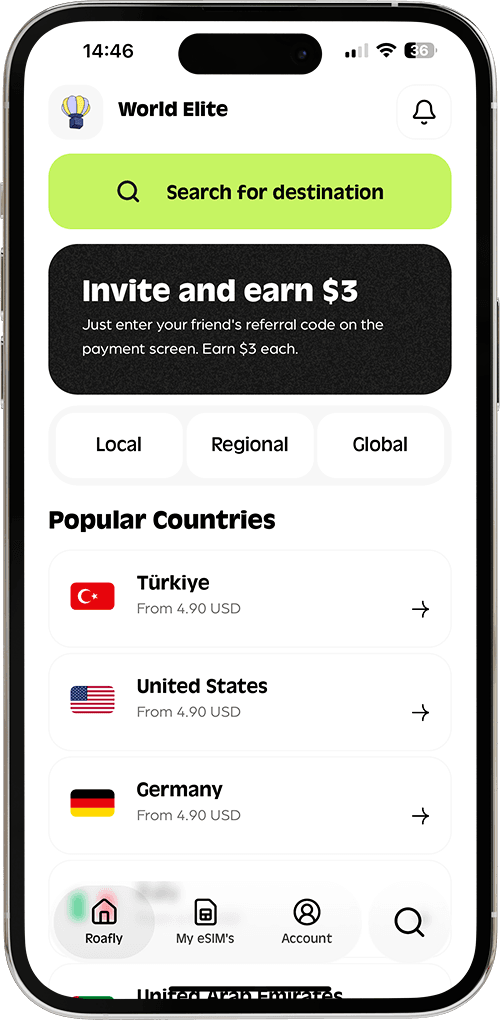
Need data in Sweden? Get an eSIM!
Choose the perfect data plan for your trip

Manage your eSIM in the app
Install, top up and track data.
Airport SIM cards in Sweden: what’s available and how much it costs
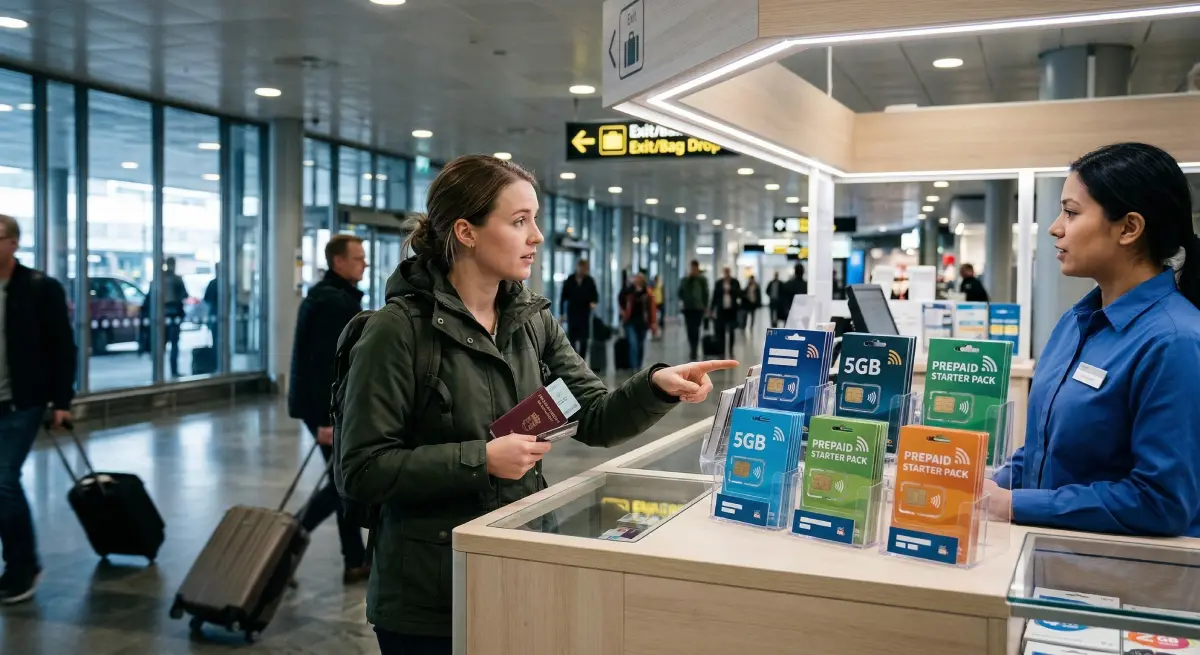
Where to buy a SIM at Stockholm Arlanda (ARN)
At Stockholm Arlanda Airport, the easiest places to buy a prepaid SIM (kontantkort) are convenience stores like Pressbyrån and 7-Eleven in the terminals. Swedavia lists multiple Pressbyrån and 7-Eleven locations across terminals, including pre- and post-security.
Pressbyrån specifically confirms it sells starter packs and top-ups for major operators including Telia and Comviq (and also Lyca and Telenor).
Where to buy a SIM at Gothenburg Landvetter (GOT)
Landvetter also has Pressbyrån stores, and it’s commonly the most practical place to find prepaid SIMs and top-ups at the airport.
What you’ll actually pay at the airport (tourist-friendly prepaid bundles)
Airport shops typically sell the starter pack, then you choose a top-up/data bundle (or “fastpris”) that does the real work. Prices vary by operator and plan, but these official prepaid bundles give you a realistic baseline for what you’ll pay even if you purchase at the airport:
-
Telia prepaid (Kontantkort Fastpris, 30 days)
-
5 GB: 209 SEK
-
10 GB: 259 SEK
-
20 GB: 299 SEK
-
-
Comviq prepaid (Kontantkort Fastpris)
-
1 GB / 7 days: 59 SEK
-
5 GB / 30 days: 149 SEK
-
10 GB / 30 days: 199 SEK
-
20 GB / 30 days: 249 SEK
-
40 GB / 30 days: 299 SEK
-
To convert SEK to USD for easy comparison, a mid-market reference in early March 2026 is about 1 SEK ≈ $0.1086.
That means, for example:
-
209 SEK ≈ $22.70
-
149 SEK ≈ $16.20
-
299 SEK ≈ $32.50
Important note about airport buying: selection can be limited late at night, and registration steps can take longer if the store is busy. If you’re arriving very late, an eSIM you install ahead of time is often less stressful.
Local tourist SIM cards in Sweden: cheaper, more choice, still very easy
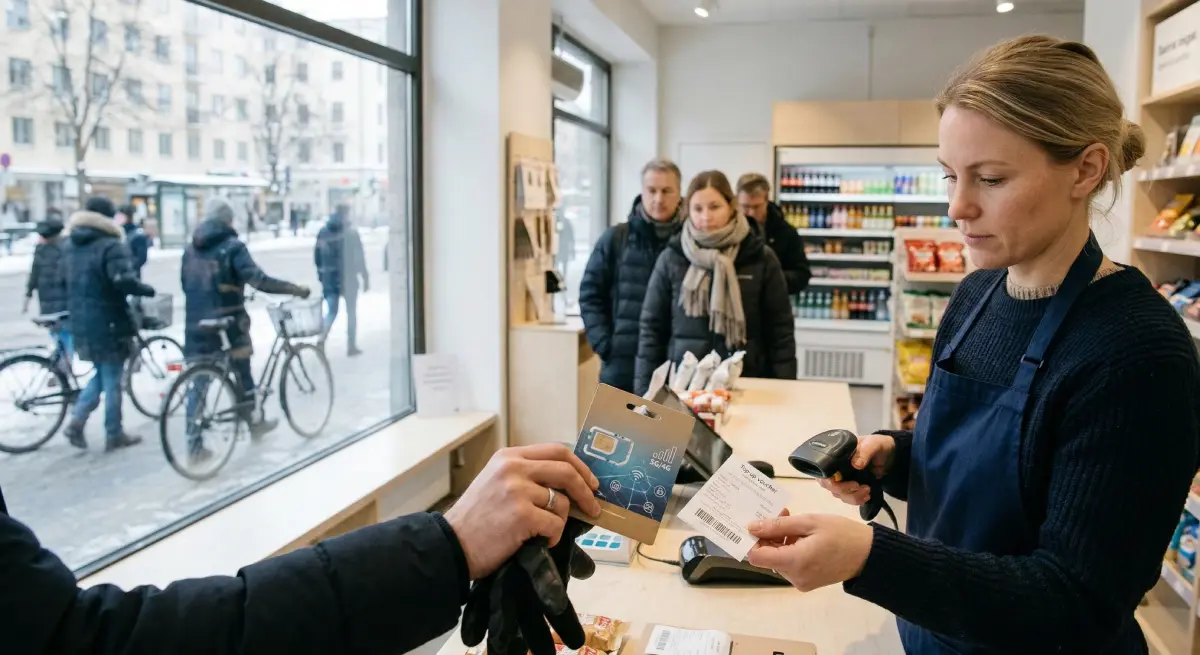
Where to buy in the city
If you wait until you’re in town, you’ll usually have more plan choices and less pressure. In Sweden, prepaid SIMs and top-ups are commonly available at convenience stores and supermarkets. Pressbyrån is a reliable option nationwide for starter packs and refills.
ID registration rules (don’t skip this)
Sweden requires prepaid SIMs to be registered and identity-verified before use, so expect to show a passport (or verify in an app/online, depending on operator).
Practical tip: if you’re buying at a convenience store, ask how the registration step works for that operator (in-store, website, or app). Budget a few extra minutes.
Local prepaid pricing benchmarks (what tourists typically spend)
For travelers, the most common spend is roughly the equivalent of $10–$35 depending on data amount and validity, which matches the range you see in official prepaid bundles (like 59–299 SEK and beyond).
If you’re staying longer than a week and using maps + social + streaming, many travelers land around the 10–20 GB range.
eSIM in Sweden: the simplest “arrive connected” method (Roafly)
If your phone supports eSIM, this is usually the cleanest way to get data in Sweden: no store visit, no plastic SIM swap, and you can set it up before you fly.
Roafly eSIM for Sweden is data-only, supports mobile hotspot, and does not require eKYC/ID verification. It activates when the eSIM connects to a supported network in Sweden. Network partners listed include 3 and Telia.
Need data in Sweden? Get an eSIM!
Choose the perfect data plan for your trip
Manage your eSIM in the app
Install, top up and track data.
Roafly Sweden eSIM packages (USD)
-
1 GB / 7 Days — $3.90
-
2 GB / 14 Days — $5.50
-
3 GB / 30 Days — $7.50
-
5 GB / 30 Days — $9.90
-
10 GB / 30 Days — $15.00
-
20 GB / 30 Days — $24.90
-
50 GB / 30 Days — $39.90
When Roafly is a great fit
-
You want internet the moment you land (rideshare, train apps, Google Maps).
-
You don’t want to deal with SIM registration steps.
-
You want a predictable setup process (iOS direct install, QR code, or manual entry) for your Sweden trip.
If you want a deeper breakdown of eSIM providers and what to compare (speed, validity, hotspot support, and installation), read our Best eSIM for Sweden guide.
Pocket WiFi in Sweden: still useful for groups, laptops, and long workdays
Pocket WiFi (portable hotspot rental) is less trendy than it used to be, but it still has a place—especially if:
-
You’re traveling as a family/group and want shared connection.
-
You need to connect laptops/tablets all day without draining a phone battery.
-
You prefer a single device that “just stays on,” rather than hotspotting from a phone.
Typical costs and tradeoffs
Pocket WiFi rentals often cost more than prepaid SIM/eSIM you add:
-
daily rental fees,
-
insurance/deposit,
-
delivery or airport pickup fees,
-
and potential power bank needs.
It can still be worth it if 3–5 people will genuinely share it all day. If person needs data, eSIM or prepaid SIM is usually better value.
Free WiFi in Sweden: good coverage, but don’t rely on it as your plan

Sweden has plenty of free WiFi, especially in:
-
airports,
-
cafés,
-
hotels,
-
many trains/stations,
-
public buildings and some city centers.
The two big limitations
-
Security: public WiFi is not ideal for sensitive logins, banking, or work accounts without extra protection.
-
Continuity: you’ll still lose connectivity exactly when you need it most (navigation while walking, transit changes, ordering a taxi, verifying a booking).
A practical strategy is using WiFi for heavy downloads (maps, updates, Netflix offline) and keeping mobile data for everything on the move.
Coverage and performance: what to expect across Sweden
In cities like Stockholm, Gothenburg, Malmö, and Uppsala, mobile coverage is generally excellent. Independent network testing has consistently found strong overall coverage, and Sweden continues expanding 5G availability.
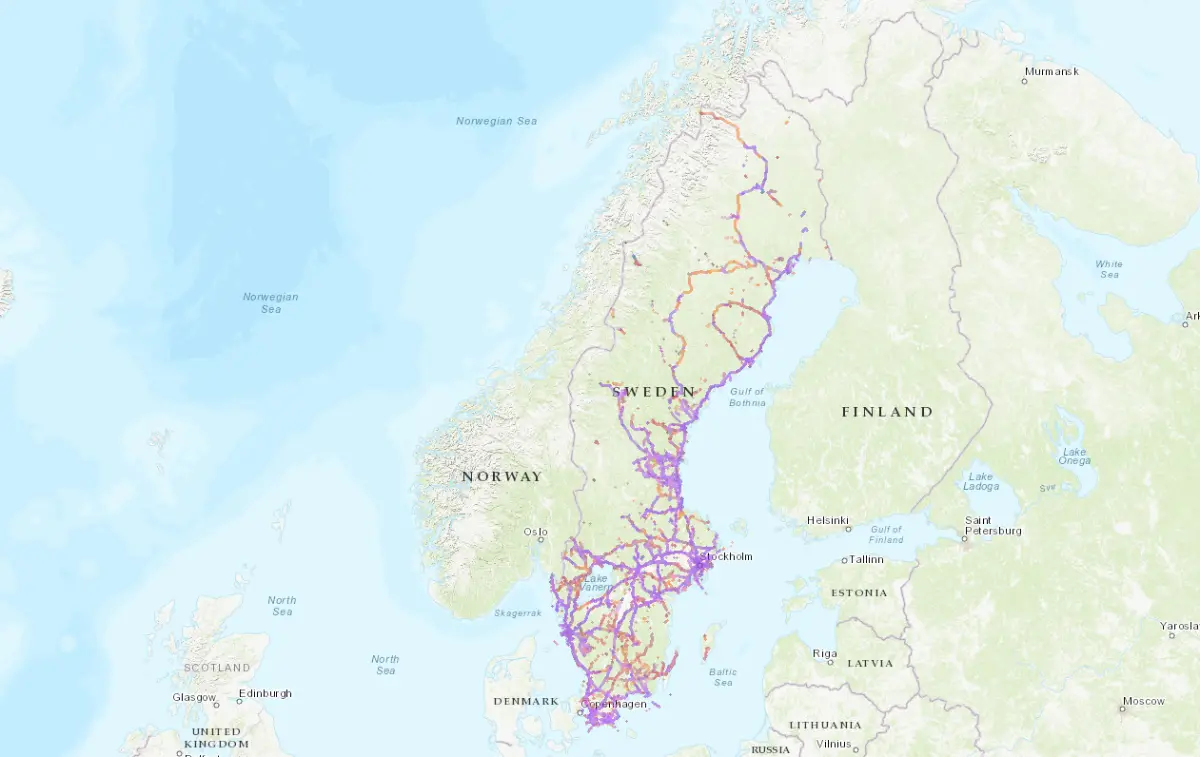
Telia
-
Best all-around geographic coverage (especially strong outside big cities, and often the most reliable pick for remote trips).
-
Where it shines: long-distance trains, smaller towns, northern stretches, road trips.
-
Remote reality check: even Telia can drop out in true mountain areas.
Tele2
-
Very strong in cities + solid national footprint, with strong performance across Sweden’s road network and many rural areas.
-
5G expansion: Tele2 (with Telenor) has announced nationwide 5G activation across their mobile network, with coverage figures emphasizing wide landmass + population reach.
Telenor
-
Strong nationwide coverage and consistently competitive real-world network experience metrics.
-
5G: Opensignal reporting has highlighted Telenor leading on “time on 5G” in Sweden (how often users are on an active 5G connection).
-
Works well for: city-to-city travel, highways, and many rural segments.
3 (Tre / Hi3G)
-
Great urban performance and widely used in Sweden, but 5G coverage depth can lag the top three in some reports.
-
Works well for: Stockholm/Gothenburg/Malmö daily use and short trips where you’re mostly in populated areas.
Rural Sweden & Lapland: what to expect (regardless of operator)
- In the northern Lapland mountains, coverage can be very limited or non-existent, especially on classic trekking routes (Kungsleden sections, Padjelantaleden, Nordkalottleden).
- Coverage varies by location and operator, and Telia is often noted as the best bet, but you still must plan for dead zones.
Practical tip (keep this): download offline maps before you go remote, and don’t assume every trailhead has signal.
How much data do you need in Sweden?
Most travelers underestimate how quickly maps, transit apps, and scrolling add up. As a rough guide:
-
1–3 GB: light browsing + messaging + occasional maps
-
5–10 GB: normal travel use with navigation every day
-
20 GB+: heavy use, hotspotting, frequent video, working remotely
If you’re unsure how much data you’ll need, use a data usage calculator to estimate your trip.
Final recommendation (simple rule)
-
If you want maximum convenience and to be right after landing, choose an eSIM and set it up before departure.
-
If you need a Swedish phone number, go with a prepaid SIM, but plan for ID registration.
-
If you’re a group sharing connection, consider pocket WiFi, but compare total costs carefully.
Check the latest eSIM packages for Sweden and pick a plan that matches your trip length and daily data use.