

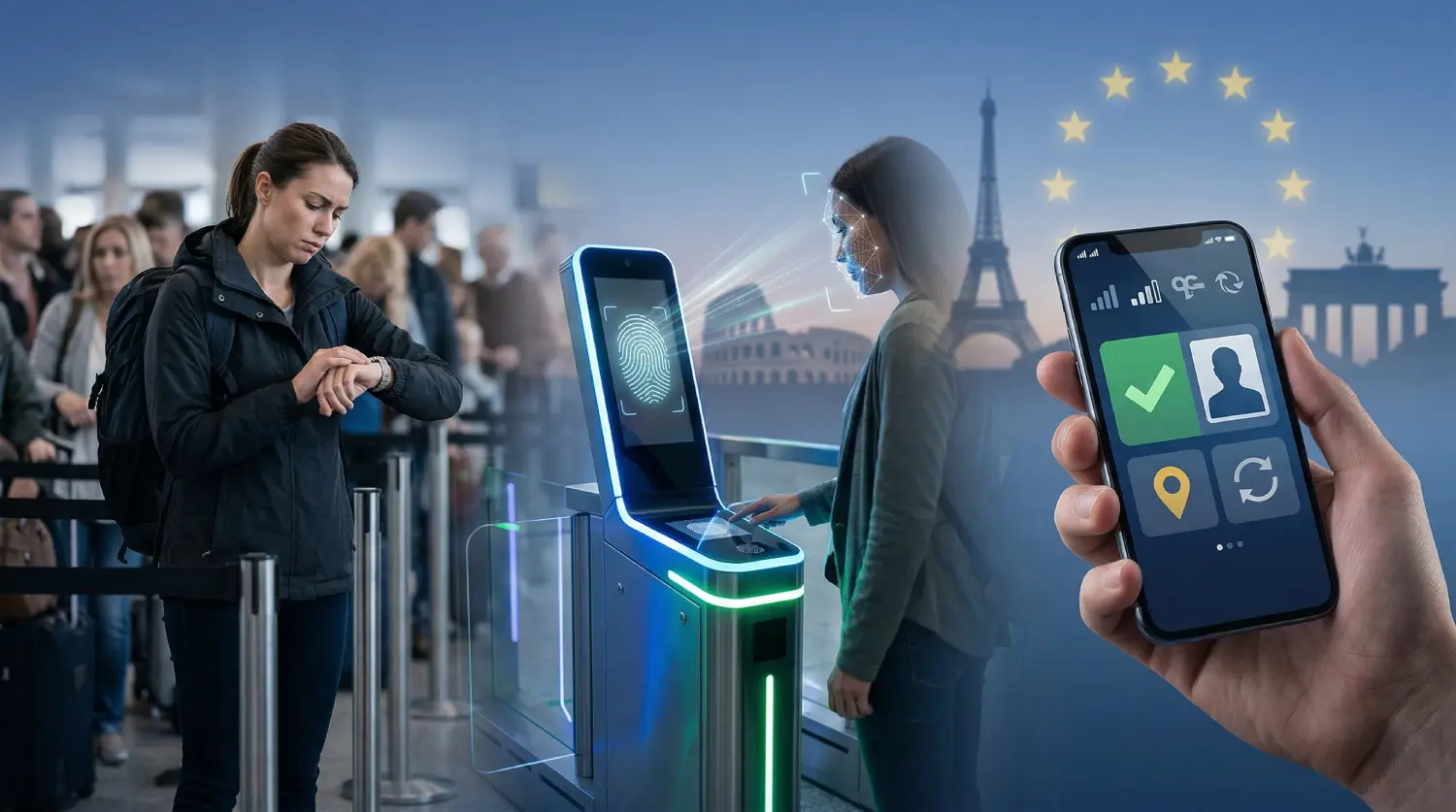

Following a phased rollout late last year, the EU’s Entry/Exit System (EES) becomes fully operational on April 10, 2026.
This new digital border protocol is designed to modernize EU security, prevent visa overstays, and identify security risks. In fact, since its initial testing phase, the system has already caught over 24,000 people attempting to enter with fraudulent documents or unjustified reasons, according to the European Commission.
However, this heightened security comes with a massive logistical cost for tourists: Unprecedented airport delays.
Here is the unfiltered reality of the new EES rules, who is exempt, how to use the new official app, and the exact steps you must take to survive the expected three-hour border queues this summer.
1. What Exactly is the EES?
The Entry/Exit System (EES) is an automated IT system for registering travelers from non-EU countries every time they cross an EU external border.
Manual passport stamping is entirely eliminated. Instead, the system digitally records:
-
Your name and type of travel document.
-
Biometric data: A high-resolution facial image and four fingerprints.
-
The exact date and place of your entry and exit.
-
Any prior refusals of entry.
This data is stored for three years, meaning your first trip under the EES will be the most time-consuming, but subsequent visits should theoretically be much faster.
2. Who Does the EES Apply To?
The new biometric system applies to almost all non-EU/Schengen citizens traveling for short stays (up to 90 days within a 180-day period).
You must register through EES if you are:
-
A UK citizen traveling for tourism or business.
-
A traveler from a visa-exempt country (such as the USA, Canada, Australia).
-
A short-stay Schengen visa holder.
-
A non-EU property owner in Europe who does not possess a formal residence permit.
Who is Exempt? You will bypass the EES biometric kiosks and use traditional or automated gates if you fall into these categories:
-
Citizens of EU and Schengen member states.
-
Non-EU nationals who hold valid long-term visas or residence permits in an EU country.
-
Family members of EU nationals holding a valid residence card.
-
Nationals of Andorra, San Marino, Vatican City, and Monaco.
-
Travelers arriving in Ireland and Cyprus (these countries are exempt from the EES and will continue manual passport checks).
Planning to combine your European vacation with a trip to London or Scotland? Just as the EU is overhauling its borders with the EES, the United Kingdom is rolling out its own strict digital entry rules this year. Make sure you don't get caught off guard across the channel by reading our complete guide: UK ETA Requirement Begins in 2026: What Every Traveler Needs to Know
3. The Airport Nightmare: Expect Severe Delays
If you are flying into a major European hub like Charles de Gaulle (Paris), Schiphol (Amsterdam), or Frankfurt in the coming months, you need to drastically adjust your timeline.
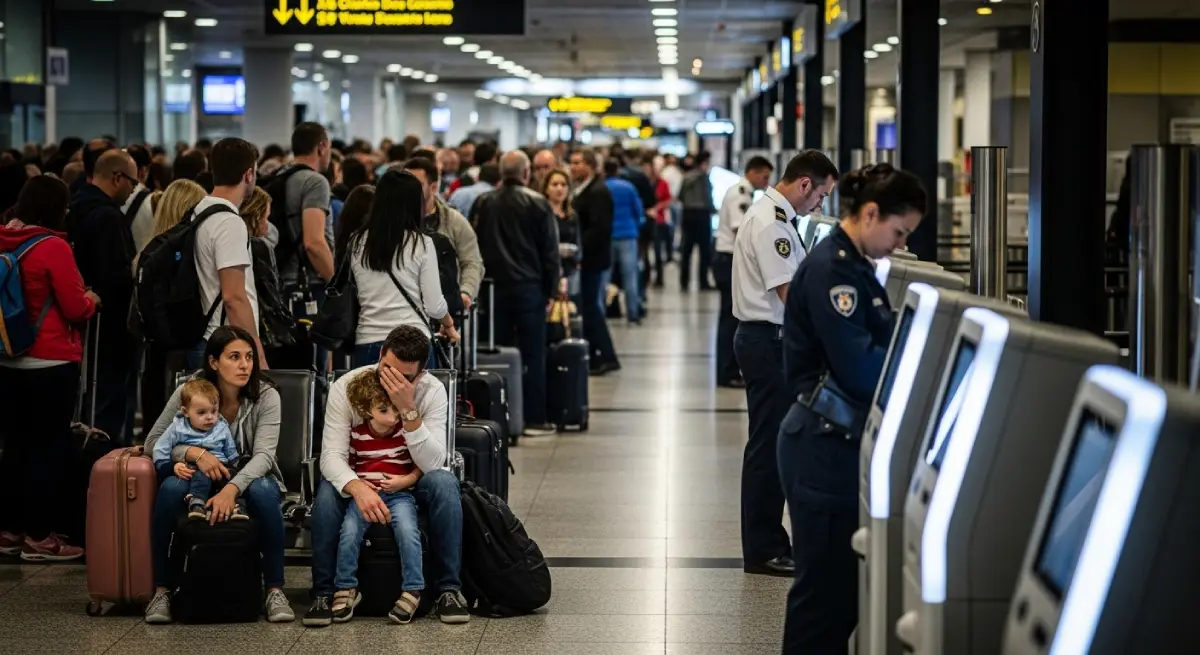
Previously, border control authorities had the power to partially or fully suspend EES processing during peak travel times to keep lines moving. As of April 10, 2026, this suspension authority is revoked. Every single third-country passenger must be processed digitally.
According to a joint statement from airport association ACI Europe and Airlines for Europe (A4E), waiting times are regularly reaching up to two hours at peak traffic times, with some airports reporting even longer queues.
Your Action Plan: When departing from Europe, do not arrive at the airport two hours before your flight as you normally would. You must arrive at least three to four hours early to ensure you make it through the mandatory biometric exit checks.
4. Standard vs. Biometric Passports
Do you need a biometric (e-Passport) to travel to Europe now? Not strictly, but not having will slow you down.
-
Biometric Passport Holders: You can use the self-service kiosks at the arrivals hall for quicker initial registration, followed by a brief verification with a border guard.
-
Standard Passport Holders: You cannot use the self-service kiosks. You must wait in line for the manned booths, where a border agent will manually take your photo and scan your fingerprints.
-
Children: Children under 12 are exempt from providing fingerprints, but they still must have their facial images digitally captured.
Important Note: Refusing to provide biometric data will result in an automatic refusal of entry.
5. The Fast-Track Hack: The "Travel to Europe" App
You do not need to register for the EES before you leave home; the main registration happens at the physical border. However, the EU has released a tool to help travelers speed up the excruciatingly slow airport queues.
The "Travel to Europe" mobile app is an official EU application designed specifically for the EES system.
How it helps: It allows third-country travelers to pre-register their passport data and submit biometric photos up to 72 hours before their arrival in Europe. You simply download the app, fill out an entry questionnaire, and take a selfie to confirm your identity.
While this does not replace the final face-to-face border control interview, it significantly reduces the time you spend standing at a kiosk. The app is currently active for destinations like Portugal and Sweden, with a rapid expansion planned across all participating EES countries.
-
You can download the official app here on Google Play or the Apple App Store.
6. Digital Survival: Why You Cannot Queue Offline
Picture this scenario: You have just landed at a crowded European airport. Ahead of you is a three-hour line for the EES border checks.
You suddenly realize you need to download the "Travel to Europe" app to speed up your process, notify your Airbnb host that you are going to be severely delayed, and check your connecting train schedule. You try to connect to the airport's free Wi-Fi, but with thousands of other stranded passengers trying to do the exact same thing, the network completely crashes.
You are stuck, disconnected, and stressed before your vacation has even begun.
During this transitional phase of European travel, your smartphone is your lifeline. You cannot afford to rely on spotty public Wi-Fi or pay exorbitant international roaming charges while trapped in an immigration hall.
The Solution: Smart travelers bypass the connectivity trap entirely by installing a Europe Regional eSIM before they even board their flight.
The moment your plane touches down in Europe, your phone instantly connects to local 4G/5G networks. You can smoothly download the required EES apps, communicate with your hotel, and plan your journey while you wait in line—all without hunting for a Wi-Fi password or swapping out tiny physical SIM cards.
Don't let the new border rules ruin your first day in Europe. Secure your connection in advance, download the apps you need, and breeze through the delays.
👉 Get connected instantly with a Roafly Europe Regional eSIM today.