Download the App and manage your eSIMs easily
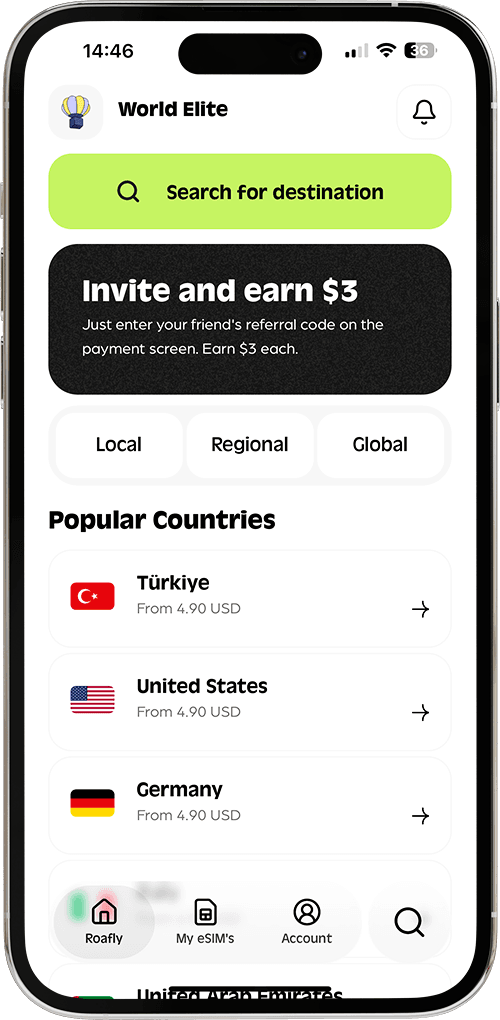
Create your order quickly
See your eSIM details
Track your remaining data
Download the App and manage your eSIMs easily
Create your order quickly
See your eSIM details
Track your remaining data
On 18 November 2025, Cloudflare began experiencing a global disruption impacting thousands of websites. Users around the world reported intermittent outages, slow loading, failed bot detections, and complete downtime on major platforms.

Ethan Brooks
Updated Nov 24, 2025
5 min read

Save 15% on your Roafly eSIM
Stay connected on your next trip. Use the code below at checkout.
View All DestinationsJump to section
👇Save 15% on your Roafly eSIM
Stay connected on your next trip. Use the code below at checkout.
View All Destinations
Manage your eSIM in the app
Install, top up and track data.
Cloudflare is currently experiencing a major global outage, causing widespread disruptions across the internet. Users around the world reported that websites were failing to load, bot detection pages were stuck, and even massive platforms like X (Twitter) and ChatGPT were intermittently unreachable.
Source: Cloudflare Status Page — https://www.cloudflarestatus.com/
Update - We continue to see errors and latency improve but still have reports of intermittent errors. The team continues to monitor the situation as it improves, and looking for ways to accelerate full recovery.
Update - Bot scores will be impacted intermittently while we undergo global recovery. We will update once we believe bot scores are fully recovered.
Update - The team is continuing to focus on restoring service post-fix. We are mitigating several issues that remain post-deployment.
A fix has been implemented and Cloudflare believes the incident is now resolved. Engineers are monitoring error levels to ensure all services have fully recovered.
A new change has been deployed, restoring Cloudflare Dashboard services.
Broad application service impact is still being remediated.
Cloudflare has officially confirmed the incident on its status page:
👉 https://www.cloudflarestatus.com/
“Cloudflare Global Network experiencing issues. We are investigating an issue which potentially impacts multiple customers.”
This confirms that the outage is not regional — it affects Cloudflare’s broader global network.
On 18 November 2025, around midday UTC, Cloudflare began experiencing instability across several layers of its infrastructure, including:
CDN delivery
DNS resolution
Reverse proxy
Bot detection & captcha
WAF (Web Application Firewall)
Edge network routing
The result?
Thousands of websites either became extremely slow, partially unavailable, or went completely offline.
Many users reported that certain pages would load once, then fail entirely seconds later. Others couldn’t pass Cloudflare’s robot verification or saw endless loops.
Although Cloudflare isn't responsible for hosting these platforms directly, its protection and routing layers impact them.
Users reported issues on:
X / Twitter
ChatGPT
Spotify’s web client
E-commerce stores
Booking/travel platforms
Online payment pages
SaaS dashboards
API-driven services
Even Downdetector — the tool people use to detect outages — became unreachable because it also relies on Cloudflare’s bot filtering systems.
Reddit thread:
👉 https://www.reddit.com/r/CloudFlare/comments/1p09n2i/cloudflare_issuesdown/
Bazı dikkat çeken yorumlar:
“I couldn’t access Downdetector because Cloudflare’s bot check is broken.”
“X is completely down for me.”
“London Cloudflare servers are offline.”
“It’s a big one.”
“It came back… nope, down again.”
This confirms that the outage fluctuates — recovering temporarily before failing again — which often happens during network-wide routing issues.
Cloudflare is one of the most dominant internet infrastructure companies. Its network handles:
20%+ of all global web traffic
Millions of websites
Billions of requests per day
DNS for major brands
Mitigation for massive DDoS attacks
When Cloudflare breaks, even partially, it feels like the entire internet is broken.
Because Cloudflare sits between the website and the visitor, outages affect:
Loading speed
Captcha/robot checks
DNS lookups
HTTPS handshakes
API calls
Static asset delivery
Traffic routing
It doesn’t matter if your server is up — if Cloudflare can’t proxy your traffic, your users can’t reach you.
For international travelers relying on:
hotel confirmations,
flight check-ins,
navigation apps,
messaging apps,
booking websites,
travel eSIM activation portals,
this outage can feel twice as disruptive.
Even if your local internet or travel eSIM is working normally, the sites themselves may fail to load, creating the impression of slow or broken connectivity.
Roafly services remain operational, but external websites—such as booking engines, travel blogs, or navigation apps—may experience temporary downtime due to Cloudflare's instability.
Cloudflare now reports that a fix has been implemented and that they believe the incident is resolved, although they continue to monitor the network closely.
While many services have already recovered — including Cloudflare Access, WARP, and the Dashboard — some regions may still notice brief fluctuations as global traffic routes stabilize.
Reddit users are also reporting improvements, with many confirming that previously unreachable sites are loading again. However, a few users still mention occasional slowdowns, suggesting that full normalization may take a short while longer.
In short: the outage is largely resolved, but Cloudflare is still monitoring and fine-tuning the network to ensure complete recovery.
There’s not much users or website owners can do except wait for Cloudflare to deploy a fix. Meanwhile:
Refreshing the page may help if your region stabilizes temporarily.
Avoid repeated bot-check attempts; they may be stuck.
If you run a website, avoid major deployments during this period.
If you’re traveling, understand that the issue is global — your device or eSIM is not the cause.
Today's Cloudflare outage shows how interconnected the web has become. When one major infrastructure provider fails, the ripple effect impacts millions of users worldwide.
As Cloudflare engineers work on a fix, expect partial recovery followed by new waves of downtime.
We’ll keep monitoring the situation and update this post as new information becomes available.
