

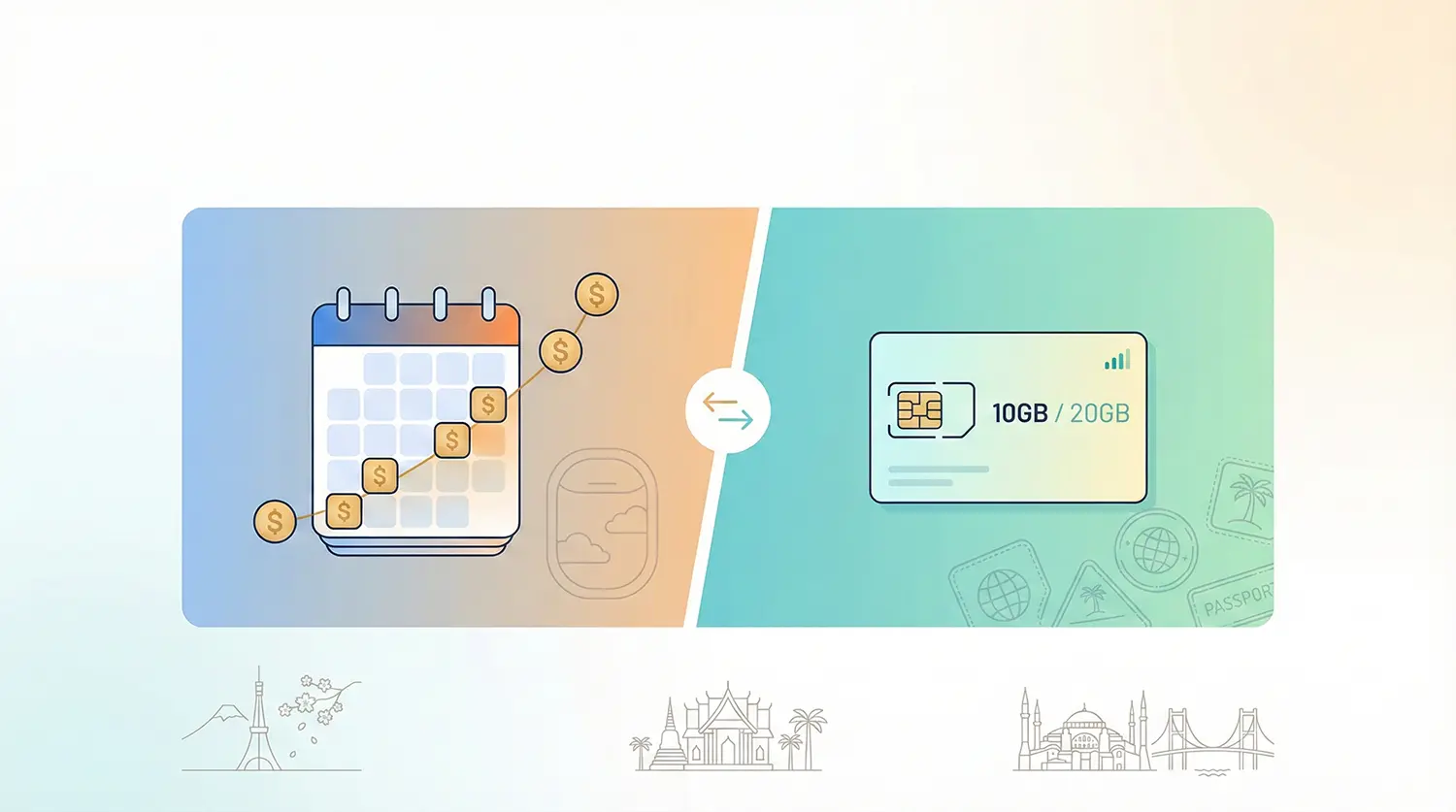

This guide breaks down how roaming really costs money, when an eSIM is cheaper, and real examples for Japan, Thailand, and Türkiye using current pricing.
How roaming is priced (and why it gets expensive fast)
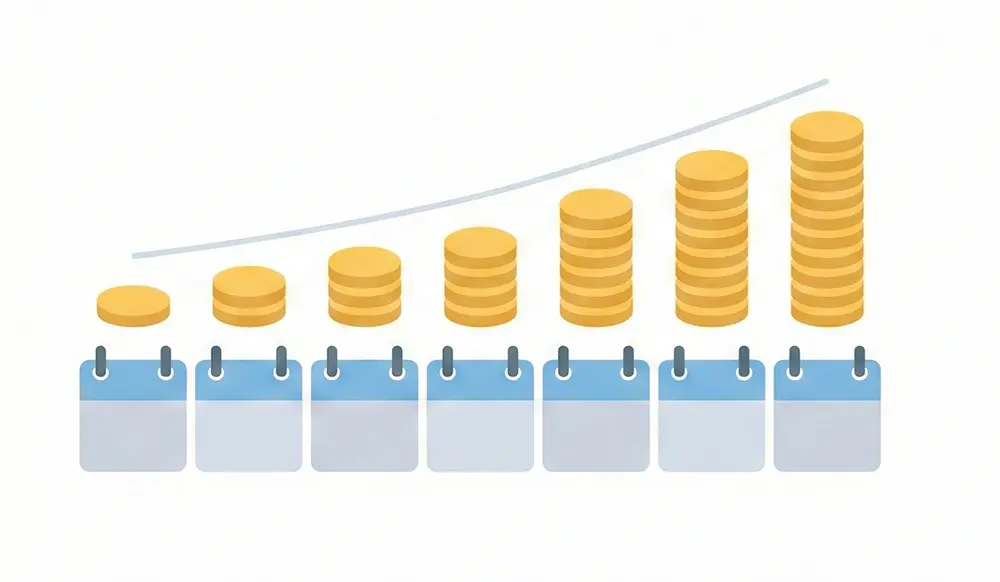
Most travelers don’t use “pay-per-MB roaming” anymore. Instead, many carriers sell daily roaming passes—great for predictability, but surprisingly expensive for trips longer than a couple of days.
Common examples:
-
AT&T International Day Pass: $12/day on land for line (extra lines typically $6/day).
-
Verizon TravelPass: $12/day in most countries ($6/day in Canada/Mexico). After 5GB of high-speed data, speeds can drop for the rest of the session.
Even if you “check maps and messages,” roaming can trigger a daily fee the moment your phone uses data in the background.
Quick comparison: Roaming vs travel eSIM vs local SIM vs pocket Wi-Fi
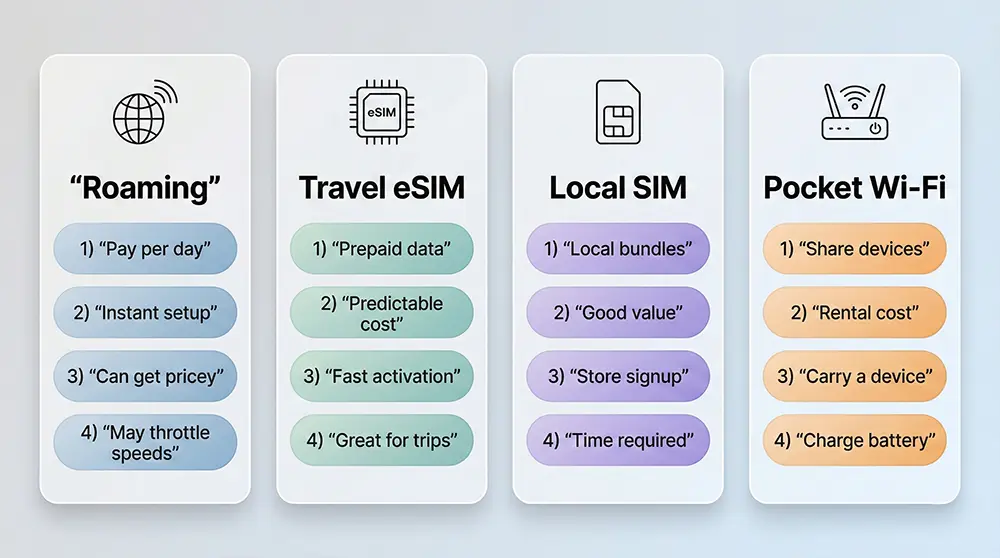
Here’s the simplest way to compare options as a traveler:
| Option | How you pay | Typical cost pattern | Setup time | Best for | Watch-outs |
|---|---|---|---|---|---|
| Roaming day pass | Per day of use | Adds up daily ($6–$12/day is common) | None | Very short trips, emergency backup | Fair-use throttling after a high-speed cap; “day” fees can stack quickly |
| Travel eSIM (Roafly) | Prepaid data pack | Fixed price for a data amount | Minutes | Most travelers who want predictable cost | Data-only (you keep WhatsApp/FaceTime; voice depends on your apps) |
| Local tourist SIM/eSIM | Local tourist bundle | Often great value in local currency | 15–60+ minutes | Longer stays, need local voice/SMS | Passport/registration steps; airport kiosks can be pricey |
| Pocket Wi-Fi | Rental per day/week | Mid to high cost | Pickup/return needed | Multiple devices sharing hotspot | Battery management, extra device, deposits |
Price note: Roafly example prices in this post are current as of December 28, 2025. Local operator and airport pricing can change and may vary by store/location.
The math: when an eSIM is cheaper than roaming
The easiest rule:
If your roaming pass is ~$12/day, then:
-
3 days ≈ $36
-
7 days ≈ $84
-
14 days ≈ $168
That’s before you factor in throttling rules or “high-speed caps” that reduce quality after a certain amount of data.
A travel eSIM typically wins when:
-
Your trip is longer than 2–3 days
-
You’re using maps daily + social media + messaging
-
You want predictable cost (no surprise billing)
Not sure how much data you’ll use? A calculator beats guessing—especially for video-heavy travel days.
Real examples: Japan, Thailand, and Türkiye (with current Roafly prices)
Below are practical comparisons using popular traveler data tiers (10GB and 20GB). These examples are meant to show how quickly roaming adds up, not to replace your exact carrier plan details.
Japan: airport SIMs can be pricey; a fixed eSIM is often simpler
At Tokyo Narita Airport, published examples include 10GB / 30 days around ¥6,600 for some tourist SIMs (prices vary by provider).
Roafly examples (Japan):
-
10GB / 30 days: $16
-
20GB / 30 days: $24
If your roaming is $12/day, a 7-day trip is already about $84—often several times more than a 10–20GB travel eSIM.
Roafly eSIM packages for Japan:
Need data in Japan? Get an eSIM!
Choose the perfect data plan for your trip

Manage your eSIM in the app
Install, top up and track data.
Roafly’s Japan coverage is designed to use major local networks.
Thailand: strong tourist SIM options, but eSIM wins on speed and convenience
Thailand’s local operators publish clear tourist pricing:
-
AIS tourist plan examples include 15 days “Unlimited Data (Max Speed)” at 699 THB (and other tiers).
-
dtac “Happy Tourist” examples include 299 THB (8 days, 15GB at max speed) and 599 THB (15 days, 30GB at max speed).
Those can be excellent value—especially if you don’t mind the in-store process. But if you want to land already set up (no counter, no passport queue), a travel eSIM is usually the fastest path.
Roafly examples (Thailand eSIM):
-
10GB / 30 days: $10
-
20GB / 30 days: $16
Roafly packages for Thailand:
Need data in Thailand? Get an eSIM!
Choose the perfect data plan for your trip

Türkiye: local tourist bundles exist, but travelers should plan ahead
Local operator tourist pricing (examples):
-
Turkcell lists a tourist welcome pack example: 20GB for 1,500 TL.
-
Türk Telekom lists tourist welcome packages such as 25GB for 28 days at 420 TL (and other tiers).
Roafly examples (Türkiye eSIM):
-
10GB / 30 days: $12
-
20GB / 30 days: $18
Roafly packages for Türkiye:
Need data in Türkiye? Get an eSIM!
Choose the perfect data plan for your trip

Important Türkiye note: there have been reports that access to some eSIM provider websites/apps may be restricted inside Türkiye, so installing your eSIM before arrival is the safest play.
Setup: how to avoid the #1 “it doesn’t work” moment after landing
Travel eSIM setup is usually easy, but setting causes most problems:
-
Your eSIM line often needs Data Roaming turned ON to connect to partner networks (this does not mean you’re paying roaming fees on a prepaid travel eSIM—it's a technical toggle).
Roafly supports three common install paths:
-
iOS Direct Install
-
QR Code
-
Manual installation
If you ever land and see “No Service,” these internal guides help:
When roaming can still make sense
Roaming isn’t always “bad.” It can be reasonable when:
-
You’re traveling for 1 day and barely touch data
-
Your plan includes meaningful high-speed international data (some plans advertise specific high-speed caps before slowing down)
-
You need to keep your home number active for bank SMS (in that case, many travelers use dual SIM: home SIM for calls/SMS + travel eSIM for data)
A smart setup for frequent travelers is often:
-
Keep your physical SIM active for calls/SMS
-
Use a travel eSIM for data (the expensive part)
The easiest way to choose your data size
If you mostly use:
-
Maps, messaging, light browsing: 3–5GB/week is often enough
-
Social + lots of short video + ride-hailing: 7–10GB/week is common
-
Heavy video, hotspot for laptop: 10–15GB/week or more
Instead of guessing, use a data estimator to match your habits and trip length. Roafly’s Trip Data Estimator is built for this.
Bottom line
For most trips longer than a weekend, a prepaid travel eSIM is usually cheaper than roaming day passes—and the fixed price makes it much easier to control your travel budget.
Check the latest eSIM packages for your destination and install before you fly for the smoothest arrival experience.