

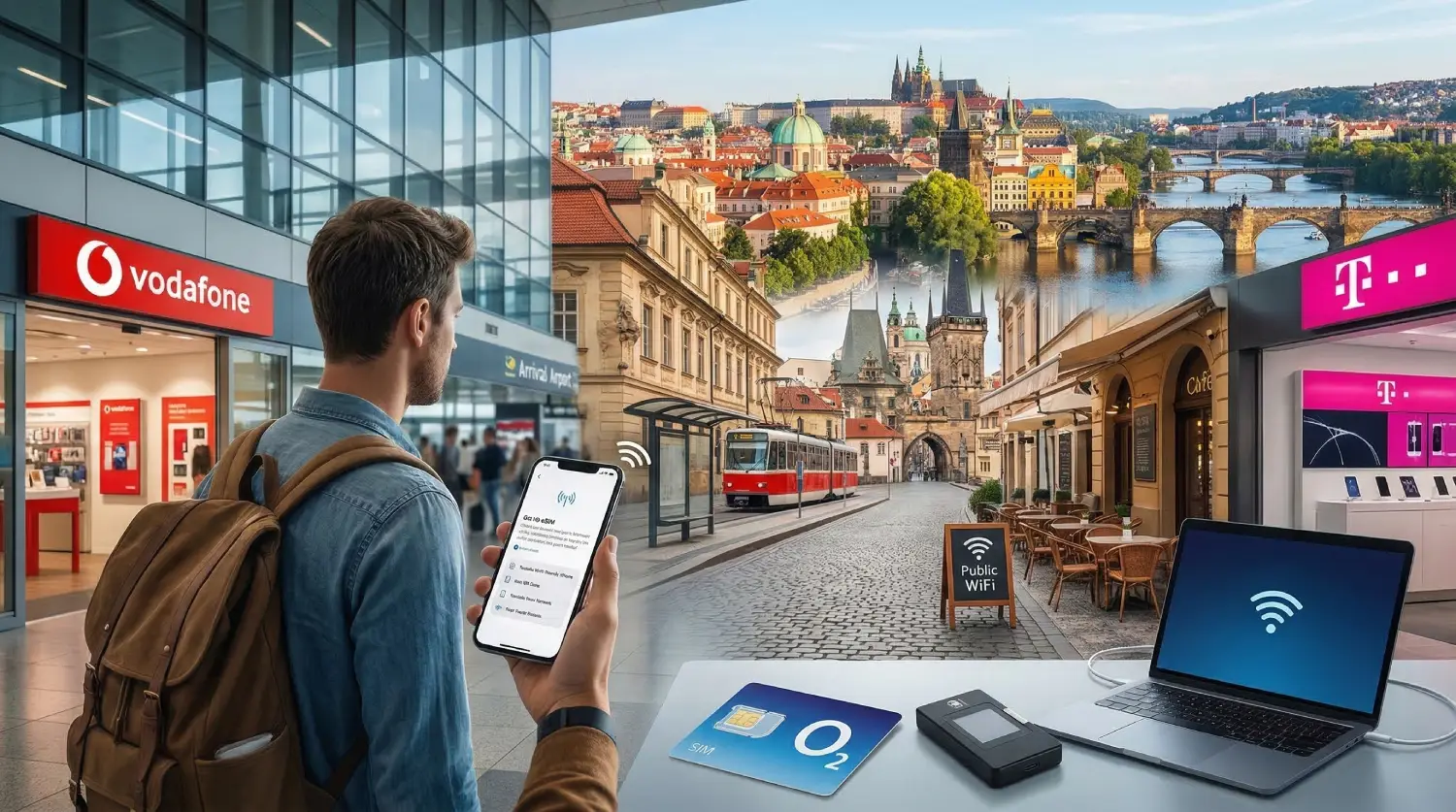

For most travelers in 2026, the real choice is between four options: airport SIM cards, local prepaid tourist SIMs, eSIM, and pocket WiFi. Public WiFi can help in a pinch, but it should not be your main connection for maps, ride apps, banking, or work.
What are your internet options in the Czech Republic?
Travelers in the Czech Republic usually choose of these:
-
Buy a SIM card at Václav Havel Airport Prague
-
Buy a local prepaid SIM card in Prague or another city
-
Install a travel eSIM before arrival
-
Rent a pocket WiFi device
-
Use airport, hotel, café, or public WiFi when needed
The country has strong mobile infrastructure overall. Official coverage tools from Vodafone, O2, and T-Mobile show broad nationwide service, and Vodafone says its LTE network reaches 98% of the population. Independent 2026 travel research also shows all three major operators have strong 4G coverage and useful 5G access in Prague and other major destinations.
That means the main difference is usually not coverage, but convenience, setup time, and price.
Need data in Czech Republic? Get an eSIM!
Choose the perfect data plan for your trip

Manage your eSIM in the app
Install, top up and track data.
Buying a SIM card at Prague Airport
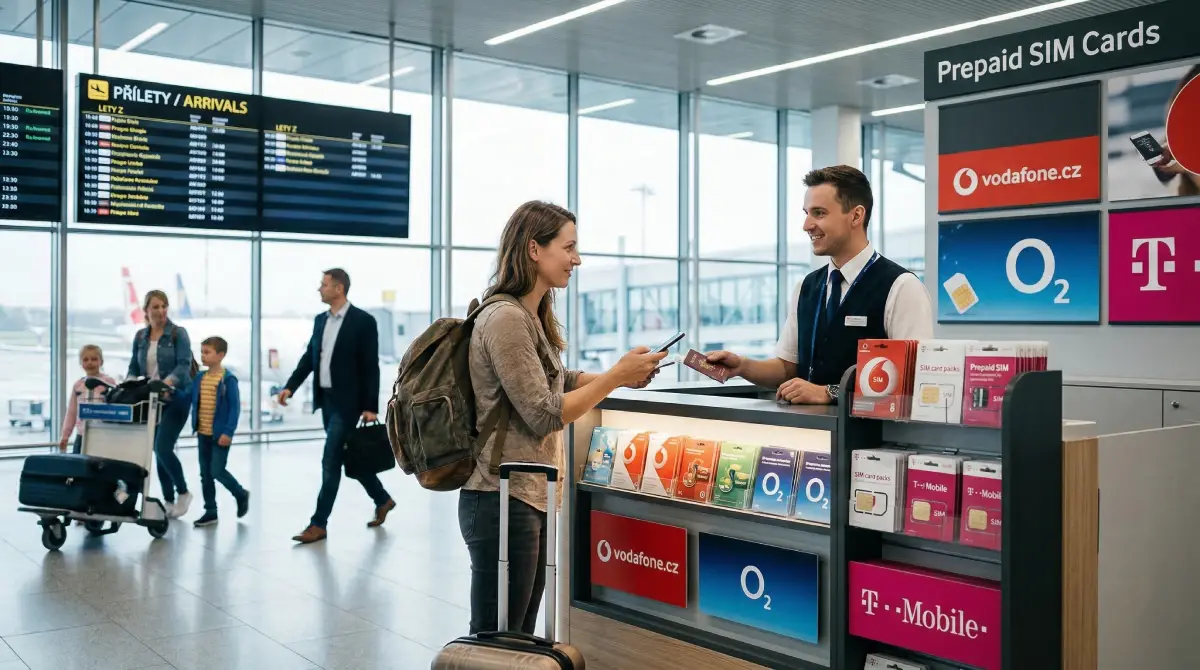
If you want to get connected immediately after landing, Prague Airport is the easiest place to do it. Third-party airport SIM guides published in 2026 report that travelers can find prepaid SIM options in the arrivals area, including stores or sales points connected to major local networks. Airport purchases are convenient, but prices are usually higher than buying in the city.
A practical airport price snapshot for 2026 looks like this:
| Airport option | Data | Validity | Price |
|---|---|---|---|
| Vodafone at Prague Airport | 10GB | 30 days | 800 CZK (about $38) |
| Vodafone at Prague Airport | 20GB | 30 days | 1299 CZK (about $62) |
| O2 at Prague Airport | 3GB | 30 days | 299 CZK (about $14) |
| O2 at Prague Airport | 1GB | 30 days | 179 CZK (about $9) |
These USD figures are approximate conversions based on a live USD/CZK rate near 20.97 CZK per USD.
The main advantage of buying at the airport is speed. You land, buy, activate, and go. The downside is value. Airport counters and convenience stores tend to sell smaller bundles at higher prices than what you can get later in a city-center carrier store. Several 2026 sources note that airport pricing can be 10% to 20% higher than city pricing.
So airport SIM cards make sense if:
-
you need data the second you land
-
you do not want to prepare in advance
-
you are staying briefly and convenience matters more than savings
If you can wait until you reach the city, local prepaid SIM cards usually give you more data for less money.
Local tourist SIM card prices in the Czech Republic
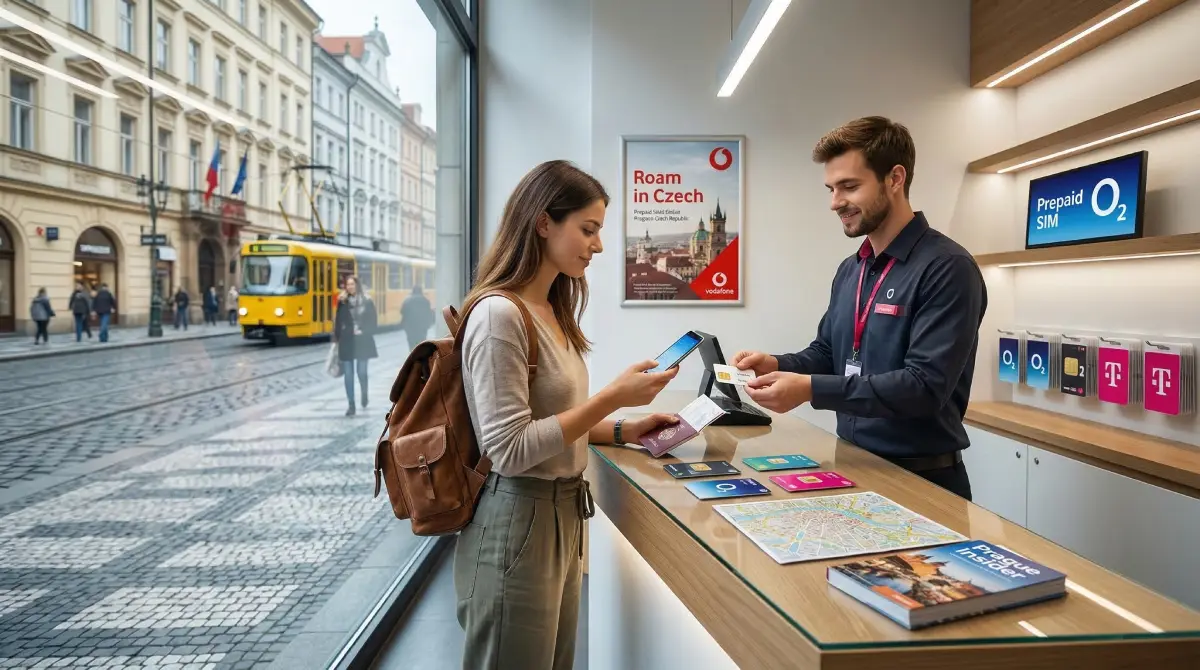
The Czech market is straightforward for travelers. The three major operators are Vodafone, O2, and T-Mobile. In practice, local prepaid offers are available through official stores, retail shops, and in some cases supermarkets or convenience outlets. Independent 2026 travel reporting says Czech prepaid SIM purchases are relatively simple and that physical prepaid SIMs are widely available.
Here is the most useful 2026 snapshot for local tourist SIM pricing:
Need data in Czech Republic? Get an eSIM!
Choose the perfect data plan for your trip
Manage your eSIM in the app
Install, top up and track data.
This is where eSIM becomes very attractive for travelers. A 10GB Roafly plan at $12 is cheaper than many airport physical SIM options and does not require any store visit. A 20GB plan at $20 is also strong for longer stays, remote work, or travelers moving between Prague, Brno, Český Krumlov, and other stops.
Roafly is especially convenient if you want to arrive with data already ready on your phone. You can install it before departure, land in Prague, and get without dealing with airport counters, local activation steps, or language friction. If you want a more detailed provider-focused breakdown, our best eSIM for Czech Republic guide covers the topic in more depth.
That can also be helpful if you are comparing broader regional options, especially if your itinerary includes more than country and you are also considering the best eSIM for Europe for the rest of your trip.
Is a local physical SIM still worth it?
Yes, sometimes. A local prepaid SIM still makes sense when:
-
you want a Czech phone number
-
you plan to make local calls often
-
your phone does not support eSIM
-
you are staying long enough to visit a store and compare bundles
But for many short-term travelers, the extra step is not worth it. A physical SIM can still mean finding a store, checking package terms, and sometimes converting to eSIM later if you prefer digital use. 2026 travel guide notes that local operator eSIM processes can be more complicated than simply buying an travel eSIM before the trip.
That is why airport SIM and local SIM both remain useful, but they are no longer the default best choice for every traveler.
Pocket WiFi in the Czech Republic
Pocket WiFi is still available in 2026, and it can be useful for some travelers. International rental providers advertise Czech Republic coverage with prices starting around €3.30 to €3.95 per day, and some devices allow up to 10 connected devices at.
Pocket WiFi can work well if:
-
you are traveling as a family or group
-
several people need to share connection
-
you need internet on phones, tablets, and laptops at the same time
-
your phone does not support eSIM and you do not want to buy multiple local SIM cards
Still, it has clear downsides. You need to carry and charge another device, track delivery or pickup, and in many cases handle return shipping or deposits. For solo travelers, couples, or short city breaks, pocket WiFi is usually less convenient than an eSIM or local prepaid SIM.
In other words, pocket WiFi is a niche solution now. It is useful for multi-device travel, but it is no longer the easiest option.
Airport WiFi and public WiFi
Free WiFi is easy to find in the Czech Republic, but it should be treated as a backup, not your main connection.

Prague Airport officially offers free WiFi under the network name “Prague Airport WiFi Free.” The airport’s own passenger information also confirms free WiFi is available on-site.
Across the country, Czech tourism guidance says wireless internet is widely available in restaurants, cafés, bars, hotels, libraries, and even some public transport.
That sounds great, but public WiFi comes with the usual limits:
-
speeds can vary a lot
-
you may need to rejoin repeatedly
-
security is weaker than using your own mobile data
-
coverage is fine in tourist zones, but not always reliable you are moving around
Public WiFi is helpful for checking email in a café or downloading offline maps in your hotel. It is not the best way to rely on navigation all day, upload work files, or use banking apps while you travel.
Mobile Coverage in the Czech Republic: Vodafone, O2 and T-Mobile
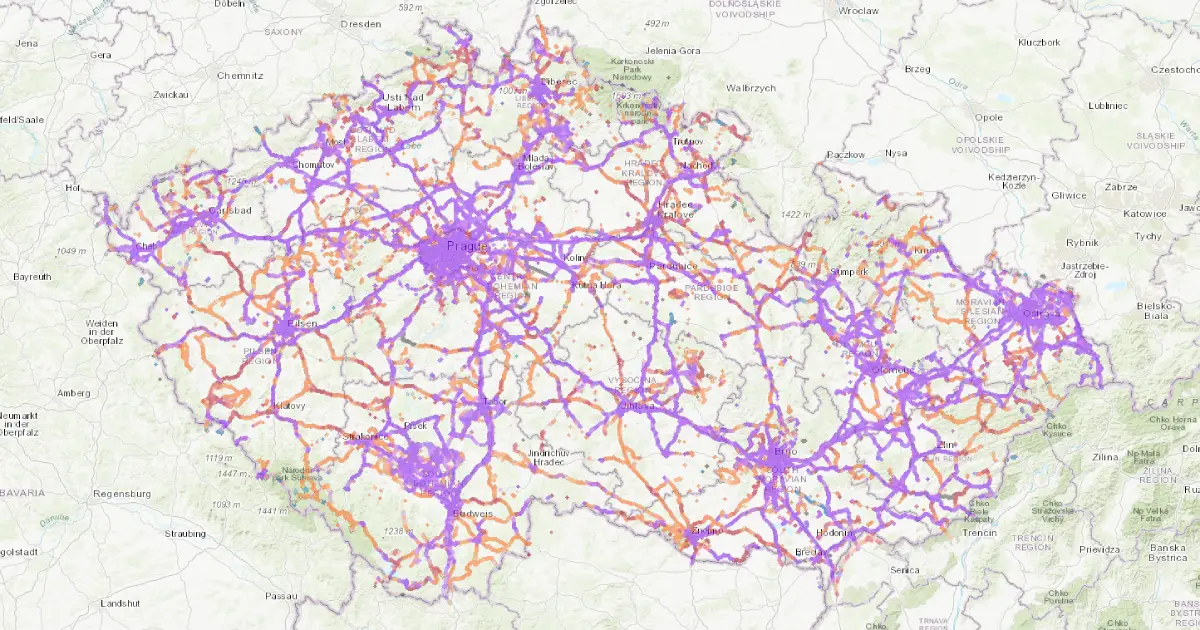
Mobile coverage in the Czech Republic is generally strong for travelers, especially in Prague, Brno, Ostrava, Plzeň, and other major cities. Across the country, Vodafone, O2, and T-Mobile all provide broad 4G service, while 5G is available in many urban areas and continues to expand through the official network maps published by each operator. Vodafone’s coverage map shows multiple 5G layers and nationwide 4G availability, O2’s map shows both 4G and 5G mobile data coverage, and T-Mobile also provides a national coverage map for LTE and 5G service.
For most tourists, the good news is simple: you are unlikely to struggle with basic mobile data coverage in the Czech Republic unless you are spending significant time in remote rural zones, mountain areas, or deep inside older buildings. In normal travel use, all three major operators are reliable enough for maps, messaging, ride-hailing, browsing, and social media.
Here is the quick version: