

'/%3e%3cpath fill='%23fff' d='m8.751-17.959 10.11 11.373L3.997-9.844l13.94-6.1-7.692 13.129z'/%3e%3c/svg%3e)
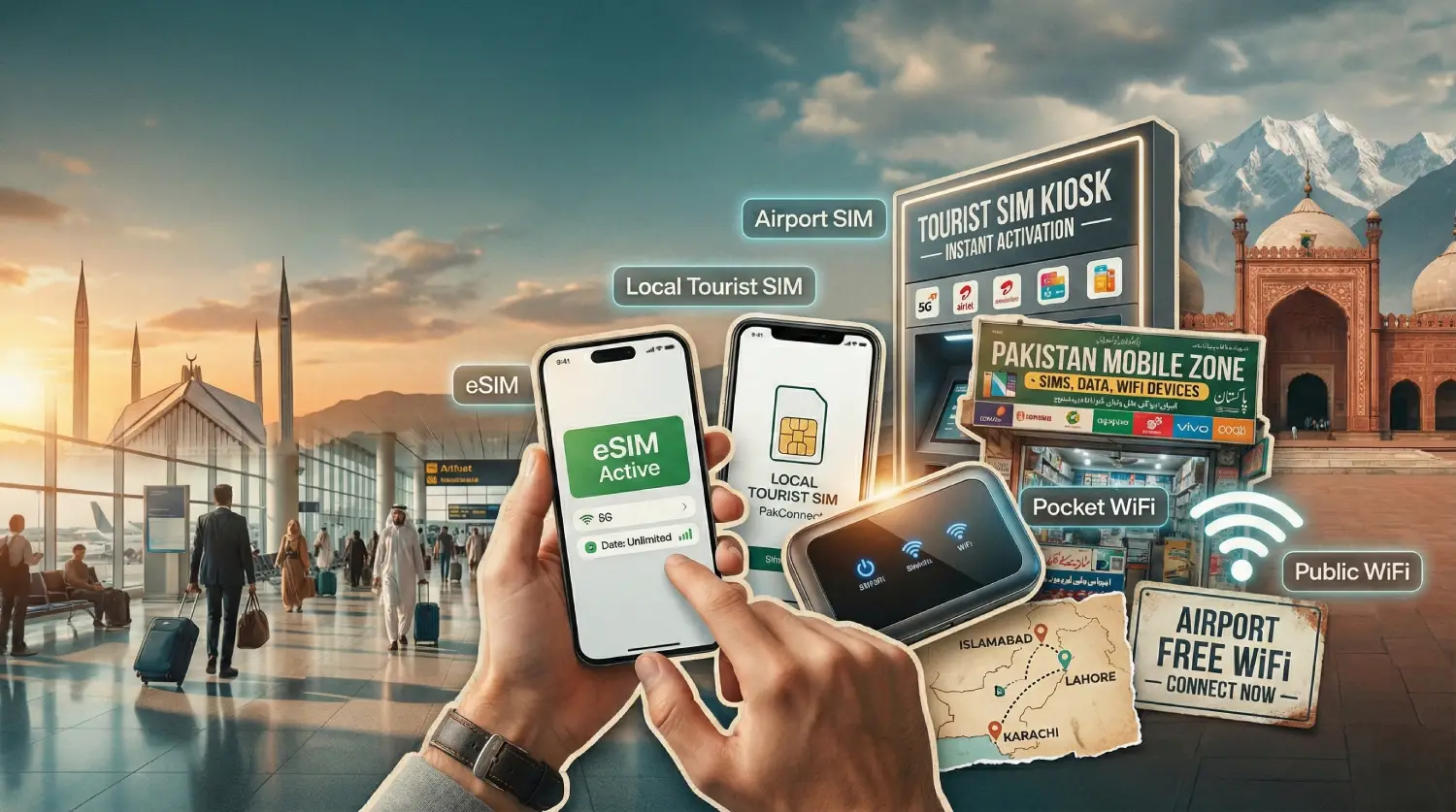
This guide covers airport SIM prices, local tourist SIM pricing, a simple eSIM option, pocket WiFi rentals, and what to expect from airport and public WiFi.
Quick comparison of internet options in Pakistan
| Option | Best for | Typical upfront effort | Typical cost level | Works immediately after landing? | Notes |
|---|---|---|---|---|---|
| Airport SIM kiosk | You want a local number right away | Medium–High | Medium | Sometimes | Airport kiosks exist at major airports, but availability and processing time can vary. |
| Local franchise/store SIM | Best value + local number | Medium | Low | Not immediately | Usually cheaper than airports, but you’ll spend time finding a store and completing registration. |
| Roafly Pakistan eSIM | Data-only, fastest setup | Low | Predictable | Yes (once you connect) | No ID verification required; activation starts when the eSIM connects to a supported network. |
| Pocket WiFi rental | Groups, multi-device sharing | Medium | Medium–High | Depends on pickup/delivery | Good for teams/families; daily rental fees add up. |
| Airport/public WiFi | Light browsing, backups | Low | Free | Sometimes | Often requires SMS login; speeds and reliability vary by location. |
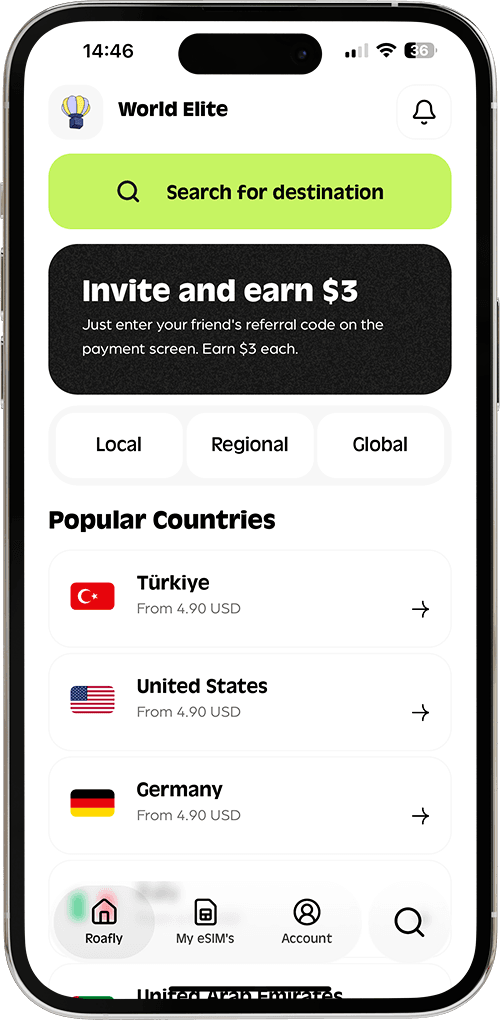
Need data in Pakistan? Get an eSIM!
Choose the perfect data plan for your trip

Manage your eSIM in the app
Install, top up and track data.
Buying a SIM card at the airport in Pakistan
Major international airports like Islamabad (ISB), Lahore (LHE), and Karachi (KHI) may have mobile operator kiosks or counters where you can buy a SIM after landing.

What airport SIM buying is like in 2026
Airport SIM purchase is not always a quick “pay and go.” In many cases, you’ll need:
-
Your passport and valid visa
-
On-the-spot biometric verification or documentation capture
-
A short wait while your line is processed
Travelers also report that airport availability can be inconsistent (especially late at night), and where kiosks exist, pricing can be higher and the process slower than in city stores.
Airport SIM prices: what to expect
Exact airport pricing can vary by airport, operator, and season. A practical expectation is:
-
SIM issuance/activation fees: commonly a few hundred PKR
-
A first bundle/top-up: depends on whether you pick a weekly or monthly plan
For reference, official operator SIM pricing in Pakistan commonly starts in the low hundreds of PKR (depending on number choice and channel). Jazz lists prepaid new SIM pricing starting from PKR 350, and Ufone lists new SIM pricing starting from PKR 200.
Airport counters may charge more or bundle the SIM with a starter package, so don’t be surprised if the “all-in” airport amount is higher than what you’d pay at a franchise in the city.
When an airport SIM is worth it
Choose an airport SIM if:
-
You need a Pakistani number immediately (local calls, bank OTPs, delivery coordination)
-
You’re arriving in a major airport at a time when kiosks are open
-
You prefer face-to-face setup help
If you mainly need data (maps, WhatsApp, ride-hailing, hotel messages), an eSIM is often faster because you can set it up before you travel and skip queues.
Local SIM pricing (SIM + typical data bundles)

Local SIM fees and packages vary, but common ranges you’ll see in practice include:
-
SIM issuance: often PKR 200–400 at official channels (depending on operator/number type)
-
Tourist SIM/package ranges: some travel guides summarize “tourist SIM” bundles commonly falling around PKR 500–1,500 depending on inclusions
For plan examples (to understand the market shape), Zong’s prepaid page shows weekly and monthly bundles priced in the hundreds to a few thousand PKR (for example, weekly data-heavy bundles and monthly high-data bundles).
Another example: Wise notes a Jazz weekly plan priced at PKR 113 for a 7-day data allowance (plan details can change, but it illustrates how inexpensive local promos can be).
Where to buy locally
In big cities, the easiest places are:
-
Official franchise stores / customer service centers (recommended)
-
High-footfall commercial areas and malls where operator outlets exist
-
Authorized retailers (fine, but franchises are safest for foreigners if you want fewer issues)
In tourist-heavy routes (Islamabad ↔ Lahore ↔ Karachi), you’ll rarely be far from an operator store. In remote regions, availability drops—and coverage becomes the bigger story.
Coverage and reliability: what to expect across Pakistan (operator-by-operator)
In 2026, you’ll usually get solid 4G service in the big cities (Islamabad/Rawalpindi, Lahore, Karachi) and along most major highways. The main difference between networks is how consistent they feel in your exact neighborhoods, indoors (malls, older buildings), and on long intercity drives—then how quickly they drop off you head into mountainous or sparsely populated regions.
Here’s a practical, traveler-friendly way to think about Pakistan’s four major mobile networks:
Need data in Pakistan? Get an eSIM!
Choose the perfect data plan for your trip
Manage your eSIM in the app
Install, top up and track data.
Roafly Pakistan eSIM plans (USD)
-
1GB / 7 Days — $3.90
-
3GB / 30 Days — $6.90
-
5GB / 30 Days — $9.90
-
10GB / 30 Days — $16.00
-
20GB / 30 Days — $24.90
Installation methods (choose what fits your phone)
-
Direct Install: easiest if you’re on iPhone & Android and prefer-tap installation
-
QR Code: works well if you can scan from another screen/device
-
Manual setup: helpful if you can’t scan a QR or need to enter details manually
Best practices for a smooth eSIM experience
-
Install before you fly (on hotel WiFi or home internet)
-
Keep your primary SIM active for banking OTPs (if needed) and set Roafly eSIM for mobile data
-
Turn on Data Roaming for the eSIM line (common requirement for travel eSIMs)
If you want a deeper provider-style breakdown for planning purposes, you can also reference the best eSIM for Pakistan article alongside this setup guide.
Pocket WiFi in Pakistan: when it makes sense
Pocket WiFi is a portable router that connects to a cellular network and then shares internet to your phone/laptop via WiFi. It’s useful for:
-
Families or groups (one connection, many devices)
-
Work trips (laptop + phone + tablet)
-
Content creators (uploading from multiple devices)
Typical pocket WiFi pricing
Pricing depends on provider, data limits, and pickup/delivery. Many international rental services price pocket WiFi per day, and costs can start around a few euros per day (for example, some global rental listings show rates from about €3.30/day, depending on plan and terms).
Some providers offer delivery/pickup options in Pakistan and describe hotel delivery or airport pickup workflows.
Pocket WiFi downsides
-
You must keep it charged (battery anxiety is real)
-
It’s another item to carry
-
Total cost can exceed SIM/eSIM for longer trips
If you’re traveling solo, an eSIM is usually simpler. If you’re traveling as a group and you know you’ll tether a lot, pocket WiFi can be cost-effective.
Airport WiFi and public WiFi in Pakistan
Free WiFi can be a helpful backup, but you shouldn’t rely on it as your primary internet.
Islamabad airport WiFi (and what “free” often means)
Travel sources note that Islamabad Airport offers free WiFi, but registration may require receiving an SMS password (which can be easier if you already have a Pakistani number).
Some airport FAQ pages also indicate free wireless internet availability in lounges.
Public WiFi in cities
Hotels and cafés in major cities often provide WiFi, but quality varies widely:
-
Better in business hotels and newer cafés
-
Patchy in crowded areas during peak hours
-
Sometimes captive-portal logins that are annoying on laptops
Safety tips for public WiFi
-
Avoid logging into banking apps on unknown networks
-
Use a VPN if you’re working remotely
-
Turn off auto-join WiFi on your phone
-
Use your mobile data hotspot for sensitive tasks (bookings, payments, work logins)
A practical plan: what to choose based on your trip
If you’re landing late at night
Pick Roafly eSIM so you can get immediately without relying on airport kiosk hours.
If you need a Pakistani phone number
Buy a local SIM from an official franchise/customer service center after you arrive in the city (passport + visa).
Use Roafly eSIM in parallel if you want guaranteed data while you handle local SIM logistics.
If you’re visiting multiple cities quickly
Roafly eSIM keeps your data consistent without store visits, top-ups, or language friction.
If you’re traveling with family or a team
Consider pocket WiFi, especially if multiple laptops will be daily.
How much data do you actually need in Pakistan?
Use these as realistic travel averages:
-
Light (maps, messages, ride-hailing): 1–3GB for a week
-
Moderate (social media + navigation + some video): 5–10GB for 1–2 weeks
-
Heavy (remote work, video calls, frequent uploads): 10–20GB+ for a month
If you’re unsure, a data usage calculator is a good way to estimate based on your apps and habits.
Step-by-step: get connected in the first hour after landing
-
Connect to airport WiFi if available (use it as a temporary bridge).
-
If you already installed Roafly eSIM, switch your phone’s Mobile Data line to the eSIM and enable Data Roaming.
-
If you need a local number, plan a franchise-store visit the next morning with your passport and visa.
-
Download offline maps for your next destination (especially if heading north).
-
Save key addresses in your notes (hotel, meeting point, embassy) in case you hit coverage gaps.
Check the latest eSIM packages for Pakistan on Roafly and get set up before you fly.